In Federalism Challenges, Consensus is the Solution
India’s federal structure was designed to balance national unity with regional diversity through cooperation between the Centre and States. However, changing demographics, unequal economic growth, fiscal disputes, and increasing political centralisation have created tensions within Indian federalism. In such a diverse democracy, lasting stability cannot emerge through domination or unilateral decision-making; it requires consultation, accommodation, and democratic consensus.
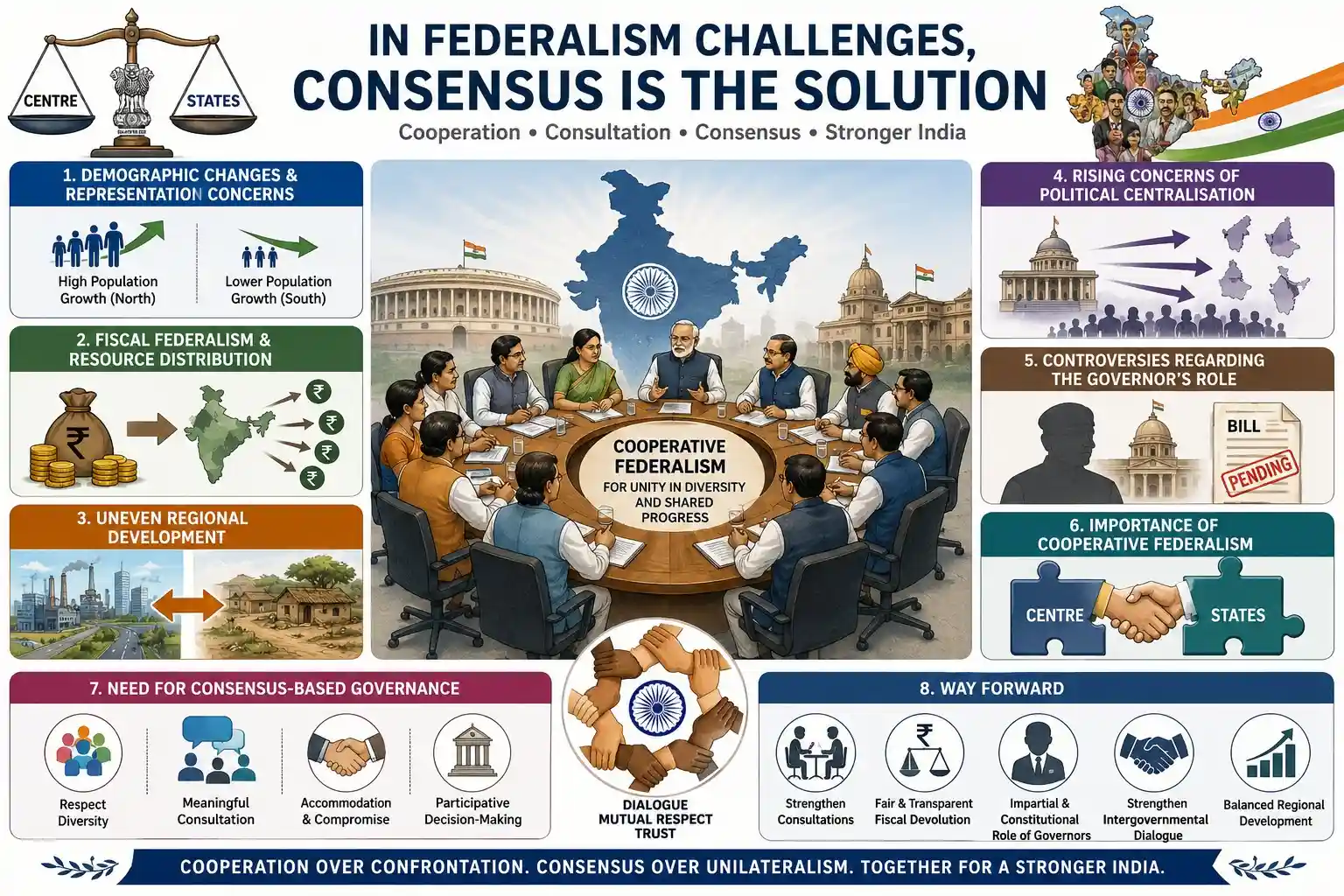
Demographic Changes and Representation Concerns
- Population growth patterns have changed unevenly across Indian States over recent decades significantly today.
- Southern States successfully controlled fertility rates, while northern States continue experiencing higher population growth continuously.
- Delimitation based strictly on population may reduce representation of southern States within Parliament substantially.
- States performing better socially fear losing political influence despite developmental achievements significantly further today.
Fiscal Federalism and Resource Distribution
- Economically stronger States contribute significantly higher tax revenues to the national economy consistently today.
- Southern and western States often contribute more taxes than several beneficiary northern States collectively.
- Donor States increasingly demand fairer fiscal transfers and greater financial autonomy from Centre significantly.
- Unequal resource distribution creates tensions regarding fairness and cooperative federalism within India increasingly today.
Uneven Regional Development
- Economic growth remains concentrated in specific regions, widening interstate developmental disparities continuously today nationwide.
- Southern and western States experienced stronger industrialisation and service-sector expansion over recent decades significantly.
- Several northern and eastern States continue struggling with poverty and weaker infrastructure development substantially.
- Uneven development increases regional grievances and weakens trust within the federal structure significantly further.
Rising Concerns of Political Centralisation
- States increasingly accuse the Centre of imposing policies without adequate consultations significantly further today.
- Excessive centralisation often undermines cooperative and participatory principles within Indian federal governance systems nationally.
- Centrally sponsored schemes and administrative interventions frequently generate tensions between governments increasingly today nationwide.
- Political centralisation weakens mutual trust between Union and State governments over time significantly further.
Controversies Regarding the Governor’s Role
- Governors are expected to function impartially as neutral constitutional authorities within States independently today.
- Allegations of political bias have increased tensions between Governors and elected State governments significantly.
- Delays involving Bills, government formation, and Assembly procedures raise constitutional concerns repeatedly today nationally.
- Such controversies deepen mistrust regarding Centre-State relations and federal democratic functioning significantly further today.
Importance of Cooperative Federalism
- Cooperative federalism promotes dialogue, partnership, and coordination between Centre and States consistently nationwide today.
- Federal stability requires consultation and consensus rather than confrontation and unilateral policymaking continuously further today.
- Consensus-based governance strengthens democratic legitimacy and improves implementation of national policies significantly further.
- Institutions like the Inter-State Council can improve coordination and dispute resolution effectively nationwide today.
Need for Consensus-Based Governance
- India’s diversity makes accommodation and compromise essential for preserving democratic stability significantly further today.
- Policies imposed without meaningful consultation often generate resistance and political conflict across States increasingly.
- Democratic federalism functions effectively when States participate actively in national decision-making processes consistently today.
- Mutual respect between governments remains essential for sustaining long-term national unity and stability significantly.
Way Forward
- The Centre should strengthen consultations before implementing major national policy decisions significantly further today nationwide.
- Fiscal devolution mechanisms must become more transparent, equitable, and regionally sensitive across India nationally.
- Governors should function impartially while respecting constitutional morality and democratic mandates consistently nationwide today.
- Institutions promoting intergovernmental dialogue should be strengthened for resolving federal disputes effectively nationwide today.
- Balanced regional development remains essential for preserving trust within India’s federal political structure significantly.
India’s federal system can remain strong only when cooperation replaces confrontation and consensus replaces unilateralism. Demographic changes, fiscal disputes, regional inequalities, and centralising tendencies are increasingly testing the resilience of Indian federalism today. In a country as diverse as India, democratic stability depends upon dialogue, mutual respect, and institutional trust between the Centre and States. Cooperative federalism rooted in consultation and accommodation remains the most sustainable path for preserving both national unity and regional aspirations.
Prelims Boosters
United Nations Forum on Forests (UNFF)
Context:
Recently, the Global Forest Goals Report 2026 was launched during the 21st session of the United Nations Forum on Forests.
About United Nations Forum on Forests
- The United Nations Forum on Forests is an intergovernmental body established in 2000.
- It was created by the United Nations Economic and Social Council (ECOSOC).
Objective
- The main objective of UNFF is to promote sustainable forest management and forest conservation across the world.
Mandate of UNFF
Political Commitment
Policy Dialogue
|
International Cooperation
Forest Policy Development
|
Sessions of UNFF
- The forum holds annual sessions at the United Nations Headquarters.
- Technical discussions are generally held in odd years.
- Policy-level dialogues are conducted in even years.
Membership
- All United Nations member states and states belonging to specialised agencies participate in the forum on an equal basis.
- India is a founding member of the UNFF.
Headquarters
- The headquarters of UNFF is located in New York, United States.
Global Forest Financing Facilitation Network (GFFFN)
- UNFF established the Global Forest Financing Facilitation Network.
- It helps countries access financial support and share best practices related to forest management.
Indian Pharmacopoeia Commission (IPC)
Context:
Recently, the Indian Pharmacopoeia Commission organised a Scientific Conclave and Interactive Session on Indian Pharmacopoeia 2026 at NIPER Hyderabad.
About Indian Pharmacopoeia Commission
- The Indian Pharmacopoeia Commission is an autonomous institution under the Ministry of Health and Family Welfare.
- It is responsible for setting standards for drugs in India.
Objective
- IPC aims to ensure the quality, safety, and efficacy of medicines used in the country.
Key Functions of IPC
Updating Drug StandardsIPC regularly updates standards for medicines commonly used in treatment of diseases in India.Publication of Indian PharmacopoeiaIt publishes the Indian Pharmacopoeia, which contains official quality standards for medicines. New monographs are added and existing ones are updated periodically. |
Promotion of Generic MedicinesIPC promotes rational use of medicines through publication of the National Formulary of India.Prescribing StandardsIt prescribes standards for the identity, purity, and strength of drugs used for humans and animals.IP Reference SubstancesIPC provides Indian Pharmacopoeia Reference Substances which act as standard reference materials for drug testing and identification. |
What is Pharmacopoeia?
- A pharmacopoeia is an official collection of quality standards for medicines and pharmaceutical substances.
- It specifies standards for drugs that are imported, manufactured, sold, or distributed in India.
Captagon
Context:
Recently, the Narcotics Control Bureau, under Operation RAGEPILL, uncovered an international drug trafficking syndicate linked to Captagon.
About Captagon
- Captagon is a highly addictive amphetamine-type synthetic drug.
- The original Captagon contained fenetylline, a synthetic stimulant belonging to the phenethylamine family.
Origin and Development
- Captagon was first manufactured in Germany during the 1960s and 1970s.
- It was initially developed for treating attention deficit disorders and certain sleep-related conditions.
Composition
- Captagon commonly contains: Fenetylline, Caffeine, Other stimulants
- Inside the body, fenetylline breaks down into: Amphetamine, Theophylline
- Both substances act as stimulants on the nervous system.
Ban and Legal Status
- Due to its highly addictive nature, Captagon was banned in most countries during the 1980s.
- It was officially discontinued from medical markets in 1986.
- Later, it was included under Schedule II of the United Nations Convention on Psychotropic Substances.
Popularity and Illegal Use
- Captagon is often called the “poor man’s cocaine.”
- It has become widely abused in parts of the Middle East and North Africa.
- The drug is linked to illegal trafficking and financing activities in conflict-prone regions.
Effects of Captagon
- Increased alertness and energy
- Euphoria and stimulation
- High addiction potential
- Serious mental and physical health impacts with long-term use
National Test House (NTH)
Context:
Recently, the National Test House in Ghaziabad established a modern Shoe Testing Laboratory under the Department of Consumer Affairs.
About National Test House
- The National Test House is a premier scientific organisation of the Government of India.
- It was established in 1912 under the then Railway Board.
Objective
- NTH provides testing, calibration, and quality evaluation services for industries, trade, and commerce according to national and international standards.
Key Features
- It is India’s largest multi-location and multidisciplinary government testing laboratory.
- It deals with testing and quality assessment for a wide range of industrial products and services.
Major Functions
Testing and Calibration
|
Support to NABL and BIS
|
Drone Certification
|
Branches
NTH has branches at: Kolkata, Mumbai, Chennai, Ghaziabad, Jaipur, Guwahati, Varanasi
Nodal Ministry
- NTH functions under the Department of Consumer Affairs.
- The department comes under the Ministry of Consumer Affairs, Food and Public Distribution.
International Criminal Court (ICC)
Context:
The International Criminal Court recently unsealed an arrest warrant against Senator Ronald Dela Rosa in connection with alleged crimes against humanity.
About International Criminal Court
- The International Criminal Court is a permanent and independent international criminal court.
- It was established to prosecute individuals responsible for the gravest international crimes.
- It is the only permanent international criminal tribunal in the world.
Establishment
- The ICC was created under the Rome Statute.
- The Rome Statute came into force on 1 July 2002.
Mandate of ICC
The ICC investigates and prosecutes individuals accused of:
- Genocide, Crimes against humanity, War crimes, Crime of aggression
Principle of Complementarity
- The ICC acts as a court of last resort.
- It intervenes only when national courts are unwilling or unable to prosecute offenders.
- Therefore, it complements national judicial systems rather than replacing them.
Difference Between ICC and ICJ
- The ICC prosecutes individuals for international crimes.
- The International Court of Justice settles disputes between countries.
Membership
- The ICC currently has 125 member countries.
- India, China, Russia, Israel, and the United States are not parties to the Rome Statute.
Funding
- The ICC is funded mainly through contributions from member states.
- It also receives voluntary contributions from governments, organisations, corporations, and individuals.
Composition of ICC
Judges
|
Presidency
|
Office of the Prosecutor (OTP)
|
Registry
|
Jurisdiction of ICC
The ICC can hear a case if:
- The country where the crime occurred is a party to the Rome Statute; or
- The accused person’s country is a party to the Rome Statute.
- The ICC only has jurisdiction over crimes committed after 1 July 2002.
Referral of Cases
Cases can be referred to the ICC by:
- Any State Party to the Rome Statute
- The ICC Prosecutor
- The United Nations Security Council (UNSC)
Role of UNSC
- The UNSC can request the ICC to defer investigations for a limited period if proceedings may affect international peace and security.