Thorium and India’s Long-Term Energy Security Strategy
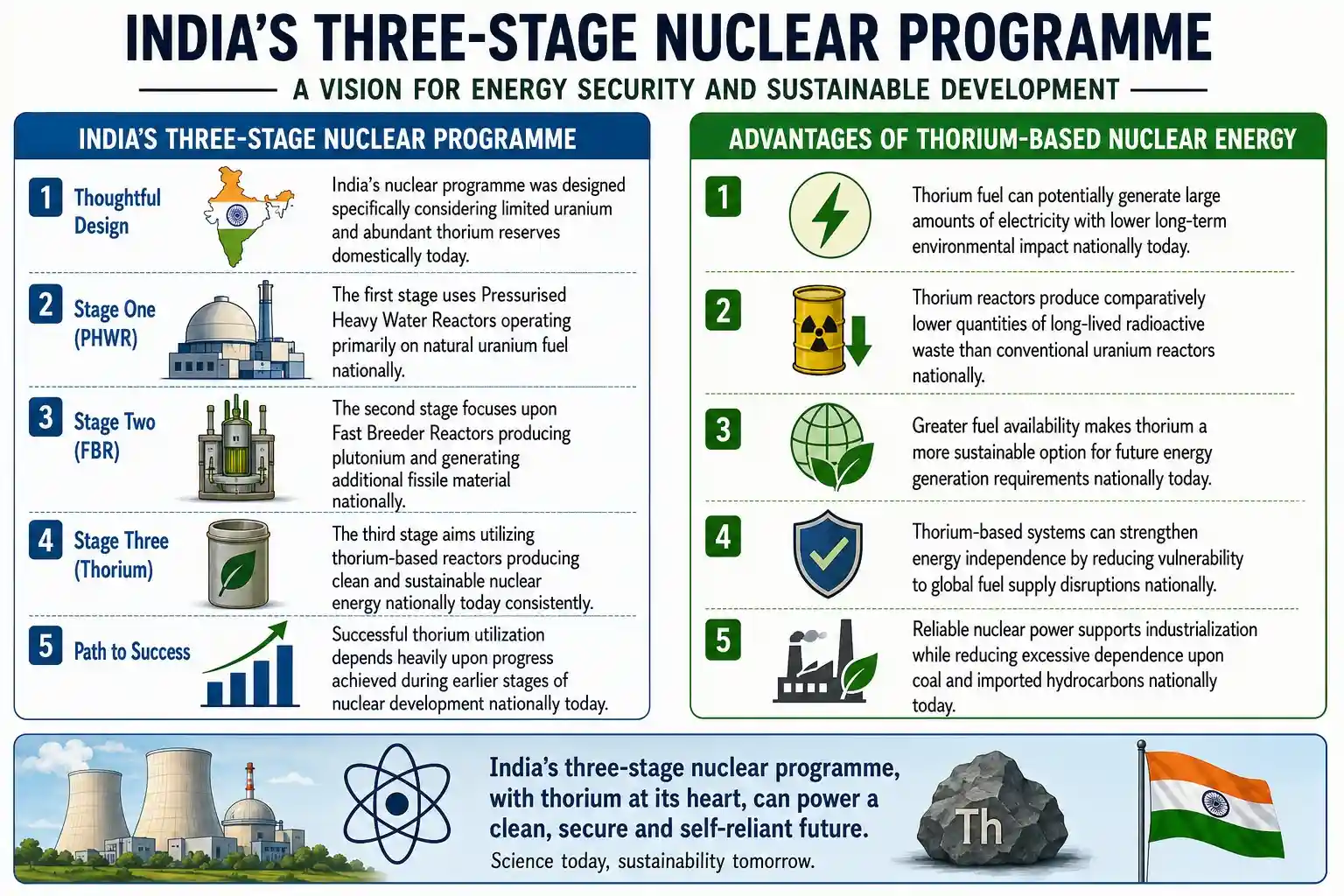
India’s rapidly growing economy requires a stable, affordable, and long-term energy supply to sustain development. Rising energy demand, dependence on imported fossil fuels, and climate commitments have increased pressure on India’s energy security framework. In this context, thorium-based nuclear energy has emerged as a strategic opportunity because India possesses one of the world’s largest thorium reserves. The successful development of thorium reactors could therefore transform India’s future energy landscape significantly.
Why Thorium Matters for India
- India possesses abundant thorium reserves, especially along coastal regions containing monazite mineral deposits nationally today.
- Thorium offers India an opportunity reducing long-term dependence upon imported uranium and fossil fuels significantly.
- Indigenous thorium reserves strengthen strategic autonomy within India’s long-term energy security framework nationally today consistently.
- Thorium-based nuclear energy can provide reliable baseload electricity supporting rapid industrial and economic growth nationally.
- Growing electricity demand makes diversification towards alternative energy sources increasingly necessary for India nationally today.
Technological and Scientific Challenges
- Thorium itself cannot directly sustain nuclear reactions without conversion into fissile uranium-233 fuel nationally today.
- India still requires advanced reactor technologies for large-scale and commercially viable thorium power generation nationally.
- Development of Fast Breeder Reactors remains essential before full thorium utilization becomes practically achievable nationally today.
- Building thorium infrastructure demands massive investment, scientific expertise, and long-term technological commitment nationally today significantly.
- Delays in reactor construction and fuel cycle development continue affecting progress within
Economic and Strategic Significance
- Thorium energy can reduce India’s costly dependence upon imported fossil fuels and external energy markets nationally.
- Stable electricity supply remains essential for manufacturing growth, urbanisation, and technological modernization across India nationally.
- Indigenous nuclear capability strengthens India’s strategic autonomy within an increasingly uncertain geopolitical energy environment nationally.
- Expansion of clean nuclear energy supports India’s climate commitments and low-carbon developmental objectives nationally today.
- Thorium technology leadership can potentially enhance India’s position within future global nuclear energy markets nationally today.
Environmental and Energy Transition Benefits
- Thorium-based energy produces significantly lower greenhouse gas emissions compared to conventional fossil fuel generation nationally.
- Clean baseload nuclear electricity can complement renewable energy sources like solar and wind effectively nationally today.
- Reliable nuclear power reduces risks associated with intermittent renewable electricity production and storage limitations nationally today.
- Lower carbon emissions help India balance developmental needs with international climate and sustainability responsibilities nationally today.
- Thorium technology can contribute towards building a diversified and resilient long-term energy mix nationally today significantly.
Steps Needed for Successful Thorium Development
- India must accelerate development and operationalization of Fast Breeder Reactor technology for future thorium utilization.
- Greater investment in nuclear research, scientific manpower, and reactor safety infrastructure remains essential nationally today.
- Public awareness regarding nuclear safety and environmental benefits should improve through transparent communication initiatives nationally.
- International cooperation in nuclear research can strengthen technological capabilities and accelerate thorium commercialization nationally today.
- Consistent policy support and regulatory clarity remain necessary for expanding India’s advanced nuclear energy programme nationally.
Thorium represents a strategic opportunity capable of reshaping India’s long-term energy security and developmental future. With abundant domestic reserves and rising energy requirements, India possesses unique advantages for pioneering thorium-based nuclear technology. However, technological complexity, infrastructure requirements, and long development timelines remain major challenges. By investing consistently in scientific innovation, reactor technology, and nuclear infrastructure, India can gradually transform thorium from a strategic resource into a reliable pillar of sustainable, clean, and self-reliant energy generation.
Rebalancing India’s Justice Budget for Accessible and Fair Governance
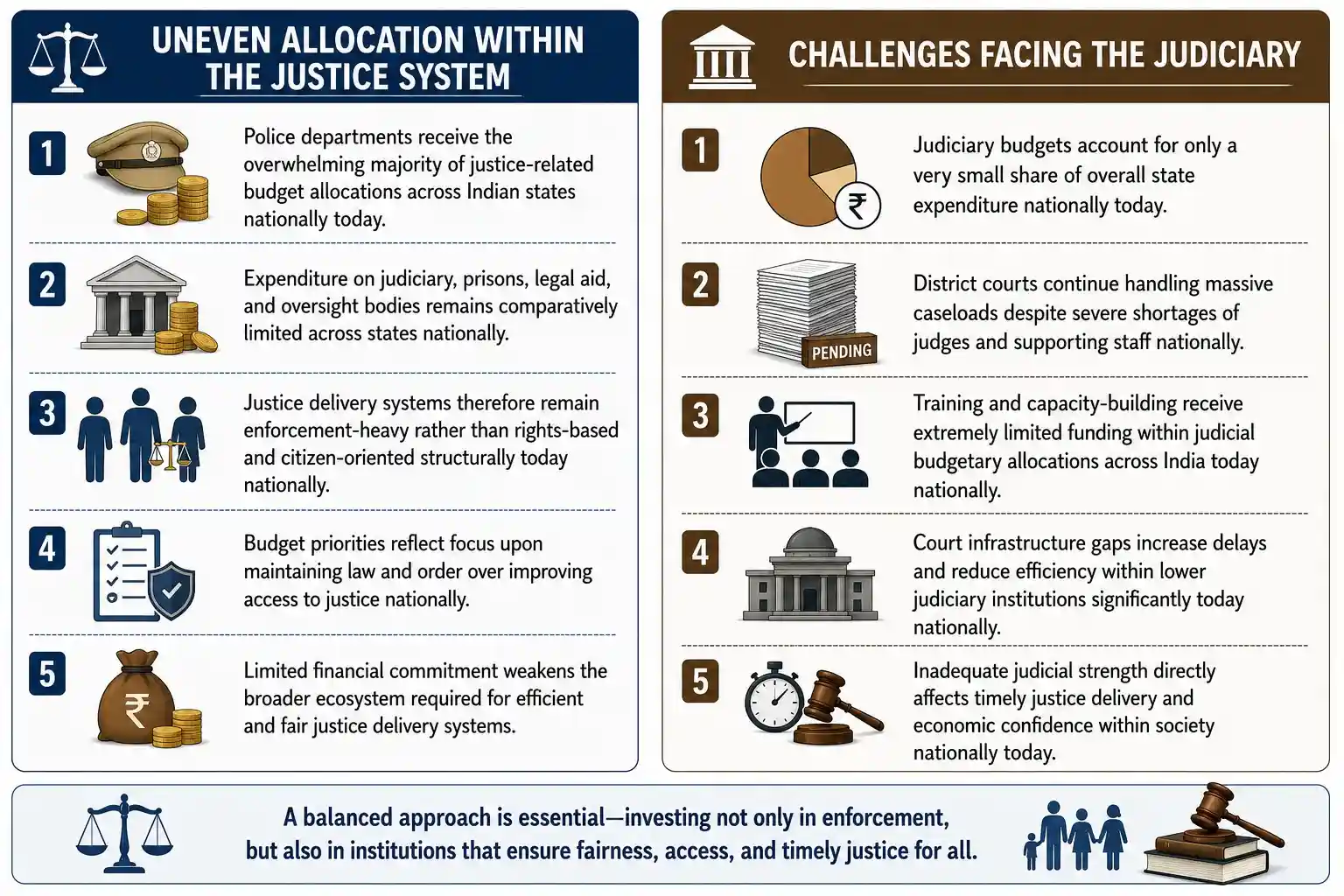
The allocation of public funds reflects the priorities of a democratic state and its governance philosophy. Recent analysis of India’s justice budgets reveals a major imbalance, where policing receives overwhelming financial support while institutions ensuring access to justice remain severely underfunded. This imbalance weakens judicial efficiency, legal aid delivery, prison reforms, and independent oversight mechanisms, ultimately affecting constitutional promises of justice, equality, and dignity.
Problems Within Prison Administration
- Indian prisons remain overcrowded, with occupancy levels frequently exceeding official institutional capacity limits nationally today.
- Prison budgets largely focus upon maintenance while neglecting rehabilitation, training, and correctional reforms significantly today.
- Severe staff shortages continue weakening prison administration and prisoner welfare mechanisms across several states nationally.
- Poor prison conditions undermine constitutional protections related to dignity and humane treatment of prisoners nationally.
- Weak correctional infrastructure increases long-term social and economic costs for democratic governance systems nationally today.
Underfunding of Legal Aid Services
- Legal aid services receive the smallest share of financial support within India’s justice delivery framework nationally.
- Marginalised citizens frequently struggle accessing quality legal representation because of inadequate institutional support nationally today.
- Limited funding weakens outreach, awareness, and timely assistance for economically vulnerable sections across India nationally.
- Delayed or inadequate legal aid reduces equal access to justice guaranteed under constitutional principles nationally.
- Effective legal assistance remains essential for ensuring substantive rather than merely procedural democratic equality nationally today.
Weak Support for Oversight Institutions
- State Human Rights Commissions often function with severe vacancies and extremely limited financial resources nationally today.
- Oversight institutions struggle performing investigations and monitoring rights violations effectively across several states nationally today.
- Weak institutional capacity undermines accountability within policing, prisons, and administrative governance mechanisms nationally today significantly.
- Independent oversight bodies remain essential for protecting constitutional rights and democratic accountability nationally today consistently.
- Neglecting such institutions weakens citizens’ trust in fairness and transparency of governance systems nationally today.
Structural Consequences of Budget Imbalance
- Excessive focus upon policing creates an enforcement-centric rather than justice-centric governance framework nationally today significantly.
- Arrests and detentions often receive greater institutional support than rehabilitation and legal protection mechanisms nationally.
- Marginalised communities become disproportionately affected because weaker safeguards limit equal access to justice nationally today.
- Delayed justice delivery weakens economic productivity, investment confidence, and public faith in constitutional institutions nationally.
- Democratic legitimacy suffers when citizens perceive justice systems as inaccessible, unequal, or excessively coercive nationally today.
Need for Recalibrating Justice Budgets
- Justice budgets should balance policing needs with stronger investments in judiciary and legal aid nationally.
- District courts require greater funding for judges, infrastructure, staff recruitment, and technological modernization nationally today.
- Prison reforms must prioritize rehabilitation, mental healthcare, vocational training, and humane living conditions nationally today.
- Legal aid institutions should expand outreach services for poor and vulnerable communities across India nationally.
- Human Rights Commissions require adequate staffing, independence, and financial support for effective functioning nationally today.
- Budgetary reforms should align justice delivery systems with constitutional values of equality and dignity consistently today.
A justice system cannot remain effective when one pillar receives disproportionate support while others remain institutionally weak. India’s current justice budgeting pattern reflects a governance approach heavily centered upon enforcement rather than equitable access and rehabilitation. Strengthening judiciary institutions, legal aid systems, prison reforms, and independent oversight bodies is therefore essential for deepening constitutional democracy. A balanced and people-centric justice framework will not only improve rule of law but also strengthen public trust, economic stability, and democratic legitimacy across the country.
Prelims Boosters
Unmanned Aerial Vehicle Launched Precision Guided Missile-V3 (ULPGM-V3)
Context:
DRDO recently successfully completed the final development trials of the ULPGM-V3 missile in both Air-to-Ground and Air-to-Air modes.
About ULPGM-V3
- ULPGM-V3 is a precision-guided missile launched from unmanned aerial vehicles (drones).
- It is designed mainly for air-to-surface operations.
Developed By
- Developed by the Research Centre Imarat (RCI), Hyderabad as the nodal laboratory.
- Other DRDO laboratories also participated in its development.
Key Features
Advanced Seeker System
All-Terrain Capability
| Day and Night Operations
Two-Way Data Link
|
Modular Warhead Options
The missile can carry three types of warheads:
Anti-Armour Warhead
- Designed to destroy modern armoured vehicles protected by:
- Rolled Homogeneous Armour (RHA)
- Explosive Reactive Armour (ERA)
Penetration-cum-Blast Warhead
- Used against bunkers and fortified structures.
Pre-Fragmentation Warhead
- Creates a large lethal zone against enemy personnel and soft targets.
Operational Advantages
- Lightweight and portable.
- Can be carried and operated by soldiers in remote and mountainous regions.
- Suitable for integration with lightweight drones.
Technical Specifications
- Weight: Around 12.5 kg and Range: Up to 4 km during daytime and Around 2.5 km at night.
Shaheed Veer Gundadhur
Context:
The Union Home Minister recently inaugurated the Shaheed Veer Gundadhur Seva Dera Jan Suvidha Kendra in Bastar, Chhattisgarh.
About Shaheed Veer Gundadhur
- Veer Gundadhur was a famous tribal revolutionary leader from the Bastar region of present-day Chhattisgarh.
- He is remembered for leading the historic Bhumkal Rebellion of 1910 against British colonial rule.
- He became a symbol of: Tribal resistance, Tribal identity and Protection of local rights and resources
Early Life
Birth and CommunityHe was born in Netanar village in Bastar. He belonged to the Dhurwa tribal community.Original NameDuring his early life, he was known as Baga Dhurva. |
Skills and LeadershipThough he had no formal education, he was respected for:
|
Bhumkal Rebellion (1910)
Meaning of Bhumkal
- “Bhumkal” means: Earthquake and Great uprising or rebellion
Causes of the Revolt
The rebellion was launched against:
- British exploitation of tribal resources, Forest reservation policies and Colonial interference in tribal life and administration
Secret Communication System
To mobilize people secretly, Gundadhur used local symbols:
- Red chilies → signal for urgent revolt
- Clay bows and arrows → preparation for armed resistance
- Mango branches → unity and protection of tribal identity
Guerrilla Warfare
- Gundadhur used guerrilla tactics in Bastar’s forests.
- His fighters attacked British forces through ambush strategies.
- The rebellion disrupted British administration in Bastar for several weeks.
Suppression of the Revolt
- The British eventually crushed the rebellion through military force.
- Many tribal leaders were executed at Golbazar Chowk, Jagdalpur.
- Around 25,000 tribal people are believed to have died during the suppression.
Last Days
- Veer Gundadhur was never captured by the British.
- He disappeared into the forests of Bastar and became a legendary figure in tribal folklore.
Legacy
- He is regarded as a hero of tribal resistance in India’s freedom struggle.
- Chhattisgarh government presents the Shaheed Gundadhur Award in archery in his honour.
Zwan-Wolf Effect
Context:
NASA’s MAVEN spacecraft recently detected the Zwan-Wolf effect in the atmosphere of Mars for the first time.
About Zwan-Wolf Effect
- The Zwan-Wolf effect is a process in which charged particles are squeezed along magnetic structures called flux tubes.
- It was discovered in 1976.
- Earlier, it had only been observed in planetary magnetospheres and not inside planetary atmospheres.
How Does It Occur?
Solar Wind
- The Sun continuously releases a stream of charged particles called the solar wind.
Interaction with Magnetic Field
- As solar wind approaches a planet’s magnetic region, it gets compressed near magnetic boundaries.
Pressure Gradient Formation
- This creates a pressure difference that pushes charged particles along magnetic field lines and away from the solar wind stream.
Result
- Areas close to the stream develop lower densities of charged particles.
- This process is known as the Zwan-Wolf effect.
Importance on Earth
- On Earth, this mechanism helps deflect much of the harmful solar wind.
- Earth’s global magnetic field protects the planet from constant solar radiation.
Discovery on Mars
- NASA’s MAVEN spacecraft observed the effect in the Martian ionosphere at altitudes below 200 km.
- The ionosphere contains electrically charged particles.
Why is this Significant?
- Mars does not have a strong global magnetic field like Earth.
- Yet, the discovery shows that Mars still experiences solar wind interactions similar to magnetized planets.
- It provides important insights into: Martian atmosphere loss, Space weather interaction and Evolution of Mars’ climate
About MAVEN Spacecraft
- MAVEN stands for Mars Atmosphere and Volatile EvolutioN.
- It is NASA’s first mission dedicated to studying the upper atmosphere of Mars.
Launch and Arrival
- Launched: November 2013 and Reached Mars: September 2014
Objectives of MAVEN
- To understand how Mars lost much of its atmosphere over time.
- To study the interaction between solar wind and the Martian atmosphere.
Instruments on MAVEN
Solar Wind PackageStudies solar wind and its impact on Mars. |
Ultraviolet SpectrometerExamines the upper atmosphere. |
Mass SpectrometerStudies atmospheric composition. |
Important FindingMAVEN discovered that Mars lost nearly two-thirds of its early atmosphere into space. |
International Booker Prize
Context:
Taiwan Travelogue by Yáng Shuāng-zǐ, translated by Lin King, won the 2026 International Booker Prize.
About International Booker Prize
- The International Booker Prize is awarded annually.
- It was established in 2005 as the Man Booker International Prize.
Objective
- The prize celebrates the best works of Long-form fiction and Short story collection that are translated into English and published in the UK and/or Ireland.
Key Features
Recognition of Translators
- The prize equally recognises both the author and the translator.
- The prize money of £50,000 is shared equally between them.
Shortlisted Entries
- Each shortlisted author and translator receives £2,500.
Global Literature Promotion
- The award encourages reading and translation of quality literature from across the world.
Eligibility
- Books must be: Originally written in another language, Translated into English and /9Published in the UK or Ireland
Indian Winners
Geetanjali Shree
|
Banu Mushtaq
|
Loktak Lake
Context:
Loktak Lake in Manipur is globally known for its unique floating islands called phumdis.
About Loktak Lake
- Loktak Lake is located in the state of Manipur.
- It is the largest freshwater lake in Northeast India.
- The lake spreads across nearly 287 sq. km.
Famous Feature – Phumdis
- Loktak Lake is famous for its phumdis.
- Phumdis are floating masses of: Vegetation, Soil and Organic matter
- Around 20% of the phumdi remains above water while the remaining 80% stays submerged.
- These floating masses are strong enough to support: Fishing huts, Human settlements and Wildlife habitats
Keibul Lamjao National Park
- The lake contains Keibul Lamjao National Park.
- It is the world’s only floating national park.
Important Species
- The park is the natural habitat of the endangered Sangai deer (brow-antlered deer), which is native to Manipur.
Rivers Draining into Loktak Lake
Major rivers flowing into the lake include:
- Khuga, Nambul, Imphal, Iril, Thoubal, Sekmai, Kongba, Heirok
International Recognition
Ramsar Site
- Loktak Lake was designated a Ramsar Wetland of International Importance in 1990.
Montreux Record
- It was included in the Montreux Record in 1993 due to ecological changes and environmental threats.
Importance of Loktak Lake
- Supports fisheries and livelihoods
- Provides hydropower benefits
- Helps inland transport and tourism
- Maintains biodiversity and wetland ecology
Threats
- Pollution and siltation
- Changes in water level due to dams
- Degradation of phumdis
- Encroachment and ecological imbalance