Securing India’s Tiger Future Through Prey Base Conservation
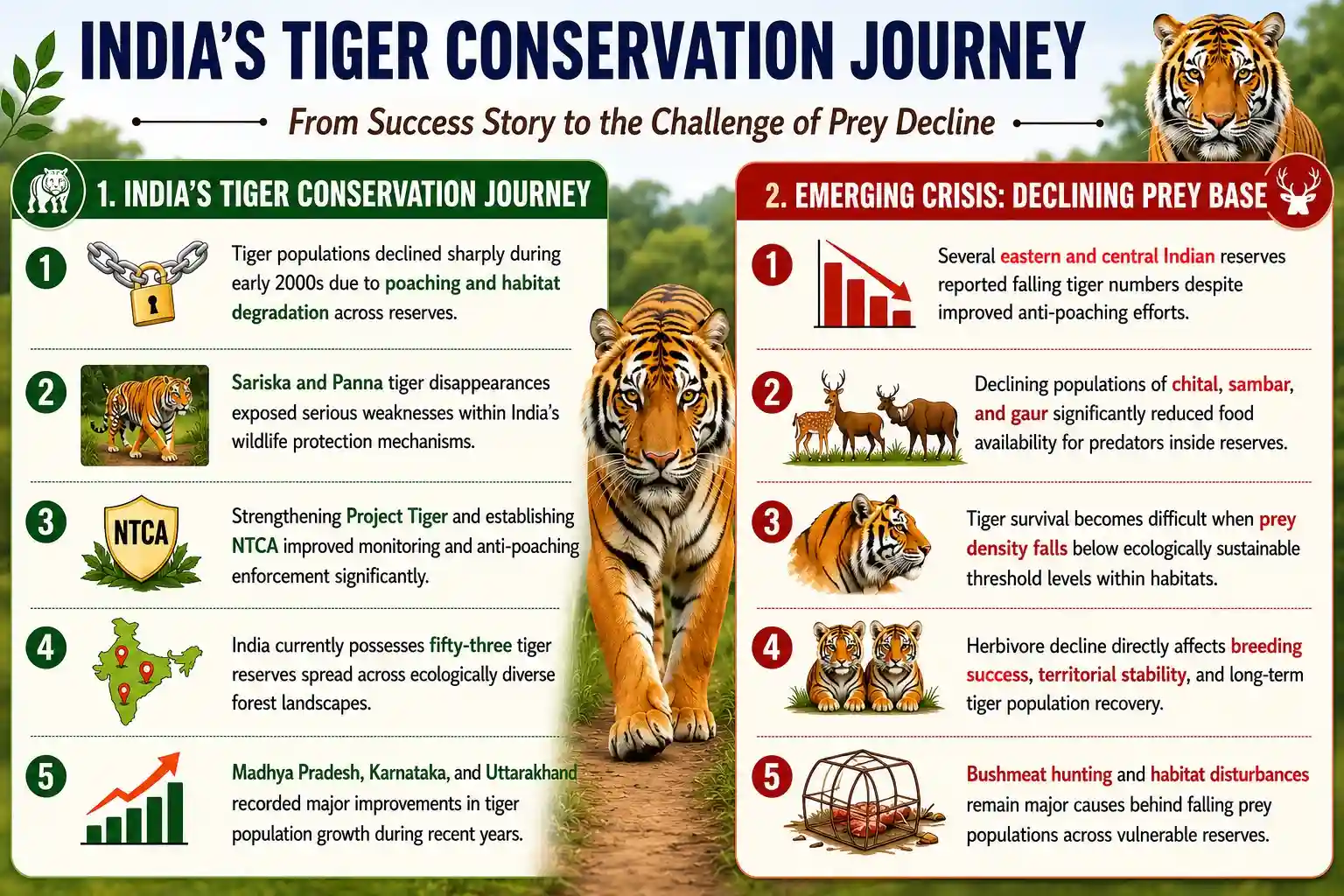
Ecological Importance of Herbivores
- Tigers function as apex predators whose ecological survival depends upon abundant herbivore populations within forests nationally today.
- Healthy prey populations maintain ecological balance and support stable predator-prey relationships inside wildlife ecosystems nationally today.
- Herbivores also contribute toward seed dispersal and vegetation management within forest ecosystems significantly across habitats today.
- Reduced prey availability forces tigers toward human settlements increasing risks of human-wildlife conflicts nationally today significantly.
- Long-term tiger conservation becomes impossible without restoring grasslands, water sources, and herbivore breeding habitats nationally today.
Socioeconomic Drivers Behind Prey Decline
- Many affected tiger reserves lie within economically backward tribal districts facing poverty and livelihood insecurities nationally.
- Bushmeat hunting often emerges from lack of affordable protein sources and limited employment opportunities locally today.
- Traditional traps and snares indiscriminately kill herbivores, predators, and several non-target wildlife species within forests today.
- Weak governance and poor forest protection mechanisms increase illegal hunting activities across vulnerable regions nationally today.
- Palamau Tiger Reserve illustrates how sustained hunting pressure destroyed both herbivore and tiger populations significantly today nationally.
Habitat and Institutional Challenges
- Habitat fragmentation caused by roads, mining, and power infrastructure disrupts wildlife movement across landscapes nationally today.
- Forest fires and invasive plant species reduce availability of grazing resources for herbivores within reserves nationally today.
- Captive breeding programmes face limitations because released animals often struggle adapting to wild ecological conditions naturally.
- Wildlife-rich forests in Chhattisgarh and Odisha still offer opportunities for ecological restoration and conservation intervention nationally.
- Declining left-wing extremism improves possibilities for research, monitoring, and long-term conservation planning across reserves today.
Role of Eco-Tourism in Conservation
- Wealthier reserves generate tourism revenues supporting wildlife protection and local employment opportunities within surrounding communities today.
- Bandhavgarh, Ranthambore, and Kabini benefit from stronger conservation awareness and economic incentives through tourism nationally.
- Poor and isolated reserves lack similar economic incentives necessary for sustaining conservation participation among communities today.
- Inclusive eco-tourism models can improve local livelihoods while strengthening long-term wildlife conservation efforts nationally today significantly.
- Community participation increases when conservation directly improves household incomes and local developmental opportunities within regions today.
Community-Centric Conservation Approach
- Conservation policies must recognize local communities as partners rather than obstacles within wildlife protection efforts nationally today.
- Alternative livelihoods like poultry farming and fisheries can reduce dependence upon bushmeat hunting significantly nationally today.
- Forest rights recognition and co-management systems help build trust between authorities and tribal communities nationally today.
- Self-help groups linked with handicrafts, tourism, and forest products improve local economic resilience significantly nationally today.
- Awareness campaigns in schools and villages can strengthen grassroots support for wildlife conservation initiatives nationally today.
International Lessons for India
- Namibia successfully integrated tribal ownership models with wildlife tourism and conservation-based economic incentives nationally today.
- Costa Rica rewards rural communities directly for protecting forests under ecosystem service payment programmes nationally today significantly.
- Indonesia combined habitat restoration with anti-poaching patrols for successful prey recovery within protected areas nationally today.
- International examples demonstrate conservation succeeds when ecological protection aligns with local economic interests effectively nationally today.
- India can adapt community-driven conservation models according to regional social and ecological conditions effectively nationwide today.
Way Forward
Policy Measures
- Tiger Conservation Plans should prioritize prey base restoration alongside direct tiger protection mechanisms nationally today consistently.
- Central assistance should strengthen forest departments in underperforming states facing severe ecological pressures nationally today significantly.
- Performance-based green funding can encourage measurable improvements in conservation outcomes across vulnerable reserves nationally today.
Ecological Measures
- Grassland restoration and improved watering points can enhance herbivore survival inside protected forests nationally today significantly.
- Wildlife corridors should be expanded to prevent habitat fragmentation and ensure safe animal movement nationally today.
- Drones, camera traps, and artificial intelligence can improve real-time wildlife monitoring and anti-poaching operations nationally today.
Social Measures
- Tribal welfare programmes should integrate livelihood security with long-term conservation planning mechanisms nationally today consistently.
- MGNREGA-linked conservation activities can create employment while supporting ecological restoration inside buffer zones nationally today.
- Gram Sabhas and Van Panchayats should participate actively in managing forest buffer areas sustainably nationally today.
PRELIMS BOOSTERS
Section 124A (Sedition Law)
Context:
The Supreme Court clarified that pending sedition cases under Section 124A IPC may proceed if the accused person agrees to continue the trial or appeal.About Section 124A
What is Sedition?
Historical Background
|
Purpose During British Rule
Famous Leaders Charged Under Sedition
|
Key Features of Section 124A
Acts Covered
- The law punished: Spoken words, Written words, Signs, Visual representation, Electronic communication
- if they created: Hatred, Contempt, Disaffection against the government.
Nature of Offence
Section 124A was:
- Cognizable (Police can arrest without warrant); Non-bailable (Bail is not a right) and Non-compoundable (Cannot be settled privately between parties)
Punishment
- Punishment could extend to: Life imprisonment Or imprisonment up to 3 years with fine.
Additional Consequences
An accused person could lose eligibility for government jobs, Face passport restrictions, Be required to appear regularly before courts
Supreme Court and Sedition Law
2022 Supreme Court Order
Case: S.G. Vombatkere v. Union of India (2022)
Key Decision
- Supreme Court kept Section 124A in Abeyance (temporary suspension).
Directions
- No fresh FIRs under sedition and Pending cases and trials were paused.
2026 Clarification
Case: Kamran v. State of Madhya Pradesh
Clarification
- If the accused person agrees: Pending appeals or trials can continue in lower courts.
Sedition under Bharatiya Nyaya Sanhita (BNS)
Replacement of IPC
- IPC has now been replaced by: Bharatiya Nyaya Sanhita (BNS).
New Provision
- Section 124A IPC replaced by: Section 152 of BNS.
Important Change
Word “Sedition” Removed
- The term “sedition” is no longer used.
New Offence
Section 152 deals with: Acts endangering sovereignty, unity and integrity of India.
Acts Covered under BNS
It punishes activities related to Secession, Armed rebellion, Separatism, Subversive activities
Through Speech, Writing, Signs, Electronic communication, Financial means
Punishment under BNS
- Minimum punishment: 7 years imprisonment and Maximum: Life imprisonment
Important Supreme Court Case
Kedar Nath Singh v. State of Bihar (1962)
- Supreme Court upheld sedition law but limited its use only to: Incitement to violence and Public disorder
- Mere criticism of government is Not sedition.
WHA Declares Stroke as a Public Health Priority
Context:
The World Health Assembly (WHA) recently passed its first dedicated resolution on strokes, urging countries to recognize stroke as a major global public health priority.About Stroke
What is a Stroke?
- A stroke is a serious medical emergency that occurs when: Blood supply to a part of the brain is interrupted or reduced.
- Due to lack of oxygen and nutrients: Brain cells begin to die within minutes.
- It can lead to Brain damage, Paralysis, Disability, Death
Types of Stroke
Ischemic Stroke
Causes
Result
|
Hemorrhagic Stroke
Result
|
Major Risk Factors
Many stroke risk factors are preventable:
- High blood pressure (Hypertension), Type-2 diabetes, Smoking and tobacco use, Obesity, Physical inactivity, Unhealthy diet, Alcohol abuse, Air pollution
Symptoms of Stroke
Doctors use the B.E. F.A.S.T. method to identify stroke symptoms quickly.
B – Balance: Sudden dizziness or loss of balance.
E – Eyes: Sudden blurred or double vision.
F – Face Drooping: One side of the face droops while smiling.
A – Arm Weakness: Weakness or numbness in one arm or leg.
S – Speech Difficulty: Slurred or confused speech.
T – Time to Call Emergency: Immediate medical attention is critical.
Treatment of Stroke
For Ischemic StrokeThrombolytic TherapyClot-dissolving medicines such as Tissue Plasminogen Activator (tPA)Golden WindowMust usually be given within: 4.5 hours of symptom onset.Mechanical ThrombectomyProcedure to physically remove large clots using a catheter. |
For Hemorrhagic StrokeSurgical TreatmentSurgery may be needed to Stop bleeding, Repair blood vessels, Reduce pressure inside the brain |
Importance of WHA Resolution
- Encourages countries to Improve stroke prevention, Strengthen emergency care systems, Increase awareness, Expand rehabilitation services
- Highlights stroke as a Major cause of death and disability globally.
About World Health Assembly (WHA)
- WHA is the Decision-making body of the World Health Organization (WHO).
- It includes representatives from All WHO member states.
Padma Awards
Context:
The President of India will present 66 Padma Awards at the Civil Investiture Ceremony held at Rashtrapati Bhavan.
About Padma Awards
- Padma Awards are among the highest civilian honours of India.
- They are announced every year on the Eve of Republic Day (26 January).
Purpose
- These awards recognize: Exceptional achievements, Distinguished service, Public contribution in various fields.
Categories of Padma Awards
Padma VibhushanAwarded for Exceptional and distinguished service |
Padma BhushanAwarded for Distinguished service of a high order. |
Padma ShriAwarded for Distinguished service in any field. |
History of Padma Awards
- Instituted in 1954 by the Government of India.
Earlier Classification
Initially, Padma Vibhushan had three classes: Pahela Varg, Dusra Varg, Tisra Varg
Later, in 1955, these were renamed as: Padma Vibhushan, Padma Bhushan, Padma Shri
Suspension Periods
The awards were temporarily suspended during: 1978–79 and 1993–97
Selection Process
Open Nominations
- Any citizen can nominate: Another person and Even themselves (self-nomination allowed).
Padma Awards Committee
- Constituted every year by the Prime Minister of India
Headed By
- Cabinet Secretary
Members Include
- Home Secretary, Secretary to the President and Eminent personalities
Final Approval
- Recommendations are approved by Prime Minister and President of India
Eligibility
Universal Eligibility
- Open to all persons irrespective of Race, Gender, Occupation, Position
Restriction
- Government servants are generally not eligible.
Exception
- Doctors and scientists working in government institutions remain eligible.
Important Features
Fields Covered
Awards are given in areas such as:
- Art, Literature, Science, Medicine, Sports, Social Work, Public Affairs, Civil Service
Maximum Limit
- Total number of awards in a year: Cannot exceed 120
- However, this limit excludes: Foreigners, NRIs, OCI awardees, Posthumous awards
Posthumous Awards
- Normally not awarded posthumously, Allowed in exceptional cases.
Upgradation Rule
- A higher Padma Award can generally be given only after: Five years from the previous award.
Constitutional Position
- Under Article 18 of the Constitution:Padma Awards are not titles.
- Therefore they cannot be used as prefixes or suffixes with names.
What Awardees Receive
Recipients receive:
- A Sanad (certificate signed by the President), A medallion and A miniature replica for ceremonial use
Conocarpus Plant
Context:
Ecologists recently raised concerns over the planting of the invasive Conocarpus tree along highways in Tamil Nadu.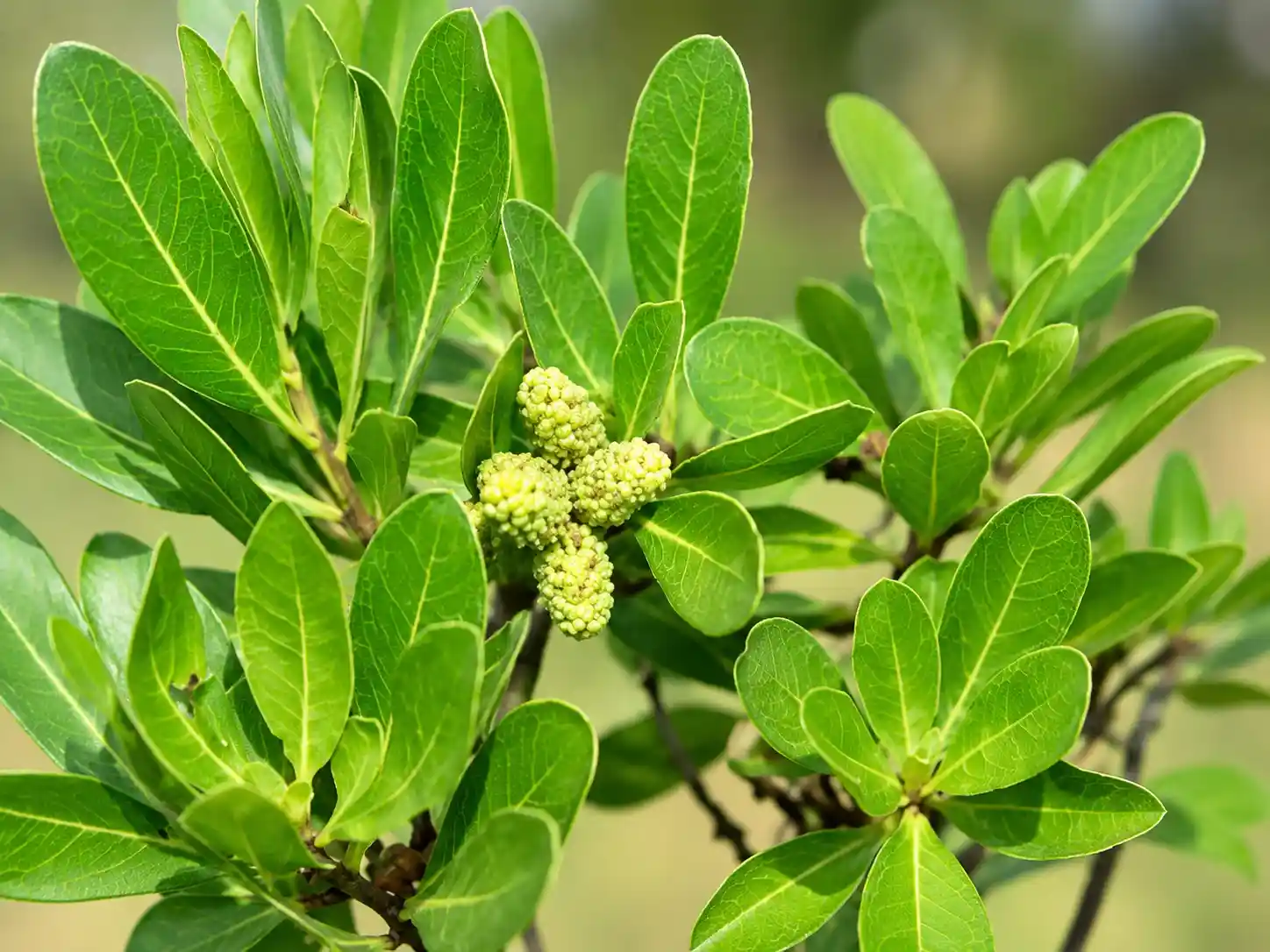
About Conocarpus Plant
Scientific Name- Conocarpus erectus
Common Names: Buttonwood, Button Mangrove, Green/Silver Buttonwood
Classification
- It belongs to the Combretaceae family and It is a hardy Mangrove shrub or tree
Origin
- Native to Tropical and subtropical coastal regions of Americas and West Africa
- Found naturally from South Florida and Mexico to Peru and Brazil.
Introduction in India
- Introduced mainly for Landscaping, Highway plantations, Urban greenery
Reasons for Popularity
- Fast growth, Evergreen foliage, Ability to survive Heat, Salinity, Harsh climatic conditions
Features of Conocarpus
Size and Growth
Bark and Twigs
|
Leaves
Flowers
Fruits and Seeds
|
Varieties of Conocarpus
Green Buttonwood
- Scientific variety: C. e. var. erectus
- Features: Dark green shiny leaves
Silver Buttonwood
- Scientific variety: C. e. var. sericeus
- Features: Silvery velvety leaves, Popular in landscaping
Concerns and Impacts of Conocarpus Plantation
Public Health RisksReleases large amounts of pollen. May trigger: Allergies, Asthma, Respiratory problems, Cough and irritationDamage to InfrastructureIts aggressive roots may Crack pavements, Damage pipelines, Disrupt telecom cables, Block sewage systems |
Groundwater DepletionConsumes large quantities of water. Can lower groundwater levels and dry nearby soil.Biodiversity LossEncourages monoculture growth. Suppresses native plant species. Disturbs local soil microbial ecosystems. |
Staten Island
Context:
Recently, a fire and two explosions at a shipyard on Staten Island in New York City caused casualties and injuries.
About Staten Island
- Staten Island is an island and one of the five boroughs of New York City, United States.
Location
- It is located in New York Harbor
- It lies: South of Manhattan and Between New Jersey and Brooklyn
Connectivity
Staten Island is connected through:
Staten Island Ferry
- Connects Staten Island with Manhattan.
- Carries both Passengers and Automobiles
Bridges
- Connected to New Jersey through several bridges.
Verrazzano–Narrows Bridge
- Connects Staten Island with Brooklyn.
- One of the longest suspension bridges in the world.
Geographical Features
- Shape: Roughly triangular
- Waterfront: About 56 km long
- Area: Nearly 155 sq. km.
Historical Background
- Originally inhabited by: Lenape Native Americans
- Later settled by: Dutch and English colonizers
Historic Richmond Town
- Located near the center of the island.
- It is a historic settlement containing: Restored houses, Farms, Schools, Buildings from the 17th century onward
Nickname
- Staten Island is often called: “Borough of Parks”
because a large part of the island is covered with: Parks, Forests, Green spaces