Understanding the Fall of the Indian Rupee
Role of Current Account Deficit
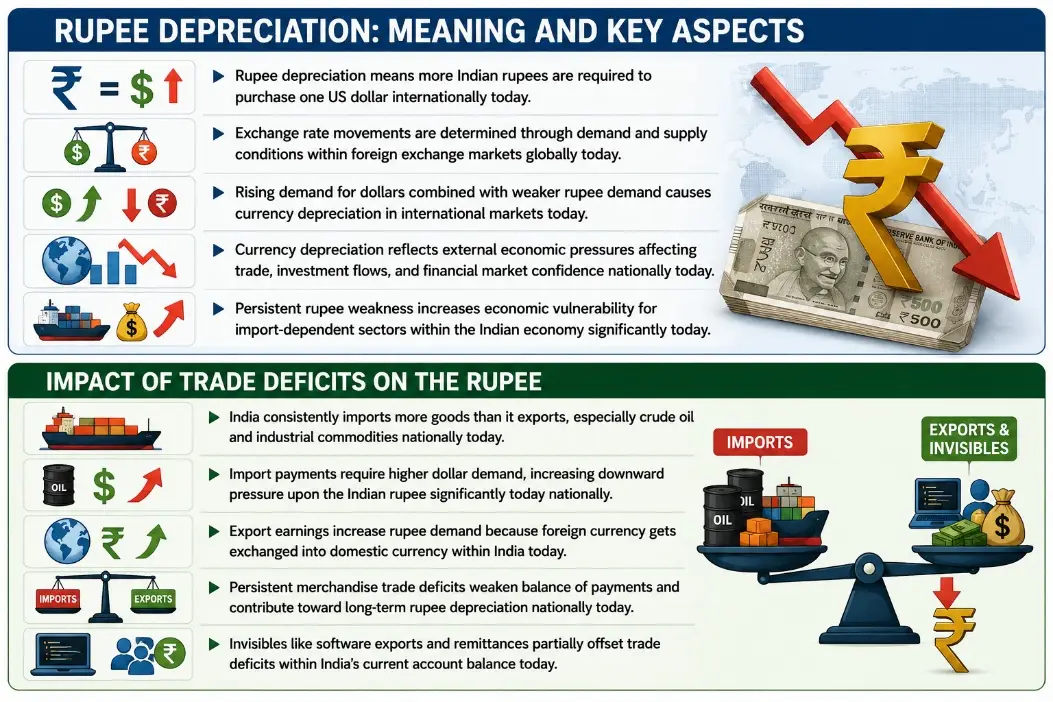
- Current account deficit occurs when foreign currency payments exceed foreign currency receipts within economy nationally today.
- India’s current account frequently remains under pressure because imports exceed merchandise exports consistently over time nationally.
- Higher oil prices worsen current account deficits by increasing India’s import bill significantly during global crises today.
- Large current account deficits increase dependence upon foreign capital inflows for maintaining external economic stability nationally.
- Weak current account conditions often create sustained downward pressure upon domestic currency exchange rates nationally today significantly.
How Capital Outflows Weaken the Rupee
- Foreign portfolio investments are highly volatile and strongly influenced by global financial market sentiments internationally today.
- Investors withdraw capital from emerging economies during uncertainty and shift funds toward safer developed markets internationally.
- Capital outflows reduce demand for rupee-denominated assets within Indian stock and bond markets significantly today nationally.
- Investors exchange rupees for dollars during exits, increasing dollar demand and weakening domestic currency significantly today.
- Geopolitical tensions and higher United States interest rates accelerated foreign investment outflows from India recently nationally.
Economic Effects of Rupee Depreciation
Positive Effects
|
Negative Effects
|
Difference Between Weak Rupee and Falling Rupee
- A weak rupee may reflect economic fundamentals and long-term structural trade imbalances within economy nationally today.
- Falling rupee indicates rapid and continuous depreciation driven by panic or speculative financial market behaviour today.
- Gradual currency adjustment may support exports, whereas sudden collapse creates inflationary and financial instability risks nationally.
- Expectations of future depreciation can trigger panic purchases and further intensify downward currency pressures nationally today.
- Falling rupee often reflects speculative outflows rather than genuine long-term economic fundamentals within markets nationally today.
Role of the Reserve Bank of India
- Reserve Bank intervenes within currency markets to prevent excessive and destabilizing exchange rate volatility nationally today.
- RBI sells dollars from foreign exchange reserves to increase rupee demand during depreciation pressures nationally today.
- Foreign exchange reserves provide critical protection against speculative attacks and sudden external financial shocks nationally today.
- India’s forex reserves remain strong enough to support external stability during periods of uncertainty nationally today significantly.
- RBI intervention slows excessive depreciation but cannot permanently override long-term market and economic fundamentals nationally today.
Challenges Before India
- Rising global oil prices continue increasing India’s import bill and external economic vulnerabilities significantly today nationally.
- Speculative foreign investment flows create instability within exchange rates and domestic financial markets nationally today significantly.
- Heavy dependence upon imported energy weakens India’s ability to maintain currency stability during crises nationally today.
- Global geopolitical conflicts disrupt trade routes and increase uncertainty across international capital markets significantly today nationally.
- Persistent inflation risks reduce purchasing power and complicate economic management for policymakers nationally today significantly.
Policy Measures for Currency Stability
- India should strengthen exports and domestic manufacturing to improve long-term balance of payments sustainability nationally today.
- Reducing dependence upon imported crude oil can significantly lower external sector vulnerability within economy nationally today.
- Stable inflation and prudent fiscal policies improve investor confidence and strengthen currency fundamentals nationally today significantly.
- RBI should continue balanced intervention preventing panic while avoiding excessive market distortion during crises nationally today.
- Encouraging long-term foreign direct investment can reduce dependence upon volatile portfolio investment inflows nationally today significantly.
PRELIMS BOOSTERS
Pyrite
Context:
Geologists recently discovered a rare microscopic sunflower-shaped pyrite structure inside lignite coal reserves of Gujarat.
About Pyrite
- Pyrite is a naturally occurring iron disulfide mineral.
- Chemical formula: FeS₂
- It is the most common sulfide mineral found on Earth.
Appearance
- Pyrite has: Brass-yellow colour and Bright metallic shine (luster)
- Because it resembles gold, it is popularly called: “Fool’s Gold”
Origin of the Name
- The name pyrite comes from the Greek word “pyr”, meaning fire.
- It produces sparks when struck against metal.
Historical Importance
- Pyrite nodules were used by ancient people for producing fire.
- Evidence of its use has been found in prehistoric burial sites.
Where is Pyrite Found?
Pyrite occurs in many geological environments:
Rock Types
Other Occurrences
|
Formation of Pyrite
Common Environments
|
Pyrite Fossils
- Pyrite can replace: Plant remains, Shells and Fossils
- Flattened pyrite structures are called: Pyrite dollars
Gossan Formation
- When pyrite oxidizes, it forms: Iron oxides or hydroxides like limonite
- This creates rusty surface zones called: Gossan
- Gossans often indicate the presence of minerals below the surface.
Major Producers
Current major producers include: China, Italy, Russia, Peru
(Spain was historically the largest producer.)
Uses of Pyrite
Sulfuric Acid Production
Chemical Industry
Agriculture
|
Water Treatment
Medical Uses
Gold Extraction
|
BHAVYA Scheme
Context:
The Central Government recently released guidelines for the BHAVYA (Bharat Audyogik Vikas Yojna) Scheme.
About BHAVYA Scheme
- BHAVYA stands for: Bharat Audyogik Vikas Yojna
- It is a Central Sector Scheme aimed at developing: Investment-ready and World-class industrial parks across India.
Main Objective
The scheme focuses on creating:
- Modern industrial ecosystems
- Plug-and-play manufacturing infrastructure
- Integrated logistics and utility systems
Target
- Development of: 100 industrial parks across the country.
Duration
- Time period: 2026–27 to 2031–32
- Total duration: 6 years
Key Features of BHAVYA Scheme
Plug-and-Play InfrastructureIndustrial parks will include:
Multimodal Logistics Connectivity
|
Greenfield and Brownfield ParksThe scheme supports:
Land Requirement
|
Implementation Mechanism
- The scheme will be implemented through: Special Purpose Vehicles (SPVs)
SPVs will be incorporated under: Companies Act, 2013
Link with Other Government Initiatives
BHAVYA supports: Make in India and PM Gati Shakti Programme by creating integrated manufacturing and logistics hubs.
Asian Infrastructure Investment Bank (AIIB)
Context:
The Asian Infrastructure Investment Bank (AIIB) recently launched a $10 billion fund facility to support member countries affected by the ongoing Middle East conflict.
About Asian Infrastructure Investment Bank (AIIB)
- AIIB is a multilateral development bank established in 2016.
Objective
The bank aims to:
- Promote sustainable economic growth
- Improve regional connectivity
- Support infrastructure development
- Mobilize public and private investment capital
Headquarters
- Located in: Beijing, China
Membership
- AIIB currently has: 111 approved member countries worldwide.
India and AIIB
- India is: A founding member of AIIB and The second-largest shareholder after China
Governance Structure
Board of Governors
- Highest decision-making body.
- Each member country appoints: One Governor and One Alternate Governor
Board of Directors
- Responsible for: Strategic direction, Policies, Budget approval and Oversight functions
- AIIB has a: Non-resident Board of Directors
President
- The bank is headed by a President: Elected for a 5-year term and Eligible for one re-election
Main Areas of InvestmentAIIB mainly funds:
|
Significance of AIIBInfrastructure Financing
Sustainable Development
Regional Connectivity
Alternative Multilateral Institution
|
Idu Mishmi Tribe
Context:
The Idu Mishmi tribe of Arunachal Pradesh was recently highlighted for its unique conservation-based cosmology and deep relationship with nature.
About Idu Mishmi Tribe
- The Idu Mishmi are one of the major tribal groups of Arunachal Pradesh.
- They mainly inhabit: Dibang Valley, Lower Dibang Valley and Lohit district
- They primarily live in the Mishmi Hills region near the Tibet border.
Distinctive Features
The tribe is known for: Unique hairstyles, Distinct customs and traditions and Artistic designs woven into their clothes
Occupation
- The community is especially known for: Weaving, Handicrafts, Traditional craftsmanship
Language
- They speak the: Idu Mishmi language
- UNESCO considers this language: Endangered
Relationship with Nature
Traditional Belief System
- The Idu Mishmis traditionally follow: Animism
(belief that nature, animals, and natural objects possess spiritual significance) - They maintain a strong spiritual relationship with forests and wildlife.
Importance of Tigers
- Tigers hold a sacred position in Idu mythology.
- According to their beliefs: Humans and tigers were born from the same mother.
- Therefore, tigers are considered: “Elder brothers”
Iyu-ena Belief System
- The tribe follows a traditional code called: Iyu-ena
Features of Iyu-ena
- Includes myths, taboos, and conservation ethics.
- Restricts hunting of many animals.
- Completely prohibits killing of tigers.
Festivals
Major festivals celebrated by the tribe include: Reh Festival and Ke-Meh-Ha Festival
Traditional Drink
- They prepare a local rice beer called: Ebu
Social Structure
- Idu Mishmi society is: Patriarchal and Patrilineal
- Property is generally inherited: From father to son
Indian Cybercrime Coordination Centre (I4C)
Context:
The Indian Cybercrime Coordination Centre (I4C) recently detected a sophisticated phishing campaign targeting Apple iPhone users whose phones were lost or stolen.
About Indian Cybercrime Coordination Centre (I4C)
- I4C is a national-level cybercrime coordination centre established under the: Ministry of Home Affairs (MHA)
- It acts as the: Nodal agency for combating cybercrime in India.
Purpose
I4C was created to:
- Strengthen cybercrime investigation and prevention.
- Provide a coordinated framework for law enforcement agencies (LEAs).
- Improve cybercrime detection, investigation, and prosecution.
Headquarters
- Located in: New Delhi
Major Objectives of I4C
National Nodal Agency
Protection of Women and Children
Cybercrime Reporting
Early Warning System
|
Public Awareness
Capacity Building
Research and Development
Legal and International Cooperation
|
Major Initiatives of I4C
Citizen Financial Cyber Fraud Reporting System
- Helps report financial cyber fraud quickly to prevent money loss.
Helpline Number 1930
- National toll-free helpline for cyber fraud complaints.
CyberDost
- Social media awareness initiative sharing cyber safety tips.
Cyber Crime Volunteers Program
- Encourages citizen participation in fighting cybercrime.
Pratibimb Platform
- Geospatial crime mapping system for tracking cybercriminal networks and infrastructure.
What is Phishing?Meaning
Methods UsedAttackers may use:
Common ObjectivesPhishing is often used for:
|