Judicial Pendency and Supreme Court Reforms
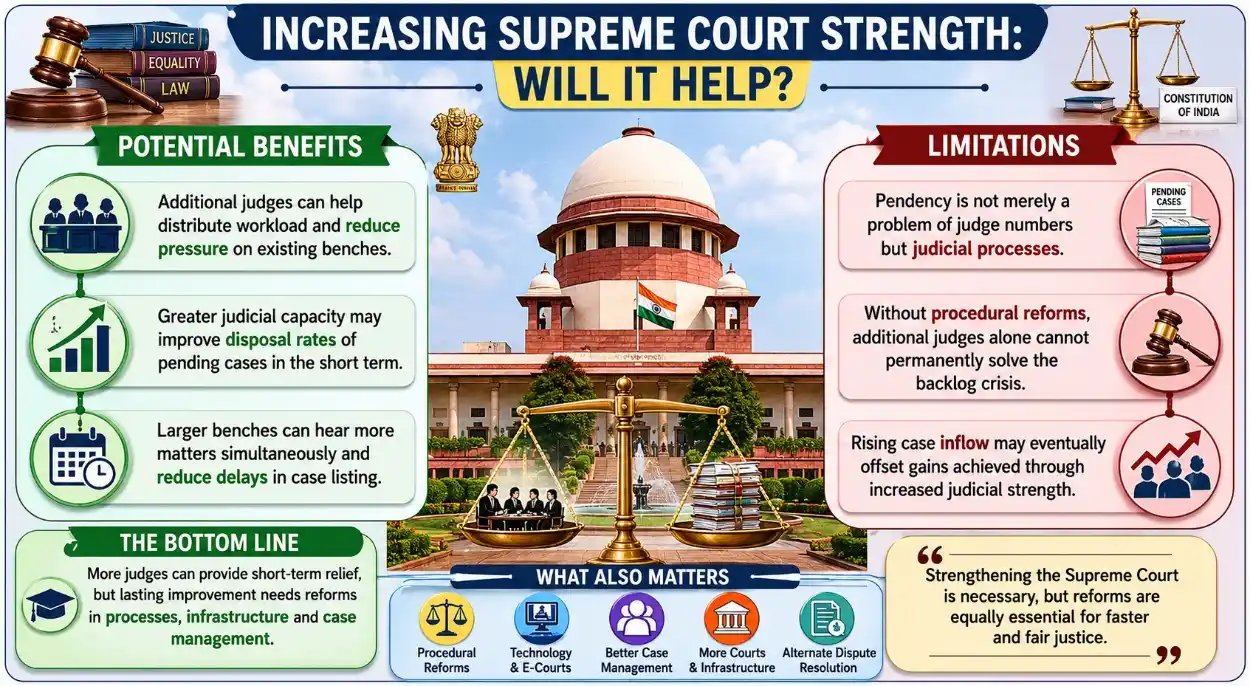
India’s judiciary continues to face a severe pendency crisis, with millions of cases awaiting resolution across courts. To address delays, the government recently increased the sanctioned strength of the Supreme Court from 34 to 38 judges. While expanding judicial capacity may provide some relief, experts argue that pendency is a structural problem that requires deeper institutional reforms, improved case management, and more efficient use of judicial resources.
Role of Special Leave Petitions (SLPs) in Pendency
Growing Dependence on SLPs
- Article 136 grants the Supreme Court extraordinary discretionary appellate jurisdiction nationally significantly today.
- SLPs increasingly dominate the Court’s docket and consume substantial judicial time nationally today significantly.
- Many routine disputes reach the Supreme Court despite lacking major constitutional significance nationally today significantly.
Challenges
- Excessive SLP admissions divert attention from important constitutional and public law issues nationally today significantly.
- Absence of clear guidelines contributes to inconsistent use of discretionary jurisdiction nationally significantly today.
- The Supreme Court often functions as another appellate court instead of a constitutional court nationally today significantly.
Constitutional Court vs Appellate Court Debate
Constitutional Role
- The Supreme Court was envisioned primarily as the guardian of the Constitution nationally today significantly.
- Constitutional interpretation and protection of fundamental rights remain its core responsibilities nationally significantly today.
Appellate Burden
- Growing appellate litigation reduces time available for constitutional adjudication nationally today significantly.
- Important constitutional questions often face delays due to heavy routine case workloads nationally significantly today.
- Experts suggest prioritising cases involving substantial questions of law and constitutional interpretation nationally significantly today.
Issue of Conflicting Judgments
Increasing Judicial Strength and Coordination
|
Need for Larger Benches
|
Government Litigation as a Major Contributor
Largest Litigant
- Governments remain among the biggest contributors to judicial pendency across Indian courts nationally today significantly.
- Many disputes continue unnecessarily through repeated appeals up to the Supreme Court nationally significantly today.
Policy Inconsistencies
- Frequent changes in officials often alter litigation strategies and increase legal disputes nationally significantly today.
- Lack of coordinated litigation management leads to avoidable burdens on the judiciary nationally today significantly.
Institutional Reforms Required
Filtering Frivolous Litigation
- Strong mechanisms are needed to screen non-serious cases before reaching higher courts nationally today significantly.
- Public Interest Litigation must focus upon genuine public causes rather than private interests nationally significantly today.
Improving Case Management
- Greater reliance on written submissions can reduce lengthy oral arguments nationally today significantly.
- Efficient scheduling and case prioritisation can improve judicial productivity and disposal rates nationally today significantly.
Technology and Administrative Reforms
- Digital case management systems can reduce procedural delays and improve transparency nationally today significantly.
- Better coordination between courts can streamline judicial administration and reduce inefficiencies nationally today significantly.
Gender Representation in the Judiciary
- Increasing representation of women judges can strengthen diversity within judicial decision-making nationally today significantly.
- Greater transparency in judicial appointments may improve inclusiveness and institutional legitimacy nationally significantly today.
- Seniority-based conventions sometimes limit opportunities for deserving women judges nationally today significantly.
Way Forward
- The Supreme Court should focus more strongly on its constitutional responsibilities nationally today significantly.
- Clear guidelines are needed regarding admission of Special Leave Petitions nationally today significantly.
- Government litigation policies must discourage unnecessary appeals and repetitive legal disputes nationally today significantly.
- Larger Constitution Benches should resolve important legal conflicts quickly and authoritatively nationally significantly today.
- Institutional reforms, technology adoption, and judicial discipline should complement increases in judge strength nationally significantly today.
Increasing the sanctioned strength of the Supreme Court may provide temporary relief from mounting pendency, but it cannot serve as a standalone solution. The deeper challenges arise from excessive appellate litigation, overuse of Special Leave Petitions, government-led disputes, and procedural inefficiencies. A sustainable solution requires reorienting the Supreme Court toward its constitutional role, strengthening case management systems, filtering frivolous litigation, and implementing broader judicial reforms. Only a combination of capacity expansion and structural transformation can effectively address India’s judicial pendency crisis.
Brinkmanship in Contemporary International Relations
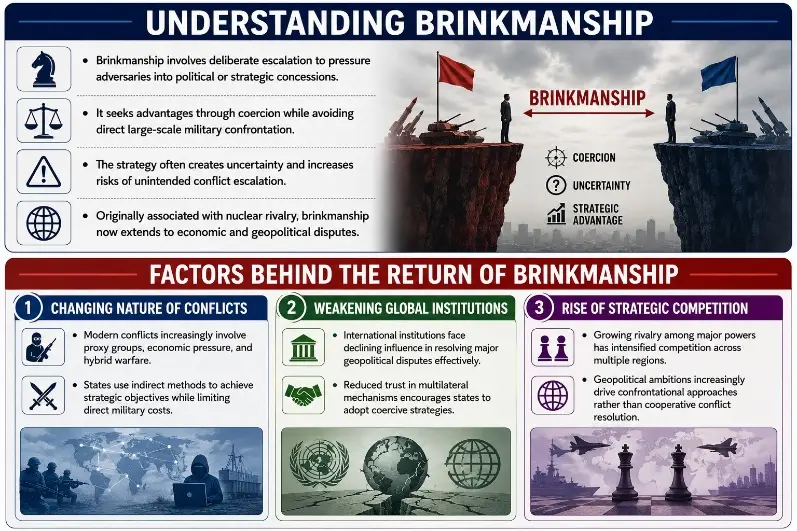
Brinkmanship refers to a strategy in which states deliberately push a conflict toward the edge of escalation to force adversaries into concessions without engaging in full-scale war. Emerging during the Cold War nuclear era, brinkmanship was associated with crises such as the Berlin Blockade and the Cuban Missile Crisis. In the contemporary world, growing geopolitical rivalries, proxy wars, economic coercion, and regional conflicts have revived brinkmanship as a major instrument of statecraft, raising concerns about global peace and stability.
Contemporary Examples of Brinkmanship
West Asia
| Russia–Ukraine Conflict
|
China’s Maritime Strategy
| North Korea
|
Consequences of Brinkmanship
Threat to Global Stability
- Escalatory actions increase risks of miscalculation and unintended military confrontation internationally today significantly.
- Regional conflicts can rapidly acquire broader international dimensions through alliance commitments internationally today significantly.
Economic Disruptions
- Brinkmanship frequently disrupts trade routes, supply chains, and energy markets globally today significantly.
- Rising uncertainty negatively affects investments, economic growth, and market stability internationally today significantly.
Humanitarian Costs
- Prolonged conflicts resulting from brinkmanship create severe humanitarian crises and displacement globally today significantly.
- Civilian populations often bear the greatest burden of escalating geopolitical confrontations internationally today significantly.
India’s Approach: Diplomacy over Brinkmanship
Strategic Restraint
- India traditionally emphasises dialogue, diplomacy, and peaceful conflict resolution mechanisms internationally today significantly.
- Indian foreign policy generally avoids escalatory behaviour and coercive geopolitical strategies internationally today significantly.
Responsible Global Actor
- India promotes multilateralism and respect for international law in resolving disputes internationally today significantly.
- The country advocates cooperative security frameworks rather than zero-sum geopolitical competition internationally today significantly.
Balancing National Interests
- India combines strategic preparedness with diplomatic engagement to safeguard national interests internationally today significantly.
- This approach enhances credibility while reducing risks associated with aggressive brinkmanship internationally today significantly.
Way Forward
- Global powers should strengthen diplomatic channels to prevent unintended conflict escalation internationally today significantly.
- International institutions require reforms to improve credibility and effectiveness in dispute resolution internationally today significantly.
- Confidence-building measures can reduce mistrust among rival states and regions internationally today significantly.
- Greater emphasis on dialogue and negotiated settlements remains essential for long-term peace internationally today significantly.
- Responsible leadership must prioritise stability over short-term geopolitical gains internationally today significantly.
The resurgence of brinkmanship reflects the growing uncertainties and rivalries shaping contemporary international relations. While it may offer temporary strategic advantages, excessive reliance on coercion and escalation risks destabilising regional and global security. In an interconnected world, diplomacy, dialogue, and multilateral cooperation remain the most sustainable tools for conflict resolution. As geopolitical tensions intensify, the international community must work toward strengthening institutions and fostering trust to prevent the world from repeatedly approaching the brink of crisis.
Prelims Boosters
CLEAR Technology (Cleavable Light-Erased Antibody Reporter)
Context:
Researchers at JNCASR recently developed the innovative CLEAR imaging technology platform.
About CLEAR Technology
- CLEAR stands for Cleavable Light-Erased Antibody Reporter imaging technology platform.
- It is a novel protein imaging and mapping technology developed recently.
- The technology was developed by researchers at JNCASR, Bengaluru successfully.
- Researchers from IISc also collaborated in demonstrating its biological applications.
Purpose
- CLEAR helps scientists visualize and map proteins within biological samples accurately.
- It overcomes limitations of conventional spatial protein mapping techniques effectively.
- The technology enables observation of many proteins within the same sample.
How CLEAR Technology Works
- CLEAR uses a special light-cleavable probe system for protein imaging.
- Scientists first label proteins using a fluorescent marker and image them.
- After imaging, fluorescent signals are removed using gentle LED light.
- A 365 nanometre LED light pulse erases the previous fluorescent signal.
- Researchers can then label and image a new protein set.
- This process can be repeated multiple times within same sample.
Key Features
Single Fluorescent Marker Usage
Repeated Imaging Cycles
High Multiplexing Capability
|
High Spatial Resolution
Compatibility with Delicate Samples
Detailed Protein Maps
|
Advantages Over Existing Methods
- Existing multiplex imaging methods often face speed and compatibility limitations.
- CLEAR combines multiplexing, speed, resolution, and sample safety together effectively.
- It reduces need for multiple fluorescent markers and complex procedures.
Applications
Disease Detection
- CLEAR can improve early detection of cancers and neurological disorders.
Immunology Research
- It helps scientists understand immune responses and cellular interactions better.
Cell Biology
- The technology enables deeper understanding of cellular behaviour and functions.
Precision Medicine
- It can support personalized treatment through detailed molecular analysis.
- It may assist development of targeted therapies for specific diseases.
Fiji
Context:
Quad’s proposed model port project in Fiji highlighted the country’s strategic importance recently.
About Fiji
- Fiji is an island nation located in the South Pacific Ocean region.
- It lies northeast of New Zealand and southwest of Hawaii geographically.
- The country surrounds the Koro Sea within the Pacific Ocean region.
- Fiji does not share any land border with another country internationally.
Islands and Physical Features
- Fiji consists of nearly three hundred islands spread across Pacific waters.
- Around one hundred islands are permanently inhabited by human populations currently.
- The islands contain central mountain ranges, plateaus, lowlands, and coastal plains.
- Nearly half of Fiji’s total land area remains covered by forests.
- Dry grasslands are mainly found in western regions of larger islands.
Major Islands
Highest Peak
Geological Origin
People and Culture
Languages
Religions
|
Currency
Economy
Political History
Parliament
|
Strategic Importance
- Fiji occupies important location within Pacific Ocean and Indo-Pacific geopolitics.
- Its ports and maritime infrastructure hold growing strategic significance internationally.
PM-WANI (Prime Minister Wi-Fi Access Network Interface)
Context:
Department of Telecommunications recently introduced user-friendly reforms under PM-WANI framework nationally.
About PM-WANI
- PM-WANI stands for Prime Minister Wi-Fi Access Network Interface initiative nationally.
- It was launched by Department of Telecommunications during December 2020 officially.
- The scheme promotes expansion of public Wi-Fi hotspots across India extensively.
- It aims creating robust digital communication infrastructure, especially within rural regions.
Objectives of PM-WANI
Bridging Digital Divide
- PM-WANI seeks increasing internet connectivity in remote and underserved rural regions.
Affordable Internet Access
- It enables citizens and businesses accessing affordable internet services across country.
Promoting Entrepreneurship
- The scheme encourages local entrepreneurs becoming providers of public Wi-Fi services.
- Small shopkeepers can participate directly within India’s growing digital economy.
PM-WANI Ecosystem Components
Public Data Office (PDO)
Public Data Office Aggregator (PDOA)
|
App Provider
Central Registry
|
Importance of PM-WANI
- PM-WANI promotes affordable internet access and digital inclusion across India significantly.
- It supports Digital India initiative through wider internet penetration nationwide.
- The scheme creates employment and entrepreneurial opportunities at grassroots level.
- It improves connectivity in rural and remote regions lacking broadband infrastructure.
Benefits
- Affordable public Wi-Fi access for citizens across urban and rural areas.
- Increased digital literacy and participation in online services and platforms.
- Additional income opportunities for small businesses and local shopkeepers nationwide.
- Better access to education, healthcare, banking, and e-governance services digitally.
National Health Accounts (NHA) Estimates 2022-23
Context:
Ministry of Health recently released National Health Accounts Estimates for India 2022-23 officially.
About National Health Accounts (NHA)
- NHA provides annual estimates of healthcare expenditure incurred across India systematically nationwide.
- It covers spending by government, private sector, households, and other sources comprehensively.
- The 2022-23 report represents the tenth edition since series began officially nationwide.
- NHA estimates have been published regularly since financial year 2013-14 onwards.
Prepared By
- NHA is prepared by National Health Accounts Technical Secretariat under Health Ministry.
- It functions under National Health Systems Resource Centre of Ministry officially.
- Estimates follow internationally accepted System of Health Accounts 2011 framework globally recognized.
Key Highlights of NHA 2022-23
Increase in Government Health Expenditure
- Government health expenditure increased from 1.30 lakh crore rupees during 2013-14 significantly.
- It reached approximately 3.85 lakh crore rupees during financial year 2022-23.
Share in GDP
- Government health expenditure share in GDP increased from 1.15 percent.
- It reached 1.43 percent in 2022-23 under previous GDP calculation methodology.
- According to new GDP series, the figure stands at 1.48 percent.
Share in Government Expenditure
- Health expenditure share within total government expenditure increased significantly over years.
- It rose from 3.78 percent during 2013-14 to 4.89 percent.
Per Capita Government Health Spending
- Per capita government health expenditure increased nearly 2.7 times nationally.
- It increased from ₹1,042 during 2013-14 to ₹2,786 during 2022-23.
Share in Total Health Expenditure
- Government contribution in total health expenditure increased considerably over study period.
- It rose from 28.6 percent to 43.7 percent during 2022-23.
Decline in Out-of-Pocket Expenditure (OOPE)
- Household out-of-pocket expenditure share declined substantially because of higher public spending.
- It reduced from 64.2 percent during 2013-14 to 43.4 percent.
Social Security Expenditure (SSE)
- Social Security Expenditure share increased significantly within total health expenditure nationally.
- It rose from 6 percent during 2013-14 to 9.9 percent.
- It includes AB PM-JAY, social health insurance, and medical reimbursements.
Private Health Insurance
- Private health insurance share in total health expenditure increased considerably nationwide.
- It rose from 3.4 percent during 2013-14 to 9.2 percent.
Primary Healthcare Expenditure
- Government spending on primary healthcare more than doubled during study period.
- It increased from 0.5 lakh crore rupees to 1.4 lakh crore.
Sanchi Stupa
Context:
Sacred relics of Buddha’s disciples are being sent from Sanchi to Mongolia.
About Sanchi Stupa
- Sanchi Stupa is the oldest surviving Buddhist sanctuary in the world today.
- It is a UNESCO World Heritage Site of immense cultural significance.
- The monument represents excellence in ancient Buddhist art and architecture traditions.
- It is located in Raisen district of Madhya Pradesh, India officially.
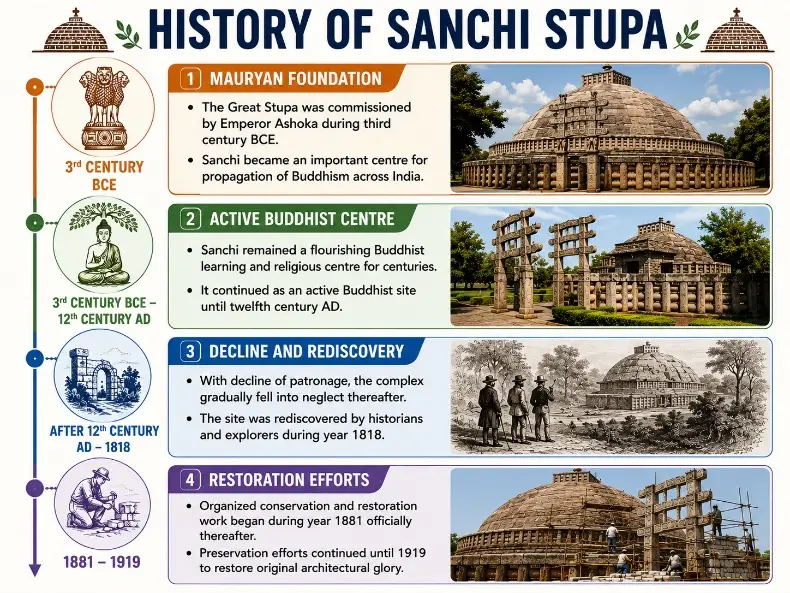
Restoration Efforts
- Organized conservation and restoration work began during year 1881 officially thereafter.
- Preservation efforts continued until 1919 to restore original architectural glory.
Architectural Features
Great Stupa Dome
Toranas (Gateways)
Ashoka Pillar
|
Great Bowl
Monastic Structures
Sacred Relics
|