IMEC: Balancing Connectivity Ambitions and Geopolitical Realities
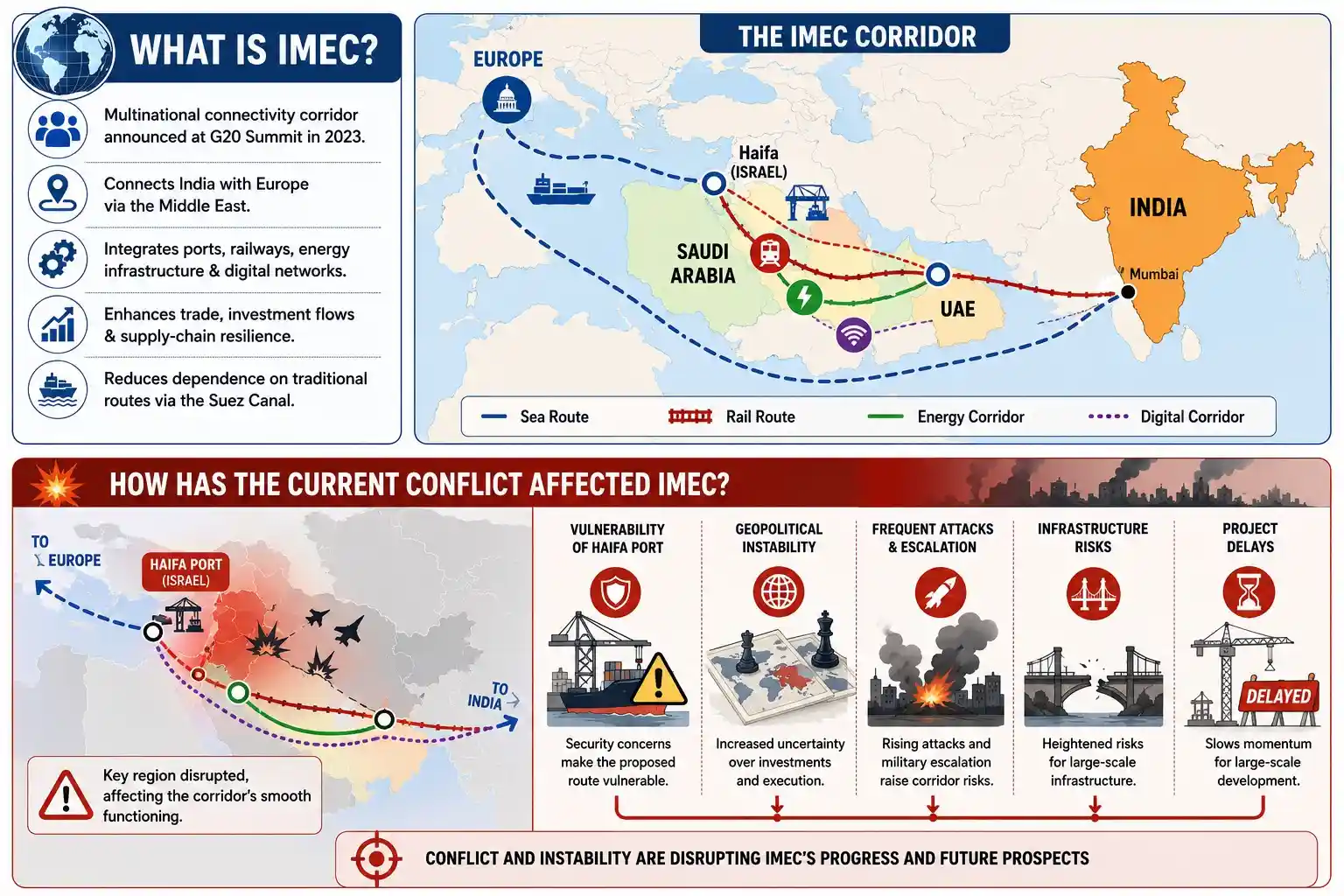
The ongoing conflict in West Asia has exposed the fragility of global trade networks and highlighted the dangers of excessive dependence on strategic chokepoints. In this context, the India-Middle East-Europe Economic Corridor (IMEC), envisioned as a transformative connectivity initiative, has acquired greater strategic significance. At the same time, the conflict has created fresh geopolitical and security challenges that could delay its implementation and test its long-term viability.
Lessons from the Iran Conflict
- The Iran-Israel conflict has demonstrated that military superiority alone cannot guarantee strategic success.
- The conflict has exposed the vulnerability of global trade and energy supply chains.
- The Strait of Hormuz remains one of the world’s most critical maritime chokepoints.
- India remains highly dependent on maritime routes for its energy imports and trade.
- The conflict has reinforced the need to diversify trade routes and connectivity networks.
- Modern conflicts increasingly involve asymmetric warfare, making traditional deterrence less effective.
Major Challenges Before IMEC
- Political instability in West Asia continues to threaten the smooth implementation of the corridor.
- Security concerns may discourage investors from committing long-term capital to the project.
- Strategic competition among regional powers could complicate coordination among participating countries.
- Energy security concerns may divert policy attention away from connectivity initiatives.
- Large infrastructure projects require sustained political commitment, which may be difficult during periods of conflict.
Navigating the Challenges
- India should work with partners to develop alternative routes that bypass conflict-prone regions.
- The corridor should evolve into a flexible framework capable of adapting to changing geopolitical realities.
- Greater cooperation with the UAE and Saudi Arabia can strengthen the project’s resilience.
- Additional logistics hubs and transit points should be developed to reduce dependence on single routes.
- European partners should be encouraged to deepen their participation in financing and implementation.
- Green energy networks, digital infrastructure, and industrial corridors should be integrated into IMEC planning.
- Participating countries should establish mechanisms to manage geopolitical risks and disruptions.
The Iran-Israel conflict has simultaneously strengthened the strategic rationale for IMEC and complicated its implementation. While geopolitical tensions have exposed vulnerabilities in the proposed corridor, they have also underscored the urgent need for diversified and resilient connectivity networks. If India and its partners can adapt the project to evolving regional realities, IMEC can emerge as a transformative initiative that enhances trade, energy security, and economic integration across Asia, the Middle East, and Europe.
Summer Air Pollution in Indian Cities: Beyond Winter Smog
Air pollution in India is often associated with winter smog, but cities increasingly face serious pollution episodes during summer as well. Despite stronger winds and higher temperatures that help disperse pollutants, many cities continue to record dangerous levels of PM10 and ground-level ozone. Rising temperatures, dust storms, construction activities, vehicular emissions, and industrial pollution have made summer air quality a growing environmental and public health concern.
Why Are Cities Experiencing Summer Pollution?
- Many Indian cities continue recording high PM10 and ozone levels during summer months.
- Pollution is no longer confined to Delhi and affects major cities nationwide.
- Vehicular emissions, construction activities, industrial pollution, and road dust remain significant contributors.
- Heatwaves and changing weather patterns are intensifying pollution episodes across urban areas.
- Summer pollution increasingly threatens public health despite seemingly favorable meteorological conditions.
How Is Summer Pollution Different From Winter Pollution?
- Winter pollution is mainly dominated by fine particulate matter known as PM2.5.
- Summer pollution is largely driven by coarse PM10 particles and ground-level ozone.
- Winter conditions trap pollutants near the surface because of low temperatures.
- Summer heat and sunlight promote chemical reactions that generate ozone pollution.
- Dust storms become major contributors to air pollution during summer months.
Why Does Ozone Increase During Summer?
- Ozone is not directly emitted from vehicles, industries, or other pollution sources.
- It forms when nitrogen oxides react with volatile organic compounds under sunlight.
- Vehicle exhaust, industrial emissions, paints, and solvents release ozone-forming pollutants.
- Higher temperatures and intense sunlight accelerate ozone formation during summer months.
- Elevated ozone levels can cause respiratory illnesses and worsen existing health conditions.
What Causes PM10 Levels to Rise?
- Hot weather creates low-pressure systems that generate strong winds across regions.
- These winds transport dust from West Asia and the Thar Desert.
- Hot winds called “loo” often carry dust across northern parts of India.
- Localized dust storms known as “andhi” temporarily raise particulate matter concentrations.
- Dust particles remain suspended in the atmosphere and degrade air quality.
How Do Human Activities Worsen Summer Pollution?
- Construction and demolition activities release large amounts of dust into the atmosphere.
- Poor dust management practices significantly increase PM10 concentrations in urban areas.
- Vehicles moving over damaged roads resuspend loose dust into surrounding air.
- Industrial emissions continuously add pollutants that contribute to ozone formation.
- Traffic congestion and vehicle idling increase emissions of ozone-forming gases.
Impacts of Summer Air Pollution
- Increased exposure to particulate matter causes respiratory and cardiovascular diseases.
- Ground-level ozone can irritate lungs and reduce overall respiratory function.
- Children, elderly citizens, and people with existing illnesses face greater risks.
- Frequent pollution episodes increase healthcare burdens and reduce quality of life.
- Poor air quality affects productivity, outdoor activities, and overall urban well-being.
Measures to Combat Summer Air Pollution
- Cities should strengthen air quality forecasting and early warning systems.
- Authorities should issue timely alerts regarding dust storms and ozone spikes.
- Construction sites must implement strict dust-control measures throughout the year.
- Road dust management should remain a priority beyond the winter season.
- Industrial and vehicular emissions of nitrogen oxides and volatile compounds must decline.
- Cleaner transport systems should be promoted to reduce pollution at source.
- Public campaigns encouraging reduced vehicle idling can help lower emissions.
- Municipal bodies should use technology-based monitoring systems for better enforcement.
Way Forward
- Every major city should develop a dedicated summer air pollution action plan.
- Forecasting, public health advisories, and dust management must be integrated effectively.
- Authorities should strengthen enforcement against uncontrolled construction-related emissions.
- Investments in cleaner fuels and sustainable urban transport should be accelerated.
- Air quality management should treat summer pollution with equal seriousness as winter smog.
Summer air pollution is emerging as a significant environmental challenge across Indian cities. While winter smog remains a major concern, rising ozone levels, dust storms, and construction-related emissions are creating a distinct summer pollution crisis. Addressing this challenge requires year-round planning, effective enforcement, technological monitoring, and sustained efforts to reduce emissions, ensuring cleaner and healthier urban environments throughout the year.
Prelims Boosters
Doctrine of Promissory Estoppel
Context:
Supreme Court observed that promissory estoppel cannot be claimed for benefits never intended for a particular class under government policy.
About Doctrine of Promissory Estoppel
- Promissory Estoppel is a legal doctrine based on fairness and justice.
- It prevents a person from withdrawing a promise unfairly later.
- The doctrine protects individuals who relied upon a promise genuinely.
- It ensures that promises causing reliance cannot be casually ignored.
Meaning
- If a person makes a clear promise to another person.
- And the other person acts relying on that promise reasonably.
- Then the promisor may be legally prevented from denying it.
- This applies even when a formal contract may not exist.
Purpose
- To prevent injustice arising from broken promises and representations.
- To protect rights of persons acting on good faith.
- To ensure fairness in legal and commercial relationships.
Conditions for Application
Clear Promise
Reliance by Promisee
|
Detriment or Loss
Preventing Injustice
|
Supreme Court Checklist (1981)
Chhaganlal Keshavalal Mehta Case
- First, there must be a clear and definite promise.
- Second, the promisee must reasonably rely upon that promise.
- Third, the promisee must suffer some loss or detriment.
Example
- A shopkeeper promises replacement if clothes do not fit.
- Customer purchases clothes relying on that assurance given.
- Later, clothes fail to fit the customer properly.
- Customer returns clothes expecting replacement as promised earlier.
- Shopkeeper cannot refuse because customer relied upon promise.
Effect of Doctrine
- It prevents the promisor from going back on promise.
- It enables the aggrieved party to seek legal relief.
- It promotes trust and fairness in transactions and governance.
Applicability Against Government
- The doctrine can sometimes apply against government authorities.
- However, it cannot override statutory provisions or public interest.
- It cannot be used for benefits never intended under policy.
- Government cannot be compelled to act contrary to law.
Limitations
- No application if promise was vague or uncertain.
- No application where overriding public interest demands otherwise.
- Cannot compel actions prohibited by law or statute.
- Cannot create rights beyond scope of government policy.
Ayushman Bharat Digital Mission (ABDM)
Context:
ABDM has crossed the milestone of generating over 90 crore ABHAs.
About Ayushman Bharat Digital Mission (ABDM)
- ABDM is India’s flagship digital health infrastructure initiative nationwide.
- It is implemented by the National Health Authority (NHA).
- The mission functions under Ministry of Health and Family Welfare.
- ABDM acts as a unified digital highway for healthcare services.
- It connects citizens, doctors, hospitals, pharmacies, and insurers seamlessly.
Launch
- The Ayushman Bharat Digital Mission was launched in September 2021.
Aim
- To create an integrated and interoperable digital health ecosystem.
- To bridge information gaps between public and private healthcare sectors.
- To establish a reliable and unified health data framework.
- To provide citizens ownership of lifelong digital health records.
Key Building Blocks of ABDM
Ayushman Bharat Health Account (ABHA)
Healthcare Professionals Registry (HPR)
Health Facility Registry (HFR)
|
Health Information Exchange and Consent Manager (HIE-CM)
Unified Health Interface (UHI)
National Health Claims Exchange (NHCX)
|
On-Screen Marking (OSM) System
Context:
CBSE’s On-Screen Marking system has faced criticism after Class 12 results.
About On-Screen Marking (OSM)
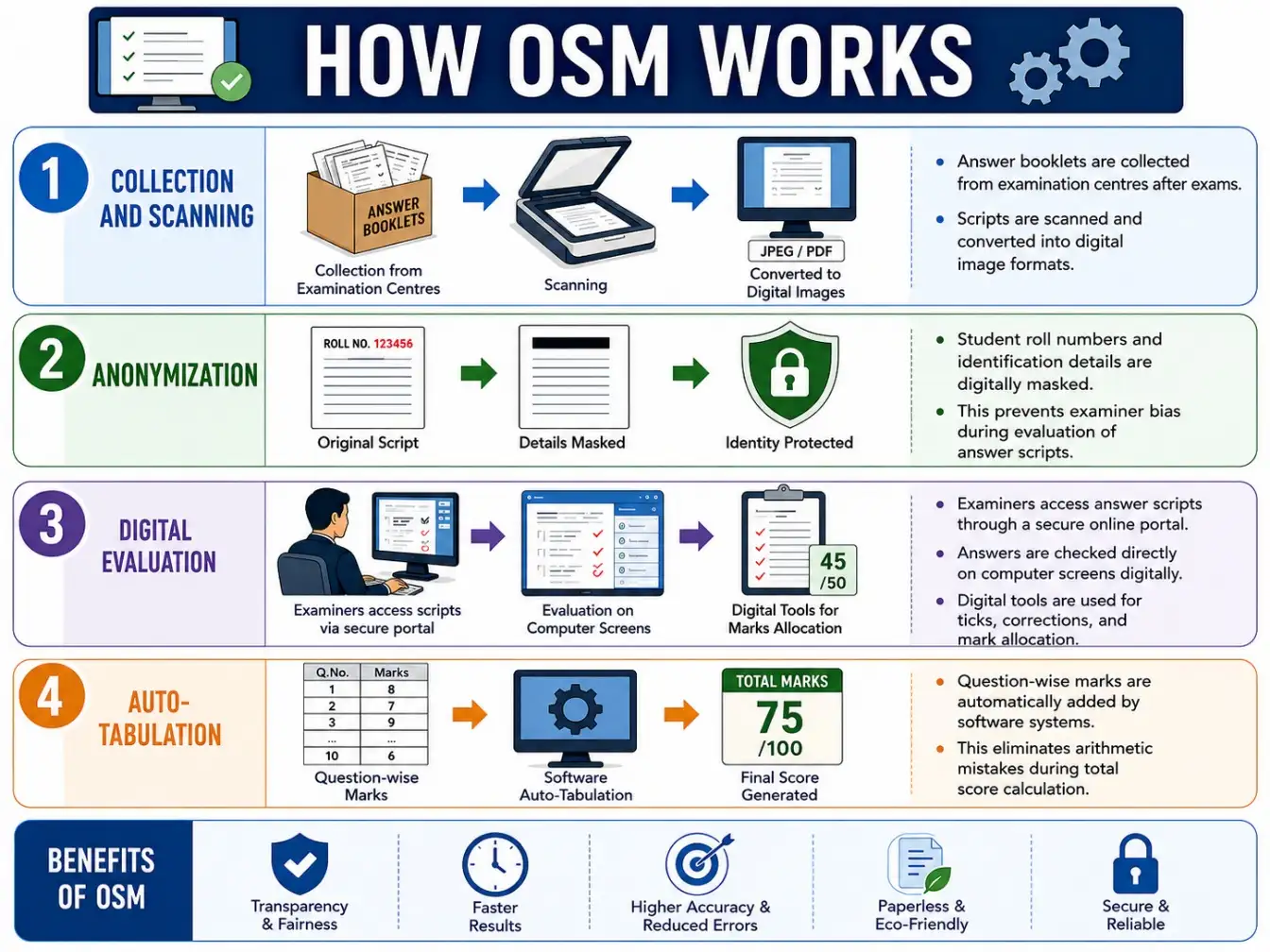
- OSM is a digital system for evaluating handwritten examination papers.
- Physical answer scripts are scanned and uploaded for digital assessment.
- Examiners evaluate answers on computer screens instead of paper copies.
- The system replaces traditional manual checking using physical answer sheets.
Developed and Managed By
- CBSE’s OnMark digital evaluation platform was outsourced externally.
- The system is developed and managed by Coempt Eduteck Pvt. Ltd.
History
- CBSE first tested an early OSM version during 2013-14.
- Initial implementation faced challenges due to limited digital literacy.
- Infrastructure limitations also affected the success of early trials.
- In 2026, CBSE implemented OSM across all subjects nationwide.
Aim of OSM
- To modernize the examination evaluation process across the country.
- To eliminate manual totaling and tabulation errors completely.
- To reduce evaluation time and accelerate result processing.
- To improve transparency in the marking and assessment process.
- To reduce post-result verification and rechecking applications significantly.
Key Features
Secure Evaluation
Faster Processing
|
Error Reduction
Service Level Agreement (SLA)
|
Advantages
- Faster evaluation and quicker declaration of examination results.
- Reduced chances of human calculation and totaling errors.
- Greater transparency through digital tracking of evaluation activities.
- Easier storage and management of answer script records.
Concerns
- Technical glitches can affect accuracy and consistency of evaluation.
- Examiner adaptation to digital marking may require additional training.
- Large-scale implementation may face infrastructure and software challenges.
- Errors in scanning or uploading may affect student outcomes.
BrahMos Missile
Context:
India has signed a major BrahMos missile export deal with Vietnam.
About BrahMos Missile
- BrahMos is a long-range supersonic cruise missile developed jointly.
- It can be launched from land, sea, air, and submarines.
- The missile follows the Fire and Forget operational principle.
- It maintains supersonic speed throughout its entire flight path.
- High speed makes interception extremely difficult for enemy defenses.
Developed By
- BrahMos Aerospace manufactures and develops the BrahMos missile system.
- It is a joint venture established during 1998 officially.
- Partners are DRDO of India and NPO Mashinostroyeniya of Russia.
Name Origin
- BrahMos combines names of Brahmaputra River and Moskva River.
- The name symbolizes India-Russia technological cooperation and partnership.
Aim
- To provide precision-strike capability against high-value enemy targets.
- To strengthen maritime denial and strategic deterrence capabilities.
- To enhance offensive and defensive military preparedness significantly.
Key Features
Two-Stage Propulsion System
High Speed
High Destructive Power
|
Warhead Capacity
Flight Altitude
Universal Launch Canister
|
Multi-Platform Deployment
Land Version
- Launched vertically from Mobile Autonomous Launchers on land.
Sea Version
- Deployed on warships using vertical or inclined launch systems.
Submarine Version
- Can be launched from submarines beneath the sea surface.
Air Version
- Integrated with Indian Air Force’s Su-30MKI fighter aircraft.
Advantages
- About three times faster than traditional subsonic cruise missiles.
- Possesses much higher strike effectiveness and survivability.
- Difficult for enemy air defence systems to intercept successfully.
- Suitable for precision attacks against land and maritime targets.
International Buyers
Philippines
|
Vietnam
|
Indonesia
|
Democratic Republic of the Congo (DRC)
Context:
WHO Director-General visited DRC amid the ongoing Ebola outbreak response.
About Democratic Republic of the Congo (DRC)
- DRC is the second-largest country in Africa by land area.
- It was formerly known as Zaire before adopting present name.
- DRC is a unitary multiparty republic located in Central Africa.
- The country possesses vast reserves of strategic mineral resources.
- Major resources include cobalt, copper, diamonds, and rainforest wealth.
Location
- DRC is located in Central Africa and straddles Equator.
- The Equator passes through the country’s central region.
Capital
- Kinshasa is the capital and administrative centre of DRC.
- It is the largest city in Central Africa region.
- Kinshasa lies on the banks of Congo River strategically.
Borders
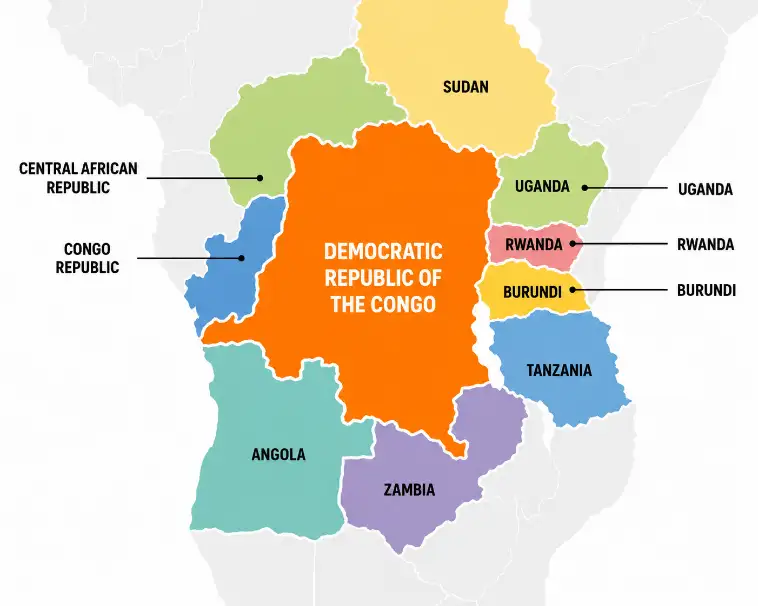
DRC shares borders with nine countries:
Physical Features
Central Congo Basin
- Interior DRC consists of vast low-lying Congo Basin region.
- Dense equatorial rainforests cover much of this basin area.
- It contains one of world’s largest tropical forest ecosystems.
- Lakes Tumba and Mai-Ndombe support biodiversity and freshwater resources.
Eastern Highlands and Rift Valley
Mitumba Mountains
- Mitumba Mountains run along the eastern border of DRC.
- They influence climate patterns and regional river systems significantly.
Ruwenzori Mountains
- Ruwenzori Range lies along the Uganda-DRC international border.
- It contains Margherita Peak, DRC’s highest point at 5,109 metres.
Virunga Mountains
- Virunga Mountains form an important volcanic chain in eastern DRC.
- They include active volcanoes like Mount Nyiragongo.
Great Lakes Region
- Lakes Albert, Edward, Kivu, and Tanganyika occur in region.
- These lakes provide fisheries, transport routes, and freshwater resources.
Plateaus
Ubangi-Uele Plateau
- Northern plateaus separate Congo Basin from Nile Basin watersheds.
Katanga Plateau
- Katanga region is rich in copper and cobalt deposits.
- It is one of DRC’s major economic regions.
Congo River
- Congo River drains one of world’s largest river basins.
- It crosses the Equator twice before reaching Atlantic Ocean.
- It is Africa’s second-longest river after the Nile.
Volcanic Soils
- Eastern volcanic regions possess highly fertile agricultural soils.
- These areas support dense populations and intensive farming activities.
Ebola Outbreak Hotspots
Ituri Province
|
Eastern Conflict Zones
|