India’s Semiconductor Journey: Building a Self-Reliant Chip Ecosystem
Semiconductors have become the backbone of the modern digital economy, powering everything from smartphones and automobiles to defence systems and artificial intelligence. Recognizing their strategic importance, India has launched ambitious initiatives under the India Semiconductor Mission (ISM). However, a recent NITI Aayog report highlights that India’s semiconductor ecosystem is still not fully prepared to meet domestic demand and must strengthen local manufacturing, design capabilities, and research infrastructure to achieve technological self-reliance.

Major Challenges Facing India
Dependence on Imports
- India remains heavily dependent on foreign countries for semiconductor supplies.
- Global disruptions can create shortages affecting critical sectors of the economy.
- Geopolitical tensions may threaten access to essential semiconductor technologies.
Absence of Mature Fabrication Facilities
- Semiconductor fabrication plants require massive investments and advanced technologies.
- Establishing fabrication units involves long gestation periods before commercial production.
- Building globally competitive fabrication capabilities requires sustained policy support.
Technology and Equipment Constraints
- Chip manufacturing requires highly specialized machinery sourced from a few countries.
- Access to advanced semiconductor equipment remains restricted and strategically controlled.
- India must secure reliable access to critical technologies and production equipment.
Talent and Skill Gaps
- Semiconductor manufacturing requires highly trained engineers and technical specialists.
- India needs greater investment in semiconductor-focused education and research programs.
- Industry-academia collaboration must be strengthened to build skilled manpower.
Strategic Opportunities for India
Focus on Chip Packaging and Testing
Design-Led Growth Strategy
Building Trusted Partnerships
|
Role of Research and Innovation
Capital Investment Requirements
|
Way Forward
- India should continue expanding semiconductor packaging and testing infrastructure.
- Research and development capabilities must receive sustained policy and financial support.
- Academic institutions should create specialized semiconductor education programs.
- Public-private partnerships should be encouraged to accelerate ecosystem development.
- International collaborations should focus on technology transfer and skill development.
- Policies should prioritize long-term ecosystem building rather than short-term outcomes.
India’s semiconductor ambitions are driven by both economic necessity and strategic considerations. While the country currently faces challenges related to manufacturing capacity, technology access, and skilled manpower, it possesses significant strengths in design talent, market size, and policy commitment. By focusing on research, innovation, packaging, trusted partnerships, and gradual capacity building, India can develop a resilient semiconductor ecosystem and emerge as an important player in the global chip industry.
India's Heat Wave Crisis: A Growing Developmental Challenge
India is witnessing an unprecedented heat wave crisis, with temperatures frequently touching 45°C–48°C across large parts of the country. Rising daytime temperatures, coupled with steadily increasing night-time temperatures, are intensifying heat stress and reducing recovery time for both people and ecosystems. The crisis has emerged as a major challenge affecting public health, livelihoods, food security, economic growth, and environmental sustainability.
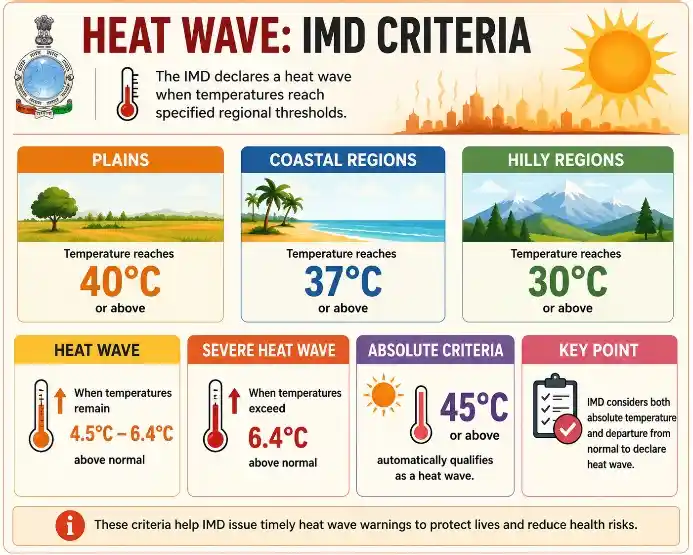
Economic and Livelihood Impacts
- Nearly 75% of India’s workforce operates in sectors directly exposed to heat.
- Agriculture, construction, mining, and informal activities face severe productivity losses.
- Heat stress reduces working hours and lowers labour efficiency significantly.
- India may account for a major share of global heat-related job losses.
- Extreme heat threatens economic growth through reduced productivity and infrastructure stress.
- The World Bank warns that heat waves could significantly impact future GDP growth.
Food Security and Agricultural Impacts
- Extreme heat damages standing crops and reduces agricultural productivity.
- High temperatures disrupt grain filling and reduce overall crop yields.
- Farmers increasingly shift agricultural activities to night-time working hours.
- Livestock suffer from thermal stress, reducing milk production substantially.
- Poultry farms experience increased mortality rates during prolonged heat waves.
- Lower agricultural output can trigger food inflation and market instability.
Public Health and Social Impacts
- Poor households face greater vulnerability due to inadequate housing conditions.
- Water scarcity and power shortages worsen the effects of extreme heat.
- Hospitals report increasing cases of heatstroke, dehydration, and exhaustion.
- Rising night-time temperatures prevent adequate physical recovery and restful sleep.
- Chronic heat exposure increases cardiovascular and respiratory health risks.
- Outdoor workers face the highest risk of heat-related illnesses and fatalities.
Environmental and Ecological Impacts
- Urban Heat Islands make cities significantly hotter than nearby rural areas.
- Concrete structures and asphalt surfaces absorb and retain large amounts of heat.
- Reduced green cover limits natural cooling and temperature regulation mechanisms.
- Wildlife suffers from dehydration and shrinking availability of water sources.
- Plants experience stress, leading to reduced growth and carbon absorption.
- Ecosystem degradation further weakens resilience against future heat extremes.
Major Causes Behind the Crisis
Climate Change
Loss of Green Infrastructure
|
Degradation of Water Bodies
Governance Challenges
|
Way Forward
Strengthening Heat Action Plans
- Heat Action Plans should focus on ward-level and village-level vulnerability mapping.
- Dedicated funding and legal backing should support effective implementation.
Nature-Based Solutions
- Cities should promote urban forestry and large-scale plantation drives.
- Wetlands, lakes, and water bodies should be restored and protected.
Climate-Resilient Infrastructure
- Public buildings should adopt cool roofs and heat-reflective construction materials.
- Cooling centres should be established for vulnerable populations during heat waves.
Labour and Social Protection
- Outdoor work should be restricted during peak afternoon heat hours.
- Direct income support should compensate workers affected by heat restrictions.
- Climate insurance should protect workers and farmers from heat-related losses.
India’s heat wave crisis is no longer merely an environmental concern but a critical developmental challenge. Its impacts extend across public health, livelihoods, agriculture, economic growth, and ecological stability. Addressing this crisis requires a comprehensive approach that combines climate adaptation, resilient infrastructure, nature-based solutions, and social protection measures. Building a heat-resilient India must become a national priority in the coming decades.
Prelims Boosters
AUKUS
Context:
AUKUS members recently announced cooperation on advanced underwater drone systems.
About AUKUS
- AUKUS is a trilateral security partnership formed in 2021.
- It brings together Australia, United Kingdom, and United States.
- The partnership focuses on defence and advanced technology cooperation.
- It aims to strengthen security in the Indo-Pacific region.
Members
- Australia, United Kingdom (UK) and United States of America (USA)
Aim
- To enhance defence capabilities of all three partner countries.
- To accelerate integration of advanced military technologies.
- To expand defence industrial capacity among member nations.
- To contribute towards stability in the Indo-Pacific region.
- To strengthen collective security and strategic cooperation.
Basis of Partnership
- Built upon longstanding bilateral defence and security relationships.
- Supports common strategic and geopolitical interests of members.
- Enhances interoperability among military forces of partner countries.
Two Pillars of AUKUS
Pillar 1: Nuclear-Powered Submarines
|
Pillar 2: Advanced Defence Technologies
|
Areas of Cooperation
Artificial Intelligence (AI)
Quantum Technologies
Innovation
Information Sharing
Cyber Technologies
|
Undersea Capabilities
Hypersonic Technologies
Counter-Hypersonic Technologies
Electronic Warfare
|
Significance
Indo-Pacific Security
- Strengthens strategic balance in the Indo-Pacific region.
- Enhances maritime security and deterrence capabilities.
Technology Cooperation
- Promotes sharing of advanced military technologies.
- Accelerates innovation among partner nations significantly.
Defence Preparedness
- Improves operational effectiveness and military interoperability.
- Strengthens collective response to emerging security challenges.
Project UDAYAK
Context:
BRO recently celebrated the 37th Raising Day of Project UDAYAK.
About Project UDAYAK
- Project UDAYAK is an important initiative of the Border Roads Organisation.
- The project supports strategic infrastructure development in India’s far east.
- UDAYAK means “Rising Sun,” reflecting its geographical significance.
- The first sunrise in India occurs within the project’s area.
Organisation
- Project UDAYAK functions under the Border Roads Organisation (BRO).
- BRO develops and maintains strategic road infrastructure in border areas.
History
- Project UDAYAK was raised on 1 June 1990 officially.
- Headquarters was established at Doomdooma in Assam initially.
- It was created during BRO restructuring for eastern region development.
Formation of Task Forces
- 48 Border Roads Task Force came from Project Vartak.
- 752 Border Roads Task Force came from Project Sewak.
- These task forces became the project’s executive implementation arms.
Area of Operation
- The project operates mainly in Arunachal Pradesh’s eastern regions.
- It also covers strategically important areas of Assam.
Major Achievements
Road Infrastructure Development
Connectivity Enhancement
|
Support Along LAC
Indo–Myanmar Border Development
Border Fencing Infrastructure
|
Significance
National Security
- Strengthens India’s border defence and surveillance capabilities.
- Supports rapid deployment of security forces when required.
Regional Development
- Promotes socioeconomic development in remote northeastern regions.
- Improves connectivity, trade opportunities, and public services.
Strategic Importance
- Enhances infrastructure near sensitive international border areas.
- Supports India’s long-term border management objectives effectively.
MAHA Water Mission
Context:
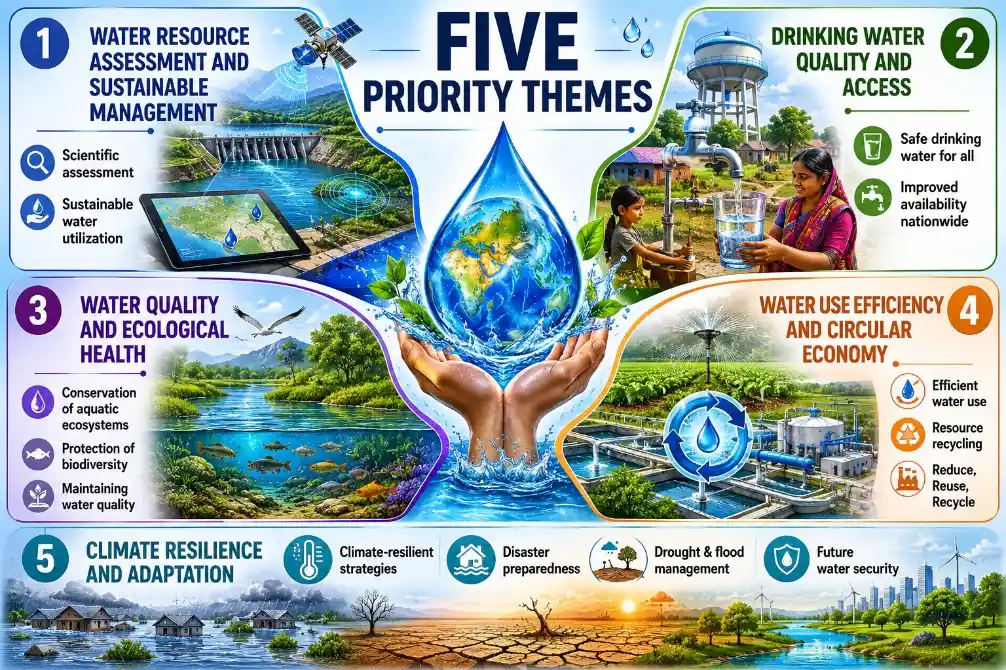
Government launched the ₹200-crore MAHA Water Mission to promote water innovation.
About MAHA Water Mission
- MAHA stands for Missions for Advancement in High-impact Areas.
- It is a high-priority national programme for water innovation.
- The mission bridges research and real-world water sector applications.
- It supports technology development, validation, and commercialization activities.
Aim
- To accelerate innovative solutions for India’s water-related challenges.
- To connect scientific research with field-level implementation effectively.
- To promote sustainable and climate-resilient water resource management.
Organisations Involved
Anusandhan National Research Foundation (ANRF)
- ANRF is the primary body supporting research funding nationwide.
Ministry of Jal Shakti
- It is the nodal ministry for water resources management.
- It oversees river development and Ganga rejuvenation programmes.
Department of Space / ISRO
- ISRO provides satellite technology and geospatial data support.
- It assists in water mapping and resource assessment activities.
Financial Support
- Total mission outlay is ₹200 crore over five years.
- Selected consortia can receive grants up to ₹20 crore.
Participation
- Universities can participate in mission research and development.
- National laboratories are eligible for collaborative project proposals.
- Research organisations can contribute expertise and innovations.
- Startups and MSMEs are encouraged to participate actively.
- Industry partners can collaborate in commercialization and deployment.
Open Call for Startups and MSMEs
- Dedicated opportunities are provided for startups and MSMEs.
- Focus is on product development and prototype creation.
- Encourages innovation-driven entrepreneurship in water technologies.
Digital Integration
JSJB-CTR Portal and App
- JSJB stands for Jal Sanchay Jan Bhagidari initiative.
- Enables real-time monitoring of mission-related activities nationwide.
- Encourages public participation in water conservation efforts.
- Facilitates citizen reporting and tracking of water projects.
India–Nepal Border Dispute
Context:
Nepal Prime Minister’s remarks revived debate on India–Nepal border issues.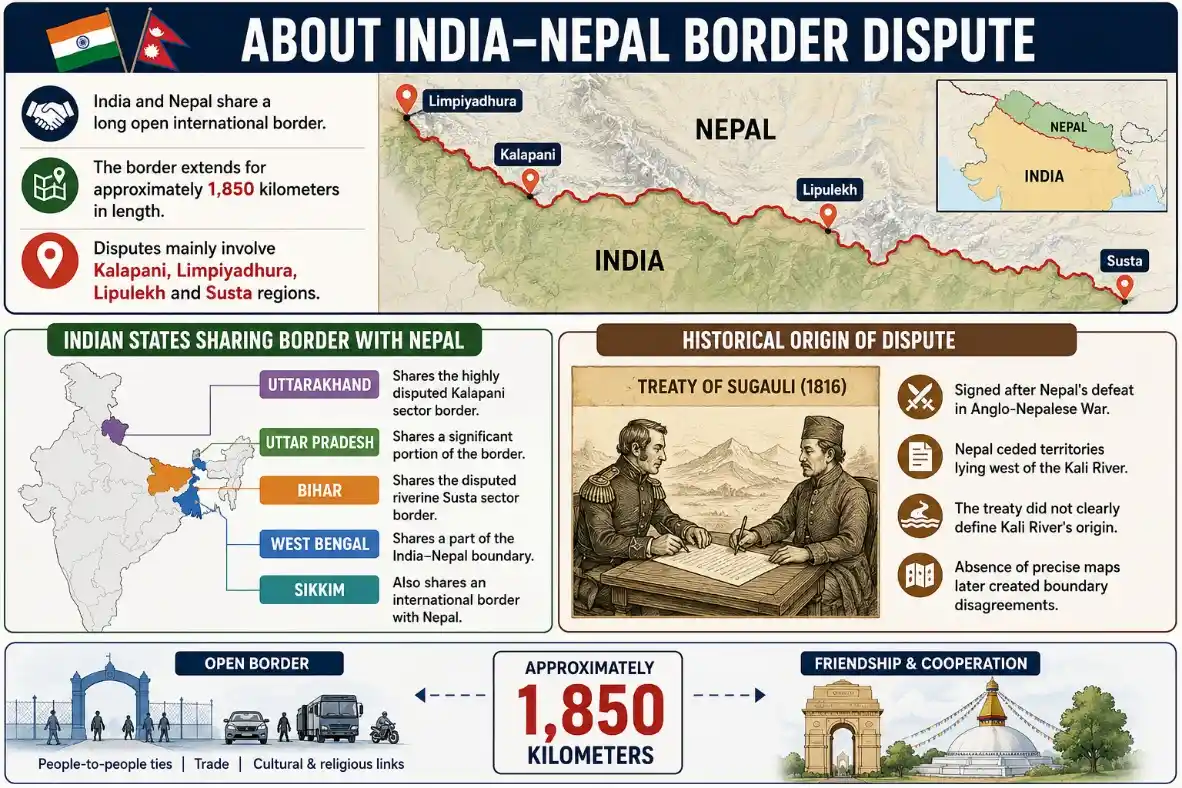
Cartographic Differences
Early Maps
| Later Maps
|
Nepal’s Earlier Acceptance
- Surveys conducted during 1924–1927 supported revised alignment.
- Maps approved in 1928–29 reflected this boundary position.
Modern Escalation (2020)
- Nepal issued a new political map in 2020.
- The map included Kalapani, Limpiyadhura and Lipulekh territories.
- Nepal amended its Constitution to adopt this map.
- India rejected the move as a unilateral action.
Major Disputed Areas
Kalapani–Limpiyadhura–Lipulekh Region
- Located near India-Nepal-China tri-junction area.
- Covers approximately 35 square kilometers of strategic territory.
- India considers it part of Pithoragarh district, Uttarakhand.
- Nepal claims it as part of Darchula district.
- India has maintained an ITBP post since 1955.
Strategic Importance
- Provides important observation point near Indo-China border region.
- Holds military and geopolitical significance for both countries.
Susta Dispute
- Susta lies near Bihar along the Gandak River.
- River course changes created uncertainty over boundary alignment.
- More than 14,000 hectares became subject to dispute.
- Local farming and settlements intensified jurisdictional confusion.
Fixed Boundary Principle
- International boundaries generally remain fixed despite river movements.
- Rivers naturally shift their course over long periods.
- This creates practical disputes despite legal boundary stability.
Right to be Forgotten (RTBF)
Context:
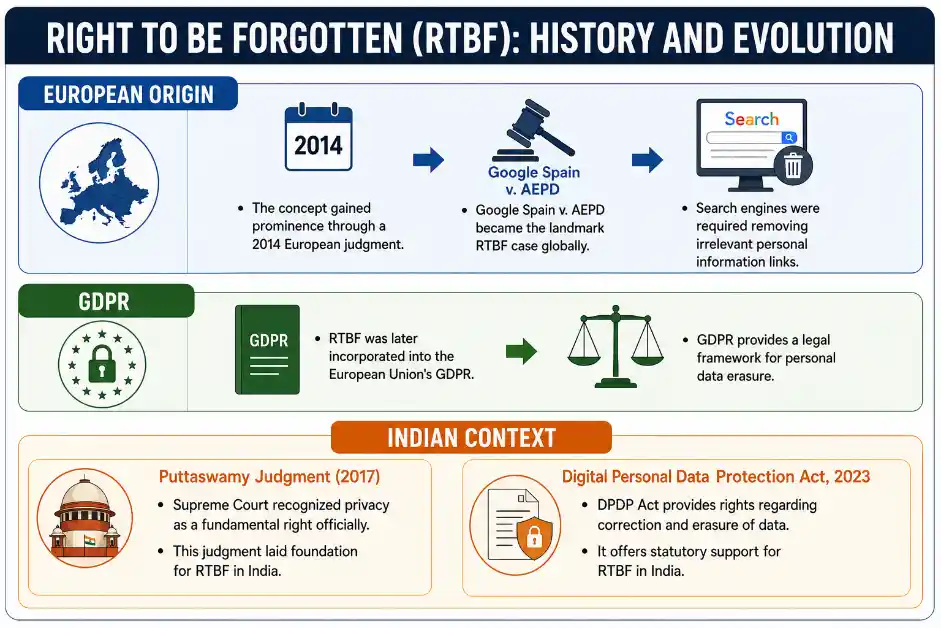
Delhi High Court recognized the Right to be Forgotten as part of Article 21.
About Right to be Forgotten
- Right to be Forgotten allows removal of personal information online.
- It enables individuals to erase outdated or irrelevant personal data.
- The right is based on informational self-determination principles.
- It helps individuals move beyond past events and mistakes.
Objective
- To protect personal dignity, reputation, and privacy of individuals.
- To prevent unnecessary public exposure of irrelevant personal information.
- To balance privacy rights with public interest and transparency.
Basis of the Right
- It is linked to the Right to Privacy under Article 21.
- It protects control over personal information in digital spaces.
- It recognizes that individuals should control their personal data.
Delhi High Court Verdict
Recognition under Article 21
- Delhi High Court recognized RTBF as part of privacy rights.
- The ruling linked RTBF with dignity and personal autonomy.
De-indexing of Information
- Search engines may disable name-based searches in specific cases.
- Information remains online but becomes harder to locate directly.
Masking of Personal Details
- Personal identifiers such as names and addresses may be hidden.
- Judicial reasoning and legal findings remain publicly accessible.
Persons Eligible for Relief
Acquitted Individuals
Matrimonial and Private Disputes
|
Incidental References
|
Responsibility of Search Engines
- Search engines must comply with lawful removal orders.
- Automated algorithms cannot override fundamental privacy rights.
- IT Rules, 2021 require compliance with such directives.
Significance
Protection from Digital Stigma
- Prevents lifelong social and professional consequences from past events.
- Protects individuals cleared by courts from continued prejudice.
Strengthening Privacy
- Recognizes challenges posed by permanent digital records today.
- Enhances protection of personal dignity in digital era.
Balanced Approach
- Supports privacy without completely deleting judicial records.
- Maintains legal transparency while protecting individual identities.