Northeast India: From Borderland to Strategic Resource Frontier
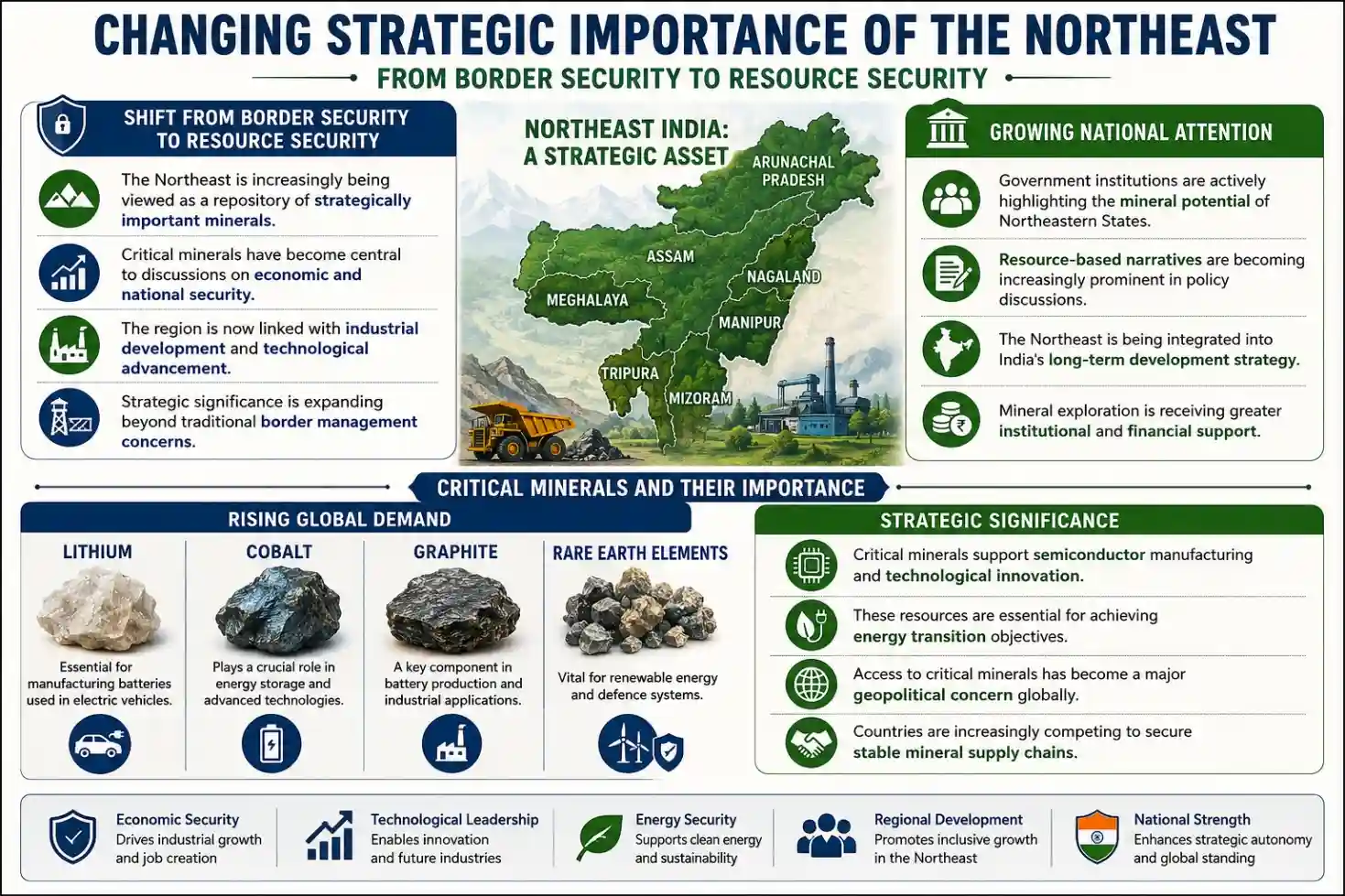
India’s Northeast has traditionally been viewed through the lens of border security, insurgency, and connectivity challenges. However, the growing importance of critical minerals is transforming the region into a strategic resource frontier. Rich deposits of lithium, cobalt, graphite, nickel, and rare earth elements are bringing the Northeast into the centre of India’s economic, technological, and geopolitical calculations. This shift presents significant opportunities but also raises important questions regarding land rights, local participation, and inclusive development.
India’s Exploration Efforts in the Northeast
Expansion of Mineral Surveys
- India has intensified exploration activities across several Northeastern States.
- Geological surveys have identified significant mineral deposits in the region.
- Exploration projects have expanded across Arunachal Pradesh, Meghalaya, and Assam.
- Nagaland and Manipur have also witnessed increasing exploration activities.
Recent Developments
- The Geological Survey of India has undertaken multiple critical mineral projects.
- Exploration efforts focus on lithium, graphite, nickel, cobalt, and rare earth elements.
- New mineral discoveries are strengthening the region’s economic significance.
- Exploration activities are expected to increase further in coming years.
The Idea of a Strategic Frontier
Changing Policy Language
- The Northeast is increasingly described as a strategic resource frontier.
- Resource security is now discussed alongside connectivity and border management.
- Mineral wealth is shaping new perceptions about the region’s future.
- Economic opportunities are becoming central to policy narratives.
Beyond Geography
- Frontiers are not merely geographical spaces but also political constructions.
- Strategic importance often reflects changing national priorities and interests.
- Resource-rich regions frequently become sites of competing developmental visions.
- Economic value can significantly alter perceptions of regional importance.
Land, Identity, and Local Communities
Deep Connection with Territory
|
Concerns Regarding Resource Extraction
|
Challenges Associated with Resource Development
Environmental Concerns
- Mining activities can affect fragile ecosystems and biodiversity-rich landscapes.
- Resource extraction may increase pressure on forests and water resources.
- Environmental degradation can undermine long-term sustainability goals.
- Proper safeguards are essential for balancing development and conservation.
Governance Challenges
- Effective institutional frameworks are necessary for managing resource development.
- Weak governance can create conflicts regarding benefits and resource ownership.
- Regulatory mechanisms must ensure transparency and accountability.
- Development gains should be distributed fairly among local populations.
Social and Political Challenges
- Resource projects may generate tensions if communities feel excluded.
- Lack of consultation can undermine trust between governments and local populations.
- Historical grievances may influence public perceptions of development initiatives.
- Inclusive governance is essential for ensuring long-term stability.
Importance of Inclusion and Participation
Community-Centred Development
- Local communities must become active stakeholders in resource development projects.
- Development initiatives should respect customary institutions and local traditions.
- Participation strengthens legitimacy and reduces the likelihood of conflicts.
- Inclusive growth can improve public acceptance of development projects.
Ensuring Equitable Benefits
- Resource wealth should generate employment and economic opportunities locally.
- Infrastructure development must directly benefit surrounding communities.
- Revenue-sharing mechanisms can strengthen local support for projects.
- Development outcomes should improve overall quality of life in the region.
Way Forward
Promoting Sustainable Mining
- Resource extraction should follow strict environmental and social safeguards.
- Scientific mining practices must minimize ecological damage.
- Continuous monitoring should ensure compliance with sustainability standards.
- Restoration measures should accompany extraction activities.
Strengthening Local Participation
- Communities should be consulted at every stage of project development.
- Traditional institutions should be integrated into decision-making processes.
- Transparent communication can build trust and reduce misunderstandings.
- Local voices should shape development priorities and implementation strategies.
Balancing Development and Rights
- Economic growth should not come at the cost of local rights.
- Land ownership concerns must be addressed through fair processes.
- Development policies should respect cultural identities and social realities.
- Resource development must remain people-centric and inclusive.
The emergence of the Northeast as a strategic resource frontier marks a significant shift in India’s developmental and geopolitical thinking. While critical minerals offer immense opportunities for economic growth, technological advancement, and energy security, their extraction cannot be viewed solely through an economic lens. Sustainable success will depend upon balancing resource development with environmental protection, local participation, and respect for community rights. The true measure of this new frontier will not be the minerals extracted from the land, but whether the people living on that land become equal partners in the region’s transformation.
Prelims Boosters
Economic Advisory Council to the Prime Minister (EAC-PM)
Context:
Prime Minister recently chaired a meeting of the Economic Advisory Council to the Prime Minister.
About EAC-PM
What is it?
- EAC-PM is an independent advisory body on economic matters.
- It provides economic advice directly to the Prime Minister.
- It examines important economic and related policy issues.
- Its recommendations are advisory and not legally binding.
Objective
- To assist the Prime Minister on economic policy matters.
- To provide expert analysis on macroeconomic challenges.
- To support informed decision-making at the highest level.
Terms of Reference
Economic Analysis
Macroeconomic Issues
|
Suo Motu Recommendations
Special Assignments
|
Nature of EAC-PM
- Functions purely as an advisory institution.
- Government is not bound to accept its recommendations.
- Serves as a source of expert economic guidance.
Public Role
- Promotes greater economic awareness among the public.
- Encourages informed discussion on economic developments.
- Contributes to understanding of policy and growth issues.
Composition
Chairperson
- EAC-PM is headed by a Chairperson.
Members
- Consists of eminent economists as members.
- Members are selected based on expertise and experience.
Support Staff
- Supported by officials and administrative personnel.
- Assists in research, coordination, and policy analysis.
Membership Structure
- No fixed number of members is prescribed.
- Size may vary according to government requirements.
Administrative Support
Role of NITI Aayog
- NITI Aayog acts as the nodal agency.
- Provides administrative and logistical support to EAC-PM.
- Assists in planning, budgeting, and coordination functions.
Significance
Policy Formulation
- Provides expert inputs for economic policymaking.
- Helps government address complex economic challenges.
Strategic Guidance
- Supports long-term economic planning and reforms.
- Offers independent perspectives on national economic issues.
Evidence-Based Governance
- Encourages data-driven and research-based policy decisions.
- Strengthens economic governance through expert consultation.
Sea of Azov
Context:
Ukraine claimed it struck five ships carrying illegal cargo in the Sea of Azov.
About Sea of Azov
Location
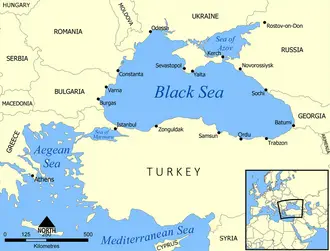
- Sea of Azov lies between Ukraine and Russia.
- Ukraine borders it in the northwest region.
- Russia borders it in the southeastern region.
- It is among the world’s shallowest seas.
Connection with Other Seas
- Connected to the Black Sea through Kerch Strait.
- Kerch Strait links Sea of Azov and Black Sea.
- Strait lies between Crimea and Taman Peninsulas.
- Ultimately connected to the Atlantic Ocean through multiple seas.
Connection Route
- Sea of Azov → Black Sea → Sea of Marmara.
- Then through Aegean Sea and Mediterranean Sea.
- Finally reaches the Atlantic Ocean via Gibraltar.
Important Peninsulas
Crimean Peninsula
- Located on the western side of Kerch Strait.
- Strategically important region in Black Sea geopolitics.
Taman Peninsula
- Located on the eastern side of Kerch Strait.
- Forms part of Russia’s southern coastal region.
Major Rivers
Don River
|
Kuban River
|
Major Ports
Russia
- Taganrog is an important Russian port city.
Ukraine
- Mariupol is a major Ukrainian port.
- Berdyansk is another significant Ukrainian port.
Coastal Features
- Coastline is generally low, flat, and heavily vegetated.
- Contains extensive lagoons and marshy coastal areas.
Important Lagoons
- Syvash Lagoon is a notable coastal lagoon system.
Sand Spits
- Arabat Spit is one of the world’s longest spits.
- Fedotov Spit extends along the coastline.
- Berdyansk Spit is another prominent coastal feature.
Climate
Winter Conditions
- Winters are cold with temperatures below freezing.
- Temperatures may occasionally fall near minus thirty degrees.
- Seasonal ice formation occurs during severe winters.
Summer Conditions
- Summers are warm with temperatures around twenty-three degrees.
- Weather remains suitable for navigation and fishing activities.
Weather Characteristics
- Frequent storms occur throughout different seasons.
- Continental climate strongly influences regional weather patterns.
Anusandhan National Research Foundation (ANRF)
Context:
Union Science and Technology Minister announced ANRF-supported digital portal for patent filing and research writing support.
About ANRF
Establishment
- ANRF was established through the ANRF Act, 2023.
- It functions under the Department of Science and Technology.
- Science and Engineering Research Board was merged into ANRF.
Objective
- To promote research and development across educational institutions.
- To foster innovation and scientific research culture nationwide.
- To strengthen universities, colleges, laboratories, and research institutions.
- To support India’s long-term scientific and technological growth.
Role of ANRF
- Functions as the apex body for scientific research promotion.
- Provides strategic direction to India’s research ecosystem.
- Implements research goals envisioned under National Education Policy.
- Encourages excellence in science, technology, and innovation sectors.
Key Functions
Research Promotion
|
Innovation Ecosystem
|
Capacity Building
|
Collaboration Framework
- Builds partnerships between academia and industry.
- Encourages cooperation among research institutions and government bodies.
- Facilitates knowledge sharing and technology transfer mechanisms.
- Strengthens innovation networks across different sectors.
Funding Target
- Aims to mobilise ₹50,000 crore during 2023–2028 period.
- Funding will come through multiple dedicated research funds.
Sources of Funding
- ANRF Fund.
- Innovation Fund.
- Science and Engineering Research Fund.
- Special Purpose Funds.
Significance
Strengthening Research
- Expands research opportunities across higher educational institutions.
- Promotes world-class scientific research within India.
Supporting Innovation
- Encourages development of new technologies and solutions.
- Bridges the gap between research and industry applications.
Global Competitiveness
- Enhances India’s position in global scientific research.
- Helps create a knowledge-driven and innovation-based economy.
Solar Cycle
Context:
IIA researchers used 100 years of Kodaikanal Observatory data to study supergranulations during different solar cycle phases.
About Solar Cycle
What is it?
- Solar Cycle is an approximately 11-year cycle of solar activity.
- It is driven by changes in the Sun’s magnetic field.
- The cycle is measured using sunspot numbers on the Sun.
- More sunspots indicate higher solar activity levels.
Magnetic Field Reversal
- The Sun’s magnetic field reverses approximately every eleven years.
- The Sun’s north and south magnetic poles switch positions.
- Another eleven years are required to restore original polarity.
- Thus, a complete magnetic cycle lasts about twenty-two years.
How Solar Cycle Works
- Solar activity depends upon changes in the Sun’s magnetic field.
- Magnetic field changes influence activity on the Sun’s surface.
- Sunspots are visible manifestations of intense magnetic activity.
- Scientists track solar cycles by counting sunspot numbers.
Stages of Solar Cycle
Solar Minimum
Rising Phase
|
Solar Maximum
Declining Phase
|
Impact of Solar Cycle on Earth
- Influences Earth through variations in solar radiation levels.
- Affects the flow of cosmic rays reaching Earth.
- Alters ozone distribution in the Earth’s atmosphere.
- Can influence climatic and atmospheric conditions on Earth.
Sun’s Supergranulation
What is Supergranulation?
- Supergranulation is a large cellular flow pattern on the Sun.
- It covers the surface of the relatively quiet Sun.
- These structures help transport energy and plasma outward.
Key Features
- Typical horizontal size is approximately 30,000 kilometres.
- Average lifetime is around 1.8 days.
- Forms a network-like pattern across the solar surface.
Discovery
- Supergranulation was discovered by Hart in the year 1954.
- Discovery was made using Doppler images of the Sun.
India's 100th Ramsar Site: Jai Prakash Narayan Bird Sanctuary
Context:
Jai Prakash Narayan Bird Sanctuary became India’s 100th Ramsar Site.
About Jai Prakash Narayan Bird Sanctuary
Location
- Located in Ballia district of eastern Uttar Pradesh.
- Situated within the fertile Indo-Gangetic alluvial plains.
What is It?
- A protected wetland ecosystem centered around Surha Tal.
- Surha Tal is a large perennial oxbow lake.
- Known for rich bird and aquatic biodiversity.
- Functions as an important habitat for migratory birds.
History
Formation
- Formed when the Ganga River changed its course.
- River shift created a horseshoe-shaped oxbow lake.
Protected Status
- Declared a wildlife sanctuary by Uttar Pradesh in 1991.
- Initially known as Surha Tal Bird Sanctuary.
- Later renamed after freedom fighter Jai Prakash Narayan.
Ramsar Recognition
- Declared India’s 100th Ramsar Site in June 2026.
- Received international recognition for wetland conservation.
Key Features
Surha Tal Wetland
Bird Migration Hub
|
Biodiversity
Ecological Importance
|
About Ramsar Sites
What is a Ramsar Site?
- Ramsar Site is a wetland of international importance.
- Designated under the Ramsar Convention framework.
- Countries commit to conserving designated wetlands.
Ramsar Convention
Establishment
- Adopted on 2 February 1971 in Ramsar, Iran.
- Came into force internationally in 1975.
India and Ramsar Convention
- India became a contracting party on 1 February 1982.
Aim
- To prevent loss and degradation of wetlands.
- To promote wise and sustainable use of wetlands.
- To encourage international cooperation in conservation.
Key Features of Ramsar Framework
Eligibility Criteria
Wise Use Principle
|
Montreux Record
International Cooperation
|
Significance
Conservation Importance
- Enhances protection of Surha Tal wetland ecosystem.
- Supports conservation of migratory bird populations.
International Recognition
- Highlights India’s commitment to wetland conservation.
- Strengthens global cooperation on biodiversity protection.