Accelerating India’s Solar Energy Transition
India has emerged as one of the world’s fastest-growing renewable energy markets, with solar power accounting for nearly 30% of the country’s installed electricity capacity. To accelerate the transition towards clean energy and enhance energy security, the government has launched flagship schemes such as PM Surya Ghar Yojana and PM-KUSUM. While these initiatives have achieved notable progress, several implementation challenges continue to limit their full potential.
India’s Expanding Solar Ambitions
Growing Importance of Solar Energy
- Solar power has become a central pillar of India’s renewable energy strategy.
- India has added significant solar generation capacity over the last decade.
- Solar energy helps reduce dependence on imported fossil fuels.
- Expansion of solar power supports India’s climate and energy security goals.
Need for Decentralised Energy Generation
- Decentralised solar systems can reduce pressure on conventional power infrastructure.
- Localised generation improves energy access in remote and underserved regions.
- Distributed solar power can strengthen resilience against supply disruptions.
- Rooftop solar systems enable consumers to become energy producers.
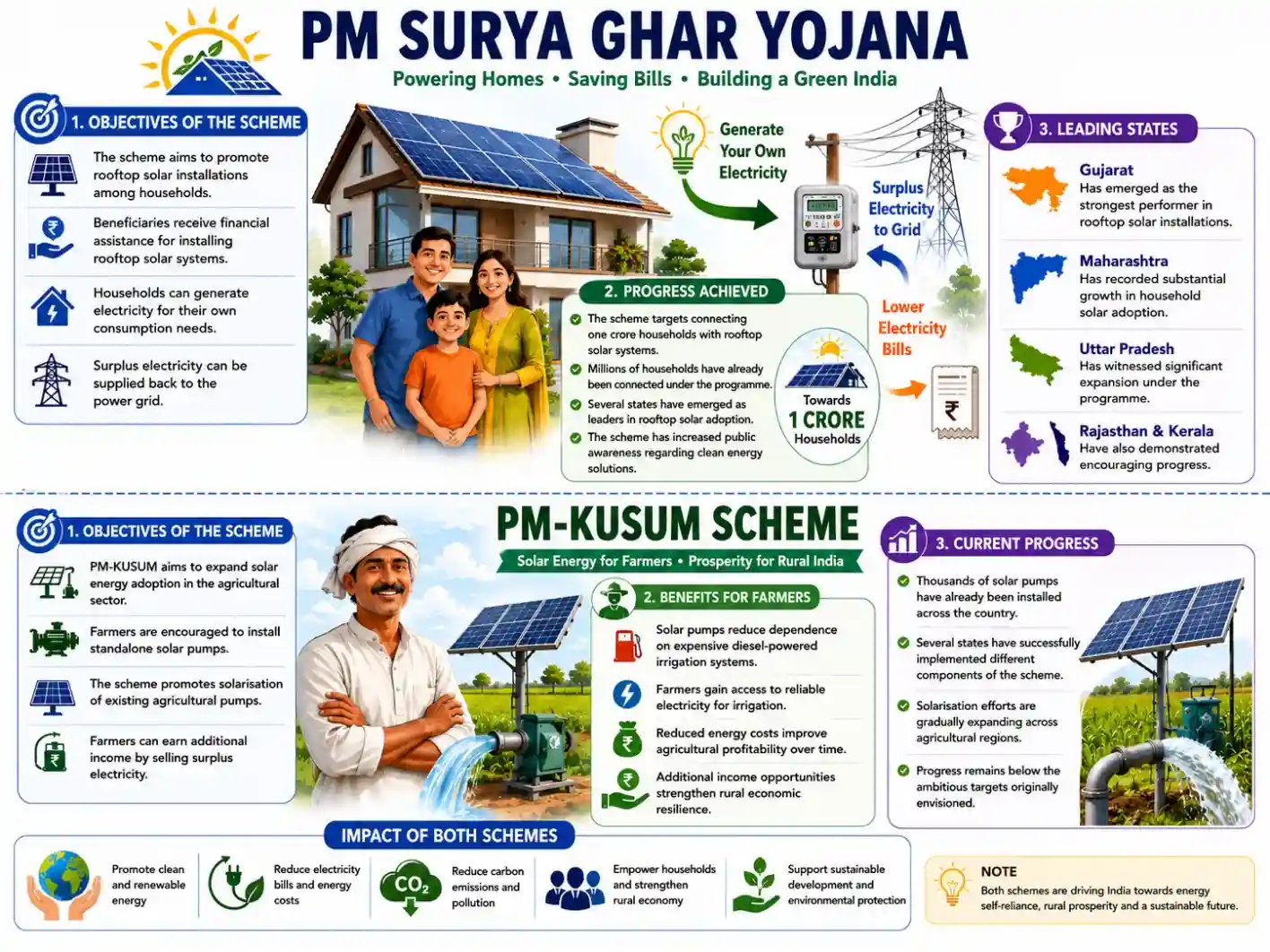
Major Challenges Facing Solar Adoption
High Upfront Installation Costs
Uneven Regional Performance
|
Awareness and Information Gaps
Infrastructure Constraints
|
Demand and Supply Implications
Meeting Rising Electricity Demand
- India’s electricity demand continues to rise due to economic growth.
- Solar power can help meet increasing energy requirements sustainably.
- Peak demand periods increasingly require additional clean energy capacity.
- Renewable energy reduces dependence on conventional power generation.
Supporting Energy Security
- Domestic solar generation reduces vulnerability to global fuel price shocks.
- Solar energy decreases dependence on imported fossil fuels.
- Diversified energy sources strengthen long-term energy security.
- Renewable expansion improves resilience against geopolitical disruptions.
Need for Better Incentive Design
Addressing Financial Barriers
- Innovative financing mechanisms can improve solar affordability.
- Low-interest loans can complement existing subsidy programmes.
- Flexible payment models can encourage wider consumer participation.
- Financial institutions should expand credit access for solar investments.
Improving Consumer Incentives
- Incentives should be designed to maximize long-term adoption rates.
- Timely subsidy disbursement can improve programme effectiveness.
- Simplified procedures can reduce administrative burdens on beneficiaries.
- Consumer confidence increases when benefits are delivered efficiently.
Way Forward
Strengthening Financial Support
- Affordable financing should be made available for households and farmers.
- Credit support mechanisms can accelerate rooftop solar installations.
- Innovative financial products should target smaller consumers.
- Public and private investment must complement government subsidies.
Improving Implementation
- States should streamline approval and installation procedures.
- Greater coordination between agencies can improve project delivery.
- Digital platforms should simplify scheme applications and monitoring.
- Capacity-building initiatives should strengthen local implementation systems.
Expanding Awareness
- Awareness campaigns should educate citizens about solar benefits.
- Local governments should actively promote available schemes.
- Technical support services should assist first-time solar adopters.
- Community participation can improve programme outreach and acceptance.
India’s solar energy transition is critical for achieving energy security, climate commitments, and sustainable economic growth. Schemes such as PM Surya Ghar Yojana and PM-KUSUM have laid a strong foundation for expanding decentralised solar generation across households and farms. However, challenges related to financing, awareness, infrastructure, and implementation continue to constrain progress. Addressing these bottlenecks through targeted reforms and stronger institutional support will be essential for unlocking the full potential of India’s solar revolution.
Prelims Boosters
Barren Island
Context:
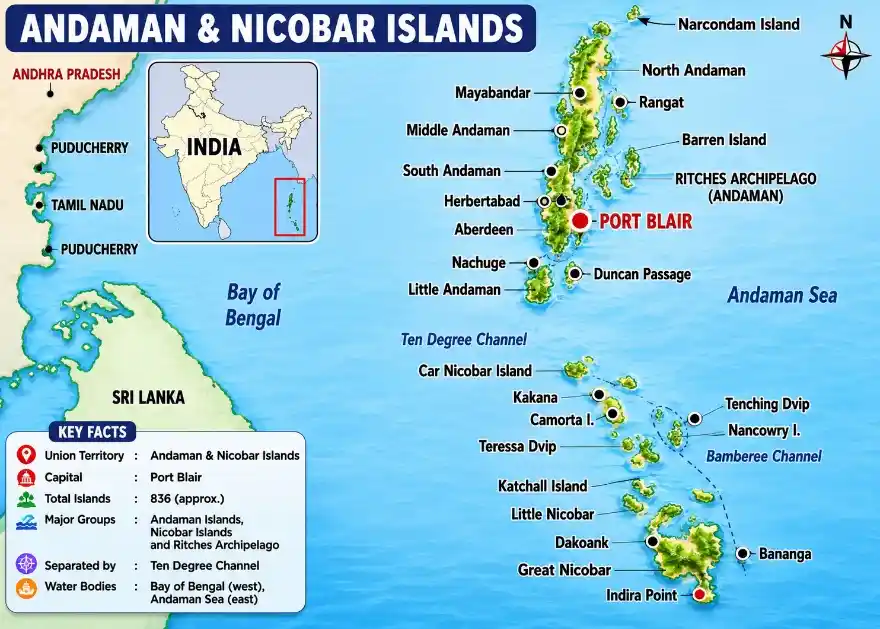
Barren Island, located in the Andaman Sea, remains the only confirmed active volcano in South Asia and the only active volcano in India.About Barren Island
What is it?
- Barren Island is a volcanic island located in the Andaman Sea.
- It is the only active volcano in India.
- It is also the only active volcano in South Asia.
- The island forms part of the Indian Union Territory of the Andaman and Nicobar Islands.
Location
Geographical Position
- Located in the Andaman Sea.
- Lies about 138 km northeast of Port Blair, the capital of the Andaman and Nicobar Islands.
- Situated in the eastern part of the Andaman archipelago.
Tectonic Setting
- Located above the subduction zone between the Indian Plate and the Burmese Plate.
- A subduction zone is an area where one tectonic plate moves beneath another.
- Such zones are commonly associated with earthquakes and volcanic activity.
Geological Features
Volcanic Structure
|
Island Size
|
Stratovolcano
|
Volcanic Activity
Active Volcano
- Barren Island is the only active volcano in the chain of islands extending from Myanmar to Sumatra.
- It has experienced several eruptions in recent history.
Recent Eruptions
- The volcano has erupted multiple times over the years.
- The most recent significant eruptions occurred in 2017.
Physical Environment
Vegetation
- The volcanic zone is largely barren and devoid of vegetation.
- Frequent volcanic activity makes plant growth difficult.
Surface Features
- Large areas are covered with sharp basaltic rocks.
- Basalt is a dark volcanic rock formed from cooled lava.
- These rocks cover nearly half of the island’s surface.
Human Presence
Uninhabited Nature
- The island is extremely remote.
- It is largely uninhabited due to active volcanic conditions.
- Human access is limited because of safety concerns and ecological sensitivity.
Autoimmune Blistering Diseases (AIBDs)
Context:
A joint study by Punjabi University, Patiala, and PGIMER, Chandigarh has developed Artificial Intelligence (AI)-based methods to assist in the diagnosis of Autoimmune Blistering Diseases (AIBDs).About Autoimmune Blistering Diseases (AIBDs)
What are AIBDs?
- Autoimmune Blistering Diseases (AIBDs) are a group of rare skin disorders.
- They are also known as Autoimmune Bullous Disorders.
- They occur when the body’s immune system mistakenly attacks healthy skin and mucous membranes.
- This abnormal immune response leads to the formation of blisters and sores.
Cause
Autoimmune Reaction
- The immune system attacks proteins that help bind skin cells together.
- This weakens the connection between skin layers.
- As a result, fluid-filled blisters develop on the skin or mucous membranes.
Affected Areas
Skin
- Some types of AIBDs mainly affect the skin surface.
- Blisters may appear on different parts of the body.
Mucous Membranes
- Other forms primarily affect mucous membranes (soft inner lining of body passages).
Symptoms
Skin-related Symptoms
|
Mucosal Symptoms
|
Why are AIBDs Serious?
Potential Complications
- Though rare, AIBDs can become severe if left untreated.
Extensive Skin Loss
- Large areas of skin may become damaged.
Secondary Infections
- Open wounds increase the risk of bacterial infections.
Nutritional Deficiencies
- Painful mouth ulcers may reduce food intake.
Eye Damage
- Eye involvement can lead to vision-related complications.
Mucosal Damage
- Long-term injury to mucous membranes may occur.
Life-Threatening Potential
- Severe untreated cases can become life-threatening due to infections and systemic complications.
Treatment
Main Objective
- To suppress the abnormal immune response.
- To prevent the formation of new blisters.
- To promote healing of existing lesions.
Corticosteroids
- Commonly used to reduce inflammation and immune activity.
- Help control blister formation.
Immunosuppressive Drugs
- Reduce excessive immune system activity.
- Used in moderate to severe cases.
Biologic Therapy
- Rituximab is an important biologic medicine used in treatment.
- Targets specific immune cells responsible for the disease.
Supportive Care
Wound Care
- Proper cleaning and dressing of affected areas.
- Promotes healing and prevents complications.
Infection Prevention
- Reduces the risk of secondary infections.
Nutritional Support
- Helps patients maintain adequate nutrition, especially when oral lesions are present.
Pyroprocessing
Context:
Pyroprocessing is being widely used across various industries around the world, including cement manufacturing, metallurgy, and the nuclear sector.About Pyroprocessing
What is it?
- Pyroprocessing is a process that changes the physical or chemical properties of a material using very high temperatures.
- It is a dry processing technique.
- It is highly energy-intensive (requires a large amount of energy).
- It is mainly used in cement production, metal extraction, and nuclear fuel reprocessing.
Key Features
High-Temperature Process
|
Dry Process
|
Energy Intensive
|
Applications of Pyroprocessing
Cement Manufacturing
Process
- Finely ground limestone, clay, and iron ore are fed into a rotary kiln (a large rotating furnace).
- At around 900°C, limestone releases carbon dioxide (CO₂).
- At about 1,450°C, the mixture partially melts.
- This forms marble-sized nodules known as clinker.
- The clinker is then ground into fine powder to produce cement.
Importance
- Forms the core manufacturing process in the cement industry.
- Accounts for the largest use of pyroprocessing globally.
Metallurgy (Metal Extraction)
Roasting
- Sulphide ores are heated in the presence of air.
- This converts sulphide ores into metal oxides.
- Example: Zinc sulphide is converted into zinc oxide.
Smelting
- Ore is melted at high temperatures.
- The desired metal is separated from impurities.
- The waste material removed during the process is called slag.
Importance
- Enables extraction and purification of metals from ores.
- Widely used in iron, copper, zinc, and other metal industries.
Nuclear Industry
Reprocessing of Spent Nuclear Fuel
- Used nuclear fuel is cut into small pieces.
- The pieces are placed in a molten salt bath.
Salt Bath Composition
- Usually contains lithium chloride and potassium chloride.
- Temperature is maintained at 500°C or higher.
Electrochemical Separation
- Electric current is passed through the molten salt.
- Different elements separate according to their electrochemical properties.
- Useful elements are recovered in separate streams.
Importance
- Helps recover valuable materials from spent nuclear fuel.
- Reduces nuclear waste volume.
- Supports efficient utilization of nuclear resources.
Advantages of PyroprocessingIndustrial Efficiency
Resource Recovery
Nuclear Fuel Recycling
|
ChallengesHigh Energy Requirement
Environmental Concerns
High Infrastructure Cost
|
Maulana Barkatullah Bhopali
Context:
- The Executive Council of Barkatullah University, Bhopal, has passed a proposal to rename the institution as Vagdevi Bhojpal University.
About Maulana Barkatullah Bhopali
Who was he?
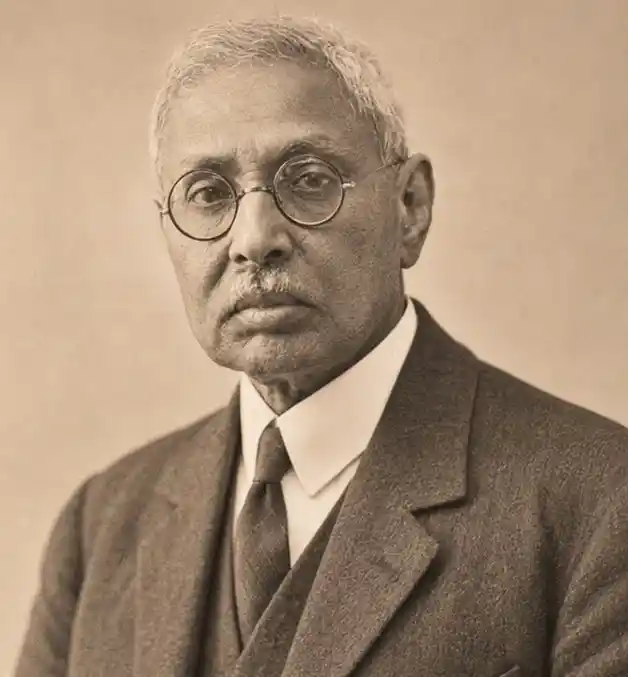
- Maulana Barkatullah Bhopali (1854–1927) was a prominent freedom fighter, revolutionary, scholar, and journalist.
- He dedicated his life to India’s struggle against British colonial rule.
- He served as the Prime Minister of India’s first Provisional Government in Exile established in Kabul in 1915.
- He spent most of his adult life abroad building international support for India’s independence.
Early Life
Birth and Education
- Born on 7 July 1854 in Bhopal, present-day Madhya Pradesh.
- He was a brilliant student with knowledge of multiple languages.
- Pursued higher studies in Bombay and later in London.
Political Awakening
- Worked as a teacher of Arabic and Persian in Liverpool, England.
- Came into contact with Indian revolutionary nationalists.
- Published anti-British articles and delivered speeches against colonial rule.
- Due to increasing British surveillance, he moved to the United States in 1899.
Ideology
Hindu-Muslim Unity
- Strongly believed in Hindu-Muslim unity.
- Opposed the British policy of divide and rule.
- Argued that colonial exploitation affected all Indians regardless of religion.
- Emphasized united action by all communities for achieving independence.
Major Contributions to the Freedom Movement
Provisional Government of India in Kabul (1915)
Key Members
Role in the Ghadar Party
|
Activities During World War I
Meeting with Lenin
Continued Revolutionary Activities
Death
|
Key Achievements
Prime Minister of Government-in-Exile
- Served as Prime Minister of India’s first Provisional Government in Kabul.
- Led diplomatic efforts to gain international recognition for India’s independence.
Internationalization of the Freedom Struggle
- Expanded India’s freedom movement beyond national boundaries.
- Built revolutionary networks across Asia, Europe, and North America.
Inspiration for Future Revolutionaries
- His efforts influenced later revolutionary movements.
- Inspired the activities of Subhas Chandra Bose.
- Contributed indirectly to the development of the Indian National Army.
E85 Fuel
Context:
- Union Minister for Petroleum and Natural Gas launched E85 fuel at a retail outlet in New Delhi.
About E85 Fuel
What is it?
- E85 is a high-ethanol biofuel blend.
- It contains 80%–85% ethanol and 14%–19% petrol.
- It is a high-octane fuel (fuel with better combustion performance).
- It is designed for specially modified internal combustion engines (engines that burn fuel inside the engine).
- It is not meant for ordinary petrol vehicles.
Context and Evolution
Global Experience
- The E85 model draws inspiration from Brazil.
- More than 80% of Brazil’s light vehicles use flexible high-ethanol fuel technology.
- Brazil has successfully used high-blend ethanol fuels for several decades.
India’s Ethanol Journey
- India’s ethanol blending level was 1.53% in 2014.
- India achieved the E20 standard (20% ethanol and 80% petrol) nationwide in 2026.
- The target was achieved five years ahead of the original schedule.
Objectives
Reducing Fuel Costs
- To pass the economic benefits of domestically produced ethanol to consumers.
- To provide a cheaper alternative to conventional petrol.
Energy Security
- To reduce India’s dependence on imported crude oil.
- To lower the country’s oil import bill.
Environmental Benefits
- To promote cleaner and renewable fuel usage.
- To support urban decarbonization (reduction of carbon emissions in cities).
Key Features of the E85 Ecosystem
Flex-Fuel Vehicle (FFV) Exclusivity
Competitive Pricing
|
Phased Rollout Plan
Retail Safety Measures
|
Future Target
Ethanol Blending Goal 2030–31
- E85 rollout is part of India’s long-term biofuel strategy.
- India aims to increase overall ethanol blending to nearly 26% by 2030–31.
- The initiative supports cleaner energy transition and reduced fossil fuel dependence.
Related Terms
Ethanol
- Ethanol is an alcohol-based renewable fuel.
- It is mainly produced from sugarcane, maize, and other agricultural feedstocks.
Flex-Fuel Vehicle (FFV)
- A vehicle capable of running on different combinations of petrol and ethanol.
- It automatically adjusts engine settings according to the fuel blend used.
E20 Fuel
- Fuel blend containing 20% ethanol and 80% petrol.
- It is currently India’s nationwide ethanol blending standard.