
IRS Customs and Indirect Taxes (C&IT): Eligibility, Roles, Salary, Training & Career

The Indian Revenue Service (Customs & Indirect Taxes), commonly known as IRS (C&IT), is a Group A Central Civil Service recruited through the UPSC Civil Services Examination. The Indian Revenue Service (Customs and Indirect Taxes) is a part of central civil service of the government of India. It is a part of the Indian Revenue Service and functions under the Central Board of Indirect Taxes and CustomsDepartment of Revenue of the Ministry of Finance. It is under the administrative direction of the Revenue Secretary and the ministerial command of the Minister of Finance. The IRS (C&IT) is primarily responsible for collecting and administering indirect taxes accruing to the government of India. IRS C&IT officers are primarily responsible for the administration and enforcement of customs and indirect-tax laws, along with revenue collection, investigation and trade facilitation.

The duties of the IRS (C&IT) include formulation and enforcement of policy concerning the Goods and Services Tax, prevention of smuggling and administration of matters related to customs and narcotics. After clearing the UPSC CSE examination, the Toppers selected for the IRS(C&IT) service first head to LBSNAA for Foundation Course and then to NACIN for specialised professional training.

IRS C&IT Eligibility: How to Become an IRS C&IT Officer Through UPSC

Candidates do not apply for IRS C&IT through a separate examination. The service is allocated through the UPSC Civil Services Examination based on the applicable service-allocation process.

The key eligibility requirements include:

Eligibility Requirement
Educational Qualification Bachelor’s degree from a recognised university or equivalent.
Age Limit As prescribed in the relevant UPSC CSE notification.
Attempts Category-wise limits as prescribed by UPSC.
Nationality As specified in the UPSC CSE notification.
Examination UPSC Civil Services Examination.

Candidates from any recognised academic stream can appear for the UPSC Civil Services Examination, provided they satisfy the prescribed eligibility conditions. UPSC’s examination notification specifies the qualifying-degree requirements.

The selection process broadly consists of Preliminary Examination, Main Examination and Personality Test, followed by service allocation.

IRS C&IT Roles and Responsibilities

The IRS C&IT job profile covers taxation, customs, investigation and enforcement. Major responsibilities include:
IRS C&IT officers may work at airports, seaports, customs formations, GST commissionerates, investigation units, headquarters and specialised directorates, depending on their posting.

IRS C&IT Grades and Pay Scale

IRS C&IT officers progress through different levels of responsibility during their career. The current Central Government pay structure is based on the applicable 7th Central Pay Commission pay matrix.
Career LevelTypical DesignationPay Level
Entry LevelAssistant CommissionerLevel 10
Senior LevelDeputy CommissionerLevel 11
Higher LevelJoint CommissionerLevel 12
Senior GradeAdditional CommissionerLevel 13
Higher Administrative LevelCommissionerLevel 14
Senior Administrative LevelPrincipal CommissionerLevel 15
The actual salary received by an IRS C&IT officer includes applicable allowances and deductions. Therefore, in-hand salary varies according to posting, allowances and other service conditions.

IRS Customs and Indirect Taxes (C&IT) Training

IRS C&IT officers undergo specialised professional training to prepare them for responsibilities related to customs, taxation, investigation and enforcement.

After selection, successful candidates undergo a 3-month Foundation Course at the Lal Bahadur Shastri National Academy of Administration (LBSNAA) in MussoorieUttarakhand.

Thereafter, IRS (C&IT) Officer Trainees (OTs) undergo specialised training at National Academy of Customs Indirect Taxes and Narcotics (NACIN), in Palasamudram located in Sri Sathya Sai districtAndhra Pradesh.

This is apex institution of government of India for capacity building in the field of customs, indirect taxes, and narcotics under the administrative control of Central Board of Indirect Taxes and Customs (CBIC). NACIN undertakes the training and other capacity training activities in the field of customs, indirect taxes, and narcotics including:

Any other capacity building activity as may be assigned by CBIC from time to time, besides carrying out normal administrative and establishment functions. NACIN has signed a memorandum of understanding with the National Law School of India University in Bengaluru to award postgraduate diplomas in business laws to the officer trainees. The finance ministry has approved exchange of officer trainees to various countries across the world such as Netherlands, Belgium, Switzerland, France, Australia, Malaysia, United States of America, Brazil, South Africa and OECD Nations for increasing exposure to the future administrators.

Professional training associated with the National Academy of Customs, Indirect Taxes and Narcotics (NACIN), provides exposure to areas such as:

Training combines classroom learning with practical exposure so that officer trainees can understand the functioning of customs and indirect-tax administration.

Responsibilities of the Indian Revenue Service (Customs & Indirect Taxes)

IRS (Customs & Indirect Taxes) officers perform a wide range of responsibilities related to tax administration, customs enforcement, GST, revenue intelligence, anti-smuggling operations, tax policy, international taxation and fiscal governance. Their major roles include:

IRS (C&IT) Career Prospects & Progression

The Indian Revenue Service (Customs and Indirect Taxes)IRS (C&IT)—is a premier Group ‘A’ Central Civil Service under the Central Board of Indirect Taxes and Customs (CBIC), Department of Revenue, Ministry of Finance. It offers a distinguished career trajectory spanning fiscal policy, enforcement, trade facilitation, and public administration.

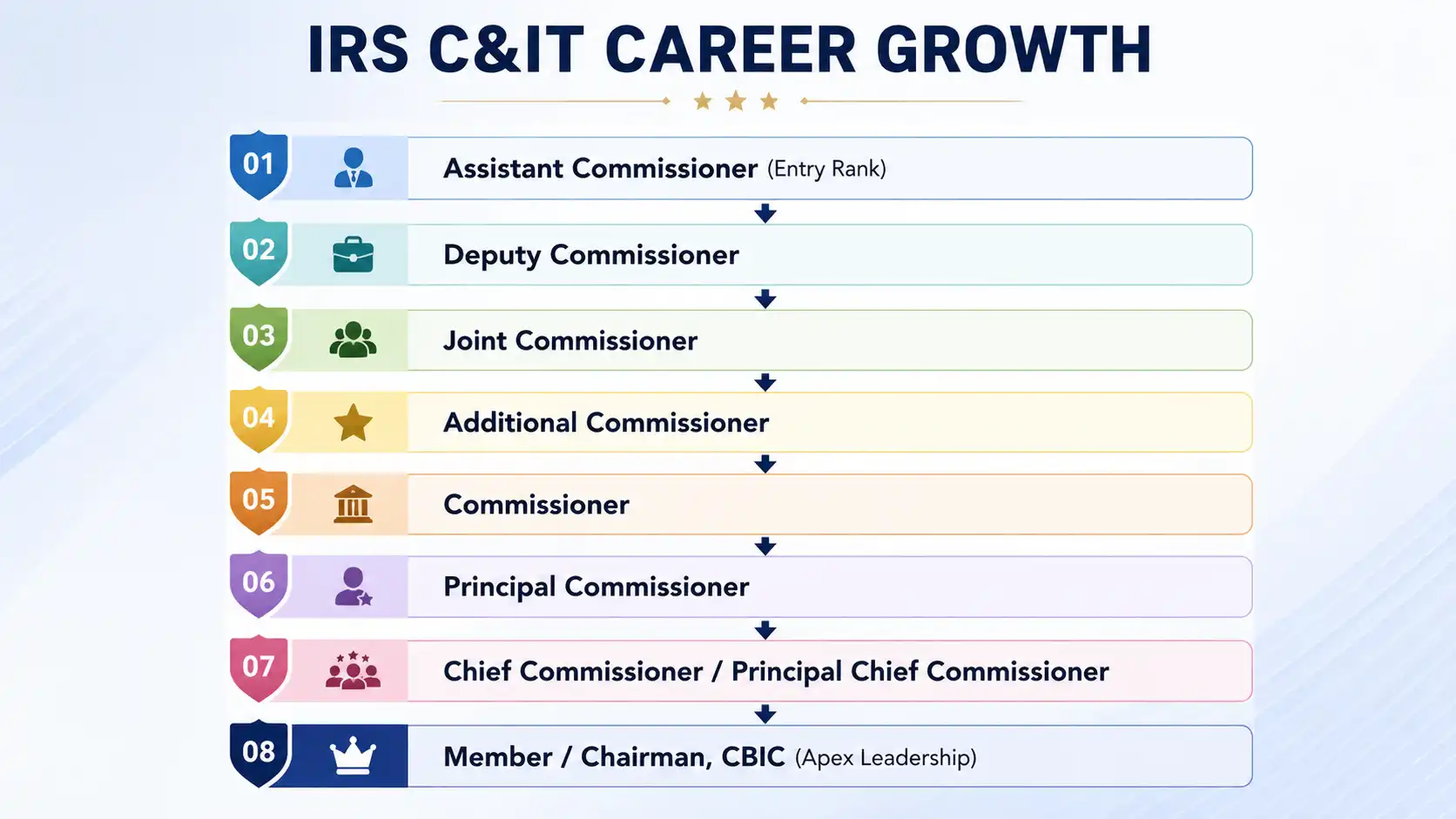
Hierarchy & Promotion Pathway

IRS C & IT Career Growth

Career Opportunities & Avenues

Governance of Progression

Cadre advancement is subject to statutory Recruitment Rules (RRs), vacancy availability, minimum residency requirements, Annual Performance Appraisal Reports (APARs), and clearance by the Departmental Promotion Committee (DPC).

Why Choose IRS C&IT?

IRS C&IT can be an attractive career option for UPSC aspirants interested in taxation, customs, economics, law, investigation and international trade.

Some of the key features of the service are:

Conclusion

The Indian Revenue Service (Customs & Indirect Taxes) is an important Central Civil Service responsible for customs and indirect-tax administration in India. IRS C&IT officers contribute to revenue collection, tax compliance, customs enforcement, anti-smuggling operations and trade facilitation.

For UPSC aspirants who are interested in taxation, law, investigation and economic administration, IRS C&IT offers a diverse and professionally rewarding career. Candidates aspiring to join the service must first qualify for the UPSC Civil Services Examination and receive the service through the applicable allocation process.

FAQ's

Frequently Asked Questions

The Indian Revenue Service (IRS) comprises two Group A Central Civil Services: IRS (Income Tax) and IRS (Customs & Indirect Taxes). Both are recruited through the UPSC Civil Services Examination but serve different departments under the Ministry of Finance.
Yes, both IRS (Income Tax) and IRS (Customs & Indirect Taxes) are Group A Central Civil Services under the Government of India.
Both IRS (Income Tax) and IRS (Customs & Indirect Taxes) officers start at Pay Level 10 with a basic pay of ₹56,100 per month, along with applicable allowances.
The Union Public Service Commission (UPSC) recruits officers for both IRS (Income Tax) and IRS (Customs & Indirect Taxes) through the Civil Services Examination.
Yes, officers of both IRS services may be authorised to carry firearms during investigation or enforcement operations, depending on their role and departmental rules.
Both IRS services offer prestigious careers in taxation and revenue administration, while IAS focuses on governance and administration. The better choice depends on your career interests.
Yes, IRS (Income Tax) and IRS (Customs & Indirect Taxes) are both Central Civil Services under the Ministry of Finance.
The training duration differs between IRS (Income Tax) and IRS (Customs & Indirect Taxes), but it generally lasts 15–18 months, including foundation, academic, and field training.
IRS (Income Tax) officers are posted in the Income Tax Department, while IRS (Customs & Indirect Taxes) officers serve in Customs, GST, and CBIC formations across India.
The Indian Revenue Service consists of IRS (Income Tax), which administers direct taxes under CBDT, and IRS (Customs & Indirect Taxes), which administers customs, GST, and indirect taxes under CBIC.