Transgender Rights Amendment: Concerns for Dignity and Mental Health
The recent amendment to the Transgender Persons law has raised concerns about rights and dignity. It has created confusion, fear, and uncertainty among transgender individuals across the country. The core issue revolves around the question of who determines a person’s gender identity. The amendment is seen as a shift away from earlier progressive legal and constitutional principles.
Background: Legal Progress on Transgender Rights
- In 2014, the Supreme Court of India delivered the landmark NALSA judgment.
- The judgment recognised gender identity as a matter of self-identification and personal autonomy.
- It was based on constitutional rights under Articles 14, 15, 19, and 21.
- The 2019 Transgender Persons Act broadly followed this principle and aimed at welfare measures.
Shift Introduced by the Amendment
- The amendment replaces self-identification with a process of medical and bureaucratic verification.
- Individuals may need to appear before a medical board to “prove” their gender identity.
- Final certification is issued by district authorities based on such verification processes.
- This represents a shift from individual autonomy to institutional control over identity.
Concerns Regarding Dignity and Rights
- Gender identity becomes subject to external validation rather than personal declaration.
- This may violate principles of dignity, privacy, and bodily autonomy.
- The process can be intrusive, arbitrary, and potentially humiliating for individuals.
- It risks reversing the progressive gains achieved through earlier judicial and legislative efforts.
Mental Health Implications
- Transgender individuals already face high levels of discrimination and social exclusion.
- Additional verification procedures may increase stress, anxiety, and mental health challenges.
- Fear of scrutiny and rejection may discourage individuals from accessing essential services.
- This could lead to a broader public mental health concern within the community.
Impact on Access to Welfare and Services
- The amendment may create barriers in accessing healthcare, education, and welfare schemes.
- Individuals may hesitate to approach institutions due to fear of verification and stigma.
- Community-based support systems and professionals may also face legal uncertainties.
- This could weaken existing support structures and reduce inclusivity.
Criminalisation Concerns
- Certain provisions may criminalise support provided to transgender individuals in some situations.
- Professionals such as doctors, educators, and counsellors may face ethical and legal dilemmas.
- This may discourage assistance and create a gap in support services for vulnerable individuals.
- It could also lead to further marginalisation of the transgender community.
Key Challenges
- Balancing administrative verification with individual rights and dignity remains a major challenge.
- Ensuring clarity and consistency in implementation across regions is difficult.
- Addressing stigma and discrimination continues to be a long-term social challenge.
- Preventing misuse of law while protecting genuine rights is essential.
Way Forward
- Reinforce the principle of self-identification as recognised in the NALSA judgment.
- Ensure that policies align with constitutional values of equality, dignity, and liberty.
- Strengthen awareness and sensitisation programmes across institutions and society.
- Focus on expanding welfare access without creating procedural barriers.
The amendment raises serious concerns about rights, dignity, and mental health of transgender persons. Any legal framework must prioritise inclusion, autonomy, and constitutional protections. Safeguarding dignity and ensuring access to services is essential for an equitable society. A balanced and rights-based approach is necessary to protect vulnerable communities effectively.
Finance Commission: Strengthening Local Bodies but Weakening States?
The Sixteenth Finance Commission recommendations have raised concerns regarding India’s fiscal federal structure. While local bodies are being strengthened, States appear to be losing fiscal autonomy and flexibility. The shift reflects increasing centralisation through discretionary transfers rather than statutory allocations. This creates a debate on balancing decentralisation with the constitutional role of States in governance.
Constitutional Framework of Fiscal Federalism
- The Constitution of India provides a structured system for financial devolution.
- Article 280 mandates the Finance Commission to recommend distribution of financial resources.
- Article 275 provides statutory grants to States based on need and equity considerations.
- Article 282 allows discretionary grants by the Union for public purposes.
The balance between Articles 275 and 282 is crucial for maintaining fiscal federalism.
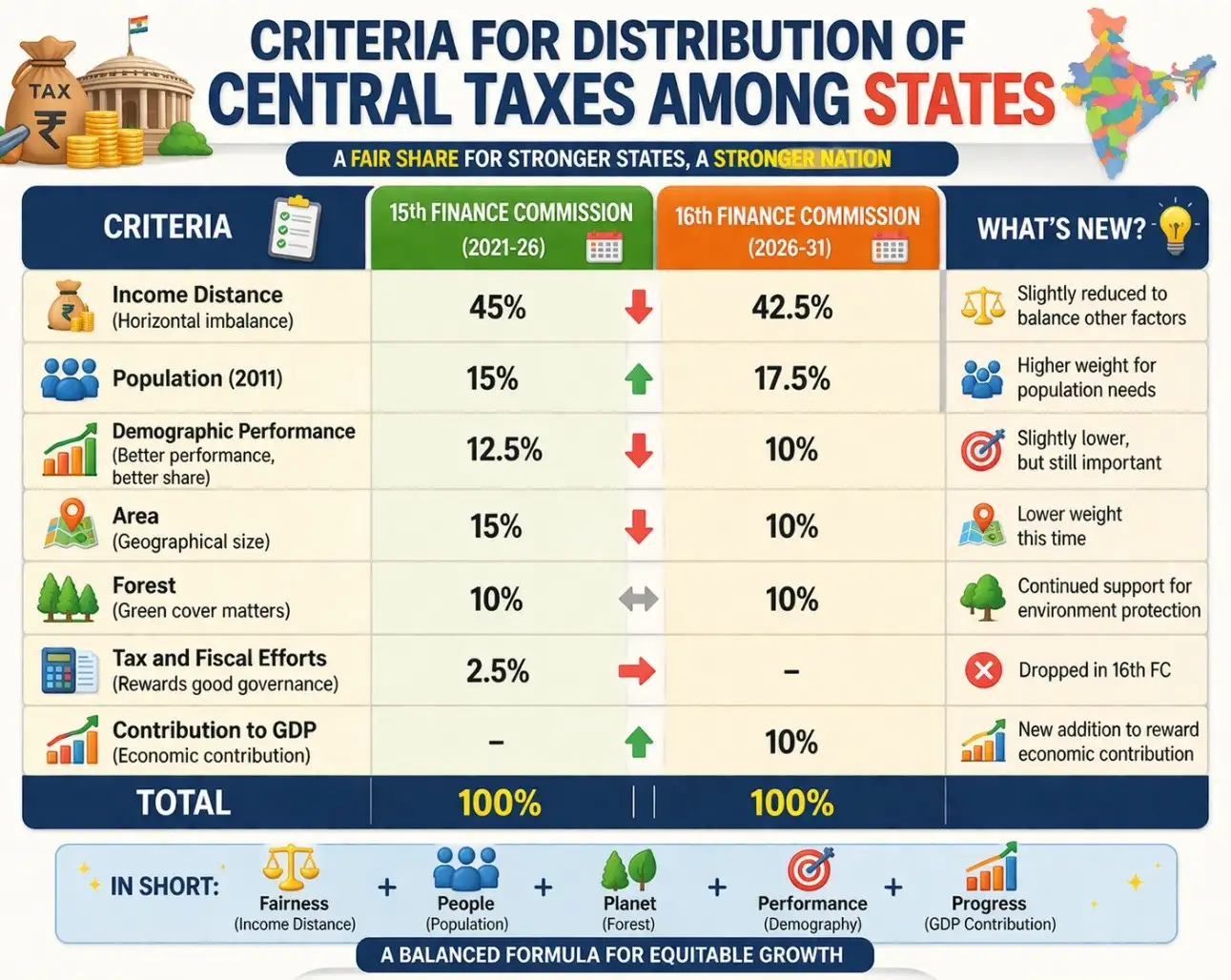
Key Changes in 16th Finance Commission Approach
- The Commission retained States’ share at 41 percent but reduced the effective divisible pool.
- Increasing use of cesses and surcharges has limited funds available for distribution to States.
- Discontinuation of revenue deficit grants has affected fiscally weaker States significantly.
- Greater reliance on discretionary transfers has increased central leverage over States.
Shift Towards Centralisation
- Movement from statutory, formula-based transfers to discretionary, condition-based allocations is evident.
- This shift reduces predictability and transparency in fiscal transfers to States.
- It also increases the Centre’s control over allocation and utilisation of funds.
- Such trends weaken the principles of cooperative federalism in practice.
Impact on States
- Several States, especially smaller and less developed ones, may face reduced financial resources.
- Loss of revenue deficit grants affects States with structural fiscal imbalances.
- Reduced share in divisible pool limits States’ capacity for welfare and development spending.
- It may also widen regional inequalities across the country.
Strengthening of Local Bodies
- The Commission has increased grants to Panchayats and Urban Local Bodies significantly.
- Funds are tied to performance and service delivery outcomes at the local level.
- This supports decentralisation and grassroots governance improvements.
- However, it may bypass States, altering the federal balance envisaged in the Constitution.
Concerns Regarding Article 275 vs Article 282
- Article 275 grants are statutory, need-based, and ensure fiscal support with accountability.
- Article 282 grants are discretionary and lack clear criteria or transparency mechanisms.
- Increasing reliance on Article 282 weakens institutional safeguards of fiscal transfers.
- It shifts power from rule-based distribution to executive discretion.
Key Challenges
- Maintaining balance between strengthening local governance and preserving State autonomy.
- Ensuring transparency and predictability in fiscal transfers across different levels of government.
- Addressing regional disparities without over-centralising financial powers.
- Aligning fiscal policy with constitutional principles of federalism and decentralisation.
Way Forward
- Restore emphasis on statutory, formula-based transfers under Article 275 for greater fairness.
- Limit excessive use of cesses and surcharges to protect the divisible pool for States.
- Strengthen cooperative federalism through consultation with States in fiscal decision-making.
- Ensure that decentralisation to local bodies complements, rather than bypasses, State governments.
The Finance Commission plays a vital role in maintaining India’s fiscal balance and federal structure. While empowering local bodies is important, it should not come at the cost of weakening States. A balanced approach is necessary to ensure both decentralisation and strong federal governance. Upholding constitutional principles is essential for sustaining cooperative federalism in India.
Prelims Boosters
NATO (North Atlantic Treaty Organization)
Context:
- NATO is in news due to remarks on its relevance and U.S. membership
About
- NATO (North Atlantic Treaty Organization) is a military alliance of 32 countries
- It is based on the principle of collective defence. This means an attack on one member is treated as an attack on all
- Headquarters: Brussels, Belgium. Established on 4 April 1949
Background
- Formed after World War II to counter the Soviet Union’s influence
- Initially included USA, Canada, and Western European countries
- After the collapse of USSR, NATO expanded to include Eastern European countries
Objective
- Ensure collective security among member states (Article 5)
- Promote cooperation in defence and security matters
- Act as a deterrent against potential threats
Members
- Total 32 member countries
- Founding members include USA, UK, France, Canada, Italy
- Recent members: Finland (2023) & Sweden (2024)
Key Features
- Does not have its own army; relies on member contributions
- Operates through a unified command system (SHAPE)
- Conducts joint military operations
- Provides nuclear deterrence through the United States
- Members commit to defence spending targets
Stagflation
Context:
- Ongoing geopolitical tensions have raised fears of 1970s-style stagflation
What is Stagflation?
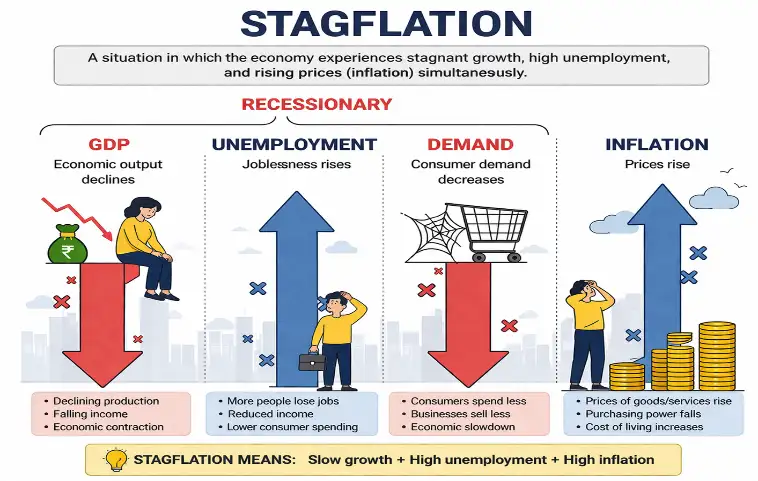
- Stagflation is an economic condition where: Economic growth is slow or negative, Unemployment is high, Inflation is high at the same time.
- The term was coined by Iain Macleod
How it Occurs
- Usually caused by a negative supply shock (sudden disruption in production)
- Examples: War or geopolitical conflict, Pandemic, Energy crisis
- Leads to: Higher prices (inflation) due to shortage and Lower output and growth
Major Causes
|
Control Measures
|
Key Features
- Low or negative GDP growth
- High inflation (often double-digit)
- High unemployment
- Policy dilemma: controlling inflation may worsen growth, and vice versa
Mudumalai Tiger Reserve
Context:
- Administrative inspection conducted in a village located inside the core area of the reserve
About
- Mudumalai Tiger Reserve is located in the Nilgiris district of Tamil Nadu
- It lies at the tri-junction of Tamil Nadu, Karnataka, and Kerala
- It forms part of the Nilgiris Biosphere Reserve, the first biosphere reserve in India
Location and Connectivity
- Shares boundaries with:
- Wayanad Wildlife Sanctuary (Kerala) in the west
- Bandipur Tiger Reserve (Karnataka) in the north
Terrain and River
- Terrain is undulating, with elevation ranging from 960 m to 1266 m
- The Moyar River flows through the reserve
Vegetation
- Includes diverse forest types such as:
- Tropical evergreen forests
- Moist and dry deciduous forests
- Teak forests
- Grasslands and swamps
Flora
|
Fauna
|
Measles
Context:
- Bangladesh has launched an emergency vaccination drive due to a measles outbreak
About
- Measles is a highly contagious viral disease that spreads through the air
- It is caused by a virus belonging to the paramyxovirus family
Transmission
- Spreads through coughing and sneezing of an infected person
- Infection occurs by inhaling contaminated air or contact with secretions
- The virus can remain active in air or on surfaces for up to two hours
- It first infects the respiratory system, then spreads throughout the body
Symptoms
- High fever appearing about 10 to 14 days after infection
- Runny nose, cough, red and watery eyes in early stage
- White spots inside the mouth (Koplik spots)
- Followed by a skin rash, starting from face and spreading downward
Risk Groups
- Unvaccinated individuals
- Young children
- Pregnant women
- These groups are more prone to severe complications
Treatment and Prevention
- No specific antiviral treatment available
- Managed through supportive care
- Prevented by Measles-Rubella (MR) vaccine, which provides long-term immunity
Afghanistan
Context:
- India has sent humanitarian assistance to Afghanistan following floods and earthquakes
About
- Afghanistan is a landlocked and mountainous country located in Southern Asia
- It lies at the crossroads of Central and South Asia, giving it strategic importance
- Capital: Kabul
Location and Boundaries
- Bordered by:
- India (northeast, as per traditional claim)
- Pakistan to the east and south
- Iran to the west
- Turkmenistan, Uzbekistan, Tajikistan to the north
- China to the northeast
Geographical Features
- Climate:
- Characterised by hot summers and very cold winters (semi-arid climate)
- Mountain Ranges: Hindu Kush (major range), Pamir Mountains (northeast), Safed Koh (south)
- Rivers: Amu Darya, Helmand River, Kabul River
- Highest Peak:
- Mount Nowshak (7,485 m)
Natural Resources
- Rich in minerals such as: Coal, Copper, Natural gas and petroleum, Gold, Lithium and rare earth elements
Significance
- Important for regional connectivity and geopolitics
- Rich mineral resources make it economically significant
- Strategic location between Central Asia, South Asia, and West Asia