India’s Updated Climate Pledges: Balancing Development and Sustainability
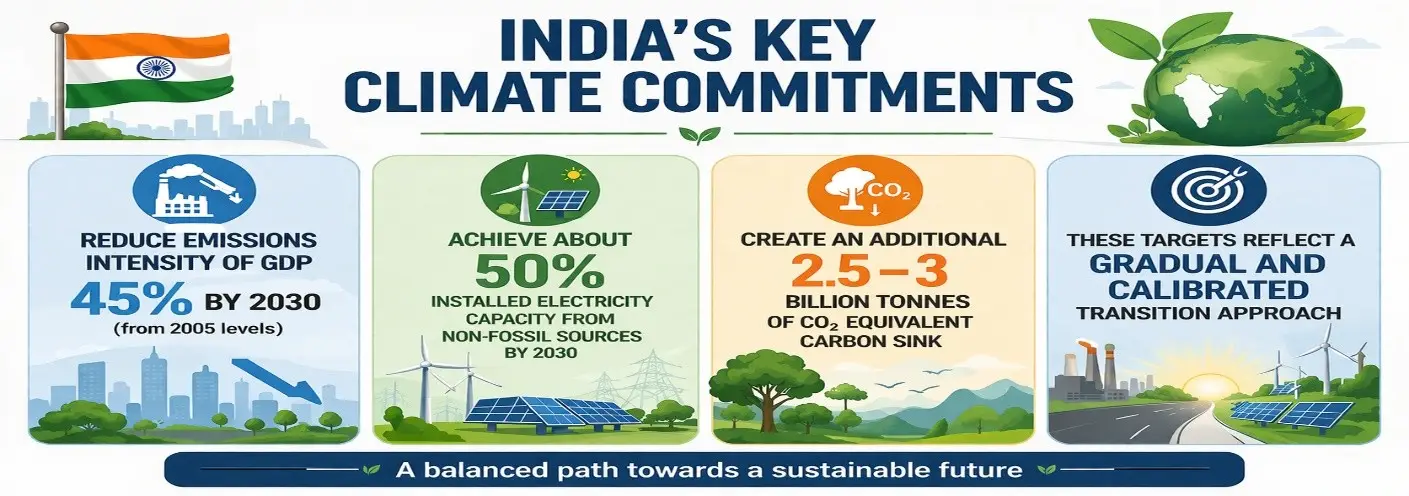
India’s updated Nationally Determined Contributions under the Paris Agreement reflect its evolving climate strategy. The approach balances climate action with developmental needs of a growing economy. Climate commitments are aligned with poverty reduction, industrialisation, and energy security goals. India continues to emphasise equity and fairness in global climate governance frameworks.
Developmental Context of India
- India’s per capita electricity generation is about 1,418 kWh, indicating lower consumption levels.
- China produces about 7,000+ kWh and the United States about 12,000+ kWh per capita.
- OECD average electricity consumption is nearly 8,000 kWh, far above India’s level.
- This shows India still requires massive energy expansion for growth and development.
Energy Mix and Ground Reality
- India generated about 1,824 TWh of electricity in 2024–25.
- Renewable sources contributed around 403 TWh, while coal remains dominant in the energy mix.
- Thermal power accounts for nearly 75 percent of electricity generation.
- Non-fossil capacity is increasing, but actual generation still depends heavily on fossil fuels.
Progress Achieved
- India has significantly expanded solar and wind energy capacity in recent years.
- Non-fossil installed capacity has reached nearly 50 percent of total capacity.
- India is among the fastest-growing renewable energy markets globally.
- Policy initiatives such as green hydrogen are supporting long-term energy transition goals.
Key Challenges
- Coal remains essential for ensuring baseload power and energy security in India.
- Renewable energy faces intermittency and requires large investments in storage systems.
- Climate finance remains inadequate for developing countries including India.
- Rising energy demand due to growth and urbanisation complicates the transition process.
Climate Justice and Global Responsibility
- India supports the principle of common but differentiated responsibilities (CBDR).
- Developed countries have contributed more historically to global emissions and climate change.
- Developing countries require financial and technological support for transition.
- Equity remains central to India’s stance in global climate negotiations.
Cost of Climate Transition
- Clean energy transition requires large investments in infrastructure, storage, and technology.
- Renewable energy expansion involves costs beyond simple capacity installation.
- Developing countries face greater financial burden compared to developed nations.
- Lack of climate finance slows down progress towards climate commitments.
Way Forward
- India should continue expanding renewable energy while ensuring energy security through diversified sources.
- Investment in energy storage, green hydrogen, and grid modernisation must be accelerated.
- Developed countries must provide adequate climate finance and technology transfer to developing nations.
- Policies should ensure a just transition, protecting vulnerable communities and employment.
- India should integrate climate action with long-term economic growth and development planning.
India’s climate pledges reflect a balance between sustainability and developmental priorities. Data shows India still has low per capita energy use and high growth requirements. Transition must be gradual, inclusive, and supported by global cooperation and finance. A practical and equitable approach is essential for achieving long-term climate and development goals.
Phule’s Life and Thought: A Constitutional Vision of Equality
Jyotirao Phule (born 11 April 1827) was a pioneering social reformer and educator. He is widely known for his work on caste equality and promotion of women’s education. His ideas can be understood as a constitutional vision, even before India adopted a Constitution. He emphasised equality, dignity, and redistribution of power in society.
Phule as a Constitutional Thinker
- Phule’s thought went beyond social reform and imagined a just social order based on rights.
- Influenced by Thomas Paine’s Rights of Man (1791), he adopted ideas of natural rights.
- He believed every individual has inherent rights by virtue of existence and social membership.
- His work reflected principles later seen in the Constitution of India such as equality and justice.
Critique of Caste and Social Hierarchy
- Born in a Shudra community, Phule experienced caste-based discrimination firsthand.
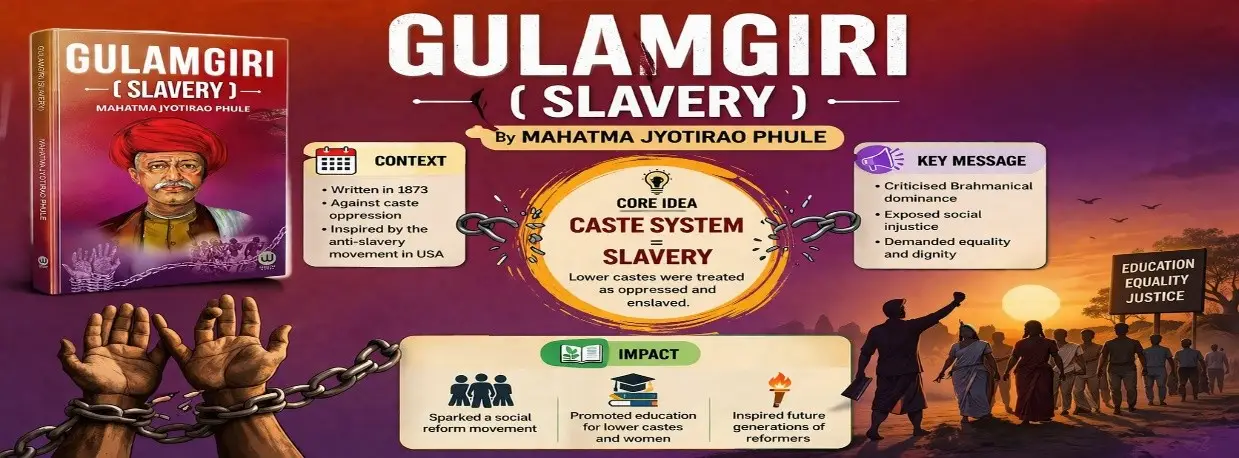
- He strongly criticised the Brahmanical social order and caste hierarchy.
- He argued that caste oppression is linked with economic exploitation and social exclusion.
- His work highlighted how inequality is deeply embedded in social structures.
Role in Education and Social Reform
- Phule established schools for women and oppressed castes in the mid-nineteenth century.
- Along with Savitribai Phule, he promoted women’s education as a tool of empowerment.
- He advocated widow remarriage and opposed child marriage practices.
- He opened public resources such as water wells to those considered “untouchable”.
Institutional Efforts: Satyashodhak Samaj
- Phule founded the Satyashodhak Samaj in 1873 to promote social equality and justice.
- The organisation challenged caste dominance and priestly authority in society.
- It worked towards creating awareness among oppressed communities about their rights.
- It aimed to build a society based on rationality, equality, and social justice.
Economic Critique and Agrarian Issues
- In Gulamgiri (1873), Phule connected caste oppression with global systems like slavery.
- In Shetkaryacha Asud (1883), he analysed the condition of farmers under exploitation.
- He showed how peasants were burdened by debt, poverty, and lack of state support.
- He criticised colonial administration for ignoring the suffering of cultivators.
Vision of Equality and State Responsibility
- Phule argued for universal primary education up to age 12 for all sections of society.
- He supported targeted scholarships for marginalised communities lacking access to education.
- He emphasised that the State must actively ensure social and economic justice.
- He linked governance with the responsibility to improve conditions of the most vulnerable.
Core Insight
- Phule’s writings highlight that social hierarchy, economic exploitation, and state indifference are interconnected.
- He believed that inequality cannot be addressed without tackling all these factors together.
- His ideas call for restructuring society to ensure fairness and justice for all.
- This reflects a deeply constitutional approach to social transformation.
Legacy and Relevance
- Phule passed away in 1890, but his ideas continue to shape modern India’s social thought.
- R. Ambedkar drew inspiration from Phule’s vision of equality and justice.
- His ideas influenced constitutional values like equality, liberty, and social justice.
- His work remains relevant in addressing contemporary issues of inequality and exclusion.
Way Forward
- Strengthen access to inclusive and equitable education for marginalised communities.
- Promote social awareness to eliminate caste-based discrimination and social exclusion.
- Ensure effective implementation of constitutional provisions related to equality and justice.
- Focus governance on improving the conditions of vulnerable and disadvantaged groups.
Phule’s life and thought represent a vision of social justice rooted in equality and dignity. His ideas anticipated key principles later embedded in India’s constitutional framework. He emphasised structural reform to address inequality in society. His legacy continues to guide India’s pursuit of an inclusive and just social order.
PRELIMS BOOSTERS
India’s First Fast Breeder Reactor (PFBR) – Criticality Achieved
Context:
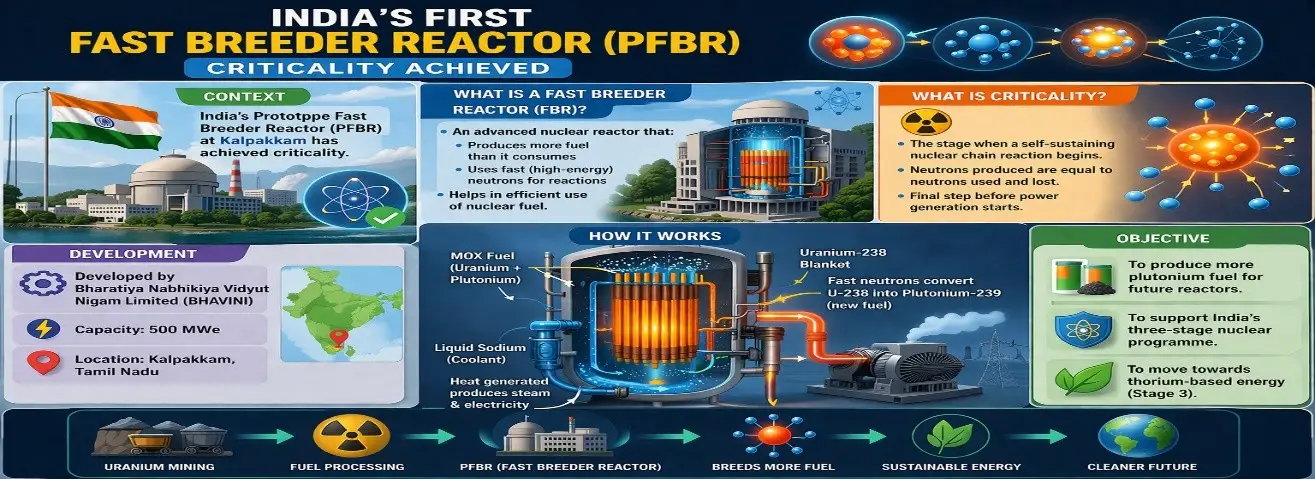
- India’s Prototype Fast Breeder Reactor (PFBR) at Kalpakkam has achieved criticality
What is a Fast Breeder Reactor (FBR)?
- A Fast Breeder Reactor is an advanced nuclear reactor that:
- Produces more fuel than it consumes
- Uses fast (high-energy) neutrons for nuclear reactions
- It helps in efficient use of nuclear fuel
What is Criticality?
- Criticality is the stage when a self-sustaining nuclear chain reaction begins
- Neutrons produced are equal to neutrons used and lost
- It is the final step before power generation starts
Development
- Developed by Bharatiya Nabhikiya Vidyut Nigam Limited
- Capacity: 500 MWe
- Location: Kalpakkam, Tamil Nadu
How it Works
- Uses MOX fuel (mixture of Uranium and Plutonium)
- Surrounded by Uranium-238 blanket
- Fast neutrons convert U-238 into Plutonium-239 (new fuel)
- Uses liquid sodium as coolant
- Heat generated is used to produce steam and electricity
Objective
- To produce more plutonium fuel for future reactors
- To support India’s three-stage nuclear programme
- To move towards thorium-based energy (Stage 3)
Key Features
|
Significance
|
Per- and Polyfluoroalkyl Substances (PFAS)
Context:
- The European Union has included PFAS in its water pollution monitoring standards
About
- Per- and Polyfluoroalkyl Substances (PFAS) are toxic, man-made chemicals
- Known as “forever chemicals” because they do not break down easily in the environment
- Consist of a large group of more than 4,700 chemicals
- They contain strong carbon–fluorine bonds, making them highly persistent
Key Features
- Extremely resistant to heat, water, and oil
- Persist in soil, water, and living organisms for long periods
- Accumulate over time, leading to bioaccumulation
- Important subgroups include: PFOS (Perfluorooctane sulfonic acid) and PFOA (Perfluorooctanoic acid)
Uses
- Used in non-stick cookware and food packaging materials
- Applied in stain-resistant fabrics, carpets, and waterproof clothing
- Used in industries such as aerospace, electronics, and construction
Exposure Pathways
- Through contaminated water and food
- By using products containing PFAS
- Through air exposure in polluted environments
Health Impacts
|
Regulation
|
Mission MITRA
Context:
- ISRO has launched Mission MITRA in Ladakh to study astronaut performance
About
- Mission MITRA (Mapping of Interoperable Traits and Response Assessment) is a team behaviour study
- Conducted by Indian Space Research Organisation and IAF–Institute of Aerospace Medicine
- It focuses on human performance in extreme environments
Objective
- To study physical, psychological, and operational behaviour of astronauts and teams
- To understand decision-making under stress conditions
- To improve team coordination between astronauts and ground control
Location and Setup
- Conducted in Leh, Ladakh, a high-altitude region
- Chosen due to: Low oxygen levels, Extreme cold conditions & Isolation similar to space environment
Participants
- Involves Gaganyaan astronauts (Gaganyatris)
- Supported by: Scientists, Engineers, Medical experts, Psychologists
Key Features
|
Significance
|
Amaravati
Context:
- Amaravati declared as the sole capital of Andhra Pradesh under the 2026 Amendment Act
About
- Amaravati is a planned capital city located on the banks of the Krishna River
- Serves as the administrative, legislative, and judicial capital of Andhra Pradesh
- Designed as a modern “People’s Capital” with historical significance
Location
- Situated in Guntur district, Andhra Pradesh
- Located on the southern bank of Krishna River
- Lies between Vijayawada and Guntur cities
Origin of Modern Amaravati
- Developed after Andhra Pradesh bifurcation in 2014
- Foundation stone laid on 22 October 2015 at Uddandarayunipalem
- Named after the ancient Amaravati of Satavahana period
Historical Importance
- It was capital of Satavahana dynasty (2nd BCE–3rd CE). It was a major Buddhist centre of learning
- Famous for Amaravati Stupa (Mahachaitya) and art style. Evidence of trade with Roman Empire and Southeast Asia
- Associated with Amareswara Temple (Pancharama Kshetra). Visited by Chinese traveller Xuanzang in 7th century CE
Significance
- Ensures single capital system for governance
- Planned as a greenfield smart city
- Potential hub for IT, pharma, and economic activities
- Represents revival of historical and cultural legacy
Government e-Marketplace (GeM)
Context:
- GeM has achieved ₹18.4 lakh crore GMV, with over ₹5 lakh crore in 2025–26
About
- Government e-Marketplace (GeM) is India’s national public procurement portal
- Launched in 2016 by the Ministry of Commerce and Industry
- It facilitates procurement of goods and services by government bodies
Key Features
- Fully digital and paperless platform for procurement processes
- Provides end-to-end solutions for buyers and sellers
- Uses AI-based tools for better efficiency and price discovery
- Includes multilingual learning system and voice-enabled access
- Supports participation from small and remote sellers
Users
- Central and State Government ministries and departments
- Public Sector Undertakings (PSUs)
- Autonomous and affiliated organisations
Objectives
- To ensure transparency and efficiency in procurement
- To promote speed and ease of doing business with government
- To enable competitive pricing and better value for money
- To make procurement more inclusive and accessible
Modes of Procurement
|
Significance
|