Fast Breeder Reactors (FBRs): India’s Nuclear Leap for Energy Security
India achieved criticality of the Prototype Fast Breeder Reactor (PFBR) at Kalpakkam in 2024. Criticality means a self-sustaining nuclear fission chain reaction has started successfully. This marks entry into Stage II of India’s three-stage nuclear programme. The development is crucial for energy security, fuel efficiency, and long-term sustainability.
Understanding Criticality and FBR Concept
- Criticality occurs when neutron production equals neutron loss, sustaining continuous nuclear reactions.
- FBRs use fast neutrons (high-energy particles) unlike conventional thermal reactors.
- They convert fertile material (Uranium-238) into fissile material (Plutonium-239).
- Thus, FBRs “breed” more fuel than they consume, enhancing fuel availability.
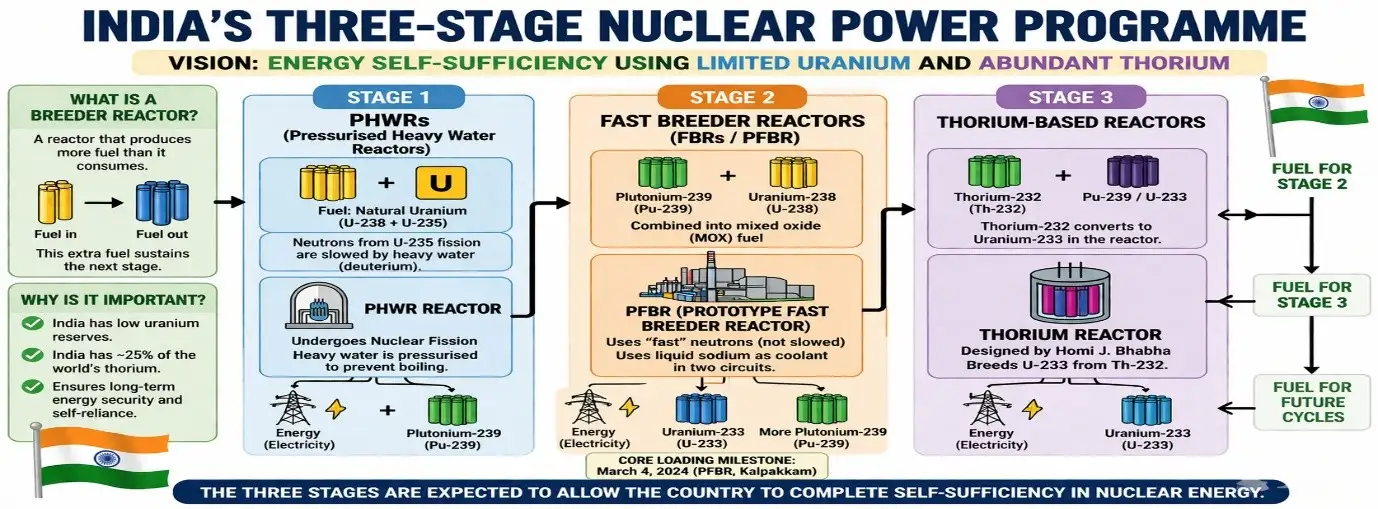
| India’s Three-Stage Nuclear Programme | ||
| Stage I (PHWRs): | Stage II (FBRs / PFBR): | Stage III (Thorium-based reactors): |
Use natural uranium (U-238, small U-235) as fuel. Produce electricity and generate plutonium-239 as by-product. | Use plutonium-based MOX fuel (mixed oxide fuel). Convert U-238 into more plutonium, multiplying fuel supply. | Use thorium (Th-232) to produce Uranium-233 (U-233). India holds about 25 percent of world’s thorium reserves, ensuring long-term energy security. |
Technical Features of PFBR
- PFBR capacity is 500 MW, located at Kalpakkam, Tamil Nadu.
- Uses liquid sodium as coolant, allowing high temperature heat transfer without high pressure.
- Employs MOX fuel (plutonium + uranium) for efficient fuel utilisation.
- Designed for a closed fuel cycle, enabling reuse of spent nuclear fuel.
Why India Needs Fast Breeder Reactors
- India has limited uranium but abundant thorium reserves, requiring alternative strategy.
- FBRs enable fuel multiplication, reducing dependence on imported uranium.
- They ensure long-term sustainability of nuclear energy programme.
- Help India achieve energy security amid global geopolitical uncertainties.
Global and Strategic Context
- India earlier faced restrictions due to limited uranium supply before the India-US nuclear deal (2008).
- Even today, excessive dependence on imports can create strategic vulnerabilities.
- FBRs reduce such dependence by enabling indigenous fuel generation.
- They strengthen India’s position in global nuclear technology and energy security domain.
Challenges in FBR Development
- High capital cost, with PFBR costing around ₹18,000 crore.
- Significant delays, with project taking over a decade beyond initial schedule.
- Technological complexity due to liquid sodium coolant (highly reactive and risky).
- Safety concerns and strict regulatory requirements increase implementation challenges.
Why FBRs are Difficult Globally
- Very few countries have successfully developed commercial breeder reactors.
- Technology involves complex fuel cycle management and advanced materials.
- High costs and long gestation periods reduce economic attractiveness.
- Public concerns about nuclear safety affect acceptance and expansion.
Role in Nuclear Waste Management
- FBRs help in recycling spent fuel, reducing nuclear waste burden.
- Enable closed fuel cycle, improving efficiency of resource utilisation.
- Address long-term concerns regarding storage and disposal of nuclear waste.
- Thus, they improve sustainability of nuclear energy systems.
Policy and Institutional Aspects
- Developed under Department of Atomic Energy and implemented by BHAVINI.
- Regulated by Atomic Energy Regulatory Board (AERB) for safety compliance.
- Linked with broader reforms like SHANTI framework for nuclear expansion.
- Requires coordination between technology, regulation, and financing mechanisms.
Future Roadmap and Expansion
- India plans additional FBRs and development of Small Modular Reactors (SMRs).
- Indigenous 220 MW PHWR model may be expanded for scalable deployment.
- Focus on thorium-based reactors for long-term sustainability.
- Nuclear energy expected to play larger role in India’s future energy mix.
Way Forward
- Ensure efficient and safe commissioning of PFBR to build technological confidence.
- Accelerate development of breeder reactors and closed fuel cycle infrastructure.
- Invest in research on thorium reactors and advanced nuclear technologies.
- Strengthen regulatory oversight and public communication for safety assurance.
- Integrate nuclear energy with renewable sources for a balanced energy mix.
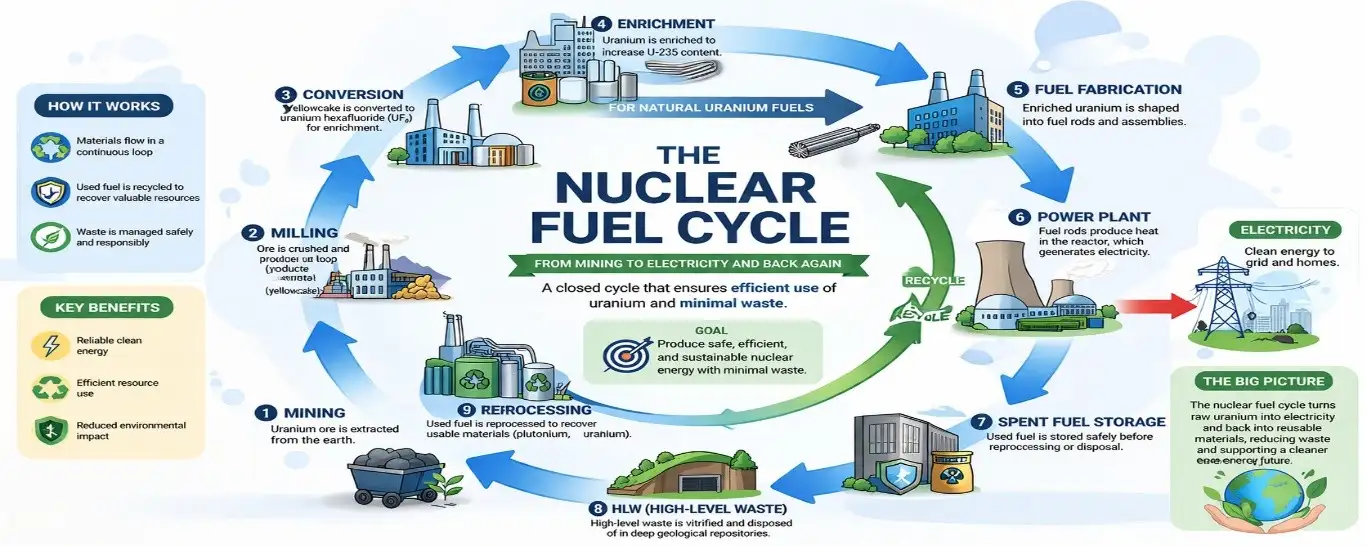
Fast Breeder Reactors are central to India’s strategy for long-term energy security. PFBR marks a major technological and strategic milestone in nuclear energy development. Despite challenges, FBRs offer a sustainable solution for fuel efficiency and waste management. India’s success in this domain will shape its future energy independence and climate goals.
Prelims Booster:
International Election Visitors’ Programme (IEVP), 2026
Context:
- The Election Commission of India has launched IEVP 2026 during Assembly elections
About
- IEVP is an international outreach programme
- Invites election officials from different countries to observe Indian elections
- Provides exposure to the world’s largest democratic process
Objective
- To showcase India’s election management system and best practices
- To demonstrate transparency and credibility of elections
- To promote global cooperation among election bodies
Key Features
Conducted in two phases of field visits:
| Includes:
| Delegates:
|
Significance
- Highlights India as a global model for free and fair elections
- Strengthens democratic cooperation and diplomacy
- Enhances India’s soft power in governance practices
Pradhan Mantri Mudra Yojana (PMMY)
Context:
- PMMY has completed 11 years of supporting micro and small entrepreneurs
About
- Pradhan Mantri Mudra Yojana (PMMY) is a flagship scheme of Government of India
- Launched on 8 April 2015
- Aims to provide loans to non-corporate, non-farm micro and small enterprises
- Implemented through MUDRA (Micro Units Development & Refinance Agency Ltd.)
Objective
- To fund unfunded micro enterprises and small businesses
- To promote self-employment and entrepreneurship
- To support activities in manufacturing, trading, and service sectors
Eligibility
- Any Indian citizen with a business plan
- Applicable for non-farm income-generating activities
- Includes allied sectors like dairy, poultry, beekeeping
Loan Categories
- Shishu: Up to ₹50,000 (early-stage businesses)
- Kishor: ₹50,000 to ₹5 lakh (growing businesses)
- Tarun: ₹5 lakh to ₹10 lakh (expansion stage)
- Tarun Plus: ₹10 lakh to ₹20 lakh (advanced stage)
Key Features
- Provides term loans and working capital
- Offered through: Commercial Banks, Regional Rural Banks (RRBs), Small Finance Banks, NBFCs and MFIs
- Interest rates follow RBI guidelines with flexible repayment
Significance
- Promotes financial inclusion and entrepreneurship
- Supports MSMEs and job creation
- Reduces dependence on informal credit sources
INS Sunayna
Context:
- INS Sunayna reached Malé under the Indian Ocean Ship (IOS) SAGAR initiative
About
- INS Sunayna is an indigenous offshore patrol vessel (OPV) of the Indian Navy
- It is the second ship of the Saryu-class
- Designed and built by Goa Shipyard Limited
- Commissioned on 15 October 2013 at Kochi
- Operates under the Southern Naval Command
Functions
- Conducts coastal and offshore patrolling operations
- Performs ocean surveillance and monitoring of sea lanes
- Provides escort and fleet support missions
- Ensures maritime security and protection of offshore assets
Key Features
Propulsion:
|
Systems:
|
Armament:
|
Additional Capability:
|
Significance
- Strengthens India’s maritime surveillance capability
- Supports SAGAR (Security and Growth for All in the Region) initiative
- Enhances presence in the Indian Ocean Region (IOR)
Angola
Context:
- Angola is emerging as an alternative energy supplier for India
About
- Angola is located on the southwestern coast of Africa
- It lies along the Atlantic Ocean
- Capital: Luanda
Location and Boundaries
- Bordered by:
- Republic of the Congo (northwest)
- Democratic Republic of the Congo (north and northeast)
- Zambia (southeast)
- Namibia (south)
- Has a coastline along the Atlantic Ocean
Geographical Features
- Climate: Tropical with a distinct dry season and Influenced by the cold Benguela Current
- Rivers: Cuango River and Cuanza River
- Waterfall: Calandula Falls (one of the largest in Africa)
- Highest Peak: Mount Moco
Natural Resources
- Rich in: Petroleum, Diamonds, Iron ore, Copper, Gold, Uranium
Significance
- Important oil and gas producer
- Emerging as a key energy partner for India
- Strategically located on Atlantic trade routes
United Nations Security Council (UNSC)
Context:
- Russia and China vetoed a UNSC resolution related to Strait of Hormuz
About
- The United Nations Security Council (UNSC) is one of the six principal organs of the United Nations
- It is responsible for maintaining international peace and security
- It is the only UN body whose resolutions are legally binding on member states
- Established in 1945
Composition
- Total 15 members
- Permanent Members (P5) with veto power: China, France, Russia, United Kingdom & United States
- Non-permanent Members (10): Elected for 2-year terms and are Distributed regionally
Veto Power
- Any one of the P5 members can block a resolution
- Even if majority supports, a single veto can stop it
Objectives
- Maintain international peace and security
- Resolve disputes through negotiation and peacekeeping
- Take action against threats using sanctions or force
Working Mechanism
- Each member has one vote
- A resolution requires: At least 9 votes and No veto from P5 members
- Presidency rotates monthly among members
Key Functions
- Imposes economic and trade sanctions
- Authorises peacekeeping missions (Blue Helmets)
- Can approve military action under UN Charter
- Recommends new UN members and Secretary-General
Significance
- Acts as the main global body for conflict resolution
- Plays a key role in maintaining global stability
- Platform for major powers to negotiate international issues
Mangroves
Context:
- Study shows declining resilience in the Sundarbans mangrove ecosystem
About
- Mangroves are salt-tolerant trees and shrubs found in coastal areas
- Grow in intertidal zones (area between high and low tide)
- Also called tidal forests or coastal forests
Habitat and Distribution
- Found in tropical and subtropical regions (25°N–25°S)
- Grow in areas with slow-moving water and sediment deposition
- Thrive in salty, waterlogged, low-oxygen soils
- Sundarbans is the largest mangrove forest
- Located in Ganga–Brahmaputra–Meghna delta
- Only mangrove ecosystem with tiger population
Key Adaptations
- Pneumatophores (breathing roots): Roots grow upward to take oxygen from air
- Stilt/prop roots: Provide support in soft muddy soil
- Vivipary: Seeds germinate on the tree before falling
- Salt control mechanisms: Some plants excrete salt through leaves & Others block salt at root level
Significance
- Act as natural barriers against cyclones, storms, and tsunamis
- Prevent coastal erosion
- Rich in biodiversity (fish, birds, mammals)
- Store large amounts of carbon (blue carbon ecosystems)