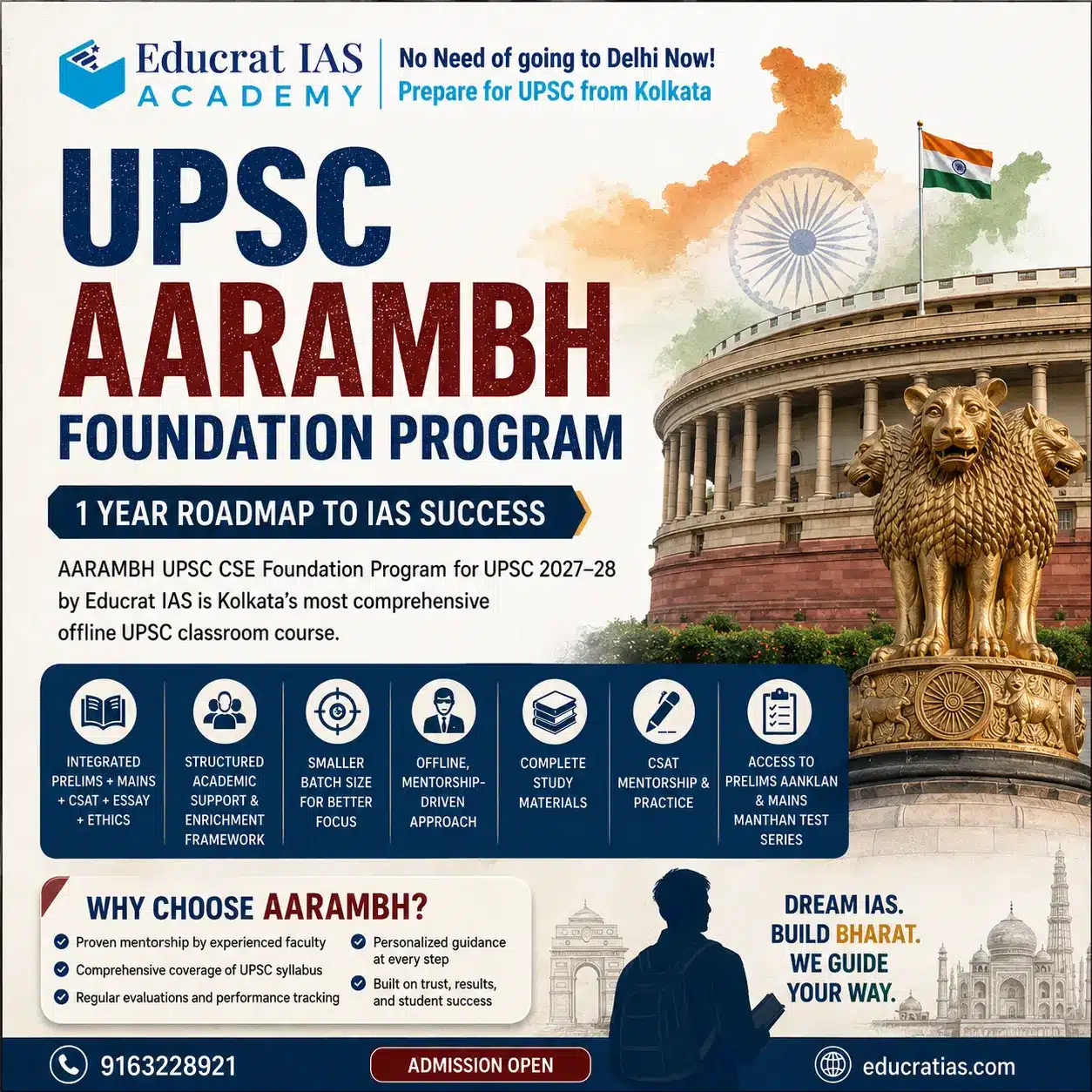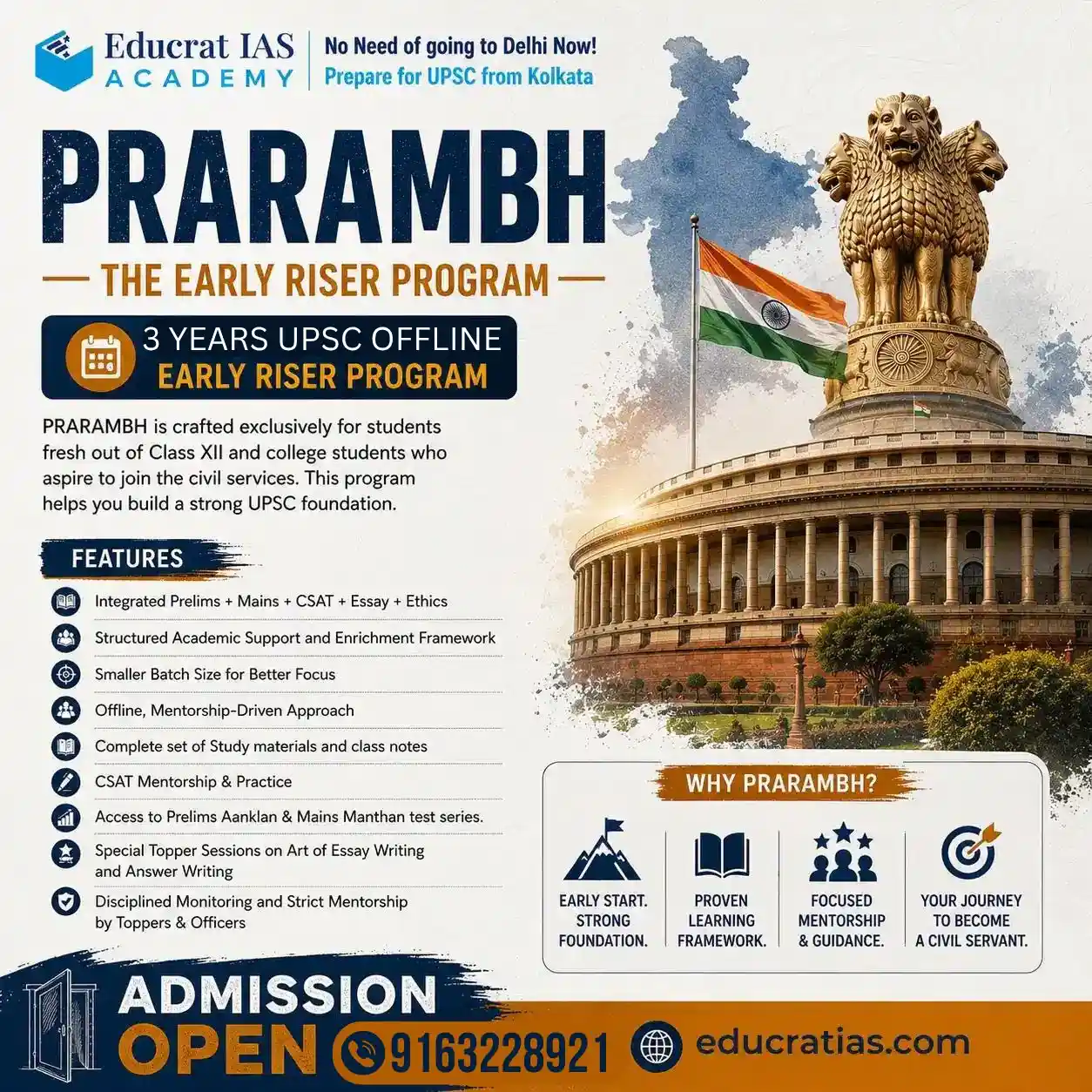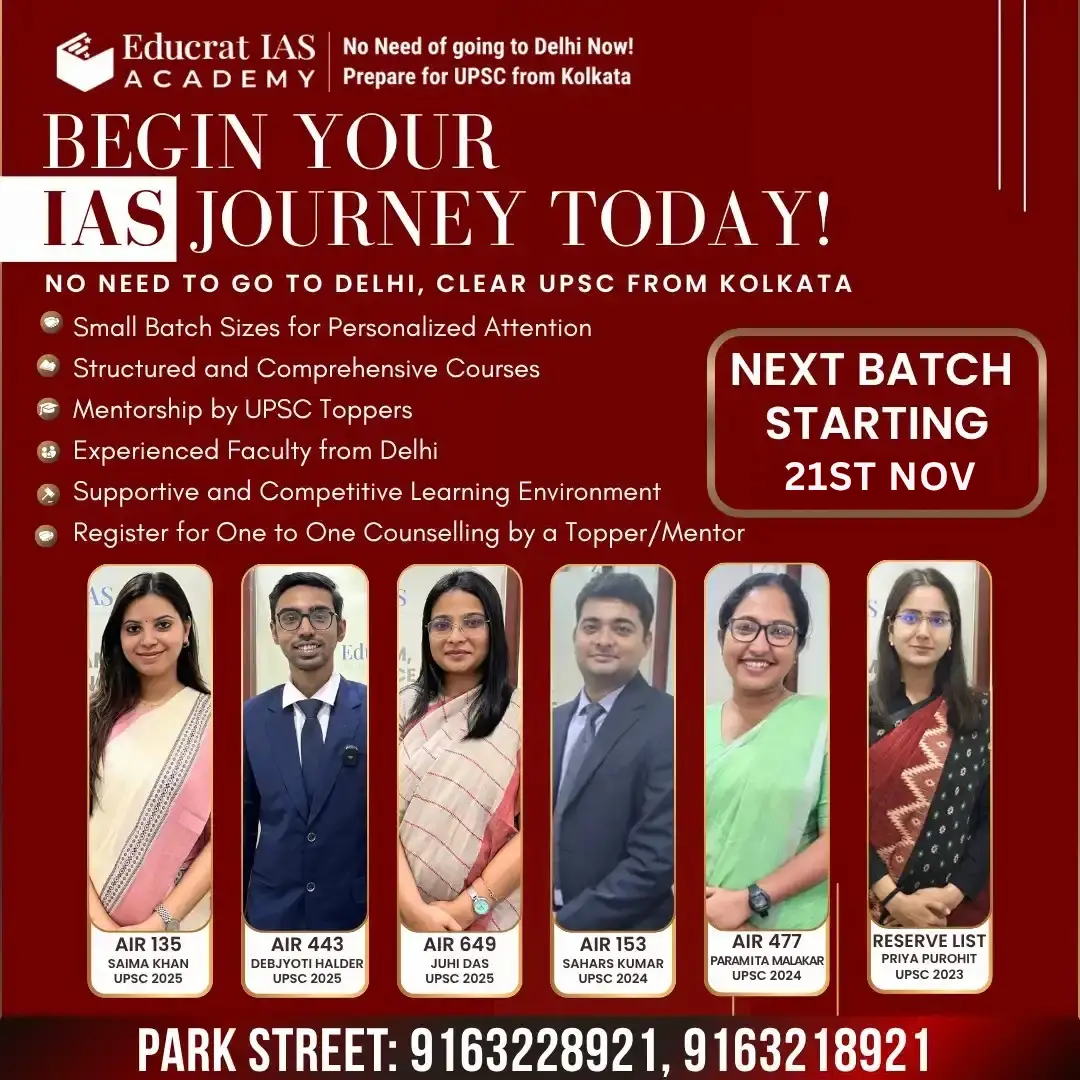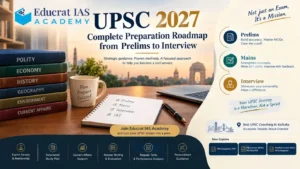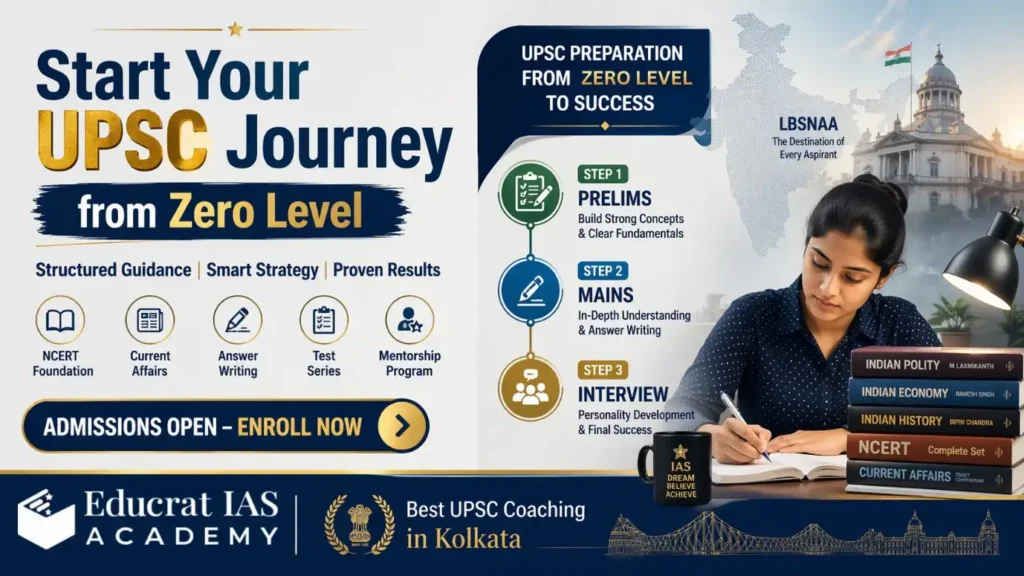
Starting UPSC preparation from zero level can feel confusing and overwhelming because of the vast syllabus and intense competition. Many aspirants struggle not because they lack capability, but because they lack proper direction and structured guidance. With the right strategy, consistent effort, and access to the best UPSC coaching in Kolkata like Educrat IAS Academy, even beginners can build a strong foundation and move confidently toward success.
If you are planning to begin your UPSC preparation in Kolkata, this guide will help you take the first step in the right direction.
Table of Content:
- How To Start UPSC Preparation From Zero Level
- UPSC Exam Overview
- Understand The UPSC Syllabus Clearly
- Build A Realistic Daily Routine
- Start With NCERT Books
- Current Affairs Strategy For UPSC
- Create a Smart Study Plan
- Choose Optional Subject Wisely
- Practice Answer Writing
- Solve Previous Year Question Papers
- Why Guidance & Mentorship Matter
- Revision Strategy
- How Much Time is Needed for UPSC Preparation
How to start UPSC Preparation from Zero Level
UPSC Exam Overview (Know Before You Start)
Before starting preparation, it is essential to understand the structure of the UPSC exam. Without this clarity, aspirants often waste time on irrelevant topics and ineffective strategies. A clear understanding helps you plan your preparation efficiently and align it with exam requirements. Designed to recruit candidates for prestigious services like the IAS, IPS, and IFS, in the UPSC CSE, the Prelims act as a gateway, your final rank is determined by the 1750 marks from the Mains and 275 marks from the Interview.
- Prelims – Objective test (GS Paper I + CSAT)
- Mains – Descriptive exam (GS, Essay, Optional subjects)
- Interview – Personality test
Important: Only GS Paper I marks count for Prelims qualification (CSAT is qualifying).
Understand the UPSC Syllabus Clearly
The UPSC syllabus is the backbone of your preparation. It defines what to study and what to ignore. Beginners often make the mistake of studying randomly without referring to the syllabus, which leads to confusion and wasted effort. Whether you are studying on your own or through an IAS coaching institute in Kolkata, clarity of syllabus is the first step.
- Read the syllabus multiple times
- Break it into smaller topics
- Identify strengths and weaknesses
Stage 1: Preliminary Examination (Screening)
The Prelims consists of two objective-type (MCQ) papers conducted on a single day. While essential for shortlisting, these marks are not counted toward the final merit list.
- Negative Marking: There is a penalty of 1/3rd of the marks assigned to a question for every incorrect answer. In both Paper I and Paper II.
- General Studies Paper I (Generally conducted between 9:30 AM to 11:30 AM): This paper evaluates the candidate’s knowledge in multiple subjects:
- Current events of national and international importance
- History
- Geography
- Indian Polity and Governance
- Economic and Social Development
- Environmental ecology, biodiversity, and climate change
- General Science
This paper plays the most important role in determining whether a candidate qualifies for the Mains stage.
- CSAT (General Studies Paper II) (Generally conducted between 2:30 PM to 04:30 PM): The Civil Services Aptitude Test (CSAT) evaluates the candidate’s logical and analytical skills.
Important topics include:
- English
- Mathematics
- Reasoning
Although the CSAT paper is qualifying, candidates should not ignore it, as failure to secure 33% marks will disqualify the candidate regardless of their GS score.
Stage 2: Main Examination (Written)
Candidates who clear the Prelims proceed to the Mains, a descriptive, essay-type examination consisting of nine papers. The Mains syllabus focuses on evaluating the analytical ability, conceptual clarity, and writing skills of the candidates.
- Qualifying Papers: Paper A (Indian Language) and Paper B (English) require a minimum score of 25%. Their marks are not counted for ranking.
- Merit-Ranking Papers: Seven papers contribute to the written total of 1750 marks:
- Essay
- GS Paper I – Indian Heritage and Culture, History and Geography of the World and Society
- GS Paper II – Governance, Constitution, Polity, Social Justice and International Relations
- GS Paper III – Technology, Economic Development, Bio-diversity, Environment, Security and Disaster Management
- GS Paper IV – Ethics, Integrity & Aptitude
- Optional Subject: Paper I and Paper II, Candidates choose one subject from a list of 48 options, including literature. This choice is critical as it accounts for 500 marks.
Stage 3: UPSC Interview (Personality Test)
The final stage is an interview conducted by a 5-member panel at UPSC headquarters in New Delhi. Candidates who qualify the Mains examination are called for the UPSC Personality Test, conducted at the UPSC headquarters in New Delhi.
The panel evaluates:
- Personality and confidence
- Communication skills
- Leadership qualities
- Awareness of national and international issues
- Suitability for a career in public service
Total Marks: 275.
Unlike a traditional academic test, the interview focuses on overall personality and decision-making ability.
At Educrat IAS Academy, the Best UPSC Coaching in Kolkata, we provide a comprehensive counselling session which helps aspirants understand the UPSC syllabus with clarity and depth.
Build a Realistic Daily Routine
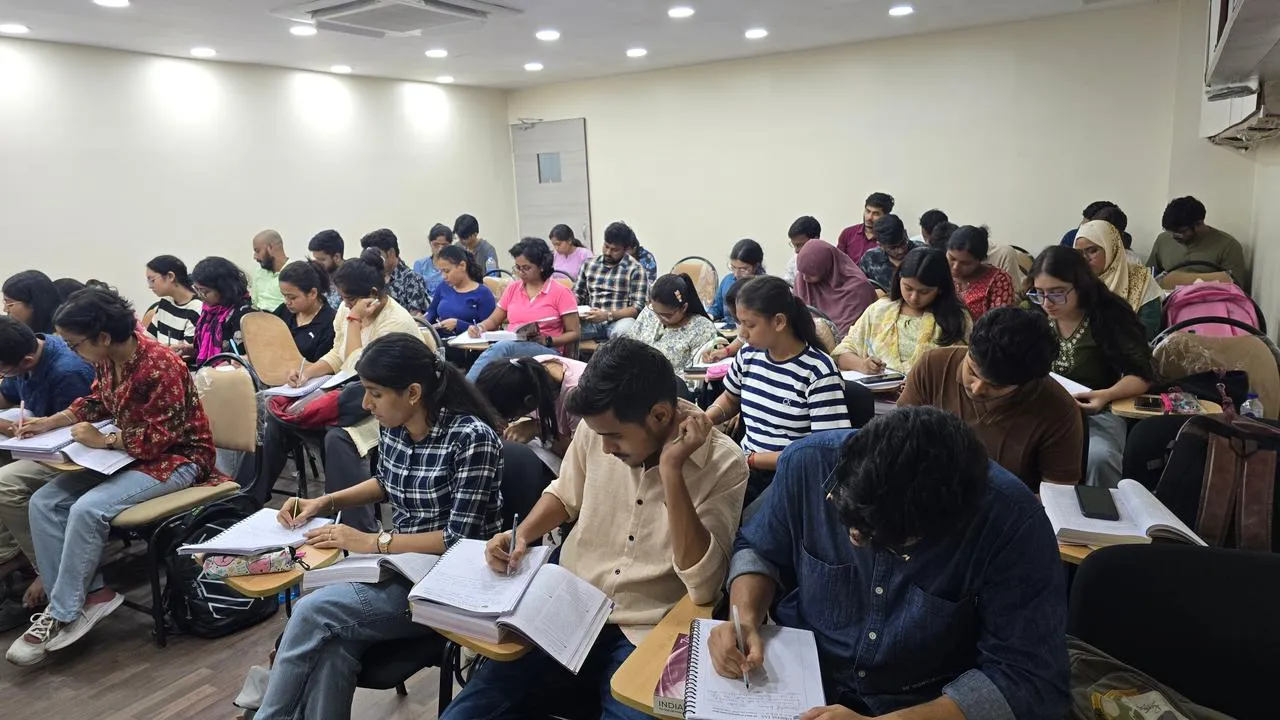
A disciplined daily routine is the backbone of consistency especially when you are just starting. Here is a suggested schedule for a serious aspirant:
- 06:00 AM – 07:30 AM: Wake up and light exercise/meditation to build mental stamina.
- 07:30 AM – 09:30 AM: Slot 1: The Newspaper. Read The Hindu or Indian Express, focusing on issues of national and international importance. Read Currrent Affair analysis and solve MCQ based on those.
- 10:00 AM – 01:00 PM: Slot 2: Core Subject. Focus on heavy subjects like History, Geography, or Polity.
- 01:00 PM – 02:00 PM: Lunch and a short power nap.
- 02:00 PM – 04:00 PM: Slot 3: CSAT
- 05:00 PM – 07:00 PM: Slot 4: Optional Subject. Dedicate these hours to your chosen optional.
- 07:30 PM – 08:00 PM: Slot 5: Answer Writing/CSAT. Spend an hour on the mains answer writing program and 30 minutes on CSAT practice.
- 8:00 PM – 9:00 PM: Revision of the day.
- 09:00 PM – 10:00 PM: Dinner and some comfort hobby.
- 10:00 PM – 10:30 PM: Plan the next day’s targets to hit the ground running.
Keep each day realistic and sustainable: small targets but consistent targets.
Start with NCERT Books (Build Strong Basics)
A strong foundation is crucial for long-term success in UPSC. NCERT books are the best starting point as they explain concepts in a simple and clear manner. At Educrat IAS Academy, the leading UPSC coaching institute in Kolkata we recommend beginning with NCERTs before moving to advanced books.
- Build conceptual clarity
- Cover basic subjects effectively
- Prepare for both Prelims and Mains
Recommended Subjects:
- History
- Geography
- Polity
- Economy
- Science
Understand this: UPSC doesn’t reward the person who reads 10 books once; it rewards the person who reads one book ten times. Minimum Resources, Multiple Revision is the key to becoming a UPSC Topper.
UPSC CSE 2025 Topper Talk: Winning Strategy of AIR 135, Saima Khan
AIR 135, Saima Khan credits her success to a “Smart Work > Hard Work” philosophy. Her core pillars is Resource Management, Mastering a few standard books through multiple revisions rather than chasing new materials.
Current Affairs Strategy for UPSC
Current affairs play a decisive role in UPSC preparation. They help you connect static subjects with real-world events. Aspirants attending UPSC classes in Kolkata are often guided on how to analyse news effectively rather than just reading it.
- Read The Hindu or Indian Express daily
- Focus on editorials and analysis
- Link current events with static subjects
At Educrat IAS Academy, the Best IAS institute in Kolkata, we provide all the required books and curated, high-yield study materials that eliminate the need for “material hopping.” Our mentors ensure you focus only on what is relevant for the 2026 exam cycle.
We provide Current Affairs and Current Affairs MCQ in forms of:
Create a Smart Study Plan
A structured study plan aligned with your daily routine ensures discipline and consistency. Without proper planning, preparation becomes scattered and ineffective. Many aspirants benefit from guidance provided by Educrat IAS Academy, the Best UPSC coaching centre in Kolkata, where structured schedules are provided.
- Set daily study targets
- Do weekly revision
- Attempt monthly mock tests
- Maintain balanced subject coverage
Choose Optional Subject Wisely
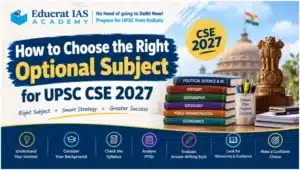
How to Choose Optional Subject in UPSC?
- Interest
- Overlap with General Studies
- Availability of Guidance & Resources
- Optional Subject Based on Graduation
- Answer Writing Nature
- Past Performance & Scoring Trend
Understand how UPSC Toppers Choose Optional Subject:
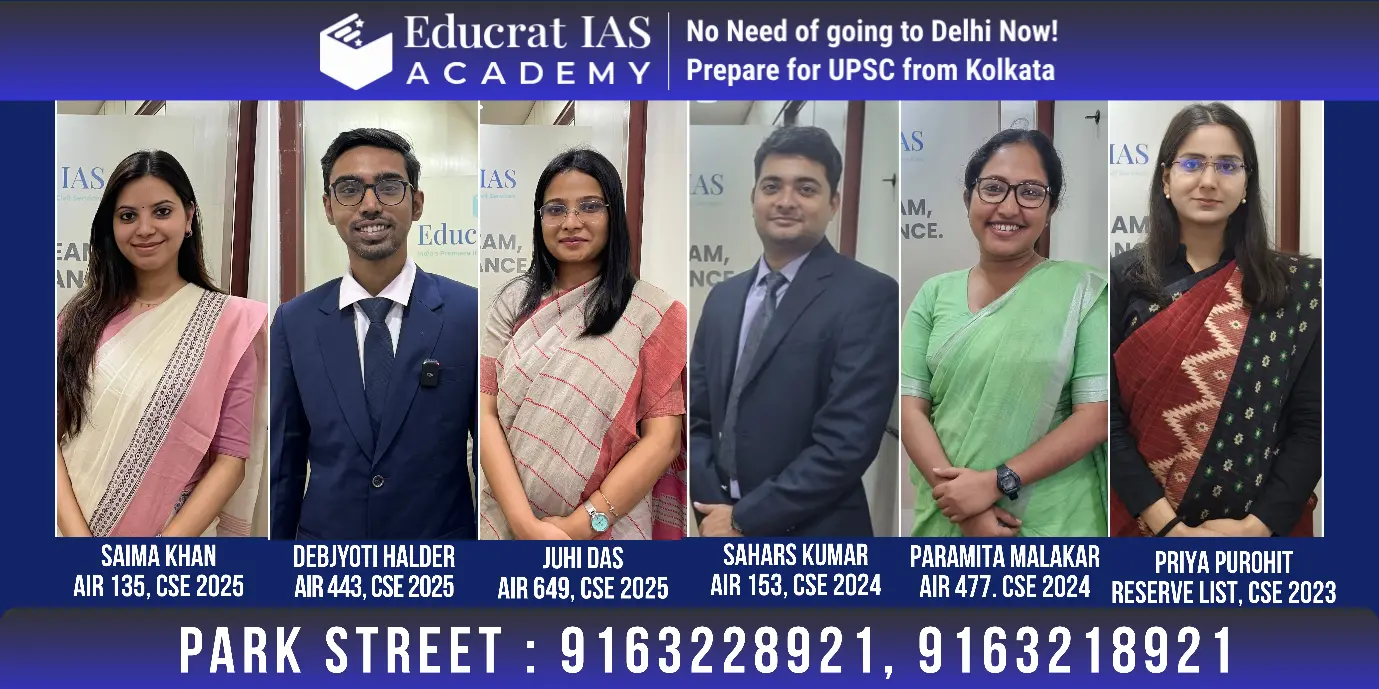
· Saima Khan, AIR 135 (CSE 2025)
Optional Subject: Sociology
Reason for Choice: Graduation subject, B.A (Hons) in Sociology, St. Xavier’s College, Kolkata
· Debjyoti Halder, AIR 443 (CSE 2025)
Optional Subject: Medical Science
Reason for Choice: Graduation subject, MBBS, R.G. Kar Medical College, Kolkata (WBUHS)
· Juhi Das, AIR 649 (CSE 2025)
Optional Subject: Anthropology
Reason for Choice: Interest in society, culture, and human development, giving her preparation a multidimensional depth.
· Sahars Kumar, AIR 153 (CSE 2024)
Optional Subject: Political Science and International Relations (PSIR)
Reason for Choice: Overlap with General Studies.
· Paramita Malakar, AIR 477 (CSE 2024)
Optional Subject: Bengali Literature
Reason for Choice: Interest in Bengali Literature.
· Ashish Kumar, AIR 338 (CSE 2023)
Optional Subject: Law
Reason for Choice: Graduation subject, B.A. LLB, Banaras Hindu University (BHU), 2019
· Priya Purohit, Reserve List (CSE 2023)
Optional Subject: Political Science and International Relations (PSIR)
Reason for Choice: Interest and Overlap with General Studies.
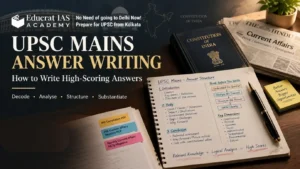
Practice Answer Writing (Game Changer for Mains)
UPSC Mains is all about how effectively you present your knowledge. Regular answer writing practice is essential to improve structure, clarity, and speed. Many institutes offer a dedicated mains answer writing program to help aspirants master this skill. At Educrat IAS Academy, we provide integrated Prelims + Mains preparation from Day 1 along with a dedicated Mains Test series.
- Improves clarity of thought
- Enhances writing speed
- Develops analytical ability
The Mains exam is a test of writing stamina and analytical speed, not just memory. At Educrat IAS Academy, the Top UPSC Coaching institute in Kolkata, our UPSC courses are specially curated to fit answer writing in every class throughout the course. Integrated preparation in UPSC CSE is what UPSC Toppers utilize to not fail in UPSC CSE.
UPSC CSE 2025 Topper Talk: Game-Changer for AIR 649, Juhi Das
AIR 649, Juhi Das believes in Answer Writing as a Game-Changer. She practiced structured, point-wise answers aligned with the UPSC demand for clarity and depth. Through disciplined study and answer writing practice, she successfully cleared as AIR 649 in UPSC CSE 2025 Topper.
Solve Previous Year Question Papers (PYQs)
Previous year question papers are one of the most valuable resources for UPSC preparation. They help you understand the exam pattern and identify important topics.
- Understand exam pattern
- Identify important topics
- Analyse question trends
Join Test Series for Evaluation
Test series play a crucial role in assessing your preparation level. They simulate real exam conditions and help you improve accuracy and time management. Many aspirants enroll in a UPSC test series in Kolkata to regularly evaluate their performance.
- Helps in self-assessment
- Improves time management
- Provides real exam experience
UPSC CSE 2025 Topper Talk: AIR 153, SAHARS KUMAR, UPSC CSE 2024
Listen to what UPSC Topper has to say:
EDUCRAT IAS UPSC Test Series:
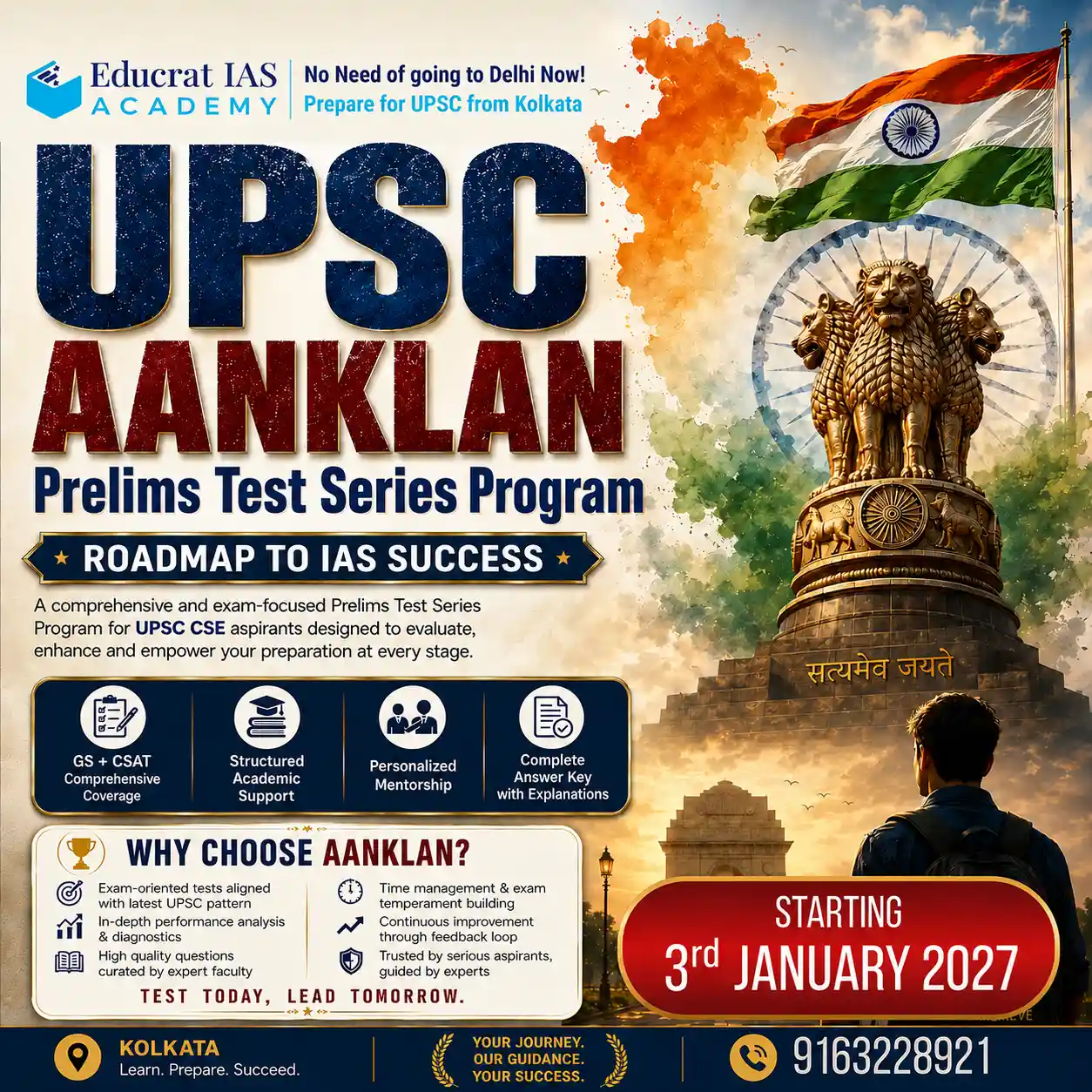
Aanklan (आकलन) Prelims Test Series
Our UPSC Prelims Test Series aims to cover the UPSC PYQs and emerging trends of UPSC Prelims MCQs, enabling the aspirants to prepare well in advance with the tricks and methods to solve UPSC level of MCQs.
The tests are conducted in UPSC like environment with strict invigilation. Detailed explanation, Answer Key, All India Ranking is provided to help students track their progress. These are all included in our UPSC Prelims Test Series Aanklan 2026.
- Compete with 200+ Aspirants from Eastern India in a UPSC-like simulated environment with a detailed answer key for each test.
- Comprehensive syllabus coverage for GS & CSAT: Covering all subjects and Current Affairs.
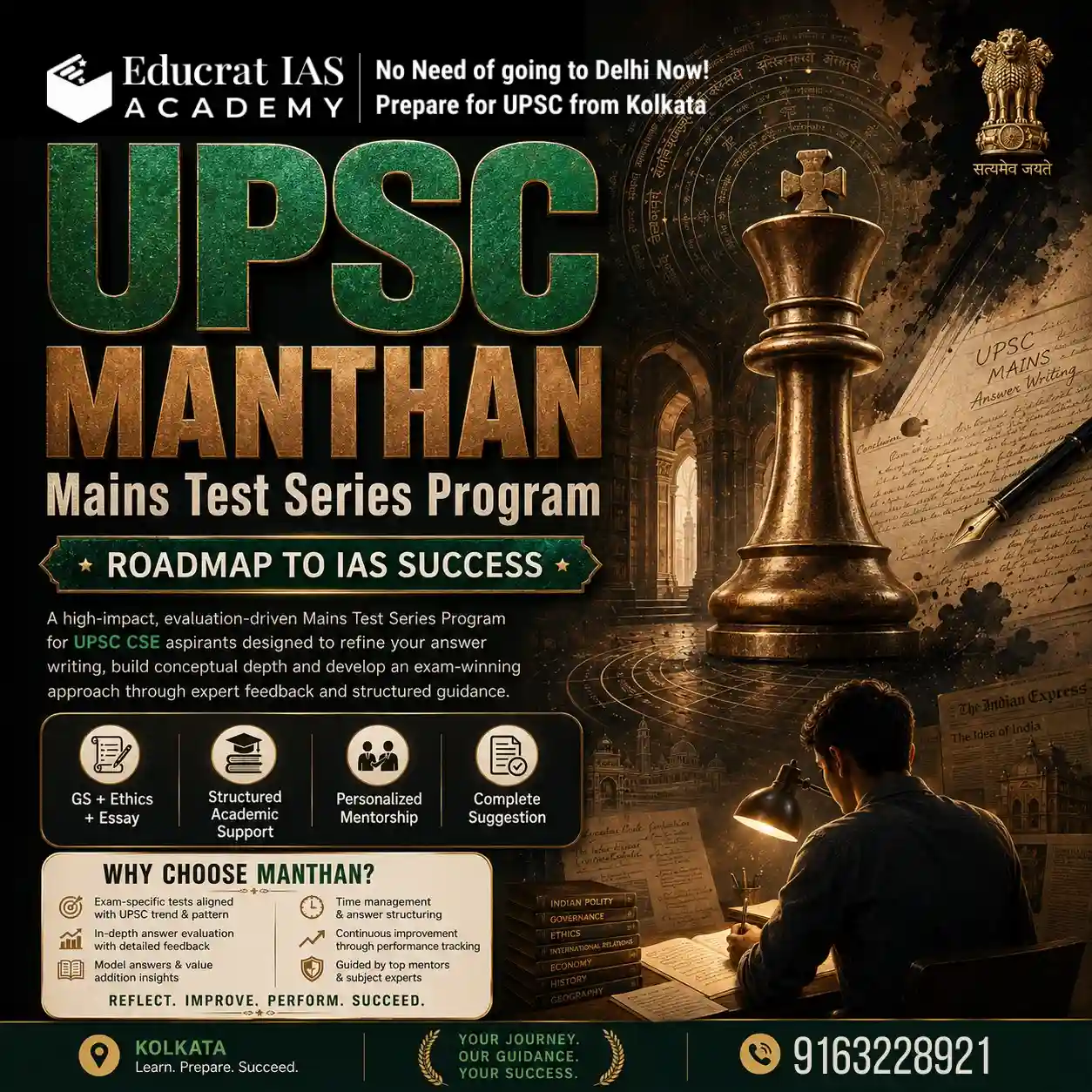
Manthan (मंथन) Mains Test Series
To ensure thorough preparation, our UPSC Mains Test Series Manthan covers UPSC Mock Tests on Essay, GS I, GS II, GS III, and GS IV papers. Practicing multiple UPSC Mains mocks is crucial for developing the art of UPSC Mains Answer Writing, Learning how to address demand of the Questions, effective time management etc.
At Educrat IAS, we take pride in our track record—over 5 essay topics from our test series appeared in UPSC 2024, and 30+ topics from our tests were reflected in the actual UPSC Mains paper.
Detailed Two Layered Evaluation & Feedback, Personalised SWOT Analysis, Mentorship on how to improve the weak areas, Model Answers will be a part of the UPSC Mains Test Series Manthan Program.
- Comprehensive Coverage: Includes GS I, GS II, GS III, GS IV, and Essay papers, covering the entire syllabus.
- UPSC-like stimulated environment and Expert personalized evaluations with doubt-clearing sessions.
Comprehensive test series to evaluate your preparation
Prepare. Perform. Succeed.
Why Guidance & Mentorship Matter
While self-study is important, the right mentorship can significantly accelerate your preparation. A structured mentorship program for UPSC helps aspirants stay focused, avoid common mistakes, and continuously improve through feedback.
With proper guidance, you get:
- Personalized strategy
- Regular feedback
- Doubt resolution
- Exam-oriented preparation
Revision Strategy
Revision is the most critical part of UPSC preparation. Without revision, even the best preparation loses its effectiveness. Many aspirants underestimate revision, but it is the key to retention and performance.
- Follow weekly revision cycles
- Do monthly consolidation
- Make short notes for quick revision
- Join a proper Test series
How Much Time is Needed for UPSC Preparation?
The time required for UPSC preparation varies for each individual. However, having a realistic timeline helps maintain consistency and direction. Aspirants enrolled in the best UPSC coaching in Kolkata often follow structured long-term plans.
- Ideal duration: 12–18 months
- Depends on:
- Academic background
- Daily study hours
- Consistency
Stay Consistent & Motivated
The UPSC journey is long and challenging. Staying consistent is more important than studying for long hours occasionally. Discipline and perseverance are the keys to success.
- Consistency is more important than intensity
- Discipline ensures long-term success
- Small daily efforts create big results
Conclusion
Starting UPSC preparation from zero level may seem difficult, but with the right approach, it is completely achievable. By understanding the exam, building strong basics, following a structured plan, and taking guidance from a reliable UPSC coaching institute in Kolkata, you can significantly improve your chances of success.
Focus on clarity, consistency, and continuous improvement, and your goal of becoming a civil servant will come within reach.
If you are serious about cracking UPSC, start today with a clear plan and expert guidance.