Reimagining Neighbourhood Policy: Trade as the Core Strategy
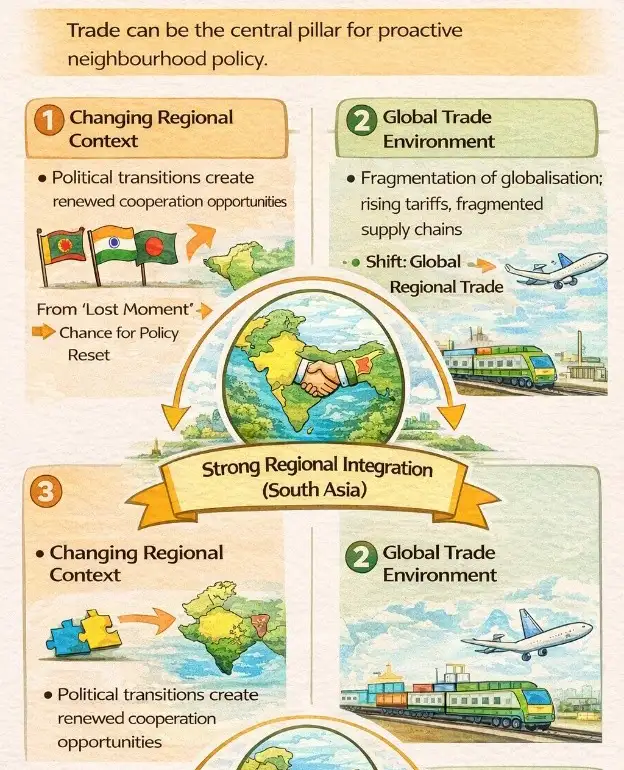
Changing Regional Context
Recent developments have opened new possibilities for India’s neighbourhood policy:
- Political transitions in countries such as Bangladesh and Sri Lanka have created space for renewed engagement.
- Earlier concerns of strained relations and strategic drift are now being replaced by opportunities for cooperation.
- India’s “lost moment” in South Asia may now be turning into a chance for policy correction.
Global Trade Environment: A Window of Opportunity
The global trading system is undergoing structural changes:
- Fragmentation of globalisation due to rising tariffs and geopolitical tensions
- Increasing uncertainty in long-distance supply chains
- Shift towards regional and proximity-based trade
In this context, India’s neighbouring countries such as Bangladesh, Nepal, and Sri Lanka gain importance due to geographical proximity and economic complementarity.
Importance of Trade in Neighbourhood Policy
Trade can act as the most effective tool for strengthening regional ties:
- Economic Integration: Enhances interdependence and reduces conflict & Promotes shared prosperity in the region
- Strategic Influence: Provides an alternative to external powers, particularly China & Strengthens India’s leadership in South Asia
- Supply Chain Resilience: Reduces dependence on distant markets & Encourages regional production networks
- Development of Border Regions: Boosts growth in India’s eastern and northeastern regions
Limitations of India’s Existing Approach
India’s regional trade policy has faced several challenges:
| Issue | Explanation |
| Protectionist Policies | Hesitation in opening markets to neighbours |
| Underutilisation of Geography | Despite proximity, trade remains limited |
| China’s Dominance | Neighbours depend more on China for imports |
| Connectivity Gaps | Weak infrastructure and trade facilitation |
For example, despite geographical closeness, countries like Bangladesh and Sri Lanka often find it easier to trade with distant economies than with India.
Trade Imbalance Challenge
India’s trade dynamics present both strengths and limitations:
- India runs trade surpluses with neighbouring countries such as Bangladesh, Nepal, and Sri Lanka.
- However, it faces a significant trade deficit with China.
- As a result, India is unable to offer neighbours the same level of market access that China provides.
This creates a structural constraint in using trade as a strategic tool.
Need for Policy Shift
- Move from a cautious and protectionist stance to a more open trade policy
- Recognise mutual benefits rather than viewing trade as a zero-sum game
- Align neighbourhood policy with India’s broader economic interests
Key Challenges
- Protectionist Mindset: Reluctance to liberalise trade with neighbours
- Institutional Weakness: Limited regional frameworks such as SAARC
- Infrastructure Deficits: Poor connectivity reduces trade efficiency
- External Competition: China’s economic presence in South Asia
Way Forward: Strengthening Trade-Led Regionalism
- Enhance Market Access: Reduce trade barriers for neighbouring countries
- Improve Connectivity: Invest in transport, logistics, and border infrastructure
- Promote Regional Value Chains: Integrate production networks within South Asia
- Deepen Economic Agreements: Strengthen bilateral and sub-regional trade arrangements
- Shift Policy Mindset: Treat neighbours as partners rather than competitors
India stands at a critical juncture where it can redefine its neighbourhood policy through trade-led engagement. By leveraging geographical proximity and adopting a more open and cooperative approach, India can strengthen regional integration, enhance strategic influence, and ensure mutual economic growth in South Asia.
Disaster Finance: When Counting People Misrepresents Risk
Understanding the Issue
- Odisha has a coastline of about 574.7 kilometres, making it highly vulnerable to cyclones.
- Over the years, it has achieved near-zero cyclone mortality through proactive governance.
- Despite this, it has faced a reduction in its disaster funding share under the latest Finance Commission.
Revised Disaster Risk Framework
The Finance Commission introduced a new Disaster Risk Index based on a multiplicative formula:
Disaster Risk Index equals Hazard multiplied by Exposure multiplied by Vulnerability
This is a shift from the earlier additive model used by the previous Finance Commission.
| Approach | Method | Implication |
| Earlier (15th FC) | Additive | Treated components independently |
| Current (16th FC) | Multiplicative | Risk depends on interaction of all factors |
The conceptual basis of the new model is sound, as disasters occur when hazards affect vulnerable and exposed populations. However, its implementation has critical flaws.
Key Issues in the Current Formula
1. Faulty Measurement of Exposure
The Commission uses total population as a proxy for exposure.
- Larger States automatically receive higher exposure scores.
- Smaller but high-risk States are undervalued.
- Scientific definition (as per IPCC) defines exposure as people located in hazard-prone areas, not total population.
Example:
| State | Hazard Score | Population Score | Outcome |
| Odisha | High | Low | Lower funding |
| Uttar Pradesh | Lower | Very High | Higher funding |
This leads to a situation where demographic size dominates actual disaster risk.
2. Inadequate Measurement of Vulnerability
Vulnerability is measured using per capita income (NSDP), which is insufficient.
- It captures fiscal capacity but not actual disaster vulnerability.
- Ignores factors such as housing quality, healthcare access, and infrastructure.
- Fails to reflect intra-state inequalities.
Example:
- Kerala, despite severe floods in 2018, receives a low vulnerability score due to higher income levels.
- Jharkhand, though vulnerable, loses funding due to lower population weight.
3. Bias Towards Large and Poor States
The multiplicative formula results in:
- Higher allocation to populous States regardless of hazard level
- Reduced share for smaller or relatively better-off States
- Around twenty States losing relative share
Thus, the formula unintentionally rewards population size over actual disaster risk.
Importance of Correct Disaster Financing
- Climate Change Context: Increasing frequency of cyclones, floods, and extreme rainfall events
- Equity in Resource Allocation: Funds must reach States with highest actual risk
- Preparedness Incentives: States investing in disaster management should not be penalised
- National Resilience: Accurate funding ensures better disaster preparedness and response
What Needs to Change
Improving Exposure Measurement
- Use population living in hazard-prone areas such as coastal belts and flood plains
- Integrate data from Vulnerability Atlas and Census data
Improving Vulnerability Assessment
Develop a composite index including:
- Housing quality
- Health infrastructure availability
- Agricultural dependence
- Insurance coverage
- Effectiveness of early warning systems
Data sources can include national surveys and institutional databases.
Institutional Reform
- Establish a standardised Disaster Vulnerability Index
- Assign responsibility to a central authority for periodic updates
- Ensure consistency across Finance Commission cycles
Key Challenges
- Data availability and standardisation across States
- Integrating multiple dimensions of vulnerability
- Balancing simplicity of formula with scientific accuracy
- Ensuring political acceptability of revised allocations
Prelims Boosters
Artemis II Mission
Context:
- The crew has arrived at Kennedy Space Center for final launch preparations
About the Mission
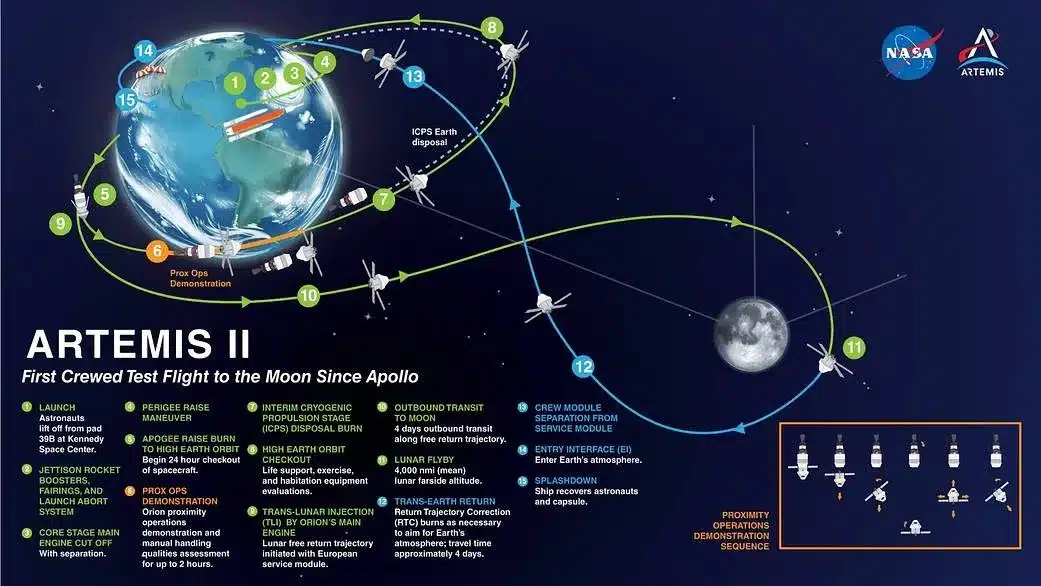
- Artemis II is a crewed lunar flyby mission undertaken by NASA
- It will carry four astronauts around the Moon and return them safely to Earth
- Scheduled launch: 1 April 2026
- Mission duration: 10 days
- It will be the first human mission to the vicinity of the Moon since Apollo 17 in 1972
Significance
- Marks the return of human spaceflight to deep space after nearly five decades
- Serves as a crucial precursor mission for future lunar landing missions under the Artemis programme
- Contributes to long-term goals of sustained human presence on the Moon and future missions to Mars
Mission Profile
- The spacecraft Orion will be launched using the Space Launch System (SLS)
- It will follow a hybrid free-return trajectory, enabling the spacecraft to:
- Travel around the Moon
- Return to Earth using gravitational forces
- The crew will travel approximately 7,600 kilometres beyond the far side of the Moon, representing the farthest distance travelled by humans in space
Key Objectives
1. Human Spaceflight Validation
- Assessment of life support systems, including oxygen supply and temperature regulation
- Evaluation of human endurance in deep space conditions, including radiation exposure
2. Navigation and Communication
- Testing of deep-space navigation systems
- Ensuring reliable long-distance communication
3. Spacecraft Performance
- Validation of Orion’s heat shield during atmospheric re-entry
- Testing of overall crew safety systems
Safety and Contingency Measures
- Provision for abort modes in case of emergencies
- Identification of alternate splashdown locations
- Deployment of search and rescue operations and medical support systems
Nagoya Protocol
Context:
- India has emerged as a global leader in issuing compliance certificates under the Nagoya Protocol
About the Protocol
- The Nagoya Protocol is a legally binding international agreement under the Convention on Biological Diversity
- It focuses on fair and equitable sharing of benefits from genetic resources
- Adopted: 2010 (Nagoya, Japan)
- Came into force: 12 October 2014
Important Distinction:
- Unlike Cartagena Protocol (which deals with GMOs), Nagoya Protocol deals with benefit sharing and compliance
Objectives
- Ensure fair sharing of benefits from genetic resources
- Promote conservation and sustainable use of biodiversity
- Provide legal clarity and transparency
Three Core Pillars
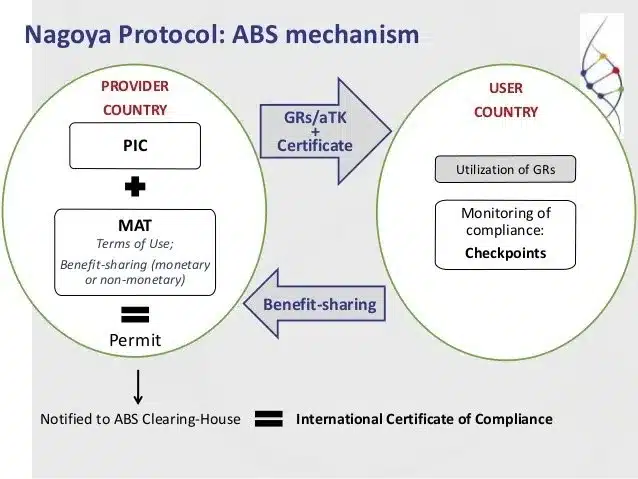
- Access: Requires Prior Informed Consent (PIC) from the provider country
- Benefit Sharing: Based on Mutually Agreed Terms (MAT)
- Compliance: Ensures resources are used as per agreed conditions
Coverage and Membership
- Covers: Genetic resources and Traditional knowledge
- Around 142 parties have ratified it
- Major non-parties: USA, Canada, Russia
India and Nagoya Protocol
- India ratified in 2012
- Implemented through:
- National Biodiversity Authority (central level)
- State Biodiversity Boards
- Biodiversity Management Committees (local level)
- Under the Biological Diversity Act, 2002
Recent Developments
- India is the largest issuer of IRCCs (Internationally Recognised Certificates of Compliance)
- Share: More than 56 percent of global certificates
- India issued 3561 IRCCs out of 6311 globally
- Other countries: France, Spain, Argentina, Panama, Kenya
- India submitted its first national implementation report in 2026
Key Concept: IRCCs
- IRCCs are official proof that:
- Prior Informed Consent has been taken
- Benefit sharing terms are agreed
- Information is uploaded to the Access and Benefit Sharing Clearing-House
Solid Waste Management (SWM) Rules, 2026
Context:
- Notified by the Ministry of Environment, Forest and Climate Change and effective from 1 April 2026
About the Rules
- The SWM Rules, 2026 provide a comprehensive framework for waste management in India
- Issued under the Environment (Protection) Act, 1986
- They replace the Solid Waste Management Rules, 2016
- The rules promote a shift from collect and dump model to a circular economy approach
- Circular economy means reuse, recycle, and recover resources from waste
Objective
- To achieve Zero Waste to Landfill
- To strengthen segregation at source and accountability
- To improve scientific waste processing and tracking
Key Features
1. Four-Category Waste Segregation
- Wet waste: Food and organic waste for composting
- Dry waste: Plastic, paper, metal for recycling
- Sanitary waste: Diapers and napkins for safe disposal
- Special care waste: Domestic hazardous items such as medicines and bulbs
2. Responsibility of Bulk Waste Generators
- Applies to entities generating large quantities of waste
- Must process organic waste on-site or obtain compliance certification
3. Digital Monitoring System
- A centralised online portal will track waste from generation to disposal
- Includes registration, reporting, and auditing
4. Polluter Pays Principle
- Imposes environmental penalties for non-compliance
- Applies to violations such as improper disposal or false reporting
5. Promotion of Waste-to-Energy
- Encourages use of Refuse-Derived Fuel (RDF) in industries
- Targets gradual increase in RDF usage
6. Landfill Management
- Landfills restricted to non-recyclable and inert waste only
- Mandatory biomining and remediation of old waste dumps
7. Special Provisions
- Hilly and island regions: Can regulate tourism and charge user fees
- Faster land allocation for waste processing units
Significance
- Reduces methane emissions from landfills
- Prevents soil and water pollution
- Promotes resource recovery and recycling
- Supports transition towards a circular economy
Bab el-Mandab Strait
Context:
- The strait is in news due to security threats and missile attacks in the region
About
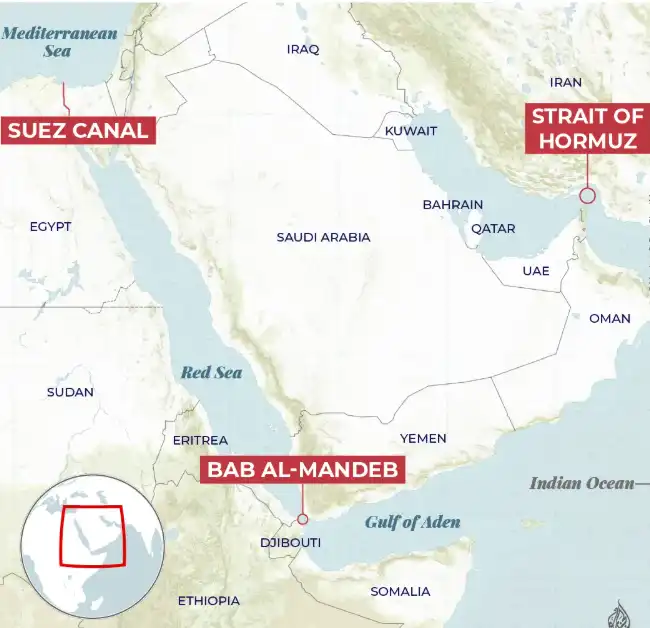
- The Bab el-Mandab Strait is a strategic maritime chokepoint
- It connects the Indian Ocean to the Mediterranean Sea (via the Red Sea and Suez Canal)
- It is one of the most important global shipping routes
Location
- Lies between: Horn of Africa (Djibouti and Eritrea) and Arabian Peninsula (Yemen)
- Connects: Red Sea to Gulf of Aden
- Divided by Perim Island into two channels
Key Features
- Narrow width of about 29 km at its narrowest point
- Handles about 10 to 12 percent of global oil and gas trade
- Major route for energy and cargo transport between Asia and Europe
- Highly vulnerable to conflicts and blockades
Strategic Importance
- Acts as a gateway to the Red Sea and Suez Canal route
- Essential for Persian Gulf oil supply to Europe and North America
- Supports large-scale global trade and container shipping
If Blocked
- Ships must take a longer route via the Cape of Good Hope (South Africa)
- This increases distance, cost, and time of shipping
Exercise Dweep Shakti
Context:
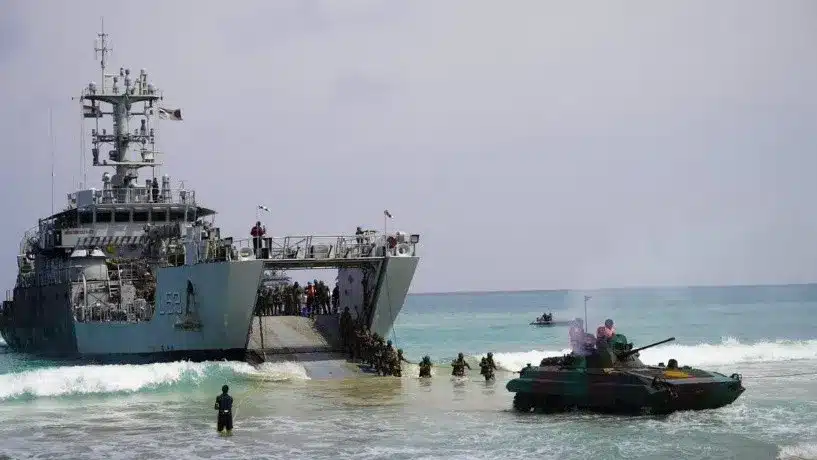
- A high-intensity tri-service exercise conducted by the Indian Armed Forces
About the Exercise
- Dweep Shakti is a large-scale joint military exercise involving: Indian Army, Indian Navy and Indian Air Force
- It focuses on defence of island territories and maritime regions
- Designed to test integrated combat capabilities in coastal areas
Host and Location
- Conducted under the Andaman and Nicobar Command (ANC)
- ANC is India’s only tri-service theatre command
- Location: Andaman and Nicobar Islands (strategically important in the Indian Ocean)
Objective
- To enhance coordination among the three services
- To ensure rapid deployment and response in case of maritime threats
- To strengthen amphibious and joint warfare capabilities
Key Features
- Amphibious Operations: Movement of troops from ships to land
- Maritime Control: Securing sea routes and preventing enemy presence
- Beach Landing Exercises: Deployment of heavy equipment on shores
- Use of Modern Technology: Drones for surveillance & Electronic warfare systems
- Joint Operations: Real-time coordination between land, air, and naval forces
Significance
- Strengthens defence of island territories (strategic assets)
- Improves protection of India’s coastline and Exclusive Economic Zone (EEZ)
- Demonstrates India’s military preparedness and joint capability
- Important in the context of increasing maritime competition in the Indian Ocean region
Prelims MCQs
Q1. With reference to Exercise Dweep Shakti, consider the following statements:
- It is a tri-service military exercise involving the Army, Navy, and Air Force.
- It is conducted under the Andaman and Nicobar Command.
- It is focused only on land-based warfare operations.
Which of the statements given above is/are correct?
(a) 1 and 2 only
(b) 2 only
(c) 1 and 3 only
(d) 1, 2 and 3
Q2. With reference to the Bab el-Mandab Strait, consider the following statements:
- It connects the Red Sea with the Gulf of Aden.
- It is located between the Horn of Africa and the Arabian Peninsula.
- It directly connects the Indian Ocean to the Atlantic Ocean.
Which of the statements given above is/are correct?
(a) 1 and 2 only
(b) 2 only
(c) 1 and 3 only
(d) 1, 2 and 3
Q3. Consider the following statements about Andaman and Nicobar Command (ANC):
It is India’s only tri-service theatre command.
It is responsible for operations in the Andaman and Nicobar Islands.
It operates under the Ministry of Home Affairs.
Which of the statements given above is/are correct?
(a) 1 and 2 only
(b) 1 only
(c) 2 and 3 only
(d) 1, 2 and 3
Q4. With reference to the Nagoya Protocol, consider the following statements:
- It is a legally binding agreement under the Convention on Biological Diversity.
- It deals with the regulation of genetically modified organisms (GMOs).
- It focuses on fair and equitable sharing of benefits arising from genetic resources.
Which of the statements given above is/are correct?
(a) 1 and 3 only
(b) 2 only
(c) 1 and 2 only
(d) 1, 2 and 3
Q5. With reference to Artemis II Mission, consider the following statements:
- It is a crewed mission that will orbit the Moon and return to Earth.
- It will be the first human mission to the Moon since Apollo 17 in 1972.
- It involves landing astronauts on the Moon’s surface.
Which of the statements given above is/are correct?
(a) 1 only
(b) 1 and 2 only
(c) 2 and 3 only
(d) 1, 2 and 3