Constitutional Morality: Balancing Law, Society, and Judicial Power
The idea of constitutional morality has become central in debates on judiciary and governance. It refers to values like liberty, equality, dignity, and respect for institutional processes. However, its increasing use by courts has raised concerns about judicial overreach. The debate revolves around balancing constitutional values with democratic decision-making.
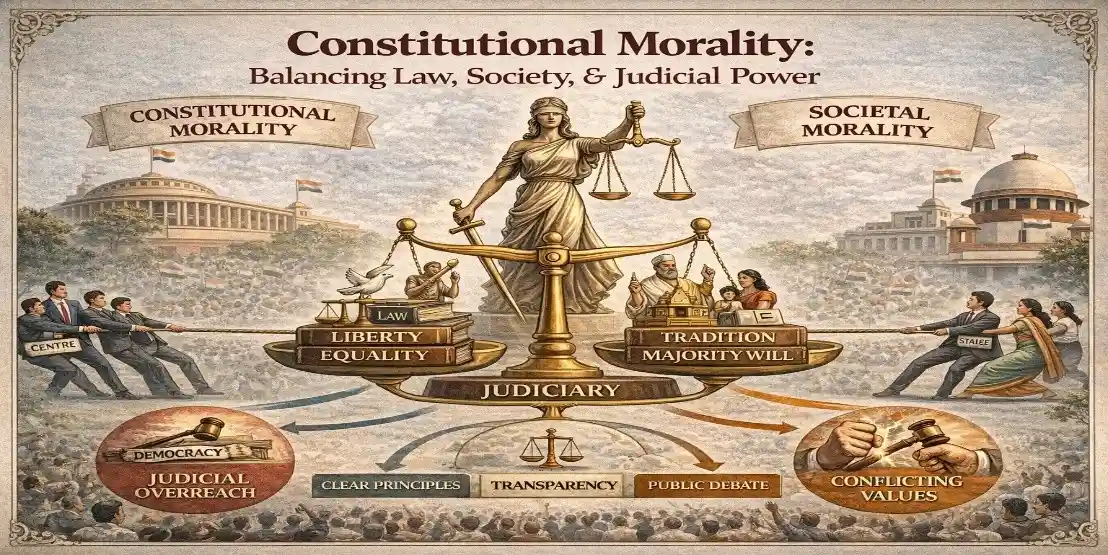
What is Constitutional Morality?
- Constitutional morality refers to adherence to core constitutional values and principles.
- It includes respect for plurality, due process, and accountability of institutions.
- It promotes freedom, equality, and protection of individual rights under the Constitution.
- It is often contrasted with societal morality, which reflects prevailing social norms.
Conceptual Concerns
- Critics argue that constitutional morality is a vague and loosely defined concept.
- It may become a tool for subjective judicial interpretation.
- There is a risk of courts imposing values without clear legal standards.
- This raises concerns about predictability and consistency in judicial decisions.
Constitutional Morality vs Societal Morality
- Constitutional morality focuses on rights and equality, even if society resists change.
- Societal morality reflects traditions, customs, and majoritarian beliefs.
- Courts have used constitutional morality to challenge discriminatory practices.
- Example: Navtej Singh Johar v. Union of India upheld LGBTQ rights.
Role of Judiciary
- Judiciary uses constitutional morality to protect fundamental rights under Part III.
- It ensures that laws and practices align with Articles 14, 19, and 21.
- Courts act as guardians of the Constitution against majoritarian excesses.
- However, excessive reliance may lead to judicial overreach into legislative domain.
Key Concerns Highlighted
- Use of constitutional morality may sometimes bypass democratic processes.
- It can reduce space for parliamentary sovereignty and public debate.
- Lack of clear standards may lead to arbitrariness and judicial inconsistency.
- Instances of selective intervention raise concerns about institutional credibility.
Illustrative Issues
- Debates like Sabarimala case highlight conflict between religious practices and equality.
- Questions arise on balancing institutional autonomy with individual rights.
- Concerns also emerge when courts avoid intervention in cases involving electoral or governance issues.
- This creates perception of inconsistency in application of constitutional morality.
Deeper Institutional Challenge
- The issue is not just interpretation but declining procedural discipline in governance.
- Concerns about arbitrariness, lack of transparency, and unpredictability are increasing.
- Constitutional morality should act as a check on misuse of power, not a vague principle.
- It must strengthen rule of law, not replace it with subjective reasoning.
Key Challenges
- Defining clear boundaries of constitutional morality in judicial decision-making.
- Balancing judicial activism with respect for legislative and executive functions.
- Ensuring consistency and predictability in application of constitutional principles.
- Maintaining public trust in institutions through fairness and transparency.
Way Forward
- Develop clearer judicial standards for applying constitutional morality in decisions.
- Strengthen institutional processes and respect for separation of powers.
- Encourage dialogue between judiciary, legislature, and society on constitutional values.
- Use constitutional morality as a guiding principle, not a substitute for law and procedure.
Constitutional morality is essential for protecting rights and ensuring justice in society. However, its misuse or overuse can lead to concerns about judicial overreach. A balanced approach is necessary to maintain democratic integrity and institutional harmony. Ultimately, constitutional morality should reinforce, not weaken, the rule of law.
An Alternative to Viksit Bharat Shiksha Adhishthan Bill: Balancing Centralisation and Federalism in Education
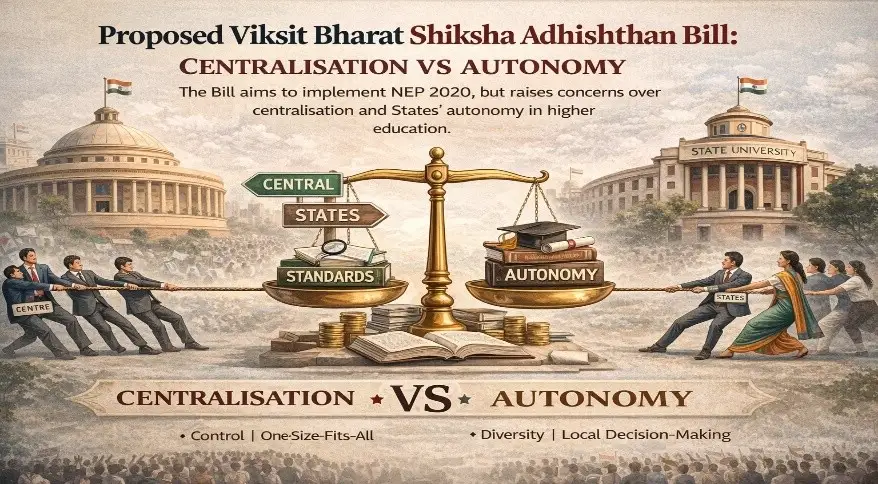
The proposed Viksit Bharat Shiksha Adhishthan Bill aims to implement the National Education Policy 2020. However, concerns have been raised regarding centralisation and constitutional overreach in education governance. Education is placed in the Concurrent List, requiring cooperation between Centre and States. The debate focuses on balancing uniform standards with federal autonomy and institutional freedom.
Key Concerns with the Bill
- The Bill gives extensive powers to Union-controlled regulatory bodies for standards and inspections.
- It reduces the role of States despite them being primary funders of higher education.
- It weakens institutions like the University Grants Commission (UGC) by diluting consultation mechanisms.
- It increases bureaucratic control over universities, affecting autonomy and innovation.
Issue of Centralisation
- The Bill allows central authorities to determine standards, accreditation, and regulation.
- This may lead to one-size-fits-all policies, ignoring regional and institutional diversity.
- States have limited say despite their responsibility in funding and managing institutions.
- Such centralisation can undermine the principle of cooperative federalism.
Impact on Institutional Autonomy
- Universities may lose decision-making power in academic and administrative matters.
- Governing bodies of institutions like IITs and IIMs may face reduced autonomy.
- Inspection-based regulation can become prescriptive rather than outcome-oriented.
- This may affect innovation, research quality, and academic freedom.
Concerns Regarding Equity and Social Justice
- The Bill does not sufficiently address inter-regional and social inequalities in education.
- It lacks provisions for strengthening access for marginalised communities (SC/ST/OBCs).
- Private institutions may not be adequately regulated for ensuring equity.
- It shifts focus from education as a public good to a market-driven approach.
Regulatory and Governance Issues
- Proposed bodies like Regulatory Council (Viniyaman Parishad) and Accreditation Council may centralise authority.
- Third-party accreditation may reduce transparency and accountability in evaluation processes.
- Output-based evaluation (like patents and publications) may not reflect real educational outcomes.
- Standard-setting by central bodies may ignore State-specific and sector-specific needs.
Need for Role of States
- States must be actively involved in decision-making on standards, funding, and governance.
- Institutions like State Higher Education Councils (SHECs) should be strengthened.
- Education governance should be based on consultation and consensus, not central imposition.
- Federal balance is essential for ensuring inclusive and effective education policy.
Proposed Alternative Framework
- Ensure representation of States and SHECs in all major regulatory councils.
- Create a Higher Education Grants Council (HEGC) for transparent and equitable funding.
- Adopt a shared governance model involving Centre, States, and institutions.
- Promote process-based and outcome-oriented evaluation, not rigid inspection systems.
Focus Areas for Reform
- Emphasise teaching, research, and outreach as integrated goals of higher education.
- Address regional disparities through targeted funding and policy support.
- Encourage innovation, interdisciplinary research, and global competitiveness.
- Incorporate local, ecological, and socio-economic realities into policy frameworks.
Way Forward
- Maintain balance between national standards and institutional autonomy in higher education.
- Strengthen cooperative federalism through active participation of States in governance structures.
- Ensure education remains a public good with focus on equity and accessibility.
- Provide adequate funding and reduce excessive bureaucratic control over institutions.
- Align reforms with long-term goals of innovation, inclusivity, and knowledge economy.
The Bill highlights the need for reform but raises concerns about centralisation and autonomy. A balanced framework is required to ensure both quality and inclusivity in higher education. Strengthening States’ role and institutional autonomy is crucial for sustainable reform. India’s higher education system must evolve with a focus on federal balance and academic excellence.
Prelims Boosters
Indian Council for Cultural Relations (ICCR)
Context:
- ICCR highlighted for strengthening India–Myanmar cultural ties
About
- ICCR is an autonomous body under the Ministry of External Affairs
- Established in 1950
- Founded by Maulana Abul Kalam Azad

Objective
- To promote India’s cultural relations with other countries
- To strengthen mutual understanding and cultural diplomacy
- To facilitate cultural exchanges globally
Functions
- Establishes and manages cultural centres abroad
- Promotes Indian art, culture, and heritage globally
- Supports cultural exchange programmes and events
- Provides scholarships to foreign students: Around 3000+ scholarships annually; Covers 180+ countries; Across 21 schemes
Scholarship Programmes
|
Significance
|
Türkiye (Turkey)
Context:
- India and Türkiye held the 12th round of Foreign Office Consultations
About
- Türkiye is a transcontinental country spanning Europe and Asia
- Majority lies in Anatolia (Western Asia), while a small part lies in Europe (Balkan region)
- Capital: Ankara
Location and Boundaries
- Bordered by: Greece and Bulgaria (northwest), Georgia (northeast), Armenia and Iran (east), Iraq (southeast), Syria (south)
- Also borders Nakhchivan (Azerbaijan exclave)
- Surrounded by seas: Black Sea (north), Mediterranean Sea (south), Aegean Sea (west)
Key Geographical Features
- Rivers: Tigris, Euphrates, Kızılırmak, Sakarya
- Lake: Lake Van (largest alkaline lake)
- Mountains: Taurus, Pontic, Köroğlu ranges
- Highest Peak: Mount Ararat

Important Straits
- Bosporus Strait: Connects Black Sea to Sea of Marmara
- Dardanelles Strait: Connects Aegean Sea to Sea of Marmara
Natural Resources
- Rich in: Chromite, Iron ore, Coal and lignite, Copper and bauxite
Significance
- Strategic location linking Europe and Asia
- Controls key maritime chokepoints (Bosporus and Dardanelles)
- Important in energy routes and geopolitics
Indravati Tiger Reserve
Context:
- The reserve is set to reopen for tourism, indicating improved conservation conditions
About
- Indravati Tiger Reserve is located in Chhattisgarh
- Part of a larger Indravati landscape along with: Bhairamgarh Wildlife Sanctuary and Pamed Wildlife Sanctuary
Location and Connectivity
- Connected with major tiger reserves: Kawal (Telangana), Tadoba (Maharashtra) and Kanha (Madhya Pradesh)
- The Indravati River forms:
- Northern and western boundary
- Interstate boundary between Chhattisgarh and Maharashtra
Vegetation
- Dominated by tropical deciduous forests:
- Southern moist mixed deciduous (with and without teak)
- Southern dry mixed deciduous
Flora
- Major species include: Teak, Arjun, Shisham; Semal, Jamun, Bel, Haldu
Fauna
- Known for rare wild buffalo (state animal of Chhattisgarh)
- Other species: Tiger, Leopard, Gaur, Sambar, Chital, Nilgai, Blackbuck, Sloth bear
Significance
- Important tiger habitat in central India
- Key site for wild buffalo conservation
- Enhances eco-tourism and local livelihoods
Commonwealth Parliamentary Association (CPA)
Context:
- CPA India Region Zone VII Conference held in Goa

About
- The Commonwealth Parliamentary Association (CPA) is one of the oldest organisations in the Commonwealth
- Established in 1911
- It is a membership-based organisation of legislators
- Headquarters: London, United Kingdom
Objective
- To promote parliamentary democracy
- To strengthen knowledge of governance and legislative practices
- To encourage youth participation, gender equality, and representation
Structure
CPA India Region
|
Important Zones
|
Administration (India Region)
- Chairperson: Lok Sabha Speaker
- Secretariat located in Parliament of India (Lok Sabha)
Significance
- Promotes exchange of parliamentary best practices
- Strengthens democratic institutions across Commonwealth
- Enhances legislative cooperation and capacity building
National Scheduled Tribes Finance and Development Corporation (NSTFDC)
Context:
- NSTFDC is celebrating its 25th Foundation Day, marking progress in tribal empowerment
About
- NSTFDC is a Public Sector Undertaking (PSU) under the Ministry of Tribal Affairs
- It is the apex organisation for economic development of Scheduled Tribes
- Established in 2001
Objective
- To promote economic upliftment and financial inclusion of Scheduled Tribes
- To support income-generating activities and entrepreneurship
- To improve livelihood and quality of life
Key Functions
- Provides concessional loans (low-interest finance) to ST individuals and groups
- Supports activities like handicrafts, dairy, poultry, fisheries, and small businesses
- Operates through State Channelizing Agencies (SCAs) for last-mile delivery
- Promotes entrepreneurship among tribal youth and women
- Offers capacity building and financial support for sustainable livelihoods
Significance
- Promotes inclusive growth of tribal communities
- Helps convert job seekers into entrepreneurs
- Reduces regional and social inequalities