Judicial Contempt vs Free Speech: Where Should the Line Be Drawn?
Contempt of Court: Constitutional Framework

Contempt of court is a mechanism to protect the authority and functioning of the judiciary. It includes both civil and criminal forms.
- Civil Contempt refers to disobedience of court orders.
- Criminal Contempt includes acts that scandalise or lower the authority of courts or interfere with justice.
| The Constitution provides this power under: • Article 129 – Supreme Court as Court of Record • Article 215 – High Courts as Courts of Record | At the same time, • Article 19(1)(a) guarantees freedom of speech • Article 19(2) allows reasonable restrictions, including contempt of court |
Thus, the Constitution itself creates a balance between authority and liberty.
Judicial Authority and Public Trust
The judiciary does not rely on force but on moral authority and legitimacy. Its strength lies in public confidence.
- Courts depend on voluntary compliance with their decisions.
- Trust is built through fairness, transparency, and reasoned judgments.
- Article 50 ensures separation of judiciary from executive, strengthening independence.
At the same time, independence must be complemented by accountability, which comes through public scrutiny.
Role of Criticism in Democracy
Criticism of the judiciary is not a threat but an essential feature of democracy. It promotes accountability and institutional improvement.
- Citizens and media have the right to question judicial decisions under Article 19(1)(a).
- Constructive criticism helps identify gaps and improve functioning.
- The judiciary itself has recognised that it is not above criticism.
However, criticism must remain responsible and not be driven by misinformation or malicious intent.
Drawing the Line: Criticism vs Contempt
The key challenge lies in distinguishing between legitimate criticism and contemptuous conduct.
Acceptable Criticism includes: | Contemptuous Conduct includes: |
Courts must ensure that only genuinely harmful actions attract contempt proceedings.
Concerns: Chilling Effect on Free Speech
Excessive or frequent use of contempt powers can create a chilling effect on free speech.
- Individuals may hesitate to express opinions
- Academic and intellectual debate may weaken
- Public discourse becomes less vibrant
Such outcomes can ultimately harm the credibility of the judiciary rather than strengthen it.
Way Forward: Ensuring Balance
A balanced and mature approach is required to maintain both judicial dignity and democratic freedoms.
- Contempt powers should be used sparingly and cautiously
- Courts should encourage constructive criticism
- Institutional dignity should be maintained through conduct and transparency
- Opportunity for clarification should be provided before initiating action
This approach strengthens both accountability and trust.
Higher Education in India: Expansion without Equity and Quality
Growth in Higher Education: A Mixed Picture
India has seen substantial progress in enrolment levels over time.
- The Gross Enrolment Ratio (GER) increased from about 16 percent in 2011 to around 28 percent in 2022.
- Enrolment among Scheduled Castes and Scheduled Tribes has also improved significantly.
- Gender parity has nearly been achieved in higher education participation.
Despite these gains, access remains uneven, and higher education continues to be dominated by students from relatively better-off households.
Expansion of Institutions without Faculty Growth
The number of colleges and universities has increased sharply, largely driven by private sector expansion.
- Institutions increased from about 1,600 in 1950 to over 69,000 by 2022.
- College density improved from 29 to 45 colleges per lakh youth (2010–2021).
However, this expansion has not been matched by teacher recruitment:
- Student-teacher ratios have worsened over time in many regions.
- Several districts, especially in northern and eastern India, face acute faculty shortages.
- This affects the quality of teaching and learning outcomes.
Regional Inequality in Access
Significant disparities exist across regions in terms of access to higher education.
- Many districts have fewer than 18 colleges per lakh youth population.
- Northern and eastern regions lag behind in both institutional availability and faculty strength.
- Expansion has been uneven, leading to unequal educational opportunities.
Thus, geographical location continues to influence access to higher education.
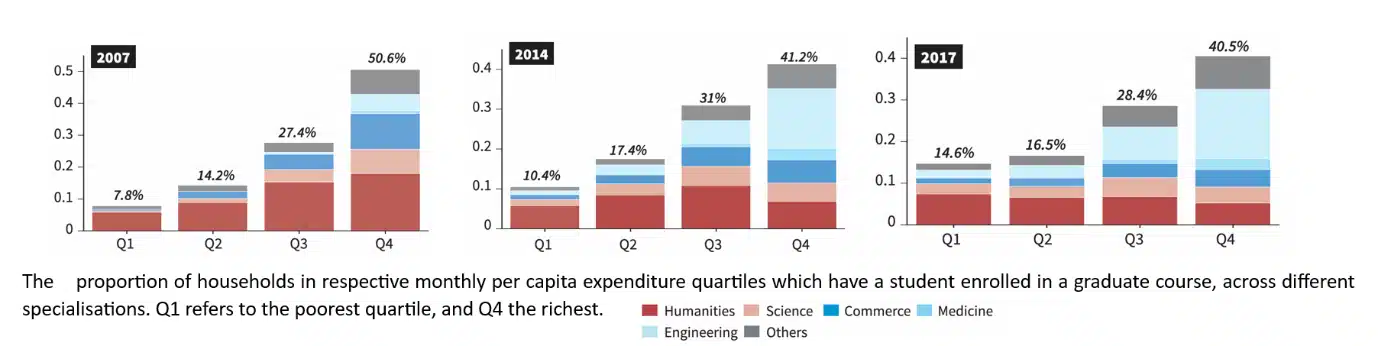
Socio-Economic Inequality: Course of Privilege
Higher education choices are strongly influenced by income levels.
- Students from wealthier households are more likely to enrol in professional courses such as engineering and medicine.
- Students from lower-income groups tend to choose humanities and commerce, which are relatively less expensive.
This creates a “course of privilege”:
- Professional courses are costly and inaccessible to poorer students.
- Education pathways reinforce existing social and economic inequalities.
Cost Barrier in Higher Education
The rising cost of education is a major obstacle to equitable access.
- Professional courses such as medicine and engineering involve high annual fees.
- For poorer households, these costs often exceed their annual income or consumption expenditure.
- Financial constraints limit access to high-return courses and career opportunities.
Thus, affordability remains a key challenge.
Key Structural Issues
The current higher education system faces multiple structural problems:
- Faculty Shortage leading to poor student-teacher ratios
- Regional Disparities in institutional distribution
- Economic Inequality affecting course selection
- Quality Concerns due to inadequate teaching capacity
- Private Sector Dominance without adequate regulation
Way Forward: From Expansion to Equity
A shift in policy focus is required to address these challenges.
- Increase Faculty Recruitment to improve student-teacher ratios
- Reduce Regional Gaps by establishing institutions in underserved areas
- Improve Affordability through scholarships, subsidies, and financial aid
- Regulate Private Institutions to ensure quality and fair pricing
- Promote Inclusive Access for disadvantaged groups
The focus must move from mere expansion to ensuring quality, equity, and inclusiveness.
Prelims Boosters
Green Ammonia
Context:
- India has signed green ammonia supply agreements under the National Green Hydrogen Mission
What is Ammonia?
- Ammonia (NH₃) is a pungent gas mainly used in fertiliser production
What is Green Ammonia?
- Green Ammonia is ammonia produced using renewable energy sources such as solar and wind
- It is made by combining: Green hydrogen (produced using renewable energy) and Nitrogen from air
- It is carbon-free and environmentally friendly
Production Process
Green ammonia is produced through a series of steps. First, hydrogen is generated by splitting water using electricity from renewable sources such as solar or wind in a process called electrolysis (breaking water into hydrogen and oxygen). Next, nitrogen is extracted from the air, since air contains a large proportion of nitrogen. Finally, the hydrogen and nitrogen are combined under high pressure in the presence of a catalyst to form ammonia (NH₃).
Types of Ammonia
- Grey Ammonia: Produced from fossil fuels, high emissions
- Blue Ammonia: Fossil fuel-based with carbon capture
- Green Ammonia: Renewable-based, no carbon emissions
Applications
Green ammonia has multiple important applications. It is widely used in fertiliser production, especially in manufacturing urea and ammonium nitrate. It also serves as a clean fuel for shipping, offering a low-emission alternative to conventional fuels. In addition, it can be used in power generation, either directly or along with other fuels. Further, it acts as an efficient carrier of hydrogen, making the transport and storage of hydrogen easier and safer.India’s Initiatives
- National Green Hydrogen Mission: Target of 5 million metric tonnes of green hydrogen by 2030
- SIGHT Programme: Provides incentives for production and manufacturing
- Large-scale agreements for green ammonia supply to fertiliser sector
Shyamji Krishna Varma
Context:
- The Prime Minister paid homage on his death anniversary
About
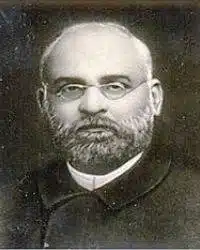
- Shyamji Krishna Varma was a revolutionary nationalist leader who operated mainly from Europe
- Among the early advocates of complete independence (Swaraj)
Early Life and Education
- Born on 4 October 1857 at Mandvi, Gujarat
- Belonged to a Bhanushali family
- Excelled in Sanskrit and English
- One of the first Indians to study at Oxford University
- Worked as a lawyer and served in princely states
- Deeply influenced by Swami Dayanand Saraswati
- Became the first President of Bombay Arya Samaj
| Revolutionary Contributions | Influence on Revolutionaries |
|
|
Later Life and Death
- Shifted to Paris and later Geneva due to British pressure
- Continued nationalist activities from abroad
- Died on 31 March 1930
- A memorial Kranti Teerth was established in Gujarat in 2010
Kugti Wildlife Sanctuary
Context:
- A rare albino Himalayan tahr has been recorded in the sanctuary
About
- The Kugti Wildlife Sanctuary is located in Himachal Pradesh
- It is the second largest wildlife sanctuary in the state (Kibber Wildlife Sanctuary located in the Lahaul and Spiti district, is the largest one.)
- Situated in the Chamba district (Bharmour region)
- It also includes the famous Manimahesh Temple, attracting pilgrims despite difficult terrain
Location and Geography
- Located between the Ravi and Chenab rivers
- Surrounded by: Dhauladhar Wildlife Sanctuary (south-east) and Tundah Wildlife Sanctuary (north-west)
- Altitude ranges from 2,195 m to 5,040 m
- Characterised by high-altitude mountainous terrain
Vegetation
- Includes:
- Alpine pastures (high-altitude grasslands)
- Western mixed coniferous forests
- Moist deodar forests
Flora
Dominant trees include:
|
Fauna
Home to several important species such as:
|
Sloth Bear
Context:
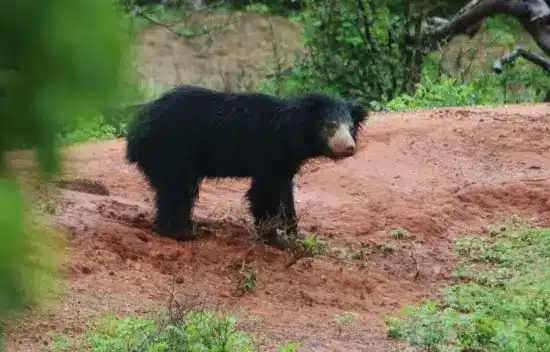
- A sloth bear was recently captured by forest officials in Karnataka
About
- The Sloth Bear is one of the eight bear species found globally
- It is myrmecophagous (feeds mainly on ants and termites)
Features
- Covered with long, shaggy dark fur
- Possesses long curved claws (adapted for digging)
- Has a long lower lip and palate used for sucking insects
- Also called “labiated bear”
Habitat and Distribution
- Found in dry and moist forests and grasslands
- Requires areas with rocks, shrubs, and trees for shelter
- Distributed mainly in: India, Nepal, Sri Lanka, Bhutan
- Mostly nocturnal (active at night)
Important Sanctuaries in India
- Daroji Sloth Bear Sanctuary (Karnataka)
- Jessore Sloth Bear Sanctuary (Gujarat)
Conservation Status
- IUCN: Vulnerable
- CITES: Appendix I
- Wildlife Protection Act, 1972: Schedule I
National Assessment and Accreditation Council (NAAC)
Context:
- No university or college has received fresh accreditation in the current academic year
About NAAC
- The National Assessment and Accreditation Council (NAAC) is an autonomous institution under the University Grants Commission
- Established in 1994 and Headquarters: Bengaluru
- It is responsible for assessment and accreditation of higher educational institutions (HEIs) such as universities and colleges
Objective
- To assess and ensure quality in higher education
- To promote continuous improvement in institutions
- To provide a quality status (grading) of institutions
Functions
- Conducts evaluation and accreditation of institutions
- Helps institutions identify strengths and weaknesses
- Encourages quality enhancement and accountability
- Provides grades based on performance
Parameters of Evaluation
NAAC assesses institutions on: Curriculum (courses and syllabus), Teaching–learning process, Infrastructure and facilities, Governance and management and Research and innovation activities
Structure
- Functions through: General Council (GC) and Executive Committee (EC)
- UGC Chairperson acts as President of General Council
- Executive Committee Chairperson is an eminent academician
Key Features
- Accreditation is currently voluntary
- Applies to colleges, universities, and recognised institutions
- Plays a key role in improving education standards in India
Prelims MCQs
Q1. With reference to the National Assessment and Accreditation Council (NAAC), consider the following statements:
- It is a statutory body under the Ministry of Education.
- It functions under the University Grants Commission (UGC).
- It is responsible for accreditation of higher educational institutions.
Which of the statements given above is/are correct?
(a) 2 and 3 only
(b) 1 and 2 only
(c) 1 and 3 only
(d) 1, 2 and 3
Q2. With reference to the Sloth Bear, consider the following statements:
- It mainly feeds on ants and termites.
- It is found only in India.
- It is also known as the labiated bear.
Which of the statements given above is/are correct?
(a) 1 and 3 only
(b) 1 only
(c) 2 and 3 only
(d) 1, 2 and 3
Q3. Consider the following statements about the contributions of Shyamji Krishna Varma:
- He founded the Indian Home Rule Society in London.
- He started a journal called The Indian Sociologist.
- He was directly associated with the Non-Cooperation Movement in India.
Which of the statements given above is/are correct?
(a) 1 only
(b) 2 and 3 only
(c) 1 and 2 only
(d) 1, 2 and 3
Q4. With reference to Kugti Wildlife Sanctuary, consider the following statements:
- It is located in Himachal Pradesh.
- It is the largest wildlife sanctuary in the state.
- It lies between the Ravi and Chenab rivers.
Which of the statements given above is/are correct?
(a) 1 only
(b) 1 and 3 only
(c) 2 and 3 only
(d) 1, 2 and 3
Q5. With reference to India’s initiatives on Green Ammonia, consider the following statements:
- It is part of the National Green Hydrogen Mission.
- India aims to produce 5 million metric tonnes of green hydrogen by 2030.
- SIGHT Programme provides incentives for production.
Which of the statements given above is/are correct?
(a) 1 and 2 only
(b) 2 and 3 only
(c) 1 and 3 only
(d) 1, 2 and 3