
Neighbourhood Matters
- Non-Reciprocity: Inspired by the Gujral Doctrine, India often provides assistance (financial, technical, or humanitarian) without expecting an equal return.
- Consultative Approach: Moving away from a “Big Brother” image to a “Lead Partner” role through mutual respect (Samman) and dialogue (Samvad).
- Connectivity as Sovereignty: Viewing regional integration (physical, digital, and energy) not just as trade but as a tool for collective strategic autonomy.
Importance of the Policy
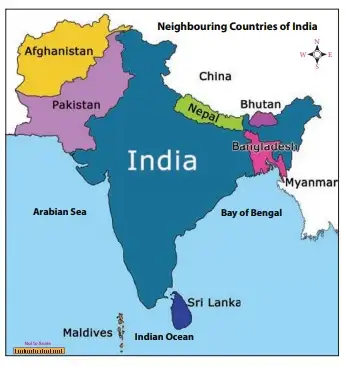
- Strategic Security: Friendly neighbours act as a “buffer” against hostile actors. Cooperation is vital to manage “non-traditional” threats like cross-border terrorism, insurgencies in the North-East (e.g., cooperation with Myanmar/Bangladesh), and human trafficking.
- Countering the “String of Pearls”: As China expands its footprint through the Belt and Road Initiative (BRI), NFP serves as India’s primary tool to offer a transparent, sustainable alternative to “debt-trap diplomacy.”
- Economic Integration: For India’s landlocked North-Eastern states, transit through Bangladesh and connectivity with Nepal/Bhutan are essential for unlocking the “Act East” potential.
- Net Security Provider: To lead in the Indian Ocean Region (IOR), India needs the support of maritime neighbours like Sri Lanka, Maldives, and Bangladesh for SAGAR (Security and Growth for All in the Region).
Current Scenario
| Country | Current Status | Key Dynamics |
| Bangladesh | The Post-Hasina Reset | Following the February 2026 elections, India is engaging with the new administration (BNP-led) to move past the “Golden Era” of the Awami League. Focus is on the Ganga Water Treaty (expiring Dec 2026) and CEPA negotiations. |
| Nepal | Stability & Energy | After a period of “tilting” toward China, Nepal has stabilized ties with India. The focus has shifted to Hydro-diplomacy (selling power to India/Bangladesh) and completing the Integrated Check Posts (ICPs). |
| Maldives | Strategic Balancing | After an “India Out” phase, relations have pivoted back to economic pragmatism. India recently restructured Maldivian debt and provided a $565 million credit line. |
| Sri Lanka | The Credible Partner | India’s $4 billion “first responder” aid during the economic crisis has created long-term goodwill, focusing now on the Trincomalee Energy Hub. |
| China | Dependence of Supply Chain. | India’s largest trading partner but issues in border settlement and rise of Chinese Cheque book diplomacy |
| Pakistan | Hub of Terrorism | Currently the ties are at the lowest point post Pulwama, Pehelgam terrorist attacks. |
Challenges to the Policy
- The “China Factor”: China’s deep pockets and rapid project execution continue to lure neighbours looking for infrastructure.
- Domestic Politics & Anti-India Sentiment: “India Out” campaigns often become electoral tools in neighbouring democracies (Maldives, Bangladesh).
- Implementation Gaps: India’s “delivery deficit”—the gap between announcing a project and completing it—remains a major hurdle compared to Chinese efficiency.
- Internal Security-Foreign Policy Linkage: Issues like the CAA/NRC or border killings (BSF-BGB) often create diplomatic friction with Bangladesh.
Way Forward: How to Improve
- Institutionalize Ties: Move away from “leader-to-leader” diplomacy to “institution-to-institution” engagement. This ensures that a change in government (as seen in Bangladesh) doesn’t result in a total collapse of ties.
- The “3Cs” Focus: Connectivity: Rapidly complete the BBIN (Bangladesh-Bhutan-India-Nepal) motor vehicle agreement. 2. Commerce: Finalize pending Free Trade Agreements (like the CEPA with Bangladesh) to reduce trade deficits. 3. Culture: Leverage “Soft Power” (Buddhism, Bollywood, Yoga) and “Health Diplomacy” (Vaccine Maitri 2.0) to build people-to-people trust.
- Digital Public Infrastructure (DPI): Export the “India Stack” (UPI, Aadhaar, Cowin) to neighbours. Making their economies digitally compatible with India creates a “sticky” relationship that is hard to undo.
- Crisis Management: Strengthen the role of BIMSTEC as a viable alternative to the dormant SAARC, focusing on disaster management and blue economy.
India’s destiny is geographically locked with its neighbours. A successful “Neighbourhood First” policy requires India to be a benevolent hegemon—one that is sensitive to the domestic anxieties of smaller states while remaining firm on its core national security interests.
India’s Energy Landscape: Transition, Vulnerabilities, and Strategic Resilience
Overview: India’s Current Energy Mix (2026 Status)
- Installed Power Capacity: India has crossed the 51% mark for non-fossil fuel sources in its installed electricity capacity (approx. 263 GW), achieving its 2030 NDC target five years early.
- Renewable Energy (RE) Dominance: Solar energy is the primary driver, with installed capacity exceeding 140 GW, followed by Wind (54 GW) and Large Hydro.
- Coal’s Paradox: While its share in installed capacity is falling (now approx. 43%), coal remains the “baseload” backbone, still accounting for over 70% of actual electricity generation.
- Oil & Gas Reliance: India remains the world’s third-largest consumer of crude oil, with an import dependence peaking at 88–89% in 2025-26.
- Emerging Sectors: The National Green Hydrogen Mission and a renewed push for Small Modular Reactors (SMRs) in the nuclear sector (target 100 GW by 2047) are the new frontiers.
Key Energy Vulnerabilities
- Import Dependence & Price Volatility: With nearly 90% of oil and 50% of natural gas imported, India’s fiscal health is a hostage to global Brent prices. Every $10/barrel rise increases the trade deficit by approx. $13 billion.
- Geopolitical Chokepoints: A significant portion of India’s LPG and LNG passes through the Strait of Hormuz. Recent regional tensions (2025-26) have highlighted how easily these “just-in-time” supply chains can be paralyzed.
- Critical Mineral Bottlenecks: The shift to EVs and solar panels has replaced “oil dependence” with “mineral dependence.” India relies heavily on imports for Lithium, Cobalt, and Rare Earth Elements, primarily from China-dominated supply chains.
- Grid Variability and Storage Gap: As RE penetration increases, the “Duck Curve” effect (mismatch between peak supply and peak demand) worsens. India lacks sufficient Battery Energy Storage Systems (BESS) and Pumped Hydro to manage grid stability.
- Climate-Induced Demand Surges: Unusually early and intense heatwaves (recorded in Feb-March 2026) cause massive spikes in cooling demand, straining even the most robust power grids.
Why These Vulnerabilities Prevailed in the Long Term?
- Stagnant Domestic Production: Despite policies like HELP and OALP, domestic crude oil production has remained stagnant for a decade due to aging fields and high geological risks in deep-water exploration.
- Inadequate Strategic Reserves: India’s Strategic Petroleum Reserves (SPR) currently cover only about 9–10 days of net imports, far below the IEA mandate of 90 days.
- Delayed Structural Reforms in DISCOMs: The financial ill-health of Power Distribution Companies (DISCOMs) prevents them from investing in modern grid infrastructure and smart meters.
- Limited “Base Load” Alternatives: Nuclear energy development was slowed by civil liability concerns and long gestation periods, leaving coal as the only viable “firm” power source for decades.
- Underdeveloped Gas Infrastructure: Until recently, the “National Gas Grid” lacked the connectivity required to make natural gas a true “bridge fuel” for industries and transport.
Management Strategy: Short vs. Long Term
Short-Term Measures (0–2 Years)
- Supply Diversification: Ramping up crude sourcing from non-traditional partners (e.g., Russia, Guyana, Norway) to bypass maritime flashpoints.
- Demand Side Management: Implementing time-of-day (ToD) tariff structures to shift industrial load to daytime (solar peak).
- Invoking the Essential Commodities Act: Regulating gas allocation to prioritize households (PNG) and fertilizers over non-essential industries during crises.
- Maximizing Refinery Flexibility: Enabling refineries to process diverse crude grades and maximize LPG output to prevent domestic kitchen-fuel shortages.
- Strategic Bilateral Swaps: Negotiating LNG “swap” deals with friendly nations to divert cargoes in case of chokepoint closures.
Long-Term Measures (5–20 Years)
- Mission Samudra Manthan: Accelerating deep-water offshore drilling to double domestic production targets by 2030.
- Expanding SPR Phase II: Fast-tracking underground storage at Chandikhol and Padur to increase the reserve buffer to 30+ days.
- Deep-Tech & Storage: Incentivizing the PLI Scheme for Advanced Chemistry Cell (ACC) batteries and Green Hydrogen to “de-fossilize” heavy industry (Steel/Cement).
- Nuclear Renaissance: Launching indigenously designed Small Modular Reactors (SMRs) to provide clean, stable baseload power.
- Biofuel Autonomy: Achieving E20 (20% Ethanol blending) and scaling up Compressed Biogas (CBG) to reduce the petroleum import bill by billions
India’s energy security is no longer just about “access” but “resilience.” While the record-breaking transition to renewables provides a sustainable path, the immediate “oil-gas-mineral” trilemma requires a pragmatic blend of aggressive domestic exploration and global strategic alliances.
Prelims Boosters
Grameen Credit Score (GCS)
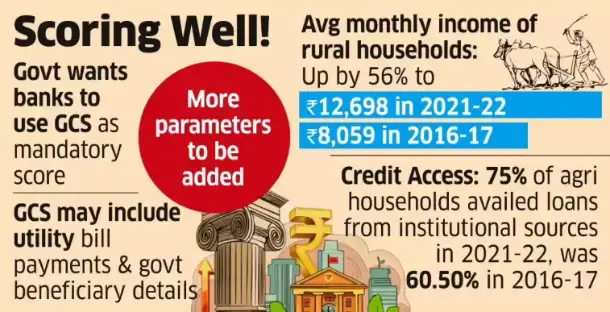
- What it is: A specialized credit scoring framework tailored for the rural economy, moving beyond traditional models like CIBIL.
- Primary Target: Members of Self-Help Groups (SHGs), Joint Liability Groups (JLGs), small farmers, and rural women entrepreneurs.
- Implementation: Developed by Public Sector Banks (PSBs) in collaboration with credit bureaus (like TransUnion CIBIL, Experian).
- Key Features
- Alternative Data Points: Unlike traditional scores that rely on bank loan history, GCS uses “non-traditional” data:
- SHG/JLG repayment patterns and internal lending records.
- Utility payments (electricity, water) and mobile/TV recharges.
- Agricultural cycles and seasonal income patterns.
- Digital footprints like UPI transactions and government benefit transfers.
- Scoring Range: 300 to 900.
- Complementary Role: It does not replace CIBIL/CRIF but works alongside them to provide a more holistic view of a rural borrower’s creditworthiness.
- Customized Credit Cards: As part of this initiative, the government is launching Credit Cards for Micro-Enterprises with a limit of up to Rs 5 lakh.
- Alternative Data Points: Unlike traditional scores that rely on bank loan history, GCS uses “non-traditional” data:
PRISM-SG Portal
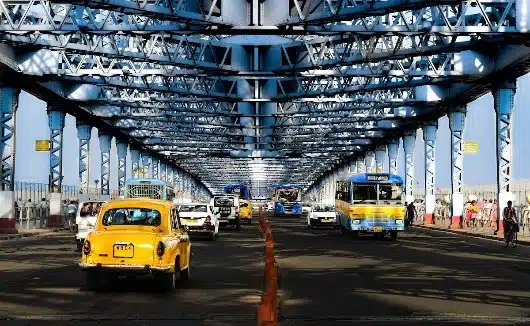
- Full Form: Portal for Rail-Road Inspection & Stages Management – Steel Girders.
- Nodal Ministries: A joint initiative of the Ministry of Road Transport & Highways (MoRTH) and the Ministry of Railways.
- Objective: To digitize and streamline the technical approvals and inspection processes specifically for Steel Girders used in Road Over Bridges (ROBs) and Railway Bridges.
- Key Technical Features
- End-to-End Digitization
- Specific Documentation: Digitizes the Quality Assurance Plan (QAP) and the Welding Procedure Specification Sheet (WPSS).
- Inspection Management: Online scheduling of physical inspections, instant upload of reports, geo-tagged photographs, and test results.
- Audit Trail: Maintains an unalterable digital log of every approval stage, ensuring high accountability and transparency.
- Significant Impact
- Timeline Reduction: Aims to reduce the approval and inspection cycle from 12 months to just 3–4 months (a 70% reduction).
- Stakeholder Integration
- Cost Efficiency
Bab-el-Mandeb Strait
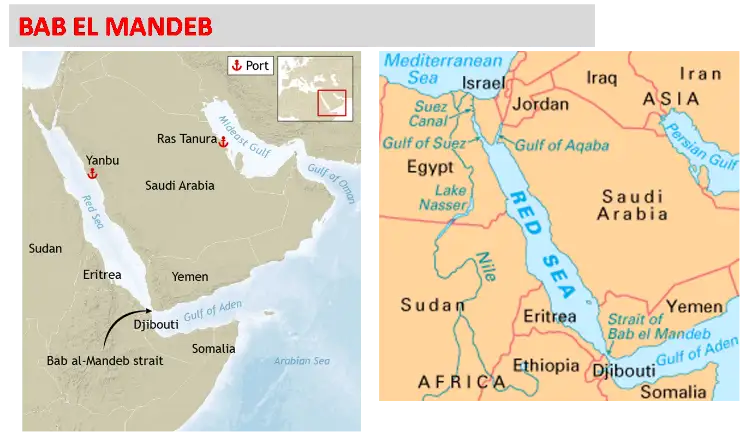
- Connects: The Red Sea (Northwest) to the Gulf of Aden / Arabian Sea (Southeast).
- Separates: The Arabian Peninsula (Asia) from the Horn of Africa (Africa).
- Bordering Countries: Yemen, Djibouti and Eritrea.
- Key Islands:
- Perim Island (Mayyun): A Yemeni volcanic island that divides the strait into two channels.
- Seven Brothers (Sawabi Islands): An archipelago located near the coast of Djibouti.
- Strategic & Economic Significance
- The “Gate of Tears”: Its name (Arabic: Bab-el-Mandeb) refers to the historical dangers of navigating its currents and reefs.
- Oil Chokepoint: It is the 3rd most important chokepoint for global oil and natural gas (after the Strait of Hormuz and Malacca).
- Suez Canal Link: It acts as the “Southern Gate” to the Suez Canal. If blocked, ships must detour around the Cape of Good Hope (South Africa), adding ~10-14 days to the journey.
- Underwater Cables: It is a major corridor for subsea fiber-optic cables that carry internet traffic between Europe and Asia.
SRY Gene Screening
- Location: Found exclusively on the Y chromosome.
- Function: It is the “master switch” for male sex determination. It triggers the transformation of undifferentiated gonads into testes.
- Mechanism: It encodes the TDF (Testis-Determining Factor) Without this gene (or if it is “switched off”), the embryo develops female reproductive structures (ovaries) by default.
- The International Olympic Committee (IOC) announced a seismic policy change mandating SRY gene screening for all female athletes in international elite sports.
- This decision effectively bans transgender women and many DSD (Differences in Sex Development) athletes from female categories.
- Aim: The primary objective is to protect the female categoryin elite sports.
How it Works?
- Sample Collection:The athlete provides a simple saliva sample or a cheek swab
- DNA Analysis:to detect the presence or absence of the SRY gene.
- Turnaround Time:The process typically takes about one week for results.
- Verification:The results are submitted to the relevant international sports body. If negative, the athlete is permanently cleared for the female category.
Tunguska Air Defence Missile System (2K22M)
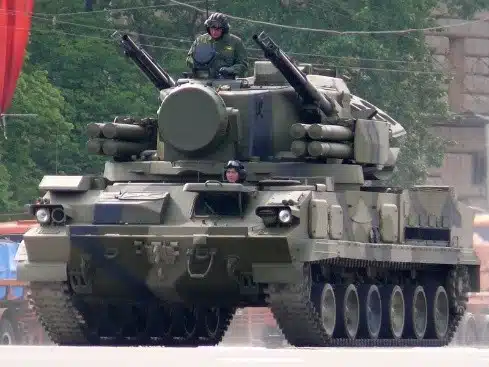
- The Ministry of Defence signed a Rs 445 crore contract with Russia’s JSC Rosoboronexport, to procure the Tunguska Air Defence Missile System for the Indian Army.
- Type: A tracked, self-propelled anti-aircraft weapon system (SPAAGM).
- Origin: Soviet Union/Russia (Developed by KBP Instrument Design Bureau).
- Role: Designed for Short-Range Air Defence (SHORAD) to protect mechanized infantry and tank regiments on the move.
- The “Hybrid” Advantage (Key Feature)- Unlike most systems that use either guns or missiles, the Tunguska integrates both on a single chassis:
- Guns: Twin 30 mm autocannons (2A38M) with a massive rate of fire (up to 5,000 rounds per minute). Effective range: 2 to 4 km.
- Missiles: Eight 9M311-series surface-to-air missiles (SAM). Effective range: 5 to 10 km; Altitude: up to 3.5 km.
- Technical Capabilities
- Radar System: Features a 360-degree target acquisition radar (detection up to 18 km) and a dedicated tracking radar.
- Optical Backup: Includes an optical sight with a laser rangefinder, allowing it to engage targets even if the enemy uses Electronic Warfare (EW) to jam its radar.
- Mobility: Mounted on a tracked armored chassis (GM-352 series), allowing it to keep pace with T-90/Arjun tanks across rugged terrain.
- Fire-on-the-move: It can fire its guns while moving, though missiles usually require a brief stop or very slow speeds for guidance accuracy.
Prelims MCQ
Q1. With reference to the Grameen Credit Score (GCS), consider the following statements:
- It is a specialized financial inclusion framework introduced in the Union Budget 2025-26 to bridge the credit gap for “credit invisible” rural populations.
- The score is uniquely calculated using alternative data such as Self-Help Group (SHG) internal lending records and utility payment history.
- Once implemented, it will legally replace the CIBIL score for all micro-finance and agricultural loan processing in India.
Which of the statements given above are correct?
- 1 and 2 only
- 2 and 3 only
- 1 and 3 only
- 1, 2, and 3
Q2. Consider the following statements regarding the PRISM-SG Portal:
- It is a collaborative digital initiative between the Ministry of Railways and the Ministry of Road Transport & Highways (MoRTH).
- The portal specifically digitizes the Quality Assurance Plan (QAP) and inspection stages for Steel Girders used in bridge construction.
- It aims to reduce the typical 12-month technical approval cycle for Road Over Bridges (ROBs) to approximately 3–4 months.
Which of the statements given above are correct?
- 1 and 2 only
- 2 and 3 only
- 1 and 3 only
- 1, 2, and 3
Q3. With reference to the Bab-el-Mandeb Strait, consider the following statements:
- It connects the Red Sea to the Gulf of Aden and separates the continent of Africa from the Arabian Peninsula.
- The strait is divided by Perim Island into two channels, of which the narrow eastern channel is the primary international shipping lane.
- Geologically, the strait is a part of the Great Rift Valley system and sits on a divergent plate boundary.
Which of the statements given above are correct?
- 1 and 2 only
- 2 and 3 only
- 1 and 3 only
- 1, 2, and 3
Q4. Regarding the SRY (Sex-determining Region Y) gene, consider the following statements:
- It is the “master switch” for male sex determination and is located on the short arm of the Y chromosome.
- In the clinical condition known as Swyer Syndrome, an individual possesses XY chromosomes but lacks a functional SRY gene, resulting in a female phenotype.
- In India, the use of SRY gene screening for fetal sex determination is permitted only in government-certified laboratories under the PCPNDT Act.
Which of the statements given above are correct?
- 1 and 2 only
- 2 and 3 only
- 1 and 3 only
- 1, 2, and 3
Q5. Consider the following statements about the Tunguska (2K22M) Air Defence System:
- It is a hybrid weapon system that integrates both 30mm autocannons and surface-to-air missiles on a single chassis.
- It is a Short-Range Air Defence (SHORAD) system specifically designed to provide mobile protection to armored columns.
- The system is designed to be purely radar-guided and cannot function if its electronic sensors are neutralized by jamming.
Which of the statements given above are correct?
- 1 and 2 only
- 2 and 3 only
- 1 and 3 only
- 1, 2, and 3


One Response
1. 1
2. 4
3. 3
4. 1
5. 1