Five Solutions Indian Cities Need to Stop Fighting for Water Week After Week
Urban water scarcity has become a recurring crisis across Indian cities, with residents facing dry taps, tanker dependence, and declining groundwater levels every summer. Rapid urbanization, poor water management, shrinking water bodies, and inadequate infrastructure have transformed seasonal shortages into a structural challenge. Addressing this crisis requires a combination of demand management, supply augmentation, governance reforms, and wastewater reuse.
Why Are Indian Cities Facing Repeated Water Crises?
Unsustainable Urban Growth
- Cities have expanded faster than their water infrastructure and resource planning capacities.
- Lakes, ponds, and wetlands have been encroached upon or converted for urban development.
- Groundwater extraction often exceeds natural recharge rates in many regions.
- Increasing populations have placed enormous pressure on limited water resources.
Poor Water Management Practices
- Authorities frequently focus on finding new sources instead of fixing existing systems.
- Water losses through leakages remain significantly high in urban distribution networks.
- Weak enforcement of groundwater regulations encourages overexploitation.
- Inadequate wastewater treatment limits opportunities for water recycling.
Five Key Solutions for Water-Secure Cities
Develop Transparent Urban Water Emergency Plans
- Cities should establish clear emergency response mechanisms for water shortages.
- Vulnerable populations and critical facilities must receive priority during crises.
- Authorities should regularly communicate storage levels and supply conditions.
- Transparent information can reduce uncertainty, grievances, and panic among residents.
Reduce Water Losses Through Leak Detection and Repair
- Significant quantities of water are lost before reaching consumers.
- Cities should conduct regular leak audits in high-loss distribution zones.
- Modern monitoring technologies can identify hidden leaks quickly and efficiently.
- Reducing non-revenue water can substantially improve urban water availability.
Promote Demand Management and Water Conservation
- Large consumers should undertake periodic water audits and efficiency improvements.
- Resident welfare associations should monitor and regulate water consumption patterns.
- Peak-season restrictions on non-essential water use can reduce pressure on supplies.
- Public awareness campaigns should encourage responsible water consumption.
Protect Water Quality During Shortages
- Water scarcity often increases dependence on tanker supplies and unsafe storage practices.
- Regular water quality monitoring should accompany emergency supply measures.
- Authorities must ensure safe drinking water access in vulnerable neighbourhoods.
- Quick communication systems can help address contamination risks promptly.
Expand Wastewater Treatment and Reuse
- Treated wastewater can reduce dependence on freshwater sources.
- Cities should promote decentralized wastewater treatment systems where feasible.
- Recycled water can be used for industrial, landscaping, and non-potable purposes.
- Wastewater reuse improves long-term urban water sustainability.
Way Forward
Integrated Urban Water Governance
- Cities should adopt a holistic approach combining supply, demand, and reuse strategies.
- Protection and restoration of urban water bodies must become a policy priority.
- Stronger groundwater regulation and monitoring mechanisms are required.
- Data-driven planning can improve resilience against future water shortages.
India’s urban water crisis is not merely a result of insufficient rainfall but of inadequate planning and management. Sustainable solutions lie in reducing losses, improving governance, conserving demand, protecting water quality, and maximizing wastewater reuse. By adopting these measures, Indian cities can move from recurring water emergencies towards long-term water security and resilience.
Prelims Boosters
Venus Flytrap
About:
- Venus Flytrap is a carnivorous plant belonging to the sundew family.
- Scientific Name: Dionaea muscipula.
- Native to North Carolina and South Carolina (USA).
Key Points
- Grows in nutrient-poor, acidic, and moist soils.
- Obtains nutrients by capturing and digesting insects.
- Trap consists of two hinged lobes at the end of leaves.
- Uses sensitive trigger hairs called trichomes.

Mechanism of Snapping
- Trap closes when trigger hairs are touched twice within a short interval.
- Closure can occur in about 1 second.
- This movement is called Thigmonasty (response to touch).
- After digestion, the trap reopens and leaves behind the insect’s exoskeleton.
New Study Findings
- Touch stimulation softens outer cell walls by about 30–40%.
- Softening releases stored internal stress.
- This causes rapid bending and closure of the trap.
Drop Shipping
About:
- Drop shipping is an e-commerce business model in which sellers do not keep products in stock.
- Products are purchased from a third-party supplier, who ships them directly to customers.
- The seller acts as a middleman between customers and suppliers.
How It Works
- Seller lists products online.
- Customer places an order.
- Seller forwards the order to the supplier.
- Supplier ships the product directly to the customer.
- Seller earns the difference between the selling price and supplier cost.
Example
- Phone case listed for ₹500.
- Customer buys it for ₹500.
- Seller purchases it from supplier for ₹300.
- Supplier ships it to the customer.
- Gross Profit = ₹200.
Advantages
- Requires very low initial investment.
- No warehouse or inventory costs.
- No risk of unsold stock.
- Easy for startups and small businesses.
Limitations
- Lower profit margins due to competition.
- Limited control over product quality and shipping.
- Customer service issues may arise if suppliers fail.
- Risk of counterfeit or poor-quality products.
San Andreas Fault
About:
- The San Andreas Fault is a major transform (strike-slip) fault in western North America.
- It marks the boundary between the Pacific Plate and the North American Plate.
- It began forming about 30 million years ago.
Key Points
- Extends for about 1,300 km through California.
- Runs from the Gulf of California to the Pacific Ocean near San Francisco.
- One of the world’s most studied fault systems.
- Movement along the fault contributed to the formation of the Baja California Peninsula.
Plate Movement
- Pacific Plate moves northwest relative to the North American Plate.
- Movement is mainly horizontal (lateral) rather than vertical.
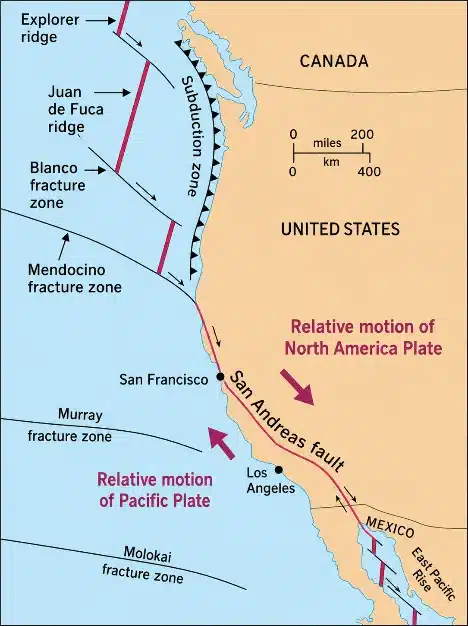
What is a Strike-Slip Fault?
- A fault where two tectonic plates slide horizontally past each other.
- Little or no vertical movement occurs.
- Often associated with powerful earthquakes.
Significance
- Responsible for many major earthquakes in California.
- Helps scientists study earthquake prediction and tectonic processes.
- Recent studies indicate increasing stress accumulation along parts of the fault.
Long Range Land Attack Cruise Missile (LRLACM)
About:
- LRLACM is an indigenously developed subsonic cruise missile designed for precision strikes against land targets at long ranges.
- Developed by DRDO, led by the Aeronautical Development Establishment (ADE), Bengaluru.
Key Features
- Range: Nearly 1,000 km.
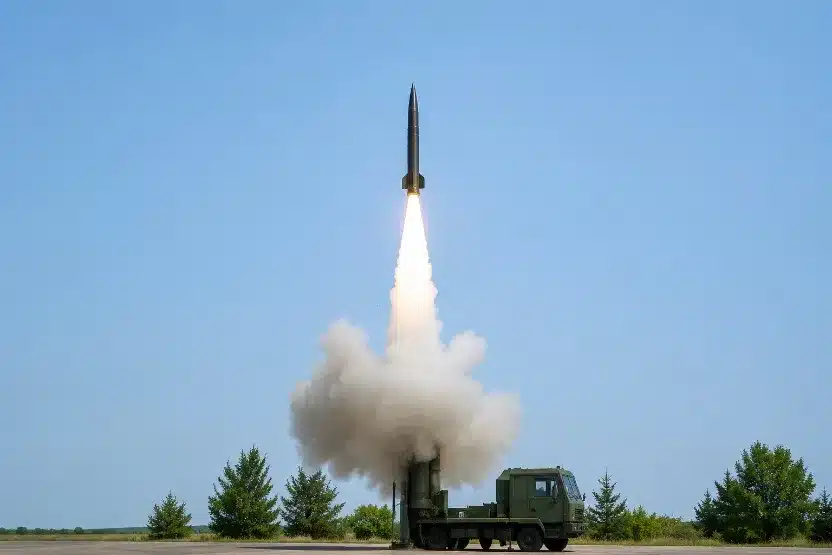
- Warhead: Can carry a 450 kg conventional warhead.
- Launch Type: Surface-launched cruise missile.
- Flight Profile: Low-altitude, terrain-hugging flight to avoid enemy radar detection.
- Propulsion: Uses turbofan/turbojet engine for sustained flight.
Guidance System
- Inertial Navigation System (INS).
- Satellite-based navigation support.
- Terrain Contour Matching (TERCOM) and terminal seeker for high accuracy.
Significance
- Enables long-range precision strikes on:
- Command and control centres.
- Radar installations.
- Logistics hubs.
- Strategic military infrastructure.
- Naval targets.
- Enhances India’s indigenous stand-off strike capability.
Exercise Pitch Black
About:
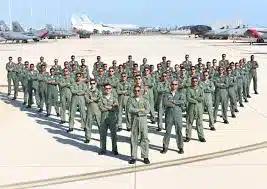
- Exercise Pitch Black is a biennial multinational air combat exercise hosted by the Royal Australian Air Force (RAAF).
- It is RAAF’s flagship international flying exercise.
- The name “Pitch Black” reflects its original focus on night-time flying operations.
Key Points
- Host Country:
- Conducted By: Royal Australian Air Force (RAAF).
- Frequency: Every two years (Biennial).
Pitch Black 2026
- Duration: 20 July – 7 August 2026.
- Locations:
- RAAF Base Darwin
- RAAF Base Tindal (Northern Territory)
- RAAF Base Amberley (Queensland)
- Participation of 19 countries, over 100 aircraft, and 4,400+ personnel.
Objectives
- Enhance interoperability among participating air forces.
- Practice complex air combat missions.
- Improve coordination in multinational operations.
- Strengthen network-centric and electronic warfare capabilities.
Major Activities
- Offensive Counter-Air Operations.
- Air Defence Missions.
- Tactical Air Combat Training.
- Joint Planning and Mission Execution.
- Electronic Warfare and Communication Integration.
India’s Participation
- India is participating through the Indian Air Force (IAF).
- IAF has previously participated in:
- 2018, 2022, 2024 and 2026
- Provides exposure to advanced air warfare tactics alongside countries such as the USA, UK, France, and Australia.