The RBI and Its Growing Fiscal Role
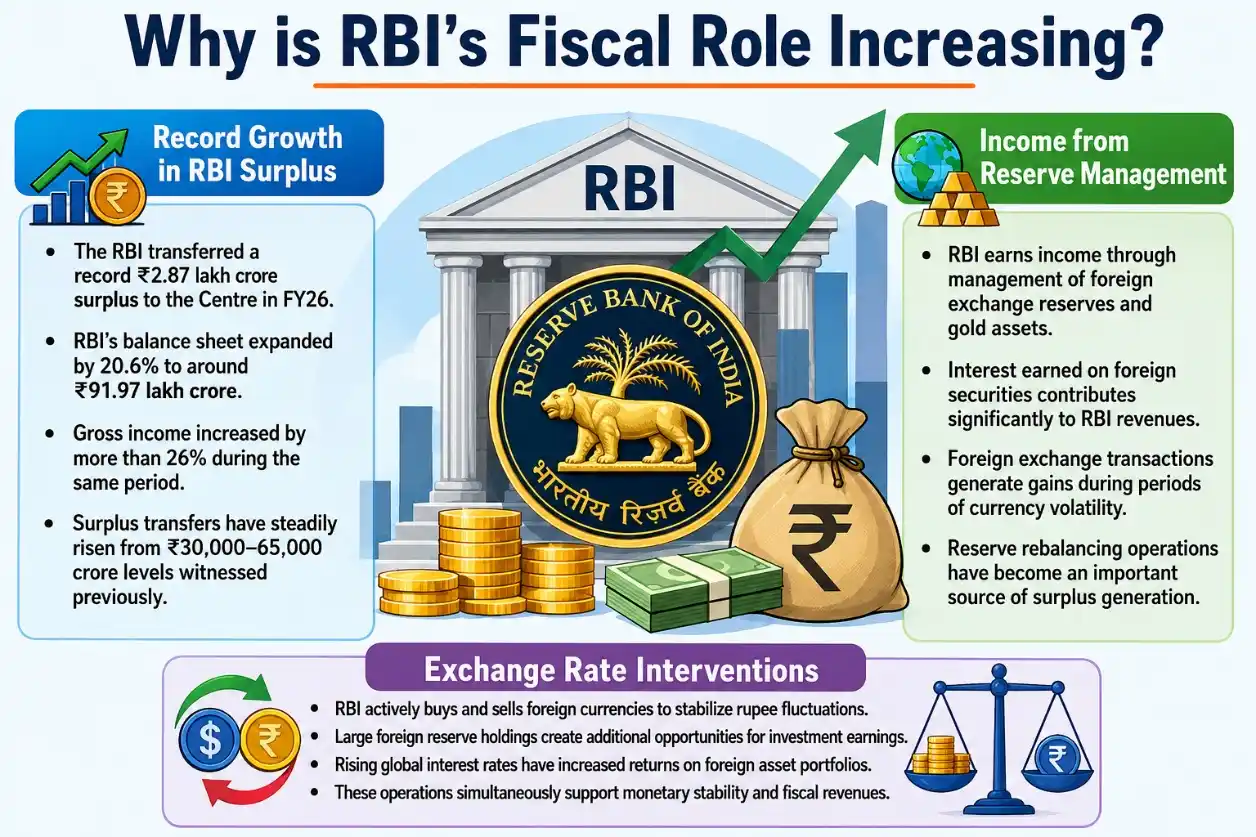
The Reserve Bank of India (RBI) recently transferred a record surplus of ₹2.87 lakh crore to the Union Government for FY26. While this strengthens government finances and provides fiscal space, it also highlights the RBI’s evolving role beyond monetary management. The growing significance of reserve management earnings raises important questions regarding central bank independence, fiscal federalism, and the changing relationship between monetary and fiscal policy.
Significance of Growing Fiscal Role
Provides Fiscal Space to Government
- Surplus transfers support government expenditure without increasing taxation.
- They reduce pressure on additional market borrowing requirements.
- Fiscal resources become available without immediate economic production costs.
- Such transfers strengthen budgetary flexibility during periods of fiscal stress.
Supports Macroeconomic Stability
- Strong RBI finances enhance confidence in monetary institutions.
- Adequate reserves strengthen India’s ability to manage external shocks.
- Stable reserve management contributes to exchange rate stability.
- Financial sector confidence benefits from a robust central bank balance sheet.
Concerns Associated with RBI’s Growing Fiscal Role
Central Bank Independence
- Excessive fiscal reliance on RBI transfers may blur institutional boundaries.
- Monetary decisions could face perceptions of fiscal influence.
- Central bank credibility depends upon maintaining operational autonomy.
- Independence remains crucial for effective inflation and monetary management.
Fiscal Centralisation
- RBI surplus transfers accrue entirely to the Union Government.
- Such transfers are not included within Finance Commission devolution formulas.
- States receive no automatic share from these large fiscal resources.
- This may strengthen fiscal centralisation within India’s federal structure.
Revenue Volatility
- RBI profits depend significantly on market conditions and reserve returns.
- Foreign exchange gains can fluctuate sharply across years.
- Such transfers cannot become predictable substitutes for tax revenues.
- Overdependence may create future fiscal uncertainties for governments.
Implications for Fiscal Federalism
Limited Benefits for States
- States continue facing expenditure responsibilities in health, education, and welfare sectors.
- Borrowing restrictions under Article 293 constrain state-level fiscal flexibility.
- Despite large public-sector transfers, states do not share RBI surplus receipts.
- This creates debate regarding equity within India’s fiscal architecture.
Need for Greater Transparency
- Growing fiscal importance of RBI transfers requires broader public discussion.
- Policymakers must examine implications for federal fiscal balance.
- Accountability mechanisms should accompany increasing fiscal significance.
- Institutional clarity remains essential for preserving public trust.
Way Forward
Maintain Institutional Balance
- RBI must continue prioritising monetary and financial stability objectives.
- Surplus transfers should remain consistent with Economic Capital Framework principles.
- Fiscal authorities should avoid treating such transfers as routine revenues.
- Strong institutional separation should safeguard central bank credibility.
Strengthen Fiscal Federalism
- Broader discussions on sharing benefits of public-sector resource transfers are necessary.
- States should receive greater fiscal flexibility to meet developmental responsibilities.
- Fiscal reforms must balance national priorities with cooperative federalism principles.
- Transparent reporting can improve accountability and policy coordination.
The record RBI surplus transfer reflects both India’s strong reserve management framework and the increasing intersection between monetary and fiscal policy. While these transfers provide valuable fiscal support to the Union Government, they also raise concerns regarding central bank independence, fiscal centralisation, and federal equity. Going forward, maintaining institutional autonomy while ensuring transparent and balanced fiscal governance will be essential for preserving economic stability and public trust.
Prelims Boosters
GRAPES-3 Telescope
About:
- GRAPES-3 (Gamma Ray Astronomy PeV EnergieS – Phase 3) is a cosmic ray observatory designed to study the origin, acceleration, and propagation of cosmic rays.
- It is operated by the Tata Institute of Fundamental Research (TIFR).
- Location: Ooty, Tamil Nadu.
Key Features
- Studies cosmic rays, gamma rays, solar activity, and thunderstorm phenomena.

- Detects Extensive Air Showers (EAS) produced when high-energy cosmic rays enter Earth’s atmosphere.
- Uses:
- Plastic scintillator detector array.
- Large-area muon detector based on proportional counters.
- Measures particles in the tera-electronvolt (TeV) to peta-electronvolt (PeV) energy range.
Recent Significance
- Researchers used GRAPES-3 to study how Earth’s upper atmospheric temperature and Sun’s magnetic field influence muons (subatomic particles produced by cosmic rays).
Cosmic Rays: Key Facts
- Discovered over 100 years ago.
- Among the most energetic particles in the universe.
- Continuously bombard Earth from outer space.
- On entering the atmosphere, they generate particle showers containing: Electrons, Photons, Muons, Protons, Neutrons
- Energy range: 10⁸ to 10²⁰ eV.
Tasgaon Lift Irrigation Scheme
About:
- Tasgaon Lift Irrigation Scheme is a major irrigation project in Maharashtra.
- Implemented under the Maharashtra Krishna Valley Development Corporation (MKVDC), Pune.
- It aims to improve irrigation and water availability in Satara district.
Key Points
- Covers a command area of 2,277 hectares.
- Benefits six villages: Tasgaon, Varne, Karandwadi, Devkarwadi, Degaon, Nigadi
- Supports agricultural productivity and rural development.
What is Lift Irrigation?
- Water is lifted using pumps from a water source to higher elevations.
- Unlike gravity-based canal systems, it depends on electrically powered pumping infrastructure.
Components of the Scheme
- Head works, Pump houses, Switch yards, Rising mains, Delivery chambers and Closed-pipe water distribution network.
Significance
- Expands irrigation coverage in water-scarce areas.
- Ensures reliable water supply to farmlands located at higher elevations.
- Promotes sustainable agriculture and rural livelihoods.
Joint Crediting Mechanism
About:
- The Joint Crediting Mechanism (JCM) is a bilateral carbon-crediting mechanism proposed by Japan and launched in 2013.
- It promotes the transfer of low-carbon and decarbonization technologies to partner countries.
- Operates under Article 6.2 of the Paris Agreement.
Objectives
- Support climate change mitigation.
- Facilitate investment in clean technologies.
- Help partner countries achieve their Nationally Determined Contributions (NDCs).
- Generate and share carbon credits between participating countries.
Key Features
- Bilateral mechanism between Japan and partner countries.
- Carbon emission reductions achieved through projects are quantified and credited.
- Complements mechanisms such as:
- Clean Development Mechanism (CDM)
- Joint Implementation (JI)
- Functions within the framework of the UNFCCC.
India and JCM
- India is among the 31 partner countries of JCM.
- India and Japan have adopted the Rules of Implementation under Article 6.2 of the Paris Agreement.
Focus Areas
- Renewable Energy with Storage, Sustainable Aviation Fuel (SAF), Compressed Biogas (CBG), Green Hydrogen, Green Ammonia, Hard-to-abate industrial sectors.
Manas National Park
About:
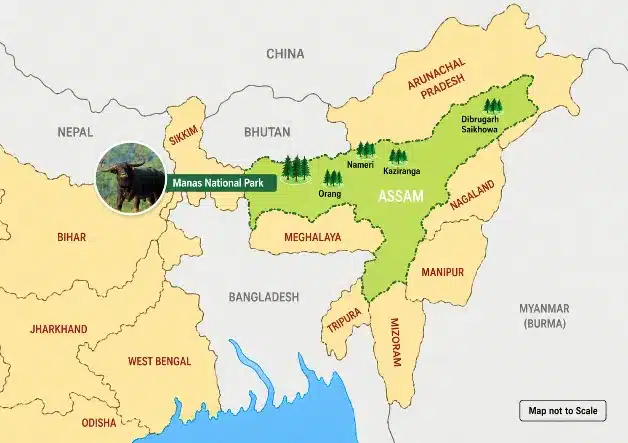
- Manas National Park is located in the foothills of the Himalayas in Assam.
- It shares an international boundary with Royal Manas National Park (Bhutan).
- Named after the Manas River, a major tributary of the Brahmaputra.
Key Features
- Elevation ranges from 60–1,500 m, supporting diverse ecosystems.
- Home to indigenous communities, especially the Bodo tribe.
- One of the first Tiger Reserves under Project Tiger (1973).
International Recognitions
- UNESCO World Heritage Site, Tiger Reserve, Elephant Reserve, Biosphere Reserve and Important Bird Area (IBA)
Vegetation
- Semi-evergreen forests, Mixed deciduous forests, Grasslands and Riparian vegetation.
Important Flora
- Hoolong (dominant species), Amari, Dewa Sam, Himolu, Garjan.
Important Fauna
- Pygmy Hog (flagship species), Hispid Hare, Golden Langur, Indian Rhinoceros, Wild Water Buffalo (Asiatic Buffalo), Bengal Tiger, Asian Elephant.
INS Tarkash
About:
- INS Tarkash is a stealth guided-missile frigate of the Indian Navy.
- It is the second ship of the Talwar-class
- Built at Yantar Shipyard, Kaliningrad, Russia.
- Commissioned on 9 November 2012.
Key Features
- Class: Talwar-class (modified Krivak III-class), Displacement: 3,850 tonnes, Length:8 m, Beam: 15.2 m, Draught: 4.2 m.
- Speed: Over 30 knots, Endurance: 30 days, Range: 4,500 nautical miles, Crew: 253 personnel.
Stealth Capabilities
- Advanced stealth design with reduced radar cross-section.
- Special hull design enhances survivability and lowers detectability.
Weapon Systems
- BrahMos supersonic cruise missiles, Surface-to-air missiles (SAMs).
- 100 mm naval gun, Torpedoes, Rocket launchers, Close-range weapon systems.
Aviation Facilities
- Can operate:
- Ka-28 Helix-A (Anti-Submarine Warfare Helicopter).
- Ka-31 Helix-B (Airborne Early Warning Helicopter).