NFHS-6 Reveals Progress Amid Nutrition Challenges
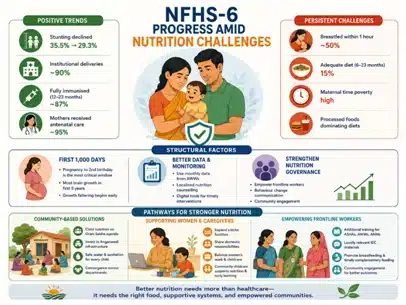
The recently released National Family Health Survey (NFHS-6) presents a mixed picture of India’s nutrition landscape. While improvements in stunting, institutional deliveries, vaccination coverage, and healthcare access indicate significant progress, persistent challenges in infant feeding practices, dietary diversity, maternal care burdens, and processed food consumption continue to hinder efforts to eliminate malnutrition. The findings highlight that better healthcare alone cannot solve India’s nutrition crisis without stronger focus on feeding behaviour and dietary quality.
Positive Trends Highlighted by NFHS-6
Improvement in Child Nutrition Indicators
- Stunting among children under five declined from 5% to 29.3%, reflecting gradual progress.
- Improvements in housing, sanitation, drinking water, and maternal education supported nutritional outcomes.
- Better healthcare access contributed to reductions in several nutrition-related vulnerabilities.
- Severe forms of wasting showed limited improvement, indicating continuing nutritional concerns.
Strengthening Maternal and Child Healthcare
- Institutional deliveries increased to nearly 90%, enhancing safe childbirth outcomes.
- Public health facilities accounted for approximately 58% of all institutional deliveries.
- About 91% of deliveries were assisted by skilled health personnel.
- Nearly 95% of mothers received antenatal care from health professionals.
High Immunisation Coverage
- Around 87% of children aged 12–23 months were fully immunised.
- Strong outreach by ASHAs, AWWs, and ANMs supported vaccination achievements.
- Public health systems demonstrated improved service delivery across most regions.
- Increased healthcare accessibility strengthened child survival and development outcomes.
Persistent Nutrition Challenges
Poor Infant and Young Child Feeding Practices
- Only about 50% of newborns were breastfed within the first hour.
- Around 60% of infants received complementary foods between six and eight months.
- Only 15% of children aged six to twenty-three months received adequate diets.
- Delayed complementary feeding contributes significantly to undernutrition and growth faltering.
Maternal Time Poverty
- Many women balance childcare responsibilities with paid and unpaid work burdens.
- Lack of childcare support affects breastfeeding and complementary feeding practices.
- Informal employment often forces mothers to leave children under relatives’ supervision.
- Maternal workload remains an under-recognised determinant of child nutrition outcomes.
Inadequate Dietary Diversity
- Processed foods and beverages increasingly dominate household food expenditure patterns.
- Consumption of pulses, fruits, vegetables, nuts, and animal proteins remains inadequate.
- Dietary diversity often creates an illusion of nutrition without ensuring nutrient adequacy.
- Easy availability of processed foods undermines healthy dietary choices.
Structural Factors Affecting Child Nutrition
Importance of First 1,000 Days
- Pregnancy to a child’s second birthday forms the most critical development window.
- Most brain growth occurs during the first five years of life.
- Growth faltering frequently begins much earlier than current interventions target.
- Preventive nutrition strategies must focus on this crucial developmental period.
Need for Better Data and Monitoring
- Monthly anthropometric data collected by AWWs requires improved analysis and utilisation.
- Localised nutrition counselling should be based on community-specific dietary realities.
- Digital tools can strengthen monitoring and improve service delivery effectiveness.
- Early identification of growth faltering allows timely corrective interventions.
Strengthening Nutrition Governance
Empowering Frontline Workers
- Additional training can improve counselling quality among ASHAs, AWWs, and ANMs.
- Nutrition workers need locally relevant communication materials and practical guidance.
- Behaviour change campaigns should promote breastfeeding and timely complementary feeding.
- Community engagement remains essential for improving nutrition outcomes.
Promoting Community-Based Solutions
- Child nutrition should become a standing agenda in Gram Sabha discussions.
- Anganwadi infrastructure requires continuous investment and modernization.
- Safe water and sanitation facilities directly influence child growth outcomes.
- Greater convergence among departments can improve programme effectiveness.
Supporting Women and Caregivers
- Expanding crèche facilities can reduce maternal care burdens significantly.
- Shared domestic responsibilities can improve childcare and feeding practices.
- Women’s economic participation should be balanced with childcare support mechanisms.
- Community-based childcare models can strengthen nutrition and early learning simultaneously.
NFHS-6 demonstrates that India has made important strides in improving healthcare access and reducing child stunting. However, persistent gaps in infant feeding practices, dietary quality, maternal support systems, and nutrition governance continue to impede faster progress. Achieving sustainable improvements in child nutrition requires moving beyond healthcare delivery toward a holistic approach that integrates nutrition-sensitive policies, empowered frontline workers, community participation, and stronger support for mothers and caregivers.
Prelims Boosters
World Gold Council (WGC)
About:
- The World Gold Council (WGC) is a non-profit organization representing the global gold industry.
- It was established in 1987 by leading gold mining companies.
- Headquarters: London, United Kingdom.
Objectives
- Promote responsible and sustainable use of gold.
- Increase demand for gold among consumers, investors, and central banks.
- Support growth and development of the global gold market.
- Develop industry standards and best practices.
Key Features
- Represents 29 major gold mining companies.
- Covers markets accounting for nearly three-fourths of global gold consumption.
- Considered the global authority on gold market analysis.
- Publishes:
- Gold Demand Trends Reports.
- Gold Market Reports.
- Central Bank Gold Reserves (CBGR) Survey.
Major Contributions
- Created the world’s first Gold Exchange-Traded Fund (Gold ETF).
- Supports research on new uses and applications of gold.
- Promotes transparency, sustainability, and responsible mining practices.
Recent Development
- The 2026 Central Bank Gold Reserves (CBGR) Survey indicated that central banks are likely to continue increasing their gold reserves in the coming years.
REWARD Programme
Full Form:Rejuvenating Watersheds for Agricultural Resilience through Innovative Development (REWARD)
About
- REWARD is a watershed development programme implemented in Karnataka and Odisha.
- Duration: 2021–2026.
- Implemented by the Department of Land Resources (DoLR) with assistance from the World Bank.
Aim
- To introduce modern and science-based watershed management practices.
- To improve agricultural resilience and sustainable livelihoods.
Objectives
- Strengthen national and state institutions for better watershed management.
- Enhance farmers’ resilience to climate change.
- Support value chains in selected watershed areas.
Funding Mechanism
- Based on the World Bank’s Program for Results (PforR)
- Funds are released based on achievement of Disbursement Linked Indicators (DLIs).
Key Focus Areas
Institutional Strengthening
- Improve policies and governance related to watershed development.
- Build capacities of national and state-level institutions.
Science-Based Watershed Development
- Promote climate-resilient agriculture.
- Improve water conservation and land management.
- Enhance rural livelihoods and productivity.
Recent Development
- National Rainfed Area Authority (NRAA) discussed National Technical Guidelines (NTG) for Improved Watershed Management under the REWARD Programme.
Mishmi Takin
About:
- Mishmi Takin is a goat-antelope belonging to the family Bovidae.
- Scientific Name: Budorcastaxicolor.
- It is one of the four subspecies of Takin.
Habitat & Distribution
- Found in the Eastern Himalayas:
- Arunachal Pradesh (India)
- Northern Myanmar
- Southeastern Tibet
- Parts of China
- Named after the Mishmi Hills of Arunachal Pradesh.
- Found from forested valleys to alpine regions up to 4,500 m

Key Features
- Large, stocky body with deep chest.Height: Up to 3 m at the shoulder.
- Weight: Over 300 kg.Long arched nose and strong ridged horns.
- Horns present in both males and females.Broad hooves help movement on steep mountain slopes.
- Long shaggy coat ranging from golden-yellow to dark brown.Oily skin secretions protect against cold and damp climate.
Behaviour
- Lives in small family groups of about 20 individuals.
- Herbivorous (folivorous), feeding mainly on leaves and vegetation.
Conservation Status
- IUCN Red List:Vulnerable.
Recent News
- First-ever video footage of a herd of Mishmi Takins was recorded in Tingda Reserve Forest, North Sikkim.
Mombasa Declaration
About:
- The Mombasa Declaration was adopted by 15 countries to strengthen global efforts against Illegal, Unreported and Unregulated (IUU) Fishing.
- It was adopted during the 11th Our Ocean Conference (OOC) held in Mombasa, Kenya (2026).
Objectives
- Combat illegal fishing activities.
- Improve transparency in fisheries governance.
- Protect marine ecosystems and fishing-dependent livelihoods.
- Strengthen international cooperation and data sharing.
Key Features
- Calls for greater transparency in:
- Fishing vessel registration; Vessel ownership records; Fishing licenses and authorizations.
- Promotes sharing of fisheries data among countries.
- Supports better monitoring and enforcement of fishing regulations.
- Builds support for the Global Charter for Fisheries Transparency.
Global Charter for Fisheries Transparency
- Consists of 10 policy principles.
- Encourages:
- Modernization of vessel registries; Publication of fishing authorizations; Improved fisheries governance.
Significance
- Helps curb IUU fishing, a major threat to marine biodiversity.
- Protects food security and livelihoods of coastal communities.
- Promotes sustainable fisheries and responsible ocean governance.
Our Ocean Conference (OOC)About
Focus Areas
|
Key Facts
- Generated 2,600+ commitments worth over $160 billion.
- 2026 Host: Mombasa, Kenya.
- Theme:“Our Ocean, Our Heritage, Our Future”.
- First OOC held on African soil.
National Statistical Commission (NSC)
About:
- National Statistical Commission (NSC) was established in 2005 based on the recommendations of the Rangarajan Commission (2000).
- It serves as the apex body for guiding and strengthening India’s statistical system.
Mandate
- Coordinate core statistical activities in the country.
- Develop, monitor, and enforce statistical standards and priorities.
- Ensure statistical coordination among various agencies.
Composition
- Part-time Chairperson.
- Four part-time Members with expertise in statistics and related fields.
- CEO of NITI Aayog – Ex-officio Member.
- Chief Statistician of India (CSI) – Secretary of the Commission.
Functions
- Identify core statistics of national importance.
- Form expert committees and working groups on statistical issues.
- Develop national statistical policies and priorities.
- Standardize statistical concepts, definitions, classifications, and methodologies.
- Prescribe quality standards for official statistics.
- Develop strategies for collection, compilation, and dissemination of data.
- Recommend release calendars for statistical datasets.
Significance
- Enhances credibility, reliability, and transparency of official statistics.
- Supports evidence-based policymaking and economic planning.
- Promotes uniform statistical standards across India.