Energy Security and Breaking Governance Silos in India
Rising geopolitical tensions, particularly around the Strait of Hormuz, have once again highlighted India’s vulnerability to external energy shocks. Despite progress in diversifying energy sources, India still lacks a unified institutional mechanism for managing energy security across petroleum, coal, power, renewables, and strategic reserves. Ensuring long-term energy security therefore requires not only energy austerity but also integrated governance that breaks administrative silos.
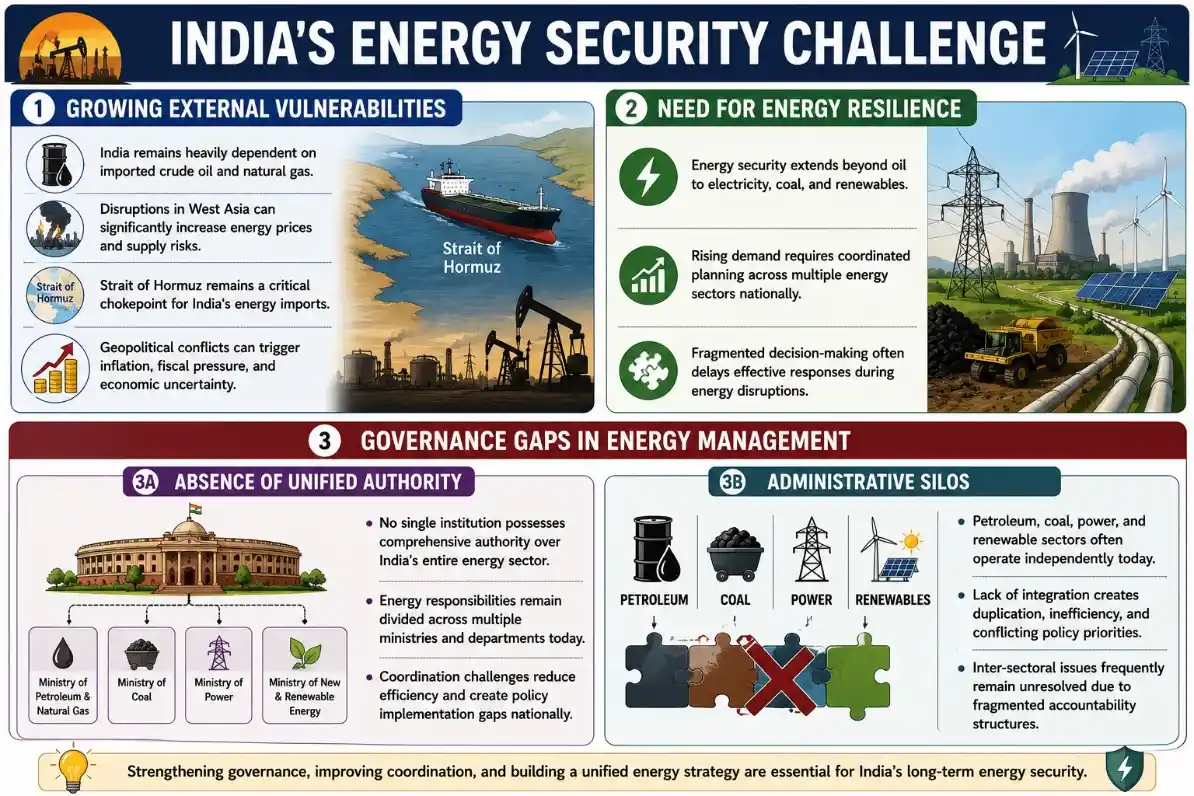
Why an Integrated Energy Framework is Needed
Whole-of-System Approach
- Energy planning should consider production, transmission, storage, and distribution together.
- Economic, environmental, and security objectives require integrated policy coordination nationally.
- Unified governance can improve resilience against future energy supply disruptions.
Reducing Economic Losses
- Poor coordination often results in stranded assets and inefficient investments nationally.
- Better planning can optimize resource allocation across energy value chains.
- Integrated decisions strengthen competitiveness and support long-term energy sustainability goals.
Proposed Institutional Reforms
Department of Energy Resources and Security (DERS)
- Establish a dedicated institution under the Prime Minister’s Office nationally.
- Provide strategic oversight across all energy-related sectors and agencies today.
- Coordinate energy planning, monitoring, implementation, and crisis management nationally.
Key Functions of DERS
- Develop integrated national energy security and sustainability strategies nationally.
- Coordinate investments across production, transmission, storage, and distribution networks.
- Strengthen international partnerships for energy resources and technology access globally.
- Serve as a central communication platform for energy-related policymaking nationally.
Regulatory and Strategic Reforms
Energy Ombudsman
- Create a unified mechanism to address regulatory overlaps and disputes nationally.
- Improve accountability and streamline energy-sector governance across institutions nationally.
Strategic Energy Planning
- Strengthen management of strategic petroleum reserves and energy storage infrastructure.
- Improve coordination regarding battery technology and critical mineral requirements nationally.
- Establish robust data systems for evidence-based energy policymaking and forecasting.
Knowledge Sharing
- Develop forums for information exchange and best-practice dissemination nationally.
- Encourage collaboration among government agencies, industry, and research institutions nationally.
Energy Responsibility and Sustainability
Energy Responsibility Framework
- Define responsibilities of governments, institutions, industries, and citizens clearly.
- Promote energy conservation alongside long-term sustainability objectives nationally today.
- Balance economic growth with environmental and energy security considerations nationally.
Citizen Participation
- Encourage responsible energy consumption and greater public awareness nationally today.
- Support behavioural changes that reduce energy wastage and improve efficiency.
India’s energy security challenges cannot be addressed through isolated sectoral approaches. As global geopolitical uncertainties increase, the country requires a coordinated and integrated governance framework capable of managing the entire energy ecosystem. Breaking administrative silos, strengthening institutional coordination, and adopting a whole-of-system approach will be critical for ensuring reliable, affordable, and sustainable energy security for the future.
How China’s Reduced Oil Imports Have Helped India
The West Asia conflict and risks around the Strait of Hormuz have raised concerns about global oil supplies and prices. However, a sharp decline in China’s crude oil imports has unexpectedly provided relief to major Asian importers, including India. By reducing its demand, China has eased competition for available crude supplies, helping moderate oil prices and limiting the impact of supply disruptions.
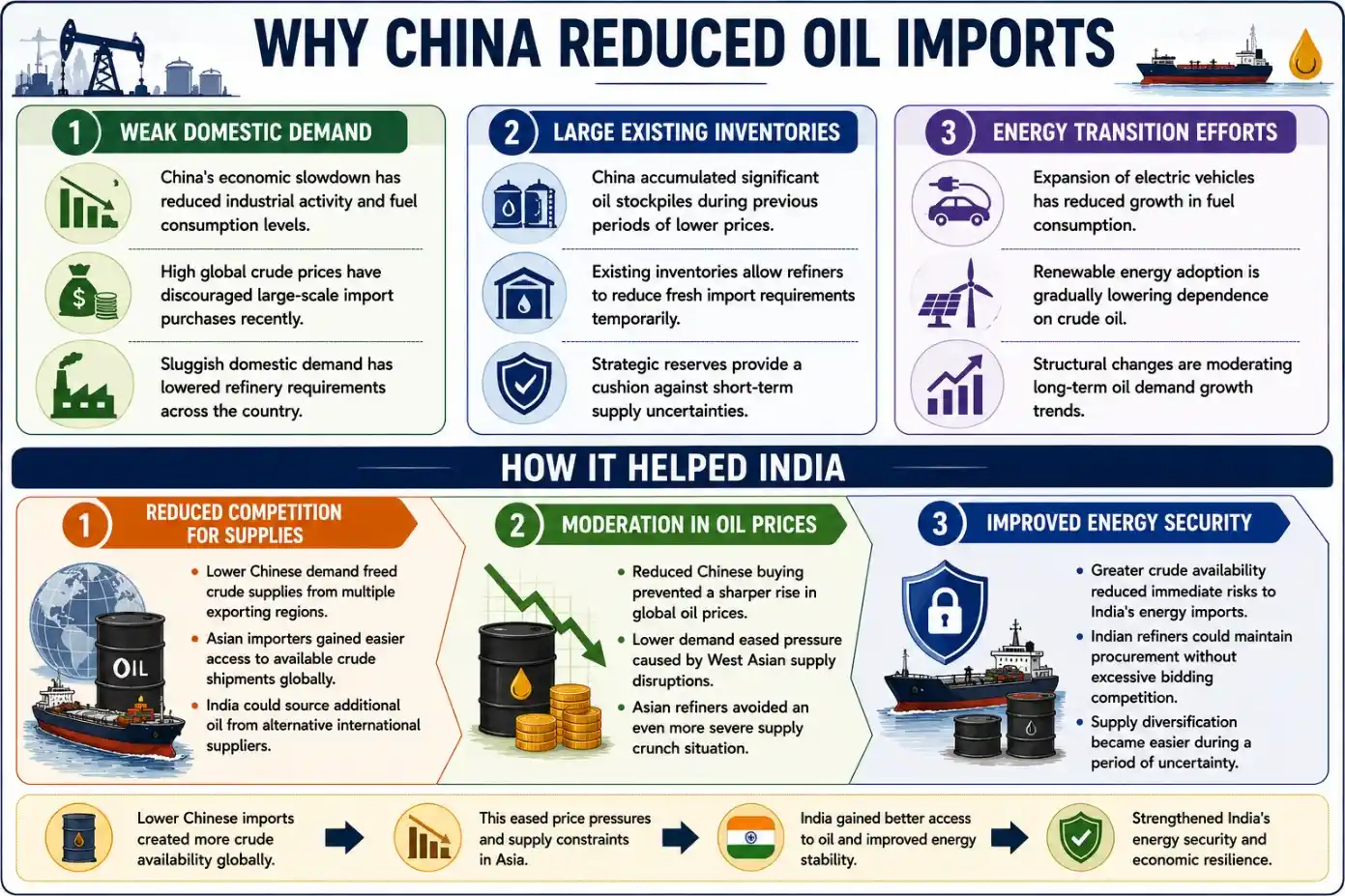
Impact on India
Current Account Stability
|
Inflation Management
|
Fiscal Benefits
|
Risks Going Forward
Possible Recovery in Chinese Demand
- Economic recovery in China could rapidly increase crude import demand.
- Higher Chinese purchases may tighten global oil supplies again.
- Competition among Asian importers could intensify significantly.
Strait of Hormuz Uncertainty
- Any disruption in Hormuz could still trigger major supply shocks.
- Oil prices may surge regardless of China’s demand conditions.
- Energy-importing countries remain vulnerable to geopolitical tensions.
India’s Import Dependence
- India continues to import a large share of its crude requirements.
- Long-term vulnerability remains despite short-term relief from lower prices.
- Energy security requires diversification and domestic capacity expansion.
Way Forward
- Expand strategic petroleum reserves to strengthen supply security nationally.
- Diversify crude import sources across regions and supplier countries.
- Accelerate renewable energy and electric mobility adoption nationwide.
- Improve energy efficiency to reduce dependence on imported fuels.
- Strengthen long-term energy partnerships with reliable producer nations.
China’s reduced oil imports have provided India with an important but temporary advantage by easing pressure on global crude markets and moderating oil prices. While this has supported India’s energy security, inflation management, and external stability, the benefit may not last if Chinese demand revives or geopolitical disruptions intensify. Therefore, India must use this window to strengthen long-term energy resilience and reduce dependence on imported oil.
Prelims Boosters
Shangri-La Dialogue
Context:
Indian Defence Secretary recently participated in bilateral engagements during Shangri-La Dialogue 2026.
About Shangri-La Dialogue
- Shangri-La Dialogue is Asia’s premier defence and security summit annually.
- It is also popularly known as the Asia Security Summit.
- The dialogue brings together defence ministers, military chiefs, and policymakers.
- Strategic experts from across the world participate in discussions regularly.
History
- The Shangri-La Dialogue was launched during the year 2002 officially.
- It has evolved into Asia-Pacific’s most influential security dialogue platform.
Venue
- The summit is held annually at Singapore’s Shangri-La Hotel.
- Singapore serves as the permanent host of this dialogue forum.
Organisers
- It is organized by International Institute for Strategic Studies, London.
- The summit is co-organized by Singapore’s Ministry of Defence officially.
Objectives
- To promote dialogue on regional and global security challenges.
- To strengthen defence diplomacy and strategic cooperation among nations.
- To encourage peaceful resolution of security and geopolitical issues.
Issues Discussed
Traditional Security Issues
| Non-Traditional Security Issues
|
Dialogue Format
Opening Keynote Address
- Summit begins with keynote speech by head of government or state.
Plenary Sessions
- Defence ministers participate as speakers during official plenary sessions.
Breakout Sessions
- Senior officials and security experts engage in specialized discussions.
Bilateral and Multilateral Meetings
- Participants hold private meetings to advance defence diplomacy initiatives.
- These meetings strengthen strategic partnerships and mutual cooperation efforts.
India and Shangri-La Dialogue
- India regularly participates at high levels in the dialogue forum.
- Representation often includes Defence Minister or senior military officials.
- Chief of Defence Staff may also represent India when required.
Importance
- It is a major platform for Indo-Pacific security discussions globally.
- The dialogue strengthens defence cooperation among participating countries significantly.
- It promotes trust-building and strategic communication between nations effectively.
- It helps address emerging regional and global security challenges collectively.
Link with India
- Raisina Dialogue is broadly modeled on Shangri-La Dialogue framework.
- Both forums focus on geopolitics, security, and strategic cooperation.
PM SVANidhi Scheme
Context:
PM SVANidhi has emerged as a major support scheme for street vendors.
About PM SVANidhi
- PM SVANidhi stands for Prime Minister Street Vendor’s AtmaNirbhar Nidhi.
- The scheme was launched by Government of India during June 2020.
- It is a Central Sector Scheme for street vendors nationwide.
- The scheme supports vendors through affordable working capital assistance.
- It promotes financial inclusion and social protection of street vendors.
Implementation
- The scheme is implemented jointly by MoHUA and DFS.
- Ministry of Housing and Urban Affairs plays a leading role.
- Department of Financial Services supports financial implementation and monitoring.
Objectives
- To provide affordable credit access to urban street vendors.
- To reduce dependence on informal moneylenders charging high interest rates.
- To promote digital transactions and financial literacy among vendors.
- To improve social security coverage for street vendor families.
Key Features
Working Capital Loans
|
UPI-linked RuPay Credit Card
Digital Adoption Incentives
|
SVANidhi se Samriddhi (SSS)
- SSS focuses on socio-economic profiling of beneficiary families comprehensively.
- Beneficiaries are linked with selected Central welfare schemes systematically.
- It aims creating a comprehensive social security network for families.
- Eight major welfare schemes are integrated under this initiative.
Capacity Building and Training
- Vendors receive training in financial literacy and money management.
- Digital literacy programmes improve adoption of online payment systems.
- Food safety and hygiene training is provided with FSSAI support.
- Entrepreneurship development programmes help strengthen vendor livelihoods sustainably.
Significance
- PM SVANidhi improves financial inclusion of urban informal workers.
- It supports livelihoods of street vendors through affordable institutional credit.
- The scheme promotes digital economy participation among small vendors.
- It strengthens social security and economic resilience of beneficiaries.
Zero Coupon Zero Principal (ZCZP) Instrument
Context:
MCA recently permitted CSR funds to be deployed through ZCZP instruments.
About Zero Coupon Zero Principal Instrument
- ZCZP is a unique financial instrument issued by non-profit organizations.
- It carries neither interest payments nor repayment of principal amount.
- Investors do not receive financial returns from these instruments.
- It functions as a philanthropic funding mechanism within market framework.
Purpose
- ZCZP instruments help non-profit organizations raise funds transparently.
- They enable fundraising through the Social Stock Exchange platform officially.
- Funds raised are utilized for specific social development projects.
Key Features
No Interest Payment
No Principal Repayment
Project-Based Funding
|
Social Stock Exchange Listing
Dematerialised Form
Non-Transferability
|
Significance
- ZCZP creates an innovative mechanism for financing social welfare projects.
- It strengthens fundraising opportunities for non-profit organizations nationwide.
- It promotes transparency in utilization of charitable and social funds.
- It connects philanthropic capital with structured market mechanisms effectively.
Corporate Social Responsibility (CSR)
What is CSR?
- CSR is a business approach promoting social and environmental responsibility.
- It encourages companies contributing positively towards society and communities.
- CSR activities improve public welfare and corporate brand reputation.
CSR under Companies Act, 2013
- CSR provisions are governed under Section 135 of Companies Act.
- Eligible companies must spend on approved social responsibility activities.
- Companies are required spending at least two percent average profits.
- Calculation is based on preceding three years’ average net profits.
Schedule VII
- Permissible CSR activities are listed under Schedule VII officially.
- Activities include education, healthcare, environment, rural development, and welfare.
Link Between CSR and ZCZP
- Companies can now channel part of CSR spending through ZCZP.
- This expands funding sources available for social sector organizations.
- It allows structured, transparent deployment of CSR resources effectively.
5G Network Slicing
Context:
Airtel launched India’s first consumer-focused 5G network slicing service recently.
About 5G Network Slicing
- 5G Network Slicing allows creation of multiple virtual networks simultaneously.
- These virtual networks operate on a single physical 5G infrastructure.
- Each slice functions as an independent end-to-end network separately.
- Every slice is customized according to specific service requirements effectively.
How It Works
- Traditional networks make all users share the same bandwidth pool.
- Network slicing creates dedicated virtual lanes for different users.
- It uses Software-Defined Networking (SDN) for intelligent network management.
- It also uses Network Functions Virtualization (NFV) technologies extensively.
- Software dynamically allocates bandwidth, latency, and computing resources efficiently.
- During congestion, premium users can receive dedicated network resources.
- This ensures stable connectivity even when network traffic increases significantly.
Key Features
Virtual Isolation
- Different slices share infrastructure but remain digitally isolated completely.
- Traffic surge in one slice does not affect another slice.
Dynamic Resource Allocation
- Resources can be increased or reduced according to demand instantly.
- Bandwidth and latency settings adjust automatically in real time.
Application and Content Agnostic
- The network slice treats all data packets equally during transmission.
- It does not distinguish between specific applications or websites.
- Netflix, YouTube, and other services receive identical treatment within slice.
Customizable Slices
- Operators can design slices for different use cases independently.
- One slice may prioritize ultra-low latency for critical applications.
- Another slice may support large-scale Internet of Things networks.
- Another slice may provide high-speed broadband for consumers consistently.
Applications
Industrial Automation
- Ultra-low latency slices support automated factories and industrial robotics.
Healthcare
- Specialized slices can assist remote surgeries and medical applications.
Internet of Things (IoT)
- Dedicated slices support massive numbers of connected smart devices.
Consumer Broadband
- Premium users can receive stable and congestion-free internet connectivity.
Significance
- Network slicing improves efficiency and utilization of 5G infrastructure.
- Telecom operators can offer customized services for different customer groups.
- It creates new revenue opportunities through premium network services.
- It supports emerging technologies requiring specialized network performance standards.
Concerns
Net Neutrality Debate
- Critics argue premium slices may create unequal internet access conditions.
- High-paying users could receive better service during network congestion.
- This may widen digital divide between premium and regular users.
Telecom Industry View
- Telecom operators argue slices treat all content equally within network.
- They maintain that network slicing does not violate net neutrality.
RBI’s Kill Switch Facility
Context:
RBI is exploring a universal Kill Switch and Switch On/Off facility.
About RBI’s Kill Switch Facility
- Kill Switch is an emergency security mechanism for digital payments.
- It instantly freezes financial operations linked to user accounts.
- The facility can block fund transfers from banks or wallets.
- It is designed to stop fraud before money leaves accounts.
Aim
- To reduce losses caused by cyber fraud and online scams.
- To strengthen confidence in India’s rapidly growing digital payment ecosystem.
- To provide users immediate control over their financial accounts.
How It Works
- Users activate the facility immediately after suspecting fraudulent activity.
- Activation can occur through banking apps, SMS, or helplines.
- Once activated, outward financial transactions are instantly blocked.
- This prevents fraudsters from transferring money to mule accounts.
- It removes delays associated with customer care or branch visits.
Key Features
Integrated Emergency Button
- Banks may provide a prominent one-tap emergency button feature.
- The button will be integrated into mobile banking applications.
Omnichannel Access
- Users can activate the facility through multiple channels easily.
- Activation options may include SMS, IVR, and internet banking.
- Alternative channels help when smartphones are compromised by scammers.
Switch On / Switch Off Facility
- Users can selectively disable specific payment channels independently.
- UPI transactions can be switched off whenever required temporarily.
- International transactions can be disabled for enhanced security protection.
- Other banking services may remain active as per user choice.
- Users can reactivate services whenever needed through secure methods.
Universal Coverage
- The facility covers the entire digital payments ecosystem comprehensively.
- It extends beyond debit and credit card transaction controls.
- UPI, IMPS, and NEFT transactions will also be covered.
Significance
Preventing Digital Fraud
- Victims can instantly stop transactions during ongoing scam attempts.
- It reduces financial losses from cybercrime and fraud schemes.
Proactive Protection
- Users act before funds are stolen rather than afterward.
- It complements existing complaint and investigation mechanisms effectively.
Strengthening Digital Payments
- The facility enhances trust in India’s digital payment infrastructure.
- It provides additional protection for less tech-savvy users.
- It encourages safer adoption of digital financial services nationwide.
Related Terms
Mule Accounts
|
Digital Arrest Scam
|