China’s Role in the International Order
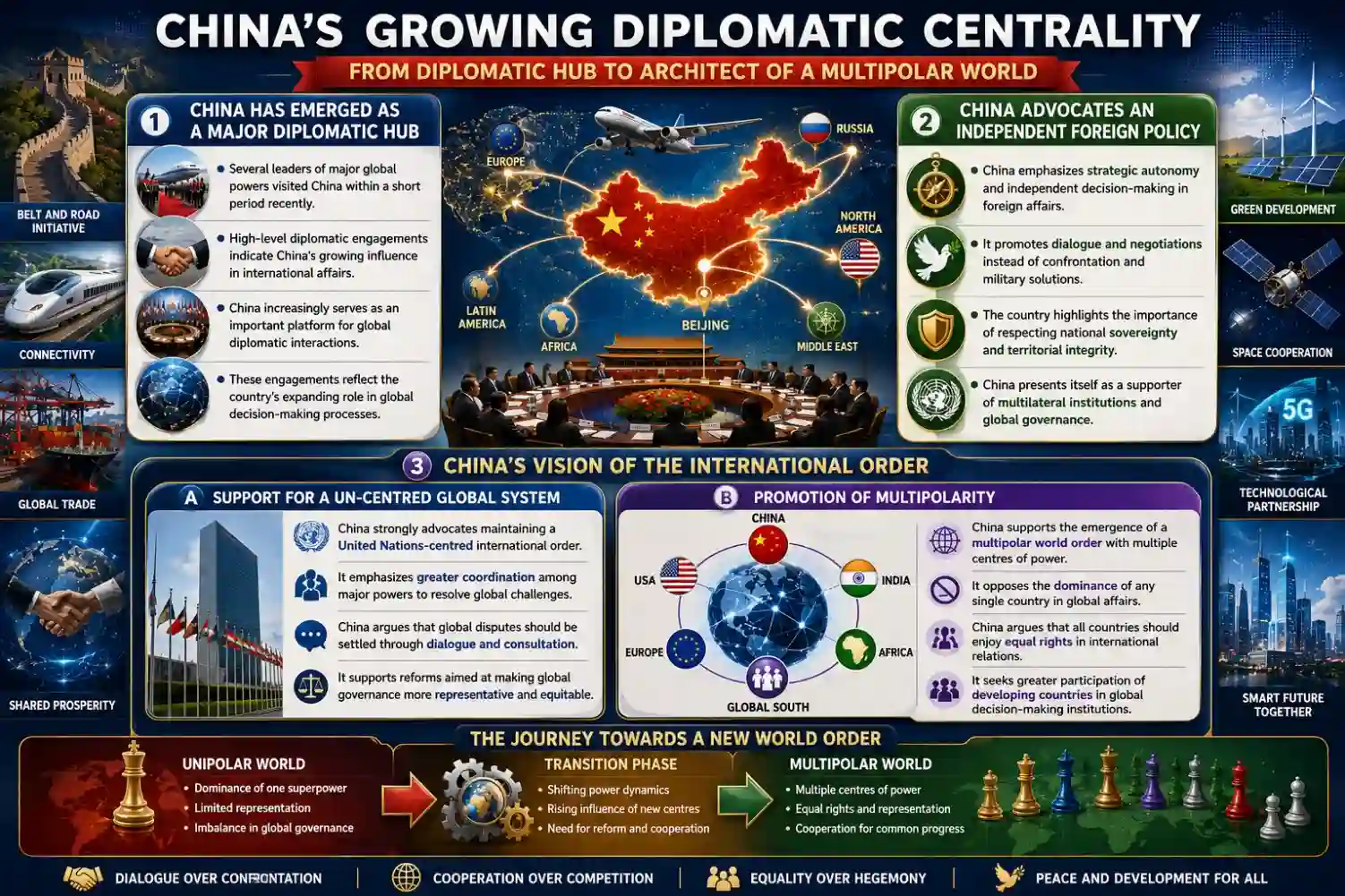
Amid rising geopolitical tensions, economic uncertainty, and shifts in global power balances, China is increasingly presenting itself as a major stakeholder in the international order. Recent visits by leaders of the United States, Russia, France, and the United Kingdom highlight China’s growing diplomatic importance. Through its emphasis on multilateralism, economic cooperation, and strategic engagement, China seeks to project itself as an influential actor in shaping global governance.
China’s Relations with Major Powers
China–United States Relations
Taiwan Issue Remains Central
|
China–Russia Strategic Partnership
China’s Engagement with Europe
|
Economic Cooperation as a Tool of Global Influence
Trade Is Viewed as a Foundation for Peace
- China argues that economic interdependence promotes stability among nations.
- Global supply chains have created deep connections between national economies.
- Trade cooperation helps reduce incentives for conflict and confrontation.
- Economic engagement remains central to China’s foreign policy approach.
China’s Contribution to Global Growth
- China remains one of the largest contributors to global economic expansion.
- Its manufacturing capacity supports international production and supply chains.
- The country continues opening sectors to foreign investment and cooperation.
- Economic growth in China influences markets across the world.
Importance of Global Connectivity
- China supports infrastructure and connectivity projects to enhance international trade.
- Improved connectivity can strengthen economic integration among countries.
- Cross-border infrastructure projects create opportunities for regional development.
- Such initiatives also enhance China’s economic and geopolitical influence.
Implications for India
Opportunities for India–China Cooperation
- India and China are among the world’s largest emerging economies.
- Both countries share interests in economic growth and development.
- Cooperation in trade, climate change, and global governance remains possible.
- People-to-people exchanges can improve mutual understanding and trust.
Areas of Concern
- Strategic competition between India and China continues in several areas.
- Border disputes remain a major source of bilateral tensions.
- China’s expanding regional influence generates security concerns for India.
- Trade imbalances continue to affect the economic relationship.
Need for Balanced Engagement
- India must engage China while protecting its strategic interests.
- Constructive dialogue can help manage differences and reduce tensions.
- Cooperation and competition are likely to coexist in the relationship.
- A stable bilateral relationship benefits regional and global stability.
Challenges to China’s Global Role
Trust Deficit Among Nations
- Several countries remain concerned about China’s strategic intentions and actions.
- Territorial disputes continue to affect China’s relations with neighbours.
- Differences over human rights and governance generate international criticism.
- Building trust remains essential for China’s long-term global leadership aspirations.
Geopolitical Rivalries
- Intensifying competition between major powers complicates global governance.
- Strategic rivalries often limit cooperation on common global challenges.
- Conflicts in different regions increase uncertainty in international relations.
- China must navigate these tensions while maintaining its global ambitions.
China’s growing economic strength, diplomatic outreach, and strategic influence have positioned it as a key actor in the evolving international order. By advocating multilateralism, economic cooperation, and a greater role for developing countries, China seeks to shape global governance according to its vision. However, geopolitical rivalries, trust deficits, and regional disputes continue to pose challenges. For countries like India, the rise of China presents both opportunities for cooperation and challenges requiring careful strategic management.
Prelims Boosters
Aurora Borealis (Northern Lights)
Context:
Aurora Borealis (Northern Lights) was recently expected to be visible in India due to increased solar activity.
About Aurora Borealis
What is Aurora Borealis?
- Aurora Borealis is a natural light display visible in the night sky.
- It is popularly known as the Northern Lights.
- The phenomenon mainly occurs near Earth’s North Pole region.
- It is concentrated around the northern magnetic pole of Earth.
Southern Hemisphere Counterpart
- Similar lights in the Southern Hemisphere are called Aurora Australis.
- Aurora Australis is popularly known as the Southern Lights.
Areas Where It Is Commonly Seen
- Aurora Borealis is frequently observed in Norway and Sweden.
- It is also commonly visible in Finland and Iceland.
- Canada, Alaska, and Greenland are major viewing locations.
Formation of Aurora Borealis
Role of the Sun
- Auroras are produced due to continuous activity on the Sun.
- The Sun constantly emits charged particles into space.
- These particles mainly consist of electrons and protons.
- This continuous flow is known as the solar wind.
Role of Earth’s Magnetic Field
- Earth’s magnetic field acts as a protective shield.
- Most solar wind particles are deflected away from Earth.
- Some charged particles become trapped within the magnetic field.
- These particles travel along magnetic field lines toward the poles.
Interaction with Atmosphere
- The trapped particles enter Earth’s upper atmosphere near the poles.
- They collide with atmospheric gases present at high altitudes.
- These collisions release energy in the form of light.
- The released light creates colourful patterns in the sky.
Colours of Aurora
Green Colour
|
Blue and Purple Colours
|
Solar Activity and Auroras
Solar Flares
- Solar flares are sudden releases of energy from the Sun.
- They increase the intensity of charged particles reaching Earth.
Coronal Mass Ejections (CMEs)
- CMEs are massive eruptions of plasma and magnetic fields.
- They release huge quantities of charged particles into space.
- Strong CMEs significantly increase auroral activity on Earth.
Geomagnetic Storms
- Extremely strong solar winds can disturb Earth’s magnetic field.
- Such disturbances are known as geomagnetic or magnetic storms.
- Geomagnetic storms can expand auroras to lower latitudes.
- During intense storms, auroras may become visible in unusual regions.
Project 18 Programme
Context:
India’s Project 18 Programme is being developed as one of the most powerful surface combatant projects of the Indian Navy.
About Project 18 Programme
What is Project 18?
- Project 18 is the Indian Navy’s Next-Generation Destroyer (NGD) programme.
- The programme aims to develop advanced multi-role stealth destroyers.
- It is planned as the successor to the Visakhapatnam-class destroyers.
- The project will significantly enhance India’s naval combat capabilities.
Organisations Involved
- The programme is overseen by the Indian Navy’s Warship Design Bureau.
- Mazagon Dock Shipbuilders Limited participates in the project’s development.
- Garden Reach Shipbuilders and Engineers also supports the programme.
Aim
- The programme aims to build highly advanced and powerful warships.
- It seeks to strengthen India’s maritime security and deterrence capabilities.
- It aims to support future network-centric naval warfare operations.
Key Features
Large Warship Platform
- Each vessel is expected to displace more than 13,000 tonnes.
- It will become among the largest warships operated by India.
- Warships above 10,000 tonnes are generally classified as cruisers.
- Project 18 will effectively mark India’s entry into this category.
Advanced Propulsion System
- The ships will use an advanced integrated electric propulsion system.
- Gas turbines and diesel generators will power the propulsion architecture.
- This system will improve operational efficiency and endurance.
Extensive Automation
- The ships will incorporate advanced automation across major functions.
- Automation will reduce crew requirements significantly compared to existing destroyers.
- Crew strength may decline by around 25 to 30 percent.
Missile Capabilities
Vertical Launch Systems
- Each ship will carry 114 Vertical Launch System cells.
- These launchers can fire multiple types of indigenous missiles.
Missile Types
- The ships will be equipped with BrahMos supersonic cruise missiles.
- They will also carry BrahMos Next Generation missile variants.
- Long-Range Land Attack Cruise Missiles can be deployed effectively.
- Precision-Guided Long-Range Surface-to-Air Missiles will strengthen air defence.
- Short-Range Surface-to-Air Missiles will provide close-range protection.
- SMART missiles will enhance anti-submarine warfare capabilities.
Unmanned Systems
- The destroyers will carry unmanned underwater vehicles for surveillance missions.
- These vehicles will help detect underwater mines and threats.
- The ships will also deploy kamikaze drones during combat operations.
- Unmanned systems will improve situational awareness and strike capability.
Advanced Sensors
- The destroyers will feature highly advanced radar systems.
- These sensors will provide complete 360-degree battlefield awareness.
- Radar systems will detect threats at distances up to 500 kilometres.
- The ships will possess strong tracking and target engagement capabilities.
Rajya Sabha Elections
Context:
The Election Commission closed nominations for Rajya Sabha elections across 27 seats.
About Rajya Sabha Elections
What is Rajya Sabha?
- Rajya Sabha is the Upper House of the Indian Parliament.
- It is a permanent legislative body that cannot be dissolved.
- Members of Rajya Sabha are elected for a term of six years.
- To ensure continuity, one-third of members retire every two years.
Retirement System
- One-third of the members retire after every two years.
- Vacant seats are filled through biennial elections.
- Newly elected members normally serve a full six-year term.
- Members elected through bye-elections serve only the remaining tenure.
Election Procedure
Indirect Election
- Rajya Sabha members are not elected directly by the people.
- Members of State Legislative Assemblies elect Rajya Sabha members.
- In Union Territories, a designated Electoral College elects members.
- At present, only Delhi and Puducherry elect Rajya Sabha members.
Voting System
- Elections are conducted through proportional representation.
- The system of Single Transferable Vote (STV) is used.
- MLAs rank candidates according to their order of preference.
- This system ensures proportional representation of political parties.
Winning Quota
- A candidate must secure a minimum quota of votes.
- The quota is calculated using a prescribed mathematical formula.
- Crossing the quota guarantees election to the Rajya Sabha.
Formula
Required Votes = (Total Valid Votes / (Vacant Seats + 1)) + 1
- Fractions, if any, are ignored while calculating the quota.
Open Ballot System
- Rajya Sabha elections are conducted through an open ballot system.
- An MLA must show the marked ballot to the authorized party agent.
- This provision was introduced to reduce cross-voting and horse-trading.
- A vote becomes invalid if the ballot is not shown properly.
Uncontested Elections
- Polling is held only when candidates exceed available seats.
- Candidates are declared elected unopposed if seats and candidates are equal.
- In such cases, no voting process is conducted.
Functions and Significance of Rajya Sabha
Legislative Role
Legislative Scrutiny
|
Federal Representation
Political Significance
|
Special Powers of Rajya Sabha
- Rajya Sabha can authorize Parliament to legislate on State List subjects.
- This power is exercised under Article 249 of the Constitution.
- Rajya Sabha can create new All India Services under Article 312.
Pradhan Mantri Surakshit Matritva Abhiyan (PMSMA)
Context:
The Ministry of Health and Family Welfare is celebrating 10 years of PMSMA under the theme “10 Years of PMSMA – A Decade of Care.”
About PMSMA
What is PMSMA?
- The Pradhan Mantri Surakshit Matritva Abhiyan is a flagship maternal healthcare programme of India.
- The scheme provides assured, comprehensive, and completely free antenatal care to pregnant women.
- The programme follows a single-window service delivery approach for maternal healthcare.
- It forms an important component of the RMNCH+A strategy of the Government of India.
Launch
- The scheme was launched on 9 June 2016 by Prime Minister Narendra Modi.
Ministry
- The Ministry of Health and Family Welfare implements and funds the programme.
Aim
- The scheme aims to reduce preventable maternal deaths across the country.
- The scheme also seeks to reduce infant mortality through better pregnancy care.
- It focuses on early identification and management of high-risk pregnancies.
- It ensures that every pregnant woman receives at least one specialist antenatal check-up during the second or third trimester.
Key Features of PMSMA
9th of Every Month Rule
|
Single-Window Care Package
|
Public-Private Partnership
|
Risk Identification System
Green Sticker
- A green sticker is placed on the MCP card of normal pregnancies.
- It indicates that no major complications have been detected.
- Such pregnancies require routine monitoring and follow-up care.
Red Sticker
- A red sticker is placed on the MCP card of high-risk pregnancies.
- It alerts health workers to provide closer supervision and monitoring.
- It helps ensure timely referrals and delivery preparedness.
e-PMSMA Features
Digital Tracking
Name-Based Line Listing
Extended PMSMA Sessions
|
45-Day Outcome Tracking
Transport Assistance
|
Gallantry Awards
Context:
President Droupadi Murmu presented 51 Gallantry Awards during the Defence Investiture Ceremony 2026.
About Gallantry Awards
What are Gallantry Awards?
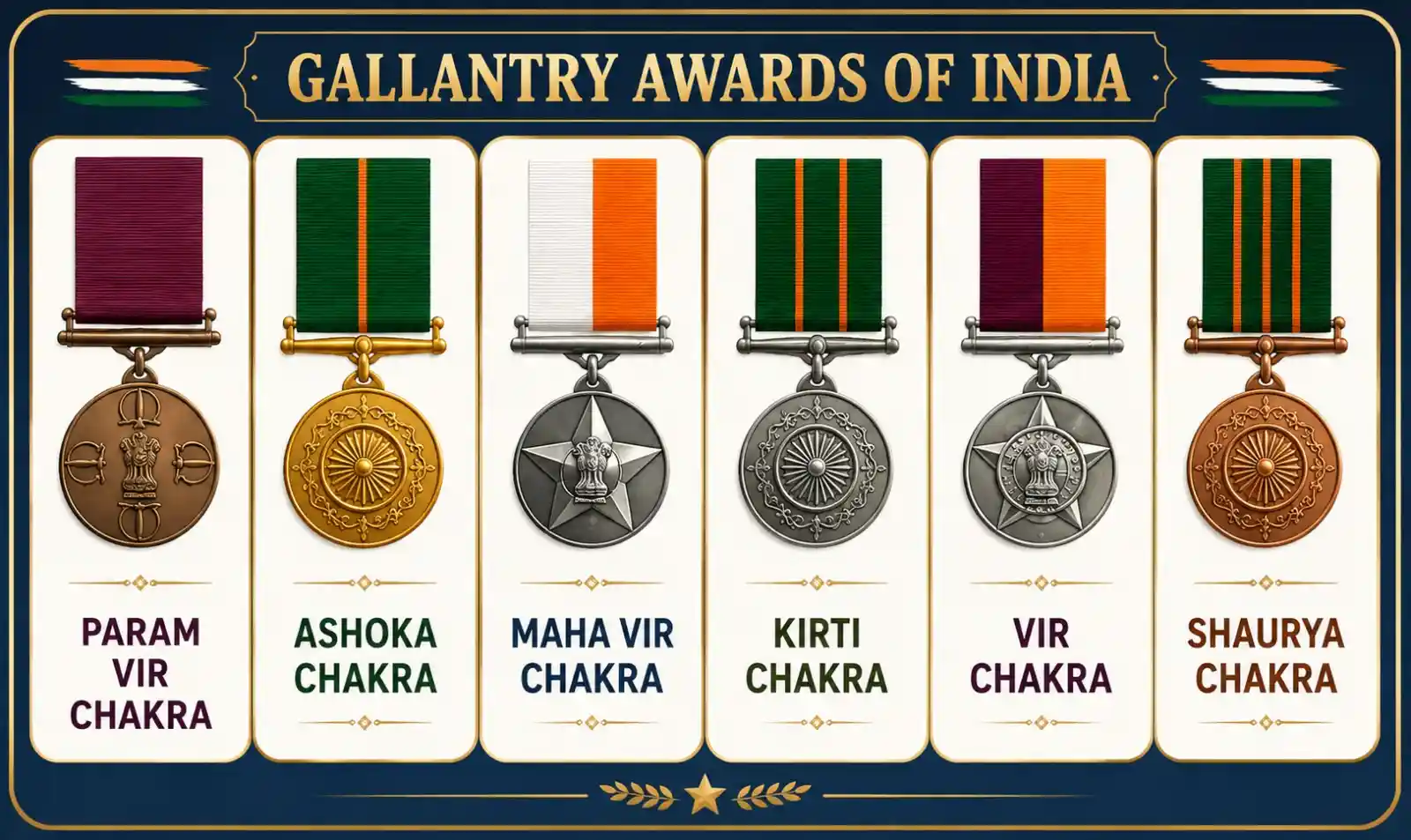
- Gallantry Awards are the highest military and civilian bravery decorations of India.
- These awards recognize extraordinary courage, bravery, and supreme sacrifice in duty.
- They are awarded to personnel of the Armed Forces, CAPFs, and Police Forces.
- The President of India confers these awards on behalf of the nation.
History
Wartime Gallantry Awards
- The Government of India instituted three wartime gallantry awards on 26 January 1950.
- These awards were given retrospective effect from 15 August 1947.
- The three wartime gallantry awards are Param Vir Chakra, Maha Vir Chakra, and Vir Chakra.
Peacetime Gallantry Awards
- The Government introduced three peacetime gallantry awards on 4 January 1952.
- These awards were initially known as Ashoka Chakra Class-I, II, and III.
- In 1967, these awards were renamed as Ashoka Chakra, Kirti Chakra, and Shaurya Chakra.
Frequency of Announcement
- The Government announces Gallantry Awards twice every year.
- The first announcement is made on Republic Day.
- The second announcement is made on Independence Day.
Categories of Gallantry Awards
Wartime Gallantry AwardsParam Vir Chakra (PVC)
Maha Vir Chakra (MVC)
Vir Chakra (VrC)
|
Peacetime Gallantry AwardsAshoka Chakra
Kirti Chakra
Shaurya Chakra
|
Defence Investiture Ceremony 2026
Kirti Chakra
- The President awarded seven Kirti Chakras during the ceremony.
- Five Kirti Chakras were awarded to living personnel.
- Two Kirti Chakras were awarded posthumously.
Vir Chakra
- The President awarded fifteen Vir Chakras during the ceremony.
- Twelve Vir Chakras were awarded to living personnel.
- Three Vir Chakras were awarded posthumously.
Shaurya Chakra
- The President awarded twenty-nine Shaurya Chakras during the ceremony.
- Twenty-eight Shaurya Chakras were awarded to living personnel.
- One Shaurya Chakra was awarded posthumously.
Important Design Features
Param Vir Chakra
Ashoka Chakra
Maha Vir Chakra
|
Kirti Chakra
Vir Chakra
Shaurya Chakra
|