Argumentative Indian must also listen, spirit of samvad must not be lost
India possesses a rich tradition of samvad (constructive dialogue and exchange of ideas) rooted in ancient philosophical debates. However, contemporary public discourse increasingly prioritizes winning arguments over understanding diverse perspectives. In a complex and interconnected world, preserving the spirit of samvad is essential for intellectual growth, effective diplomacy, and strategic decision-making.
What is the Spirit of Samvad?
Dialogue as a Search for Truth
- Ancient Indian traditions viewed debate as a collective pursuit of knowledge and wisdom.
- The objective was understanding reality rather than merely defeating an opponent.
- Intellectual engagement encouraged openness to alternative viewpoints and self-reflection.
- Samvad promoted learning, mutual respect, and continuous refinement of ideas.
Distinction Between Debate and Dialogue
- Debate often seeks victory by proving one’s position superior to others.
- Dialogue focuses on understanding, learning, and discovering common ground.
- Constructive conversations strengthen relationships while competitive arguments may create divisions.
- Healthy democracies require a balance between assertion and listening.
Reasons Behind India’s Increasingly Argumentative Culture
Historical and Psychological Factors
- Colonial experiences created a strong urge to defend national identity and perspectives.
- Many Indians remain sensitive to external criticism due to historical experiences.
- Foreign observations are sometimes viewed through lenses of suspicion and insecurity.
- Defensive reactions often prevent objective evaluation of constructive criticism.
Influence of Social Media and Polarization
- Social media platforms reward confrontation and quick rebuttals over thoughtful engagement.
- Public discussions increasingly become contests for validation and ideological dominance.
- Nuanced conversations are often replaced by binary and polarized narratives.
- The pressure to respond immediately discourages reflective thinking.
Why Listening Matters in the Modern World
Strategic and Diplomatic Benefits
- Nations improve policies by learning from international experiences and best practices.
- Constructive criticism can reveal weaknesses and opportunities for improvement.
- Diplomatic success often depends on building trust rather than winning arguments.
- Listening enhances strategic adaptability in a rapidly changing global environment.
Promoting Innovation and Growth
- New ideas emerge when diverse viewpoints are considered seriously.
- Collaborative problem-solving produces better outcomes than intellectual isolation.
- Openness to feedback strengthens institutions and policymaking processes.
- Learning from others accelerates social and economic development.
Way Forward
Reviving the Culture of Samvad
- Educational institutions should encourage critical thinking alongside respectful dialogue.
- Public discourse should prioritize evidence-based discussions over emotional reactions.
- Policymakers must cultivate openness to domestic and international feedback.
- Citizens should distinguish between challenges to their ego and challenges to assumptions.
Building Intellectual Maturity
- Constructive criticism should be viewed as an opportunity for learning and improvement.
- Greater emphasis must be placed on listening before responding.
- Intellectual confidence should arise from reasoned analysis rather than constant defensiveness.
- A mature society values understanding as much as persuasion.
India’s civilizational strength lies not merely in its ability to debate but also in its capacity to listen, learn, and evolve. Reviving the spirit of samvad can strengthen democratic discourse, improve policymaking, and enhance India’s global engagement. In an age of polarization and information overload, the ability to listen thoughtfully may prove more valuable than the ability to win arguments.
Prelims Boosters
Night Vision Devices (NVDs)
Context:
- India is strengthening its night-combat capabilities through indigenous Night Vision Devices (NVDs).
- The Ministry of Defence has signed a ₹659.47 crore contract for Netro NW 3000 night sights.
- Bharat Electronics Limited (BEL) has also commissioned a dedicated electro-optics facility in Andhra Pradesh.

About Night Vision Devices (NVDs)
What are NVDs?
- Night Vision Devices (NVDs) are advanced optoelectronic instruments.
- They help soldiers see in darkness and low-visibility conditions.
- They convert very low levels of light or heat signatures into visible images.
- They provide a significant operational advantage during night-time military operations.
Deployment of NVDs
Handheld Devices
Weapon-Mounted Sights
|
Night Vision Goggles
Platform-Based Sensors
|
How Do NVDs Work?
Image Intensification (Light Amplification)Principle
Process
Output
|
Thermal ImagingPrinciple
Process
Detection Capability
Advantages
|
Key Features of Modern NVDs
Generational Advancements
Evolution
- NVD technology has evolved through multiple generations.
- Modern systems mainly use Generation III and Generation IV technology.
Improvements
- Better image quality.
- Higher signal-to-noise ratio (clearer images with less distortion).
- Improved target detection and identification.
Fused Sensor Technology
- It combines thermal imaging and image intensification in a single system.
Benefits
- Provides both terrain details and heat signatures simultaneously.
- Improves situational awareness during combat.
Augmented Reality (AR) Integration
Features
- Displays tactical information directly in the soldier’s field of view.
- Provides: Digital maps, Target information and Friendly-force locations (Blue Force Tracking)
Advantage
- Enhances battlefield awareness and decision-making.
India’s Growing Night Vision Capabilities
Netro NW 3000 Night SightsRecent Procurement
Purpose
Deployment
Armoured Vehicle IntegrationBMP-2M Infantry Combat Vehicles
|
Aviation Night Vision SystemsNetro NB-3100 Gen-III Goggles
Platforms
Benefit
BEL Electro-Optics FacilityLocation
Investment
Products
|
Significance of NVDs
- Enhanced Combat Capability- Enables military operations during night-time and low-visibility conditions.
- Improved Surveillance- helps detect enemy movement and activities.
- Force Protection- Improves soldier safety through better situational awareness.
- Strategic Advantage- Provides operational superiority in modern warfare.
- Defence Self-Reliance- Indigenous production reduces dependence on imports and Strengthens India’s defence technology capabilities.
The LPMS – Vinimay System
Context:
- Union Home Minister inaugurated the advanced Land Port Management System (LPMS) platform named ‘Vinimay’ at Vigyan Bhawan, New Delhi.
About LPMS – Vinimay
What is it?
- Vinimay is a centralized digital platform for managing operations at India’s international land ports.
- It functions as a Single Electronic Window System.
- It enables real-time monitoring and management of cargo, passengers, and vehicles crossing land borders.
- It modernizes land port operations on the lines of automated systems used at airports and seaports.
Developed By
- Developed by the Land Ports Authority of India (LPAI).
- Operates under the administrative control of the Ministry of Home Affairs (MHA).
Objectives
Streamlining Border Trade
Reducing Paperwork
|
Enhancing Border Security
Supporting Viksit Bharat 2047
|
Key Features of Vinimay
Single Electronic Window
- Provides a unified platform for all stakeholders and Integrates cargo handling, passenger management, and vehicle processing.
Reduction in Paperwork
- Eliminates nearly 90% of physical documentation and Promotes paperless and efficient operations.
Faster Processing
Truck Movement
| Gate Processing
|
Real-Time Data Sharing
Integrated Government Databases- Connects multiple government agencies on a common dashboard and Enables real-time information exchange.
Agencies Integrated with Vinimay
ICEGATE and CBIC
|
BSF
|
UIDAI
|
DGFT and ULIP
National Motor Vehicle System
|
ANPR-Based Gate Automation
What is ANPR?
- ANPR stands for Automatic Number Plate Recognition.
- It uses cameras to automatically identify vehicle registration numbers.
Working
- Captures vehicle number plates at entry and exit gates.
- Matches vehicles with pre-booked slots automatically.
- Eliminates manual logbook entries.
Benefits
- Reduces human intervention.
- Improves speed and accuracy of vehicle processing.
Network Coverage
Present Coverage
- Currently manages operations across 15 active land ports in India.
Future Expansion
- Designed to accommodate 11 additional land ports planned over the next three years.
- Ensures scalability for future border infrastructure development.
Significance
Trade Facilitation
Digital Governance
Border Security
|
Ease of Doing Business
Regional Connectivity
|
The Election Symbols (Reservation and Allotment) Order, 1968
Context:
- The issue of election symbols gained attention after the satirical youth pressure group Cockroach Janta Party (CJP) held its first physical protest at Jantar Mantar, New Delhi.
About the Election Symbols (Reservation and Allotment) Order, 1968
What is it?
- It is a legal framework governing the allotment and regulation of election symbols in India.
- It empowers the Election Commission of India (ECI) to:
- Specify election symbols.
- Reserve symbols for political parties.
- Allot symbols to candidates.
- Regulate the use of election symbols.
- It serves as the rulebook for assigning visual identities to political parties and candidates during elections.
Legal Basis
Promulgation
- Issued by the Election Commission of India on 31 August 1968.
Constitutional Basis
- Derived from Article 324 of the Constitution of India.
• Article 324 vests the superintendence, direction, and control of elections in the ECI.
Statutory Basis
- Read along with: Rule 5 of the Conduct of Elections Rules, 1961 and Rule 10 of the Conduct of Elections Rules, 1961.
Objectives
Easy Identification of Candidates
|
Uniform Election Management
|
Protection of Party Identity
|
Classification of Political Parties
Recognized Parties
|
Unrecognized Parties
|
Reserved Symbols
For Recognized Parties
- Each recognized National or State Party is allotted an exclusive symbol.
- The symbol is permanently reserved for that party.
Exclusivity
- No other party or candidate can use that symbol within the concerned jurisdiction.
- Helps create a distinct political identity.
Free Symbols
What are Free Symbols?
- Symbols available for allocation to: Unrecognized political parties and Independent candidates.
Allotment Process
- Allocated by the Election Commission.
- Generally allotted on a first-come-first-served basis during elections.
Examples
- Common objects and everyday items such as: Balloon, Air-conditioner, Jackfruit, TV remote, Other approved symbols from the ECI’s free symbol list.
Animal Symbols Policy
Restriction on Animal Symbols
- The Election Commission stopped allotting new symbols representing living animals during the 1990s.
Reason
- Concerns were raised by animal welfare groups.
- Reports of cruelty to live roosters during the 1989 Tamil Nadu Assembly elections highlighted the issue.
Legacy Exceptions
Existing Animal Symbols
- Political parties that had already received animal symbols before the restriction were allowed to retain them.
Example
- Bahujan Samaj Party (BSP) continues to use the Elephant symbol.
Dark Patterns
Context:
- Indian consumers are estimated to lose ₹25,000–₹28,000 crore annually due to deceptive online interface designs known as dark patterns.
About Dark Patterns
What are Dark Patterns?
- Dark patterns are deceptive design techniques used on websites, apps, emails, and online platforms.
- They are intentionally designed to manipulate users into making decisions they may not otherwise choose.
- These decisions usually benefit the company rather than the consumer.
- They are also known as deceptive patterns.
Coined By
- The term “Dark Patterns” was coined by Harry Brignull in 2010.
How Do Dark Patterns Work?
Exploiting Cognitive Biases
- They take advantage of cognitive biases (natural shortcuts the human brain uses while making decisions).
- They influence user behaviour through psychological pressure and misleading design.
Manipulative Design
- Users are nudged toward actions that they may not fully understand or intend.
- Often encourage unnecessary purchases, subscriptions, or sharing of personal data.
Characteristics
Intentional Deception
Hidden Information
|
User Disadvantage
Widespread Presence
|
Guidelines in India
Regulatory Framework
- The Central Consumer Protection Authority (CCPA) notified the Guidelines for Prevention and Regulation of Dark Patterns, 2023.
Purpose
- To protect consumers from deceptive online practices.
- To promote transparency and informed decision-making.
Thirteen Dark Patterns Identified by CCPA
1. False Urgency
Example
2. Basket Sneaking
Example
3. Confirm Shaming
Example
4. Forced Action
Example
5. Subscription Trap
Example
6. Interface Interference
Example
|
7. Bait and Switch
Example
8. Drip Pricing
Example
9. Disguised Advertisement
Example
10. Nagging
Example
11. Trick Wording
Example
12. SaaS Billing
Example
13. Rogue Malware
Example
|
Impact of Dark PatternsFinancial Loss
Loss of Consumer Choice
Privacy Concerns
Reduced Trust
|
Significance of RegulationConsumer Protection
Fair Business Practices
Digital Transparency
Strengthening E-Commerce
|
Zojila Tunnel
Context:
- The Zojila Tunnel recently achieved its final breakthrough with the excavation of the last five metres, marking a major milestone in the project.
About Zojila Tunnel
What is it?
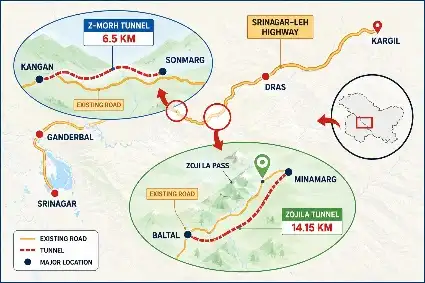
- Zojila Tunnel is a major road tunnel currently under construction.
- It will connect Sonamarg in Jammu & Kashmir with Drass in Ladakh.
- The tunnel is being built beneath the Zoji La Pass on the Srinagar–Leh Highway (NH-1).
- It aims to provide reliable, all-weather connectivity between the Kashmir Valley and Ladakh.
Location
Strategic Position
- Located under the Zoji La Pass in the Himalayas.
- Connects: Ganderbal district of Jammu & Kashmir and Kargil district of Ladakh.
Importance of Zoji La Pass
- Zoji La is one of the most important mountain passes linking Kashmir with Ladakh.
- Heavy snowfall often blocks the pass during winter, disrupting connectivity.
Key Features
High-Altitude Construction
- Being constructed at an elevation of approximately 11,578 feet above sea level.
- Built in extremely challenging Himalayan terrain.
Tunnel Design
Shape: Horseshoe-shaped tunnel.Type
- Single-tube bi-directional road tunnel.
- Vehicles travelling in both directions will use the same tunnel tube.
Global Distinction
- Will be the world’s longest single-tube bi-directional road tunnel at the highest altitude upon completion.
Construction Technology
New Austrian Tunnelling Method (NATM)
What is NATM?
|
Features
|
Importance
|
Benefits of the TunnelAll-Weather Connectivity
Reduced Travel Time
Improved Defence Logistics
Economic Development
Better Emergency Access
|
Strategic SignificanceNational Security
Regional Integration
Infrastructure Development
|