
R&D Underspending in India: Systemic and Cultural Causes
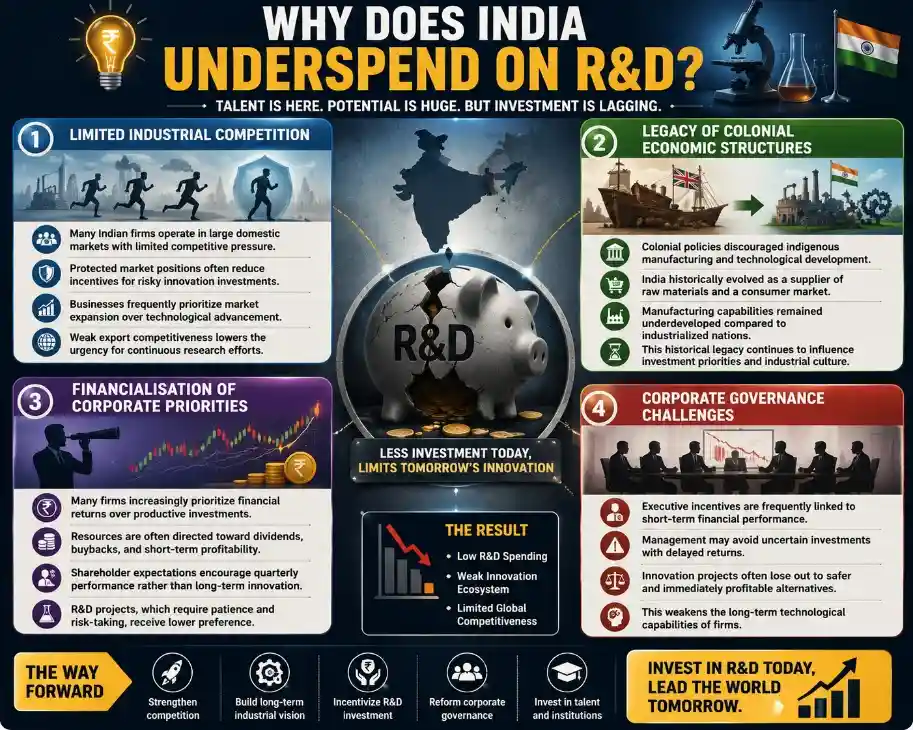
Research and Development (R&D) is a critical driver of innovation, productivity, industrial competitiveness, and long-term economic growth. Despite being one of the world’s largest economies, India’s R&D expenditure remains around 0.6–0.7% of GDP, significantly lower than major innovation-driven economies. The challenge is not attributable to a single factor but emerges from a combination of systemic, structural, and cultural constraints.
Cultural and Institutional Factors
Low Tolerance for Risk and Failure
- Innovation inherently involves uncertainty, experimentation, and possible failures.
- Indian business culture often remains cautious toward high-risk investments.
- Firms prefer predictable returns over uncertain technological breakthroughs.
- This discourages ambitious research and frontier technology development.
Weak Industry–Academia Linkages
- Collaboration between universities and industries remains limited.
- Research outcomes often fail to translate into commercial applications.
- Technology transfer mechanisms are relatively underdeveloped.
- Innovation ecosystems remain fragmented across sectors.
Inadequate Research Ecosystem
- Public and private R&D spending remains insufficient compared to global leaders.
- India faces shortages of advanced research infrastructure and funding support.
- High-quality scientific talent often migrates to countries offering better opportunities.
- Limited commercialization pathways reduce incentives for innovation.
Implications for IndiaEconomic Consequences
Strategic Consequences
|
Way ForwardStrengthening Innovation Ecosystems
Encouraging Long-Term Corporate Investments
|
India’s R&D underinvestment is neither purely structural nor purely cultural; it reflects the interaction of historical legacies, market incentives, corporate priorities, and institutional weaknesses. Addressing this challenge requires a comprehensive strategy that promotes innovation, rewards long-term thinking, and strengthens research ecosystems. Sustained investment in R&D will be essential for India’s ambition to become a technologically advanced and globally competitive economy.
Prelims Boosters
Doctrine of Forum Non Conveniens
Context:
- The Supreme Court recently observed that when a constitutional remedy is sought under Article 226(1) of the Constitution, the doctrine of forum non conveniens may rarely be applicable.
About Doctrine of Forum Non Conveniens
What is it?
- The Doctrine of Forum Non Conveniens is a common law legal principle.
- It allows a court to decline or stay proceedings even when it has jurisdiction over a case.
- The court may do so if another forum (court/jurisdiction) is considered more appropriate for hearing the matter.
Meaning
- The term “Forum Non Conveniens” is a Latin expression.
- It means “inconvenient forum”.
OriginCommon Law Doctrine
Area of Application
|
ObjectiveEnsuring Appropriate Forum
Preventing Forum Shopping
|
Nature of the Doctrine
Discretionary Principle
- Application of the doctrine is discretionary.
- Courts have significant freedom in deciding whether to apply it.
Case-Specific Decision
- Each case is examined based on its own facts and circumstances.
Factors Considered by Courts
Convenience of Parties
- Whether the parties can effectively participate in the proceedings.
Location of Evidence
- Availability and accessibility of relevant documents and evidence.
Availability of Witnesses
- Ease of producing witnesses before the court.
Applicable Law
- Which jurisdiction’s law is most closely connected with the dispute.
Fair Trial Considerations
- Whether a fair and effective trial can be conducted in the alternative forum.
Interests of Justice
- The most important consideration.
- Courts assess whether justice would be better served elsewhere.
Role of the Defendant
Invocation of the Doctrine
- Usually raised by the defendant.
Burden of Proof
- The defendant must show that: Another suitable forum exists, The alternative forum has jurisdiction, The alternative forum can provide an adequate remedy.
Conditions for Alternative Forum
Jurisdiction
- The alternative court must have authority over: The parties and The subject matter of the dispute.
Adequate Remedy
- The plaintiff should be able to obtain meaningful relief in that forum.
Fair Procedure
- The alternative forum should provide a fair judicial process.
Position in India
Relevance under Article 226
Article 226
- Empowers High Courts to issue writs for: Enforcement of Fundamental Rights. And Any other legal right.
Recent Supreme Court Observation
- The Supreme Court stated that where a constitutional remedy is invoked under Article 226(1), the doctrine of forum non conveniens may have limited application.
- Constitutional rights and remedies generally receive greater protection than ordinary civil disputes.
RISA – Timeless Tribal
Context:
- The Ministry of Tribal Affairs, through the Tribal Cooperative Marketing Development Federation of India (TRIFED), has launched a premium tribal brand called RISA – Timeless Tribal.
About RISA – Timeless Tribal
What is it?
- RISA – Timeless Tribal is a dedicated premium brand for tribal textiles, embroidery, and handicrafts.
- It aims to showcase India’s rich tribal heritage through high-quality products.
- It seeks to position tribal products in premium domestic and international markets.
Launched By
- Ministry of Tribal Affairs.
- Implemented through TRIFED.
Objectives
Creating a Distinct Brand Identity
- To establish a unique and recognizable identity for tribal products.
Strengthening Market Linkages
- To connect tribal artisans with larger national and international markets.
Design Development
- To promote innovation while preserving traditional craftsmanship.
- To support product diversification and modernization.
Promoting Tribal Heritage
- To showcase indigenous traditions, skills, and cultural heritage.
Enhancing Livelihoods
- To generate better income opportunities for tribal artisans and weavers.
Preservation of Traditional Knowledge
- To safeguard traditional crafts and indigenous knowledge systems for future generations.
First Phase of Implementation
Selection Criteria
- Products were selected based on: Cultural significance, Market potential.
Tribal Textiles and Embroidery Included
AssamEri Silk
Muga Silk
JharkhandSantal Cotton
LadakhChangpa Pashmina
OdishaKotpad Cotton
Dongria Embroidery
|
Tamil NaduToda Embroidery
Tribal Handicrafts IncludedManipurLongpi Pottery
LadakhTurtuk Brass Cutlery
ChhattisgarhDokhra Art
|
Implementation Mechanism
National Design Centre (NDC)
Role
- Nodal agency for implementation.
- An autonomous organization under the Ministry of Textiles.
Major Activities
- Design development.
- Product diversification.
- Capacity building of artisans.
- Development of garment prototypes.
- Establishment of stitching facilities.
- Strengthening weaving and handicraft clusters.
- Improvement in product presentation and packaging.
Role of Designers
Design Interventions
- Eminent fashion designers have been associated with the initiative.
- Aim is to blend traditional craftsmanship with contemporary market demand.
Sustainable Packaging
National Institute of Design (NID), Haryana
Responsibility
- Developing premium and environmentally sustainable packaging solutions.
Objective
- Improve product appeal in domestic and international markets.
First Exclusive RISA Store
Location
- Gallery No. 2, Rajiv Gandhi Handicrafts Bhawan.
- Connaught Place, New Delhi.
Key Organizations Involved
Ministry of Tribal Affairs
|
TRIFED
|
National Design Centre (NDC)
|
National Institute of Design (NID), Haryana
|
Jordan
Context:
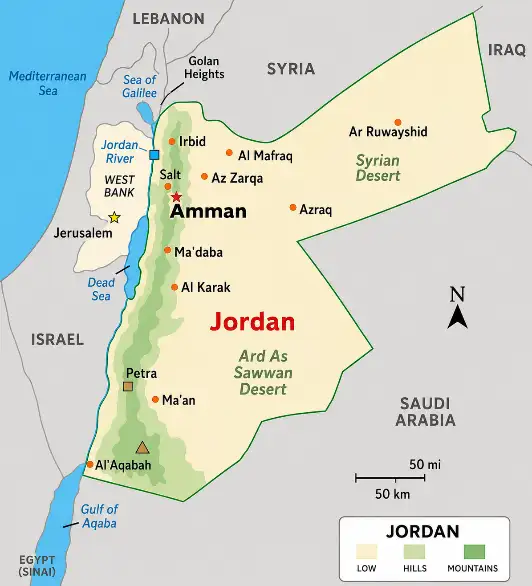
- Iran’s Islamic Revolutionary Guard Corps (IRGC) reportedly launched ballistic missiles targeting the Al-Azraq Air Base in Jordan, bringing attention to Jordan’s strategic location in West Asia.
About Jordan
What is it?
- Jordan is an independent Arab country located in Southwest Asia (West Asia).
- Officially known as the Hashemite Kingdom of Jordan.
- It is a constitutional monarchy ruled by the Hashemite dynasty.
- Jordan is known for its relatively stable political system and active diplomatic role in the Middle East.
Historical Background
- Was part of the Ottoman Empire until 1918.
- Came under British administration after World War I.
- Gained independence in 1946.
Capital
Amman
- Capital and largest city of Jordan.
- Political, economic, and cultural centre of the country.
Location
Region- Located in West Asia (Middle East).Borders
North
|
East
|
South and Southeast
|
West
|
Major Physical Features
Great Syrian DesertLocation
Characteristics
Eastern UplandsDescription
Height
Highest Point
|
Jordan ValleyImportance
Dead SeaUnique Feature
Global Distinction
|
Rivers and Drainage
Jordan River
Importance
- Principal river of Jordan.
- Flows into the Dead Sea.
Climate
Western Jordan
- Mediterranean-type climate.
- Receives relatively higher rainfall.
Eastern Jordan
- Desert climate.
- Very low rainfall and sparse vegetation.
Khamsin Winds
- Hot, dry, dust-laden winds that occasionally affect the region.
Water Scarcity
- Jordan is among the world’s most water-scarce countries.
- Freshwater availability remains a major challenge.
Disqualification of Rajya Sabha Candidature
Context:
- The Rajya Sabha nomination of senior Congress leader Meenakshi Natarajan was rejected by the Returning Officer during scrutiny of nomination papers.
About Disqualification of Rajya Sabha Candidature
What is it?
- Disqualification of a Rajya Sabha candidature refers to the rejection of a candidate’s nomination papers or the loss of membership of the Rajya Sabha.
- It occurs when a person fails to satisfy constitutional or statutory requirements.
- The objective is to maintain the integrity and credibility of Parliament.
Constitutional Provisions
Article 102 of the Constitution
What does it provide?
- Lays down the grounds for disqualification of Members of Parliament.
- Applies to both Lok Sabha and Rajya Sabha members.
Grounds of Disqualification
Office of Profit
Unsound Mind
Undischarged Insolvent
|
Loss of Citizenship
Disqualification under Law Made by Parliament
|
Statutory Basis
Representation of the People Act, 1951 (RPA)
- Provides detailed provisions relating to electoral disqualifications.
- Specifies conditions under which a person cannot contest elections or continue as a member.
Conduct of Elections Rules, 1961
Form 26 Affidavit
- Every candidate must submit a sworn affidavit containing: Criminal cases, Assets and liabilities, Educational qualifications, Income tax details, Financial interests.
Authority Responsible
Returning Officer (RO)
Powers
- Scrutinizes nomination papers.
- Verifies eligibility and required documents.
- Can reject nominations if: Forms are incomplete, Legal requirements are not fulfilled, Material information is concealed.
Grounds of Disqualification under the Representation of the People Act, 1951
Criminal Convictions (Section 8)
Section 8(1): Serious Offences
- Immediate disqualification upon conviction for offences such as:
- Bribery, Corruption, Rape, Promoting communal hatred, Insulting the National Flag.
Section 8(2): Specific Economic and Social Offences
- Convictions involving:
- Hoarding, Profiteering, Food adulteration, Drug adulteration (Disqualification applies when imprisonment is six months or more)
Section 8(3): General Criminal Convictions
- Any conviction resulting in imprisonment of two years or more leads to:
- Disqualification during imprisonment.
- Continued disqualification for six years after release.
Corrupt Practices (Section 8A)
Examples
- Bribery, Booth capturing, Voter intimidation, Electoral manipulation.
Penalty
- Disqualification for up to six years.
Government Service-Related DisqualificationsDismissal for Corruption (Section 9)
Government Contracts (Section 9A)
Government-Controlled Companies (Section 10)
| Election Expenditure-Related DisqualificationFailure to Submit Election Expenses (Section 10A)Requirement: Candidates must submit a correct account of election expenses within the prescribed period. Consequence: Failure may lead to disqualification for three years. Concealment of InformationFalse or Incomplete Form 26 AffidavitConcealment of:
Consequence
|
Foreign Currency Non-Resident (Bank) [FCNR(B)]
Context:
- The Reserve Bank of India (RBI) has introduced a special dispensation allowing banks to mobilize fresh 3- to 5-year FCNR(B) deposits.
About FCNR(B)
What is FCNR(B)?
- FCNR(B) stands for Foreign Currency Non-Resident (Bank) Deposit.
- It is a fixed-term deposit account maintained in foreign currency with Indian banks.
- It is available to: Non-Resident Indians (NRIs), Overseas Citizens of India (OCIs), Persons of Indian Origin (PIOs)
Key Feature
- Deposits are maintained in foreign currency itself.
- Unlike many NRI accounts, funds are not converted into Indian Rupees.
- Depositors are protected from exchange rate fluctuations between the Rupee and foreign currencies.
Objectives
For Depositors
|
For Indian Banks
|
For the Economy
|
Eligible Currencies
Commonly Accepted Currencies: US Dollar (USD), Pound Sterling (GBP), Euro (EUR), Japanese Yen (JPY), Australian Dollar (AUD), Canadian Dollar (CAD)Tenure
Deposit Period
- FCNR(B) deposits generally have a maturity period ranging from 1 year to 5 years.
- Under the recent RBI dispensation, banks can raise fresh deposits with 3- to 5-year maturities.
How Does FCNR(B) Work?
Deposit Placement
- An NRI deposits money in a designated foreign currency account with an Indian bank.
Currency Retention
- The deposit remains in the chosen foreign currency throughout the tenure.
- Principal and interest are repayable in the same foreign currency.
RBI Swap Mechanism
Purpose
- To encourage banks to attract more FCNR(B) deposits.
First Leg: Spot Transaction
- Banks sell foreign currency received from FCNR(B) deposits to RBI.
- Transactions occur at the reference exchange rate published by Financial Benchmarks India Private Limited (FBIL).
Second Leg: Forward Buyback
- RBI agrees to sell back the same amount of foreign currency at maturity.
Benefit
- The exchange rate for both transactions remains the same (par rate).
- Banks do not bear forward exchange risk.
- RBI absorbs the forward premium cost.
Key Features of FCNR(B)
Foreign Currency Deposit
- Maintained entirely in foreign currency.
- No exposure to Rupee depreciation.
Repatriability
- Both principal and interest are fully repatriable (can be transferred abroad).
Tax Benefits
- Interest earned is exempt from income tax in India.
- Benefit is available as long as the depositor retains non-resident status under Indian tax laws.
Fixed Returns
- Depositors earn interest at predetermined rates for a fixed period.
Regulatory Benefits for BanksCRR Exemption
SLR Exemption
Significance
|
Interest RatesBenchmark Linked
Lower than Domestic Deposits
Example
Competitive Pressure
|
Comparison with Other NRI Accounts
Feature |
FCNR(B) |
NRE Account |
NRO Account |
| Currency | Foreign Currency | Indian Rupees | Indian Rupees |
| Exchange Rate Risk | No | Yes | Yes |
| Repatriability | Fully Repatriable | Fully Repatriable | Restricted |
| Main Purpose | Foreign currency savings | Overseas earnings in India | Managing income earned in India |







3 Responses
Thankyou for helping out, excellent info .
I think other website proprietors should take this website as an example , very clean and fantastic user pleasant style.
I like this web site very much so much great info .