India-Nordic Partnership: Transforming Historical Sambandh into a Strategic Future Alliance
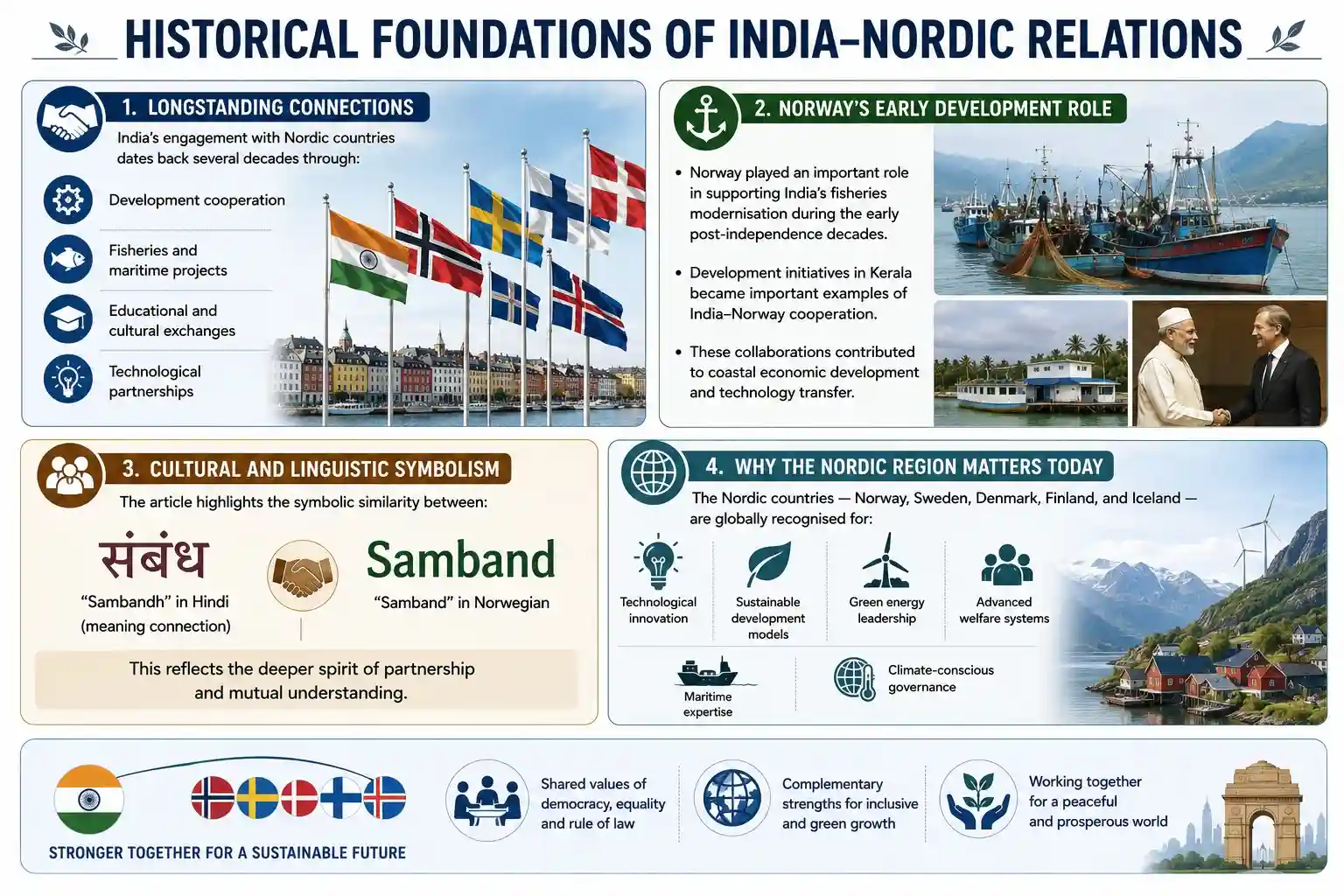
Shift from Traditional Diplomacy to Strategic Partnership
The India-Nordic relationship is evolving beyond symbolic diplomacy toward:
- Economic cooperation, Technology partnerships, Climate collaboration, Supply chain resilience, Strategic investments.
This reflects India’s broader diversification of global partnerships.
Green Transition and Climate Cooperation
Importance of Green Partnership
Climate change and energy transition have become central global priorities.
Nordic countries possess advanced expertise in:
- Renewable energy, Offshore wind technology, Carbon capture and storage (CCS), Green shipping corridors, Sustainable urban systems.
Benefits for India
India can utilise Nordic expertise for:
- Industrial decarbonisation, Clean energy expansion, Sustainable manufacturing,
- Green infrastructure development, Maritime sustainability.
Blue Economy Cooperation
India’s coastal economy can benefit significantly from:
- Sustainable fisheries management, Green maritime transport.
- Ocean-based economic activities, Coastal infrastructure development.
Investment and Economic Opportunities
India as a Growth Destination
India’s expanding economy provides major opportunities for Nordic investors in:
- Infrastructure, Green technology, Manufacturing, Renewable energy, Digital innovation.
Trade and Investment Agreements
The India-EFTA Trade and Economic Partnership Agreement (TEPA) strengthens economic engagement with European Free Trade Association countries, including Norway.
Potential benefits include:
- Increased investment inflows, Technology transfer, Market access.
- Long-term industrial collaboration.
Role of Sovereign Wealth Funds
Norway’s sovereign wealth fund, one of the world’s largest investment funds, can become an important source of:
- Long-term infrastructure financing, Green investments, Sustainable development capital.
Technology and Innovation Partnership
Nordic Strength in Innovation
Nordic countries are leaders in:
- Artificial Intelligence, Green industrial technologies.
- Advanced manufacturing, Digital governance, Smart urban planning.
Opportunities for India
India can combine:
- Nordic technological expertise, with India’s market scale and human resources.
This creates possibilities for mutually beneficial innovation ecosystems.
Maritime and Arctic Cooperation
Strategic Importance of the Arctic
Climate change is increasing the geopolitical and scientific importance of the Arctic region.
The melting Arctic has implications for:
- Global shipping routes, Climate systems, Monsoon patterns, Food security.
India-Norway Arctic Cooperation
Norway’s Arctic expertise can support India in:
- Polar research, Climate monitoring, Maritime scientific collaboration, Ocean governance.
Indian Ocean-Arctic Linkage
The Arctic and Indian Ocean are increasingly interconnected through climate systems and global trade networks.
Shared Democratic and Multilateral Values
India and Nordic countries share commitment toward:
- Democracy, Rule-based international order, Multilateralism.
- International cooperation, Peaceful global governance.
At a time of rising geopolitical fragmentation, these shared values strengthen diplomatic convergence.
Geopolitical Significance of the Partnership
Changing Global Order
The partnership gains importance amid:
- US-China rivalry, Global supply chain restructuring, Energy insecurity, Climate-related disruptions.
Strategic Diversification
India seeks diversified partnerships beyond traditional power blocs.
Nordic countries provide:
- Reliable technology partners, Stable investment sources.
- Climate cooperation opportunities, Strategic connectivity with Europe.
Challenges in India-Nordic Relations
Despite strong potential, challenges remain:
- Limited public awareness about Nordic countries in India, Geographic distance, Relatively modest trade volumes.
- Cultural misunderstandings in isolated incidents, Need for stronger institutional engagement.
However, these challenges are manageable through sustained dialogue and cooperation.
Areas for Future Cooperation
Green Energy
Maritime Sector
Technology
|
Education and Research
Climate and Sustainability
|
Broader Significance for India
The India-Nordic partnership supports India’s goals of:
- Sustainable development, Energy transition, Technological modernisation.
- Climate resilience, Strategic diversification.
It also strengthens India’s role in shaping a multipolar and rules-based global order.
Prelims Boosters
Justice Aravind Kumar Committee
Context:
Chief Justice of India Surya Kant has constituted a high-powered Judicial Infrastructure Advisory Committee headed by Supreme Court Justice Aravind Kumar.
About the Justice Aravind Kumar Committee
- The Judicial Infrastructure Advisory Committee is a high-level panel created to improve the physical and digital infrastructure of the Indian judiciary.
- It includes senior judges from the Supreme Court and High Courts along with administrative and technical experts.
- The committee has been constituted by the Supreme Court of India.
Objective
- The committee aims to address long-standing infrastructure gaps in Indian courts.
- It seeks to prepare a roadmap for developing modern, technology-driven, and citizen-friendly judicial infrastructure.
- It also aims to secure greater financial support for modernization of courts.
Chairperson
- The committee is headed by Justice Aravind Kumar of the Supreme Court of India.
Key Focus Areas
Judicial Infrastructure
Digital Transformation
Modern Court Complexes
|
Better Facilities
Faster Case Disposal
Financial Dimension
|
The Kimberley Process (KP)
Context:
India commenced the Kimberley Process Intersessional Meeting in Mumbai as the Chair for the year 2026.
About the Kimberley Process
- The Kimberley Process is an international multi-stakeholder initiative involving governments, the diamond industry, and civil society organisations.
- It aims to prevent the trade of conflict diamonds across the world.
- The initiative began in May 2000 in Kimberley, South Africa.
Kimberley Process Certification Scheme (KPCS)
- The Kimberley Process Certification Scheme was formally adopted in 2002 and came into operation in 2003.
- It acts as a certification mechanism to ensure that rough diamonds are conflict-free.
Objective
- The main objective is to stop rebel groups from financing wars through the illegal trade of rough diamonds.
- It seeks to ensure that diamond trade does not contribute to violence or human rights abuses.
Key Features
Certification System
Trade Restrictions
|
Monitoring and Compliance
Data Transparency
|
Modernisation Efforts
- India’s 2026 Chairship is promoting digital certification and blockchain-based traceability systems.
India and the Kimberley Process
- India assumed the Chairship of the Kimberley Process in 2026.
- This is the third time India has chaired the organisation.
- India’s 2026 theme is “Credibility, Compliance, and Consumer Confidence.”
National Florence Nightingale Awards 2026
Context:
The President of India presented the National Florence Nightingale Awards 2026 to nursing personnel at Rashtrapati Bhavan.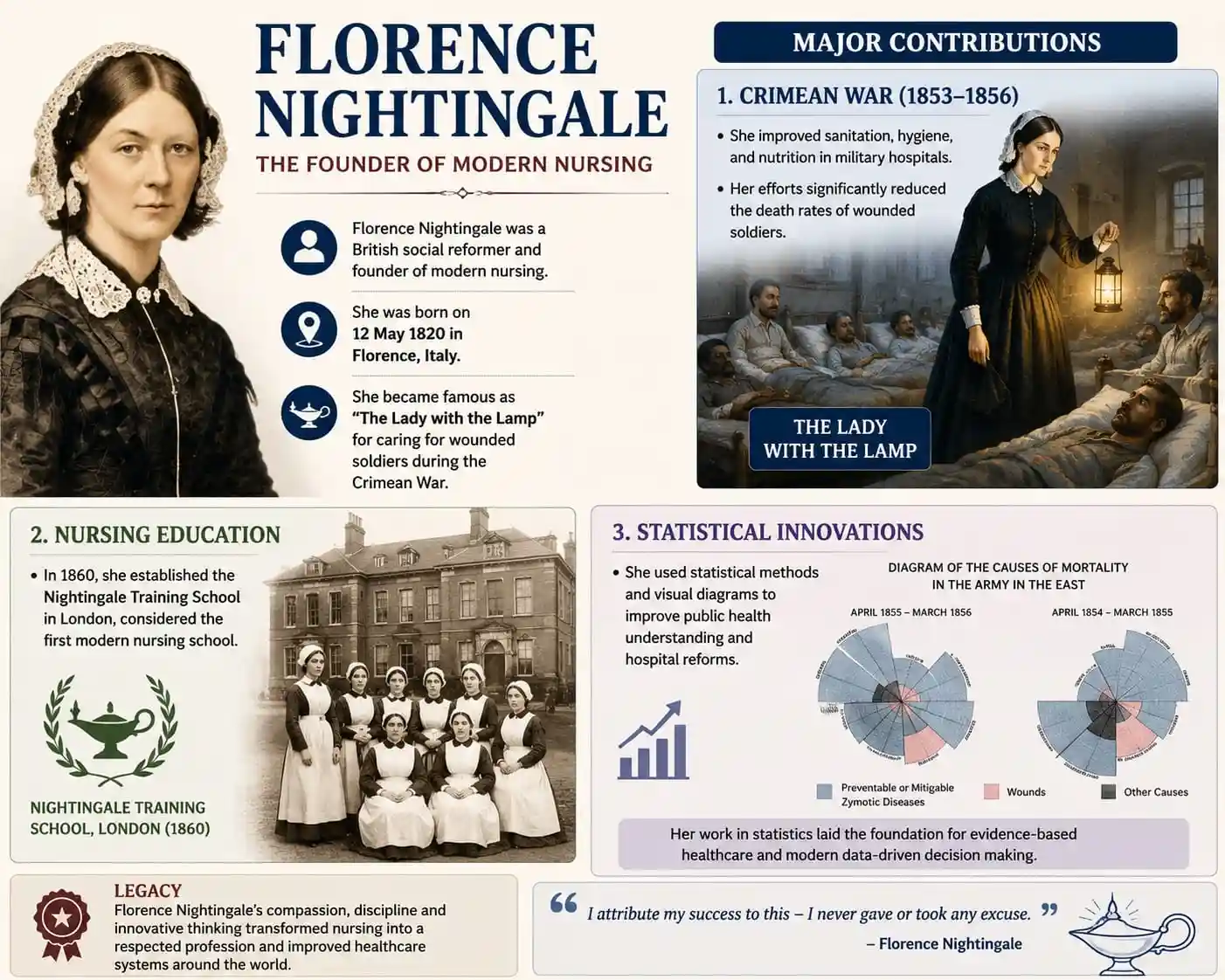
About National Florence Nightingale Award
- The National Florence Nightingale Award is the highest national honour for nurses in India.
- It recognises nursing professionals for their exceptional service, dedication, and contribution to healthcare.
- The award was instituted in 1973 by the Ministry of Health and Family Welfare.
Objective
- The award aims to honour nurses, midwives, and health workers for their outstanding contribution to patient care and public health services.
Key Features
Annual Award
- The award is presented every year on 12 May, which marks the birth anniversary of Florence Nightingale.
Eligible Categories
- It is awarded to: Registered Nurses, Midwives, Auxiliary Nurse Midwives (ANMs), Lady Health Visitors
- Awardees may belong to government, private, missionary, or voluntary healthcare institutions.
Components of the Award
- The award includes: Certificate of Merit, Medal and Cash prize of ₹50,000
About Florence Nightingale
Major ContributionsCrimean War
Nursing Education
Statistical Innovations
|
International Fund for Agricultural Development (IFAD)
Context:
Recently, the Government of India and the International Fund for Agricultural Development launched a new eight-year Country Strategic Opportunities Programme (COSOP) for 2026–2033.
About IFAD
- The International Fund for Agricultural Development is an international financial institution and a specialised agency of the United Nations.
- It was established in 1977 through a United Nations General Assembly Resolution.
Objective
- IFAD aims to eradicate poverty and hunger in rural areas of developing countries.
- It focuses on transforming agriculture, rural economies, and food systems.
- It works to improve food security, nutrition, and livelihoods of rural populations.
Key Features
- IFAD is the only UN agency exclusively dedicated to rural development and agriculture.
- Its projects are implemented in remote and environmentally fragile regions, including least-developed countries and Small Island Developing States.
- It is a member of the United Nations Development Group.
Grants by IFAD
- IFAD provides: Global or regional grants and Country-specific grants
- These grants support:
- Research and innovation, Institutional reforms
- Pro-poor technologies, Sustainable agricultural practices
Membership
- IFAD has 180 member states. India is a founding member of IFAD.
Governance
- The Governing Council is the highest decision-making body of IFAD. It meets every three years.
Headquarters
- IFAD headquarters is located in Rome, Italy.
About COSOP (2026–2033)
- COSOP stands for Country Strategic Opportunities Programme.
- It aims to strengthen rural incomes, resilience, and sustainable livelihoods in India.
Major Priorities
- Enhancing social, economic, and climate resilience of rural communities.
- Strengthening knowledge systems for scaling successful development models in India and the Global South.
Indian Ocean Rim Association (IORA)
Context:
Recently, the 10th edition of the Indian Ocean Dialogue was organised by the Ministry of External Affairs in collaboration with the Indian Ocean Rim Association Secretariat.
About IORA
- The Indian Ocean Rim Association is an intergovernmental organisation established in 1997.
- It brings together countries located along the rim of the Indian Ocean.
- It was earlier known as the Indian Ocean Rim Initiative and later as the Indian Ocean Rim Association for Regional Cooperation (IOR-ARC).
Objectives
- IORA aims to promote sustainable growth and balanced development in the Indian Ocean region.
- It seeks to enhance economic cooperation and regional integration among member states.
- It also works towards reducing trade barriers and improving the flow of goods, services, and investments.
Membership
- IORA currently has 23 member states and 12 dialogue partners.
- Its members are drawn from Asia, Africa, Oceania, and Europe.
Important Member Countries
Asia: India, Bangladesh, Indonesia, Iran, Malaysia, Maldives, Oman, Singapore, Sri Lanka, Thailand, United Arab Emirates and Yemen
Africa: South Africa, Kenya, Tanzania, Mauritius, Seychelles, Madagascar, Mozambique, Somalia and Comoros
Oceania: Australia
Europe: France
Dialogue Partners
- China, European Union, Germany, Japan, Russia, Saudi Arabia, South Korea, Türkiye, United Kingdom, United States
Priority Areas of IORA
- Trade and Investment
- Maritime Safety and Security
- Fisheries Management
- Disaster Risk Management
- Blue Economy
Governance Structure
Council of Foreign Ministers (COM)
- It is the apex decision-making body of IORA.
- It meets annually.
Secretariat
- The IORA Secretariat is located in Ebène, Mauritius.
- It is headed by a Secretary-General appointed for a three-year term.