The ‘Seven-Point IQ Opportunity’ for Indian Children
India has made significant progress in reducing child mortality, improving nutrition, and expanding early childhood services through the Anganwadi system. However, emerging evidence suggests that nutrition alone is insufficient for optimal cognitive development. Research indicates that combining nutrition, health care, sanitation, and early stimulation can substantially improve learning outcomes, creating a potential “seven-point IQ opportunity” for India’s future generations.
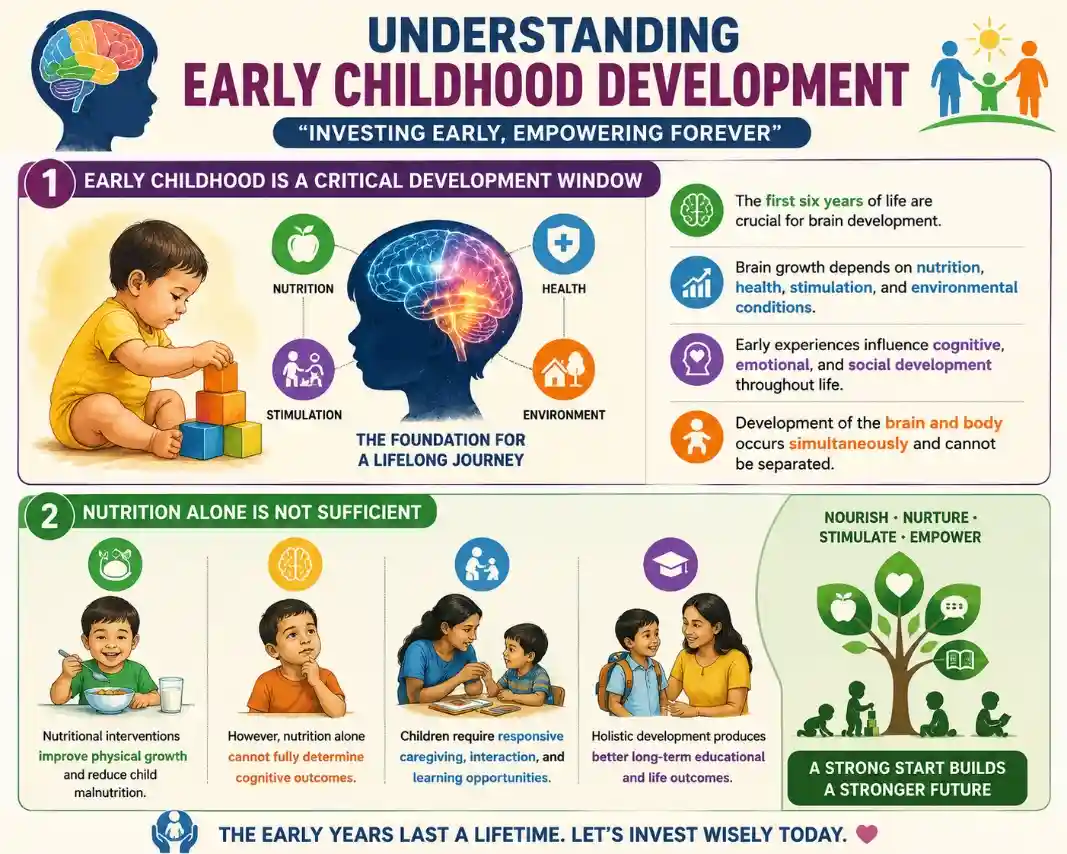
Evidence Supporting Early Stimulation
Global Research Highlights Combined Interventions
- Studies from Jamaica showed stronger gains when stimulation complemented nutritional support.
- Children receiving both interventions demonstrated better cognitive development outcomes.
- International evidence links enriched environments with improved learning capacities.
- Early stimulation has long-lasting effects on intelligence and school performance.
Indian Evidence Supports Similar Findings
- Longitudinal studies in India found that early childhood disadvantages affect later cognition.
- Children recovering physically from early deprivation often show improved cognitive outcomes.
- Home environment significantly influences developmental achievements.
- Reading, playing, and emotional support contribute strongly to intellectual development.
Role of Preschool Education
- Structured preschool education improves language and cognitive skills.
- Children attending Anganwadi-based preschool programmes perform better in assessments.
- Early learning environments enhance school readiness and future academic performance.
- Play-based learning strengthens creativity, communication, and problem-solving abilities.
Role of Anganwadis in Cognitive Development
Anganwadis Can Deliver Holistic Early Childhood Care
- Anganwadis already provide nutrition, growth monitoring, and health services.
- They can become centres for integrated child development and early learning.
- Programmes like Aadhaarshila focus on play-based preschool education.
- Navchetana supports caregivers in promoting learning through everyday interactions.
Community and Parental Participation Is Essential
- Parents play a central role in shaping children’s developmental outcomes.
- Everyday activities such as talking, reading, and playing support brain development.
- Community campaigns can increase awareness regarding early childhood stimulation.
- Reduced screen exposure can improve social and cognitive development.
Broader Developmental Benefits
Strengthening Human Capital
- Better cognitive development enhances educational achievement and productivity.
- Early investments generate long-term economic and social returns.
- Improved childhood development contributes to a skilled future workforce.
- Strong human capital supports national development goals.
Empowering Families and Communities
- Quality childcare enables greater participation of women in the workforce.
- Community-based childcare systems create employment opportunities.
- Stronger families contribute to healthier and more resilient communities.
- Holistic child development benefits society beyond individual households.
Way Forward
Integrating Nutrition with Early Learning
- Anganwadi services should combine nutrition, health, sanitation, and stimulation.
- Play-based learning must become a core component of early childhood programmes.
- Frontline workers should receive training in child development practices.
- Greater focus is needed on parental awareness and engagement.
Strengthening Policy Support
- Early childhood development should remain a priority in social sector investments.
- Monitoring systems should assess cognitive outcomes alongside nutritional indicators.
- Community-led initiatives should be expanded across rural and urban areas.
- Inter-sectoral coordination is necessary for holistic child development.
India’s demographic future depends not only on ensuring children survive but also on helping them thrive. Evidence shows that combining nutrition with early stimulation, quality preschool education, and supportive caregiving can significantly improve cognitive outcomes. By transforming Anganwadis into centres of holistic early childhood development, India can unlock the immense potential of its young population and build stronger human capital for the future.
Prelims Boosters
Euphrates River
Context:
Scientists recently explained the geological formation of the Euphrates River using seismic imaging and geological evidence.
About Euphrates River
What is the Euphrates River?
- The Euphrates is the longest river in Southwest Asia.
- It is one of the most historically important rivers in the world.
- Together with the Tigris River, it forms ancient Mesopotamia.
- Mesopotamia is widely regarded as a cradle of human civilization.
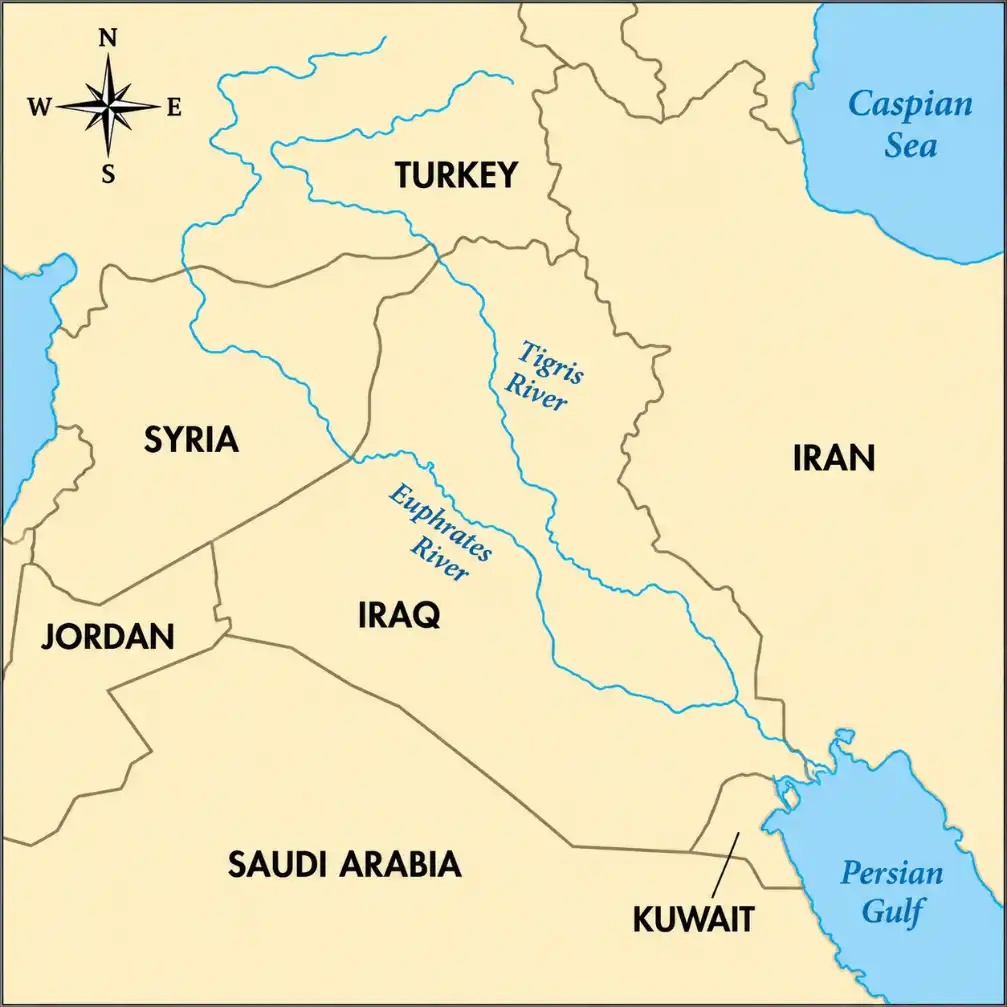
Origin
- The Euphrates originates in the Taurus Mountains of eastern Turkey.
- It is formed by the confluence of the Karasu and Murat rivers.
- These two rivers act as the main headwaters of the Euphrates.
Course of the River
Turkey
|
Syria
|
Iraq
|
Termination
|
Key Geological Features
Tectonic Evolution
- Geological uplift in eastern Anatolia altered ancient river systems.
- This tectonic activity caused the Murat and Karasu rivers to merge.
- Their confluence eventually formed the modern Euphrates River.
Seismic Imaging Findings
- Scientists used 2D and 3D seismic imaging techniques.
- These methods revealed buried river channels and sediments.
- The findings helped reconstruct five million years of river history.
Ancient Flow Volumes
- The prehistoric Euphrates carried much larger water volumes.
- Ancient discharge levels exceeded those of the modern Nile River.
Delta Formation
- The river transported huge quantities of sediments downstream.
- These sediments gradually filled parts of the Persian Gulf basin.
- This process created the fertile alluvial plains of Mesopotamia.
Historical Significance
Cradle of Civilization
- The Euphrates supported some of the earliest human civilizations.
- Ancient cities such as Uruk, Babylon, Ur, and Mari flourished here.
Development of Agriculture
- The river provided water for irrigation and farming.
- Agricultural surpluses enabled urbanization and state formation.
Birth of Writing
- Managing agricultural resources encouraged record keeping.
- This led to the development of cuneiform writing.
- Cuneiform is considered the world’s earliest known writing system.
Present-Day Importance
Water Supply
- The river remains a major source of drinking water.
- Millions of people depend on it for daily needs.
Irrigation
- Euphrates waters support agriculture in Turkey, Syria, and Iraq.
- It remains vital for food production in the region.
Hydropower
- Several dams on the river generate hydroelectric power.
- The river contributes significantly to regional energy security.
El Niño
Context:
The India Meteorological Department (IMD) has confirmed the return of El Niño conditions over the equatorial Pacific Ocean.
About El Niño
What is El Niño?
- El Niño is the warm phase of the El Niño Southern Oscillation.
- It is a major ocean-atmosphere phenomenon affecting global climate patterns.
- The term El Niño means “The Boy Child” in Spanish.
- It is associated with abnormal warming of Pacific Ocean waters.
ENSO Phases
- El Niño represents the warming phase of the ENSO cycle.
- La Niña represents the cooling phase of the ENSO cycle.
- Neutral conditions occur between El Niño and La Niña phases.
How El Niño Forms
Normal Conditions
- Strong trade winds normally blow from east to west across the Pacific.
- These winds push warm surface waters towards Indonesia and Australia.
- Cold nutrient-rich water rises near the South American coast.
- This process is known as oceanic upwelling.
During El Niño
Weakening of Trade Winds
- The easterly trade winds weaken or sometimes reverse direction.
- Warm surface water is no longer pushed strongly towards Asia.
Eastward Movement of Warm Water
- Warm water begins moving towards the central and eastern Pacific Ocean.
- Large amounts of warm water accumulate near South America.
Suppression of Upwelling
- The thermocline moves deeper in the eastern Pacific Ocean.
- Cold nutrient-rich water cannot rise to the surface effectively.
- Marine productivity declines significantly in affected regions.
Atmospheric Changes
- Rising air and rainfall shift towards the central Pacific Ocean.
- Global atmospheric circulation patterns become disturbed.
- Weather patterns change across different continents.
Key Features of El Niño
Irregular Occurrence
- El Niño generally occurs every two to seven years.
- The interval between two events is not fixed.
Global Warming Effect
- El Niño releases large amounts of oceanic heat into the atmosphere.
- It often contributes to record-breaking global temperatures.
Walker Circulation Disruption
- El Niño weakens the normal Walker Circulation system.
- Atmospheric pressure patterns across the Pacific become altered.
Impact on Marine Ecosystems
- Reduced upwelling decreases nutrient availability in ocean waters.
- Fish populations decline significantly along South American coasts.
- Fishing industries suffer major economic losses during strong events.
Impact on IndiaMonsoon Rainfall
Temperature Rise
Water Resources
|
Global ImpactsSouth America
Australia and Southeast Asia
North America
|
Significance
- El Niño is one of the most important climate phenomena globally.
- It influences weather, agriculture, fisheries, and water resources.
- Monitoring El Niño helps governments prepare for climate risks.
- Accurate forecasting supports disaster management and food security.
AN-32 Aircraft
Context:
An Indian Air Force AN-32 transport aircraft recently crashed at Jorhat Air Force Station in Assam.
About AN-32 Aircraft
What is AN-32?
- The AN-32 is a twin-engine turboprop military transport aircraft.
- It is designed for transport, logistics, and tactical airlift missions.
- The aircraft is known for operating in difficult terrains and climates.
- Its NATO reporting name is “Cline.”
Origin
- The aircraft was designed by the Antonov Design Bureau.
- Antonov is an aerospace company based in present-day Ukraine.
- The aircraft was originally developed during the Soviet Union period.
Induction into India
- India purchased the AN-32 aircraft from the Soviet Union in 1984.
- The aircraft was specially modified to meet Indian Air Force requirements.
- These modifications improved performance in India’s diverse geographical conditions.
Operator
- The Indian Air Force is the primary operator of AN-32 aircraft.
- The IAF currently operates around 100 AN-32 transport aircraft.
Key FeaturesTwin-Engine Turboprop System
High-Altitude Operations
Hot Climate Performance
Rugged Design
|
Roles and FunctionsMilitary Transport
Humanitarian Assistance
Strategic Connectivity
Air Maintenance Operations
|
Jiangmen Underground Neutrino Observatory (JUNO)
Context:
The JUNO collaboration recently published its first scientific results on neutrino oscillations from nuclear reactors.
About JUNO
What is JUNO?
- The Jiangmen Underground Neutrino Observatory is a large underground neutrino research facility.
- It is one of the world’s most advanced neutrino detection experiments.
- The observatory studies the properties and behaviour of neutrinos.
- It helps scientists understand fundamental questions in particle physics.
Location
- JUNO is located near Kaiping city in Guangdong Province, China.
- The facility is situated about 53 kilometres from nuclear power plants.
- It lies close to the Taishan and Yangjiang nuclear power stations.
International Collaboration
- JUNO is an international scientific collaboration involving 74 institutions.
- Researchers from Asia, Europe, and America participate in the project.
- The collaboration consists of nearly 700 scientists and researchers.
Lead Institution
- The project is led by the Chinese Academy of Sciences.
- The Institute of High Energy Physics manages the experiment.
Background
- JUNO is China’s second major neutrino experiment.
- It follows the successful Daya Bay Reactor Neutrino Experiment.
- The project represents a major advancement in neutrino research.
Aim
- The primary objective is determining neutrino mass ordering.
- Scientists seek to understand which neutrino type is heavier.
- The experiment also studies neutrino oscillation phenomena precisely.
What are Neutrinos?
- Neutrinos are extremely tiny subatomic particles with very small mass.
- They rarely interact with ordinary matter, making detection difficult.
- Trillions of neutrinos pass through our bodies every second.
Neutrino Oscillation
- Neutrinos can change from one type to another while travelling.
- This process is known as neutrino oscillation or flavour change.
- Studying oscillations helps scientists understand particle properties better.
How JUNO Works
- Nuclear reactors continuously emit electron antineutrinos.
- These particles travel from the reactors toward the detector.
- Scientists measure changes in neutrino flavour during the journey.
- The observed oscillation patterns reveal important particle characteristics.
Key Features
Underground Facility
Experimental Hall
|
Main Detector
World’s Largest Detector
Scientific Lifespan
|
Other Next-Generation Neutrino Experiments
Hyper-Kamiokande
- Hyper-Kamiokande is a major neutrino experiment located in Japan.
Deep Underground Neutrino Experiment (DUNE)
- DUNE is a next-generation neutrino project located in the United States.
- Together with JUNO, these experiments represent the future of neutrino research.
Significance
- JUNO will improve understanding of neutrino mass hierarchy.
- It will help answer fundamental questions about the universe.
- The project strengthens international cooperation in advanced scientific research.
- Its findings may improve our understanding of matter and cosmic evolution.
National Pharmaceutical Pricing Authority (NPPA)
Context:
The NPPA recently increased ceiling prices of two platinum-based cancer drugs by 50% due to rising raw material costs and supply shortages.
About National Pharmaceutical Pricing Authority (NPPA)
What is NPPA?
- The National Pharmaceutical Pricing Authority is India’s drug price regulator.
- It ensures the availability of essential medicines at affordable prices.
- It regulates and monitors the prices of pharmaceutical products.
- It works to balance consumer interests and industry sustainability.
Establishment
- The NPPA was constituted in the year 1997.
- It functions under the Department of Pharmaceuticals.
- The Department of Pharmaceuticals operates under the Ministry of Chemicals and Fertilizers.
Aim
- The authority aims to make essential medicines affordable for citizens.
- It seeks to prevent unreasonable increases in drug prices.
- It ensures adequate availability of medicines across the country.
Functions of NPPA
Implementation of DPCO
Price Fixation
Monitoring Drug Availability
|
Data Collection
Advisory Role
Administrative Functions
|
Drugs Prices Control Order (DPCO)
What is DPCO?
- DPCO is a legal instrument for regulating drug prices in India.
- It empowers the Government to control prices of essential medicines.
- NPPA is responsible for implementing DPCO provisions.
Schedule-I Drugs
- NPPA fixes ceiling prices for drugs listed under Schedule-I of DPCO.
- These medicines are generally based on the National List of Essential Medicines.
- Manufacturers cannot sell such medicines above the notified ceiling price.