RBI Dividend and India’s Fiscal Challenges
The Reserve Bank of India recently approved its largest-ever dividend transfer of nearly ₹2.87 lakh crore to the Union government. This transfer provides major fiscal support at a time when government expenditure pressures remain high due to subsidies, welfare commitments, and infrastructure spending. While the dividend strengthens short-term fiscal stability, it also raises concerns regarding RBI independence, dependence upon central bank profits, and the long-term sustainability of India’s fiscal management framework.
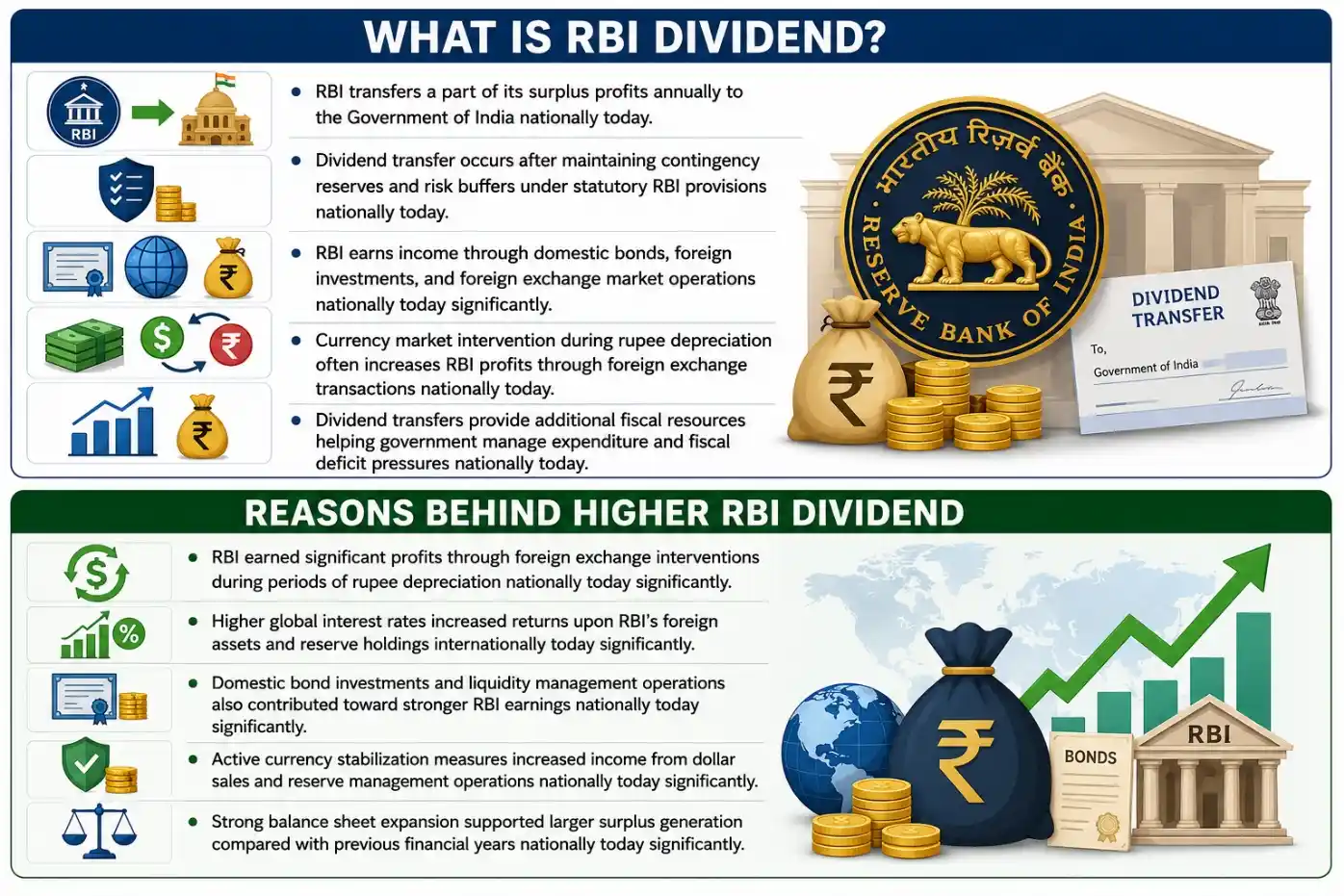
Benefits of Large Dividend Transfer
- Larger dividend provides immediate fiscal relief and supports government expenditure commitments during economic uncertainty nationally today.
- Additional revenue reduces pressure upon government borrowing requirements and fiscal deficit management significantly nationally today.
- Welfare spending and subsidy commitments become easier to finance using surplus transfers from RBI nationally today significantly.
- Infrastructure investments can continue without excessive fiscal compression or sudden expenditure reductions nationally today significantly.
- Strong fiscal support improves government flexibility during periods of slowing growth and global economic volatility nationally today.
Concerns Associated with RBI Dividend
Fiscal Dependence
|
Profit Volatility
|
Balance Sheet Risks
|
Concerns Regarding RBI Independence
- Close fiscal dependence may create perceptions regarding weakening institutional independence of the Reserve Bank nationally today significantly.
- Investors may fear government influence over monetary policy and currency management decisions nationally today significantly today.
- Global experiences show excessive political control over central banks damages financial market credibility significantly internationally today.
- Weak central bank autonomy may reduce investor confidence within debt and equity markets nationally today significantly.
- Institutional credibility remains essential for maintaining stable inflation expectations and macroeconomic confidence nationally today significantly.
Link Between Fiscal Policy and Monetary Policy
- Expansionary fiscal spending often increases pressure upon RBI to maintain supportive monetary and liquidity conditions nationally today.
- Simultaneous fiscal expansion and monetary accommodation may increase inflationary and financial stability risks nationally today significantly.
- Higher government borrowing requirements increase dependence upon domestic financial institutions and bond markets nationally today significantly.
- RBI purchases of government securities may indirectly support fiscal operations during challenging economic conditions nationally today.
- Strong coordination remains necessary while ensuring institutional boundaries between government and central bank remain protected nationally.
India’s Broader Fiscal Challenges
- India’s combined public debt remains relatively high compared with several emerging Asian economies today nationally significantly.
- Rising debt servicing costs reduce fiscal space available for productive developmental expenditure nationally today significantly.
- Welfare commitments and election-related spending promises increase long-term fiscal pressures upon governments nationally today significantly.
- Revenue constraints continue limiting investments within healthcare, education, and employment generation sectors nationally today significantly.
- Sustainable fiscal consolidation requires stronger tax collections and efficient expenditure prioritization mechanisms nationally today consistently.
Way Forward
- RBI dividends should remain supplementary fiscal support rather than permanent sources of government revenue nationally today significantly.
- Governments must focus upon strengthening tax administration and broadening sustainable revenue generation mechanisms nationally today significantly.
- Fiscal discipline and targeted expenditure management are necessary for maintaining long-term macroeconomic stability nationally today significantly.
- RBI independence should remain protected through transparent institutional and monetary policy frameworks nationally today significantly.
- Building resilient economic fundamentals will reduce excessive dependence upon central bank transfers during future crises nationally today.
The record RBI dividend transfer provides significant short-term fiscal comfort for the Indian government during a period of economic uncertainty and rising expenditure pressures. However, relying excessively upon central bank surpluses may create long-term fiscal and institutional risks. Sustainable economic stability ultimately depends upon prudent fiscal management, strong revenue generation, and preservation of RBI autonomy. Therefore, while the dividend offers immediate relief, India must continue pursuing deeper structural reforms to maintain long-term macroeconomic resilience.
India-US Relations in a Changing Global Order
The global geopolitical landscape is undergoing a major transformation due to rising US-China rivalry, regional conflicts, and shifting economic alignments. In this evolving international order, India’s strategic importance for the United States has increased significantly. Unlike earlier decades, India today possesses stronger economic capabilities, geopolitical leverage, technological potential, and strategic autonomy. This changing reality provides India an opportunity to confidently shape its foreign policy while balancing cooperation with national interests.
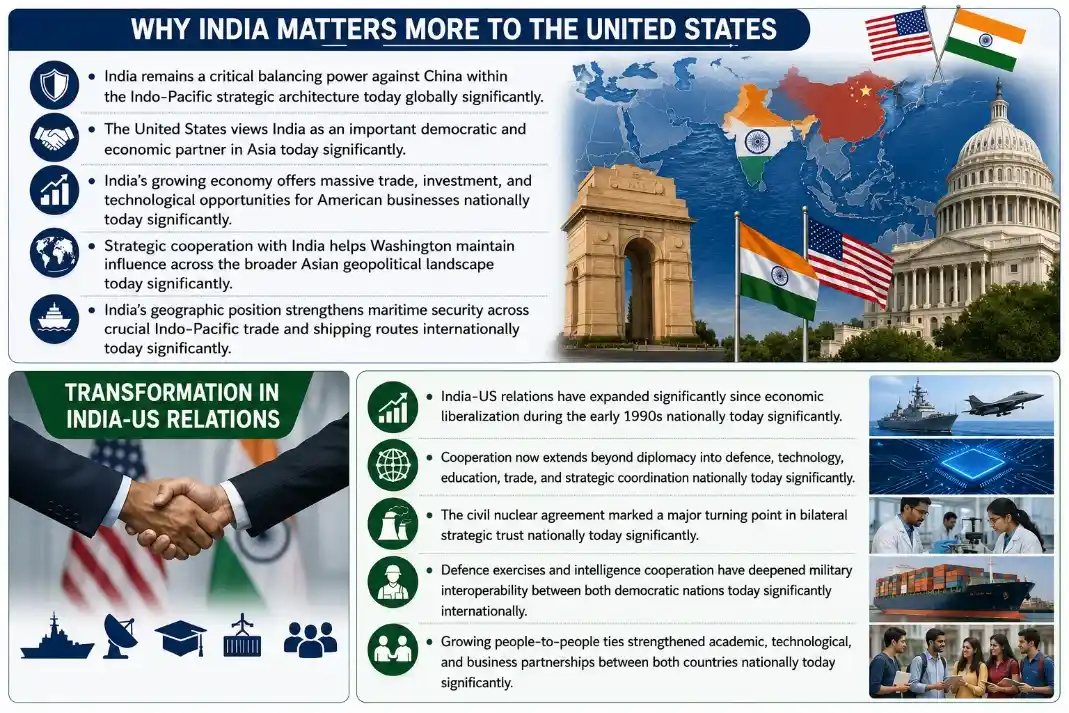
Strategic Advantages India Possesses Today
Economic Strength
|
Geopolitical Importance
|
Strategic Autonomy
|
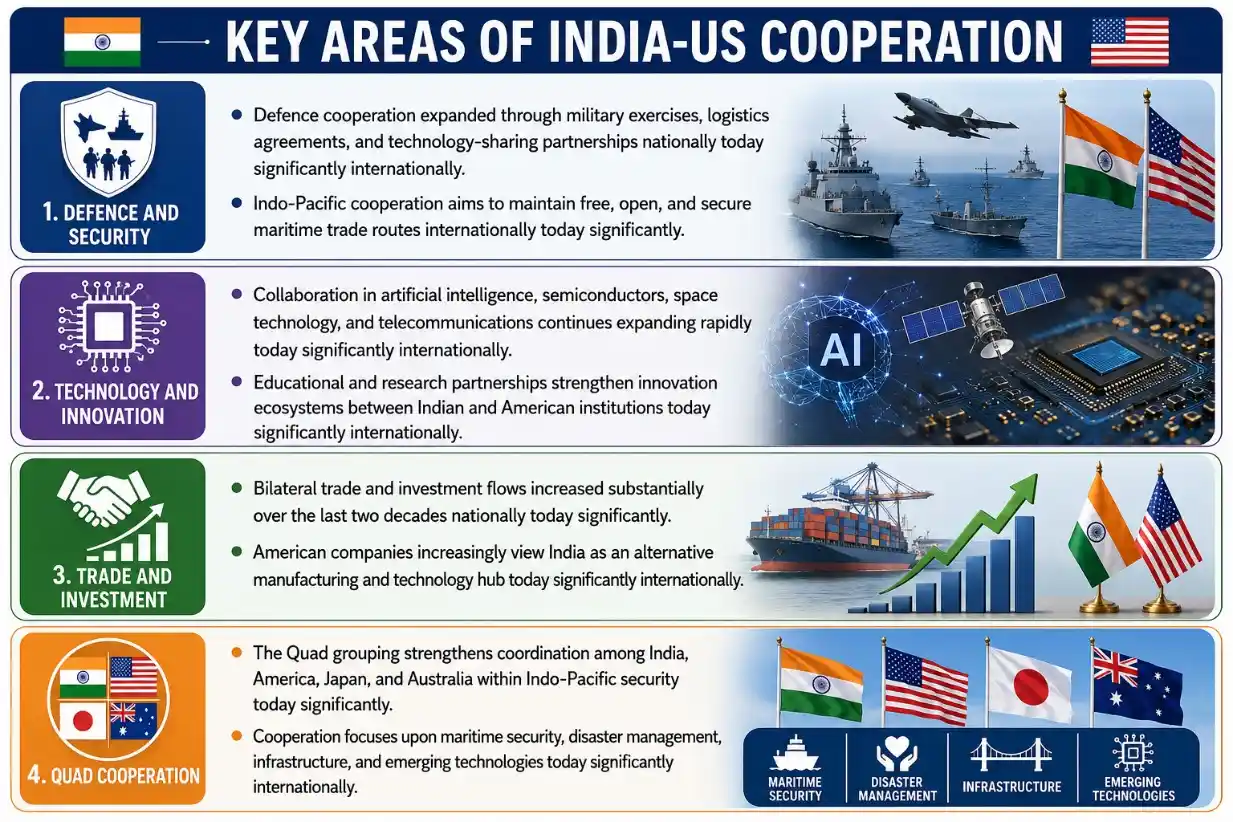
Challenges Within India-US Relations
Policy Differences
- Trade disputes and tariff disagreements occasionally create tensions between both economic partners today significantly internationally nationally.
- Differences remain regarding Russia, defence procurement, and certain geopolitical strategic calculations today significantly internationally nationally.
Uncertainty in US Policies
- Frequent changes in American foreign policy create uncertainty for long-term strategic planning today significantly internationally nationally.
- Leadership transitions within Washington sometimes alter diplomatic priorities toward Asia and Indo-Pacific partnerships today significantly internationally.
Domestic Perceptions
- Sections within India remain cautious regarding excessive dependence upon the United States strategically today significantly nationally internationally.
- Historical non-alignment traditions continue influencing sections of India’s foreign policy establishment today significantly nationally internationally.
Why India Must Act Confidently
- India no longer occupies a weak geopolitical position dependent entirely upon external powers today significantly internationally nationally.
- Strong economic growth and strategic relevance provide India greater diplomatic negotiating capacity today significantly internationally nationally.
- Global powers increasingly compete to build stronger partnerships with India across multiple sectors today significantly internationally.
- India possesses greater leverage because major economies seek alternatives to excessive dependence upon China today significantly internationally.
- Confident diplomacy allows India to protect national interests while expanding global influence today significantly internationally nationally.
Way Forward
- India should continue strengthening strategic cooperation with the United States while preserving autonomy nationally today significantly internationally.
- Greater investments in manufacturing, technology, and defence modernization will improve India’s bargaining power today significantly nationally.
- India must deepen Indo-Pacific partnerships through Quad and regional maritime cooperation initiatives today significantly internationally nationally.
- Economic reforms and innovation-driven growth will strengthen India’s long-term geopolitical influence today significantly nationally internationally.
- Balanced diplomacy with all major powers should remain central to India’s foreign policy framework today significantly internationally.
The changing global order has created a historic opportunity for India to emerge as a major strategic and economic power. The United States increasingly recognizes India’s importance within the Indo-Pacific and the broader global balance of power. However, India’s success will depend upon using this leverage with confidence, strategic clarity, and diplomatic balance. By strengthening its capabilities while maintaining strategic autonomy, India can shape the emerging world order according to its long-term national interests.
Prelims Boosters
Big Island
Context:
A magnitude 6.0 earthquake recently struck near Hawaii’s Big Island region recently.
About Big Island
- Big Island is the largest island among the Hawaiian Islands of United States.
- Hawaii is an island state located in the Pacific Ocean region globally.
- The island covers nearly 10,432 square kilometres geographical area in total extent.
- It is larger than all remaining Hawaiian Islands combined together geographically.
Volcanoes of Big Island
- Big Island is formed by five major volcanic mountains over geological periods.
- These volcanoes are Kohala, Hualalai, Mauna Kea, Mauna Loa, and Kilauea respectively.
- Mauna Loa possesses the greatest volcanic mass among Earth’s mountains scientifically measured.
- Kilauea remains among the world’s most active volcanoes continuously erupting since 1983.
Climate and Physical Features
- The island displays highly diverse climates across different geographical and elevational zones.
- Tropical rainforests, volcanic deserts, and snow-covered peaks exist on the same island.
Hawai‘i Volcanoes National Park
- Hawai‘i Volcanoes National Park is situated on the Big Island of Hawaii.
- The national park has been recognised as UNESCO World Heritage Site globally.
Vembanad Lake
Context:
Recent concerns emerged regarding increasing pollution caused by houseboats in Vembanad Lake ecosystem.
About Vembanad Lake
- Vembanad Lake is the largest lake located in Kerala state of India.
- It is also considered the longest lake found anywhere across India geographically.
- The lake spreads across nearly 2,033 square kilometres total geographical area extensively.
- It represents the largest tropical wetland ecosystem along India’s southwestern coastal region.
- Vembanad Lake is also called Vembanad Kayal, Kochi Lake, and Punnamada Lake.
Rivers Feeding Vembanad Lake
- Four important rivers feed the lake namely Meenachil, Achankovil, Pampa, and Manimala.
Connection with Arabian Sea
- The lake remains separated from Arabian Sea through a narrow barrier island naturally.
- Most regions contain freshwater, while waters near Arabian Sea become saline gradually.
Physical Features
- The lake possesses interconnected canals, lagoons, backwaters, and extensive paddy cultivation surrounding regions.
- Coconut palm vegetation and low-lying paddy fields dominate nearby landscapes around Vembanad Lake.
Vallam Kali Boat Race
- Famous Vallam Kali or Nehru Trophy Snake Boat Race occurs annually during August.
Ramsar Site Status
- Vembanad Lake received Ramsar Site recognition during the year 2002 internationally important wetland.
Conservation Status
- Government of India identified this lake under National Wetlands Conservation Programme officially.
Kumarakom Bird Sanctuary
- Kumarakom Bird Sanctuary is situated along eastern coastal side of Vembanad Lake region.
Biodiversity
- Numerous migratory birds from Siberia and Himalayan regions visit this ecosystem seasonally regularly.
- Common birds include Little Cormorant, Indian Darter, White Ibis, kingfishers, and teal species.
- Siberian cranes, parrots, owls, flycatchers, cuckoos, ducks, and larks are commonly observed.
Importance
- Vembanad Lake supports fisheries, tourism, agriculture, biodiversity conservation, and Kerala backwater transportation systems.
Environmental Concerns
- Pollution from houseboats, sewage discharge, and tourism activities threatens lake ecosystem stability.
Information Agents
Context:
Google recently unveiled information agents integrated within Search to monitor web information automatically.
About Information Agents
- Information agents are intelligent computational software entities managing information for users automatically efficiently.
- They access single or multiple distributed information sources available across digital networks globally.
- These agents proactively acquire, organize, mediate, and maintain useful information continuously for users.
Main Objective
- Information agents mainly help users handle excessive information overload present on internet platforms.
Important Functions
- They provide proactive discovery of useful information resources from diverse digital platforms automatically.
- They resolve information barriers between information providers and consumers through semantic understanding techniques.
- They offer value-added information products and services for users and other intelligent agents.
Sources of Information
- Information agents collect data from databases, websites, digital repositories, and intelligent software agents.
Key Characteristics
- Information agents work autonomously after receiving instructions from users regarding desired information objectives.
- They intelligently analyse information relevance using artificial intelligence and semantic processing technologies efficiently.
- These agents continuously adapt according user preferences, interests, and changing information requirements dynamically.
Example of Information Agents
- A user requests information regarding agent-oriented programming proposed by some researcher recently discovered.
- The information agent searches multiple FTP sites and online databases for relevant resources.
- After searching, it returns technical reports alongside researcher details and contact information successfully.
Importance
- Information agents save significant time by automating repetitive internet search and monitoring activities.
- They improve decision-making through organized, filtered, and relevant information delivery mechanisms efficiently implemented.
- Such agents support advanced AI-powered search engines and personalized digital assistance systems globally.
Concerns
- Continuous monitoring by information agents may raise important privacy and data-security related concerns.
- Incorrect or biased information sources may negatively affect outputs generated by intelligent agents.
QUAD (Quadrilateral Security Dialogue)
Context:
External Affairs Minister Dr. S. Jaishankar hosted Quad Foreign Ministers’ Meeting in New Delhi.
About QUAD
- QUAD stands for Quadrilateral Security Dialogue involving four major maritime democratic nations globally.
- Member countries include India, United States, Japan, and Australia within QUAD grouping officially.
- QUAD is a non-military plurilateral strategic coalition promoting regional stability and cooperation internationally.
Genesis and Evolution
- QUAD cooperation initially emerged after devastating Indian Ocean tsunami disaster during year 2004.
- Four countries coordinated Humanitarian Assistance and Disaster Relief operations across affected maritime regions collaboratively.
- QUAD was formally institutionalised during ASEAN Regional Forum meeting held Manila in 2007.
- Japanese Prime Minister Shinzo Abe strongly promoted QUAD strategic dialogue among participating member countries.
- The grouping later entered temporary hiatus because of changing regional geopolitical circumstances internationally.
- QUAD was revived again during East Asia Summit meeting conducted in Manila 2017.
- First virtual QUAD Leaders’ Summit was organised officially during March 2021 internationally significant milestone.
Aim of QUAD
- QUAD aims ensuring free, open, inclusive, resilient Indo-Pacific regional order based internationally rules.
- It supports sovereignty, freedom of navigation, and peaceful settlement of disputes regionally globally.
- QUAD also provides transparent alternatives against coercive economic and strategic practices internationally adopted.
Major Areas of Cooperation
Climate Change
Critical Technologies
Cybersecurity
|
Health Security
Infrastructure Development
Space Cooperation
|
Important QUAD Initiatives
Indo-Pacific Partnership for Maritime Domain Awareness (IPMDA)
- IPMDA was launched during QUAD Tokyo Summit held officially in year 2022 internationally.
- It uses commercial satellite tracking systems for real-time maritime surveillance and monitoring operations.
- IPMDA helps detect illegal fishing, dark shipping activities, and maritime piracy incidents regionally.
QUAD STEM Fellowship
- QUAD STEM Fellowship supports one-hundred graduate students annually from participating member countries internationally.
- Students pursue advanced STEM education programmes at leading universities located within United States.
Counter-Terrorism Cooperation
- QUAD condemns cross-border terrorism and strengthens intelligence-sharing mechanisms among participating countries collaboratively internationally.
- It also promotes compliance with Financial Action Task Force guidelines against terror financing.
Directorate General of Mechanised Forces (DGMF)
Context:
Indian Army recently announced restructuring of mechanised warfare setup at Army Headquarters level officially.
About DGMF
- Directorate General of Mechanised Forces is apex mechanised warfare administrative body within Army Headquarters.
- DGMF is responsible for planning, modernization, and coordination of mechanised warfare capabilities nationally.
Genesis of Mechanised Warfare
- Mechanised warfare reforms gained importance after lessons learned during 1965 India-Pakistan war operations.
- Objective was providing infantry forces armoured protection and mobility alongside advancing battle tanks.
Important Milestones
- Soviet-origin BMP Infantry Combat Vehicles were inducted into Indian Army during year 1979.
- Mechanised Infantry Regiment was officially raised under leadership of General K. Sundarji thereafter.
- Directorate General of Mechanised Forces was formally established during year 1986 officially nationwide.
- DGMF unified Armoured Corps and Mechanised Infantry under single institutional administrative framework nationally.
2026 Restructuring
- DGMF will now function under leadership of Lieutenant General rank military officer officially.
- Two Additional Directors General will separately supervise Armoured Corps and Mechanised Infantry operations.
- The restructuring integrates planning while preserving traditions and identities of both military arms.
Aim of DGMF
- DGMF aims building highly responsive mechanised forces possessing heavy firepower and operational mobility.
- It prepares mechanised units for breakthrough operations, territorial defence, and futuristic battlefield scenarios.
- The organisation ensures India’s armoured assets remain survivable against emerging technological warfare threats.
Key Functions of DGMF
GSQR Formulation
- DGMF drafts General Staff Qualitative Requirements for tanks and combat vehicle procurement activities.
Doctrine Development
- It develops operational doctrines for coordinated mechanised infantry and tank warfare strategies effectively.
Force Modernisation
- DGMF supervises upgrades and lifecycle management of India’s armoured military fleet comprehensively nationwide.
- Platforms include T-90 tanks, T-72 tanks, Arjun MBTs, and BMP-2 Sarath vehicles.
Technology Integration
- DGMF integrates drones, loitering munitions, electronic warfare systems, and battlefield sensors strategically.
- Attack helicopters and network-centric warfare technologies are incorporated into mechanised operations progressively.
Significance of Restructuring
Better Battlefield Coordination
|
Faster Procurement and Indigenisation
|