Carbon Border Taxes and India’s Trade Challenges
Global trade rules are rapidly changing as climate concerns increasingly influence international economic policies. The European Union’s Carbon Border Adjustment Mechanism (CBAM), entering its definitive phase from 2026, represents a major shift in global trade governance. By imposing carbon-linked costs on imported goods, CBAM aims to reduce carbon leakage and encourage cleaner production. However, for developing countries like India, these new rules create significant economic, industrial, and trade-related challenges.
Understanding the Carbon Border Adjustment Mechanism (CBAM)
- CBAM imposes carbon-related charges upon imported goods based on embedded emissions levels internationally today significantly.
- The mechanism aims to prevent industries from shifting pollution-heavy production outside Europe today significantly internationally.
- Carbon-intensive sectors like steel, cement, aluminium, fertilizers, and electricity remain directly affected today significantly internationally.
- CBAM links market access increasingly with environmental compliance and carbon-efficiency standards internationally today significantly.
Impact on India’s Exports
Carbon-Intensive Sectors
|
Fertilizer and Agricultural Impact
|
Broader Trade Implications
Shift in Global Trade Rules
- Market access increasingly depends upon carbon efficiency instead of traditional tariff competitiveness internationally today significantly.
- Developed countries may adopt similar carbon-border policies affecting developing economies globally today significantly internationally.
Non-Tariff Trade Barrier
- CBAM functions as a modern non-tariff barrier linked directly with climate compliance internationally today significantly.
- Developing countries fear such measures may create unfair disadvantages within global trade systems today significantly internationally.
Challenges for India
High Transition Costs
- Cleaner production technologies require major investments that many industries currently cannot easily afford nationally significantly today.
- Compliance with carbon standards may increase manufacturing costs and reduce export competitiveness nationally today significantly.
Technology and Infrastructure Gaps
- Many Indian industries still depend upon fossil-fuel-intensive manufacturing and energy systems nationally today significantly.
- Limited access to affordable green technologies creates additional barriers for industrial transition nationally today significantly.
Risk to Economic Growth
- Export-oriented sectors may face reduced demand if compliance costs rise sharply internationally today significantly nationally.
- Smaller firms could struggle more severely due to financial and technological limitations nationally today significantly.
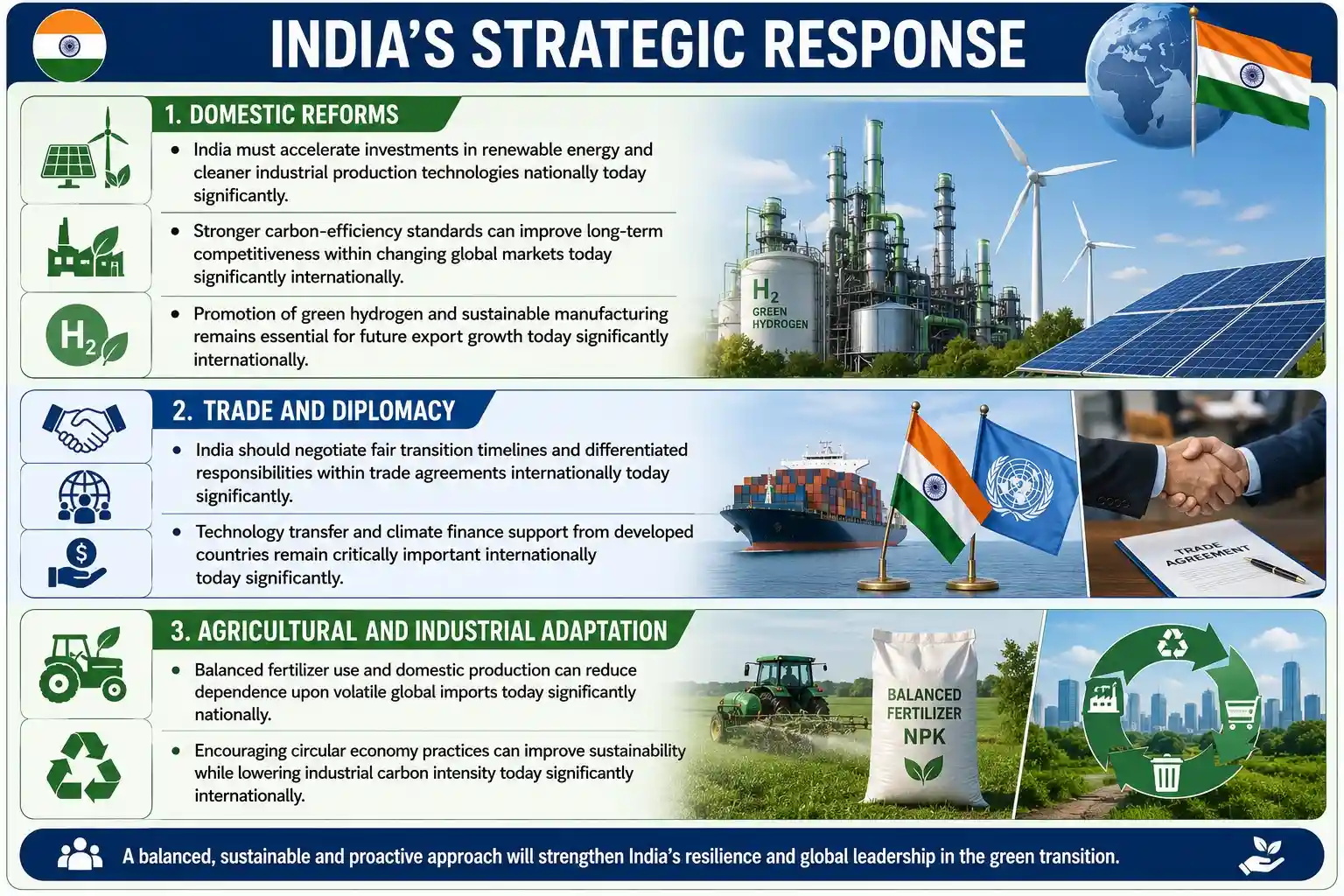
Way Forward
- India should adopt a dual strategy combining domestic reforms with strong international negotiations today significantly internationally.
- Carbon-efficient infrastructure and green manufacturing must become central pillars of industrial policy today significantly nationally.
- Financial incentives should support industries transitioning toward cleaner and energy-efficient technologies nationally significantly today.
- Collaboration with global partners can improve technology access and strengthen India’s green transition nationally significantly today.
The rise of carbon-linked trade policies marks a fundamental transformation in the global economic order. Mechanisms like CBAM demonstrate that future competitiveness will depend not only upon price and productivity, but also upon environmental sustainability. For India, the challenge is not merely adapting to these changing rules, but ensuring that climate-linked trade barriers do not undermine economic growth and development. Through strategic reforms, technological modernization, and effective diplomacy, India can transform this challenge into an opportunity for sustainable industrial advancement.
Water Governance in Peri-Urban Areas
India has made significant progress in expanding drinking water access through the Jal Jeevan Mission and urban water infrastructure. However, peri-urban regions — areas transitioning from villages into urban settlements — remain neglected. These regions suffer from weak governance, irregular water supply, poor sanitation, and environmental degradation. As India urbanises rapidly, strengthening water governance in peri-urban areas is essential for sustainable development and future water security.
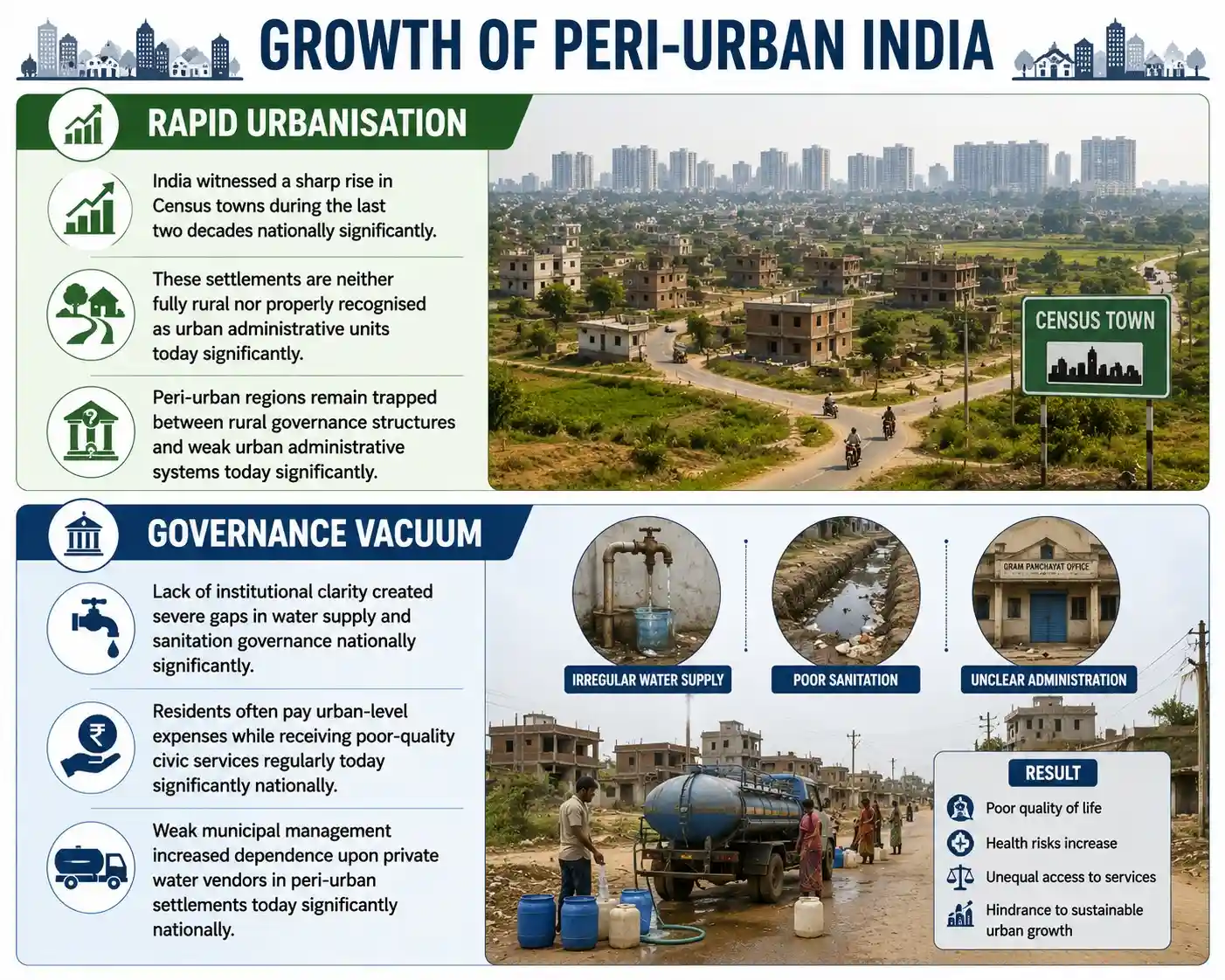
Water and Sanitation Challenges
Irregular Water Supply
- Many peri-urban households receive water only during limited hours or alternate days nationally significantly today.
- Families often sacrifice sleep and productivity while waiting for irregular nighttime water supply nationally significantly.
Groundwater Contamination
- Poor waste disposal practices contaminated groundwater sources across multiple peri-urban regions nationally today significantly.
- Toxic leachate from dumping sites created serious environmental and public health risks nationally today significantly.
Unequal Water Distribution
- Urban expansion increasingly diverts water resources away from rural and peri-urban populations today significantly nationally.
- Farmers downstream suffer declining irrigation access due to growing urban water demands today significantly nationally.
Poor Sanitation Infrastructure
- Large numbers of households still depend upon septic tanks and informal sanitation systems nationally significantly today.
- Illegal dumping of untreated septage contributes heavily toward pollution and disease outbreaks nationally significantly today.
Environmental and Public Health Consequences
- Contaminated water sources increase risks of water-borne diseases among vulnerable populations nationally today significantly.
- Poor sanitation undermines the achievements of the Swachh Bharat Mission across rapidly urbanising settlements today significantly.
- Excessive groundwater extraction threatens long-term ecological sustainability and future water availability nationally significantly today.
- Environmental degradation reduces agricultural productivity and damages livelihoods within peri-urban communities today significantly nationally.
Future Challenges
Rising Urban Demand
- India’s future urban expansion will place enormous pressure upon existing water infrastructure nationally today significantly.
- Today’s peri-urban regions are expected to transform into major urban centres by 2047 nationally significantly.
Threat to Water Security
- Weak planning may intensify water scarcity, inequality, and environmental degradation across urban regions today significantly nationally.
- Peri-urban governance will significantly influence India’s future sustainable development and public health outcomes nationally today significantly.
Solutions and Policy Recommendations
Strengthening Governance
- Establishing Nagar Panchayats can reduce administrative confusion within peri-urban governance structures nationally significantly today.
- Stronger institutional accountability is essential for improving water and sanitation service delivery nationally significantly today.
Protecting Water Sources
- Drinking water sources must be protected from pollution, encroachment, and illegal waste dumping nationally significantly today.
- Community participation can strengthen monitoring and improve local water management systems nationally today significantly.
Swachh Bharat Mission 3.0
- A specialised sanitation programme should specifically focus upon peri-urban waste management challenges nationally significantly today.
- Faecal sludge treatment plants and GPS-monitored desludging systems require large-scale expansion nationally significantly today.
Decentralised Wastewater Treatment
- Decentralised wastewater recycling technologies can significantly reduce pressure upon freshwater resources nationally today significantly.
- Government incentives and procurement support can accelerate adoption of innovative treatment technologies nationally significantly today.
Strategic Financing
- Peri-urban water infrastructure should receive recognition as critical strategic development infrastructure nationally significantly today.
- Blended financing models can help states build sustainable water and sanitation infrastructure nationally today significantly.
Peri-urban India represents the missing middle within the country’s development and urbanisation journey. Despite its growing economic and demographic importance, these regions continue suffering from poor governance, weak infrastructure, and environmental stress. Ensuring reliable water supply, sanitation access, groundwater protection, and sustainable planning is essential for India’s future urban stability. With stronger governance reforms, community participation, technological innovation, and sustainable financing, peri-urban India can become a model for inclusive and water-secure development.
Prelims boosters
INS Kolkata
Context:
INS Kolkata recently responded successfully against suspected piracy threat in Western Indian Ocean region.
About INS Kolkata
- INS Kolkata is lead warship of Kolkata-class guided missile destroyers within Indian Navy.
- Kolkata-class destroyers belong to indigenously designed and constructed Project 15A naval programme officially.
- These destroyers are upgraded follow-on versions of earlier Delhi-class destroyers inducted previously nationally.
- Ships were conceived and designed by Indian Navy’s Directorate of Naval Design officially established.
- Warships were named after major Indian port cities including Kolkata, Kochi, and Chennai respectively.
- INS Kolkata was constructed by Mazagon Dock Limited located in Mumbai city officially.
- The destroyer was formally commissioned into Indian Navy service during August 2014 officially.
Dimensions and Capacity
- INS Kolkata measures approximately 164 metres length and nearly eighteen metres width overall structurally.
- The ship possesses full-load displacement capacity of nearly 7,400 tonnes during operational deployment.
Propulsion System
- The destroyer uses Combined Gas and Gas propulsion system for high-speed naval operations.
- It contains four reversible gas turbines providing propulsion power during maritime missions extensively deployed.
- INS Kolkata can achieve operational speeds exceeding thirty knots during naval deployment operations effectively.
Power Generation
- Electrical power generation includes four gas turbine generators and one diesel alternator onboard.
- Together they produce approximately 4.5 megawatts electricity sufficient powering sophisticated naval systems efficiently.
Personnel
- INS Kolkata carries around thirty officers alongside nearly three-hundred sailors during operational deployment missions.
Weapons and Combat Systems
- The ship possesses advanced gunnery systems and Anti-Submarine Warfare weapons for naval defence.
- It carries medium-range and short-range guns alongside anti-air and surface missile systems effectively.
- Advanced surveillance radars and bow-mounted sonar enhance detection and maritime combat capabilities significantly.
Digital and Network Systems
- INS Kolkata functions as sophisticated network-enabled combat platform integrating multiple digital systems onboard.
- It possesses AISDN, Auxiliary Control System, APMS, and Combat Management System technologies advanced.
Helicopter Capability
- The destroyer can operate two Seaking or Chetak helicopters simultaneously during naval operations.
Mekedatu Project
Context:
Supreme Court dismissed Tamil Nadu’s review petition regarding Karnataka’s proposed Mekedatu Project recently officially.
About Mekedatu Project
- Mekedatu Project is a multi-purpose drinking water and hydroelectric power generation project proposed.
- The project involves constructing balancing reservoir near Kanakapura in Karnataka’s Ramanagara district officially.
- It is situated nearly ninety kilometres away from Bengaluru city in Karnataka state.
- The project site lies around four kilometres ahead of Karnataka-Tamil Nadu interstate border region.
Location
- Mekedatu Project is proposed at confluence of Cauvery River and Arkavathi tributary river.
Features of Mekedatu Project
- The project proposes construction of ninety-nine metre high concrete gravity dam structure strategically.
- The dam length is planned around seven-hundred thirty-five metres across river course officially proposed.
- It also includes underground powerhouse and advanced water conductor system for efficient operations.
- Reservoir capacity is estimated around sixty-seven thousand million cubic feet water storage capability.
- The project aims supplying drinking water requirements for Bengaluru metropolitan region extensively growing population.
- It is also expected generating nearly four-hundred megawatts hydroelectric power after completion successfully.
Environmental Concerns
- Construction of Mekedatu dam may submerge over five-thousand hectares protected forest regions extensively.
- Large areas within Cauvery Wildlife Sanctuary could face ecological disturbances because of reservoir formation.
Interstate Water Dispute
- Tamil Nadu strongly opposes project because it is lower riparian state downstream geographically situated.
- Tamil Nadu fears project may reduce unrestricted Cauvery River water flow into state regions.
- According to Tamil Nadu, Mekedatu remains final unrestricted water flow point within Karnataka territory.
- Tamil Nadu considers proposed reservoir an attempt restricting natural Cauvery River flow downstream significantly.
Importance of Project
- Karnataka views project important for Bengaluru drinking water security and future urban development needs.
- The project may improve hydroelectric generation and water management infrastructure within Karnataka significantly.
Concerns Associated
- The project may intensify interstate disputes regarding Cauvery River water sharing arrangements further nationally.
- Environmentalists also express concerns regarding biodiversity loss and wildlife habitat destruction within sanctuary areas.
Khadi and Village Industries Commission (KVIC)
Context:
KVIC achieved record sales worth 1.87 lakh crore rupees during financial year 2025-26.
About KVIC
- Khadi and Village Industries Commission is a statutory body established during year 1956.
- It was created under provisions of Khadi and Village Industries Commission Act officially enacted.
- KVIC functions as apex organisation under Ministry of Micro, Small, and Medium Enterprises.
Main Purpose of KVIC
- KVIC promotes development of Khadi and village industries across rural areas of India extensively.
- It plans, organises, implements, and supports programmes related to rural industrial development nationally.
State-Level Structure
- Separate Khadi and Village Industries Boards operate within states implementing KVIC schemes effectively.
Objectives of KVIC
Social Objective
- KVIC aims providing employment opportunities for people living in rural regions across India.
Economic Objective
- It encourages production of saleable goods supporting sustainable rural economic development nationally significantly.
Wider Objective
- KVIC promotes self-reliance among economically weaker sections through village-based employment opportunities nationwide.
Functions of KVIC
Raw Material Support
Processing Facilities
Marketing Support
|
Research and Innovation
Quality Assurance
|
Memflation
Context:
Global semiconductor revenues may cross 1.3 trillion dollars because of growing memflation phenomenon globally.
About Memflation
- Memflation refers to rapid price inflation affecting semiconductor memory and storage components globally.
- The term was introduced by Gartner analysts studying semiconductor market distortions caused internationally recently.
- It occurs when AI infrastructure demand consumes majority semiconductor manufacturing resources available globally.
- This creates shortages and price increases for traditional computing and consumer electronic hardware industries.
Main Causes of Memflation
AI Infrastructure Boom
- Rapid expansion of AI infrastructure increased demand for advanced semiconductor memory chips globally.
- Hyperscalers and cloud companies diverted memory resources toward artificial intelligence applications significantly worldwide.
Production Shift by Chipmakers
- Semiconductor firms prioritised high-profit AI GPUs and enterprise memory chip manufacturing over consumers.
- Companies like Micron shifted production focus away from conventional consumer-oriented semiconductor components recently.
Pre-Emptive Bulk Buying
- Fear regarding tariffs and rising prices encouraged companies stockpiling semiconductor chips aggressively beforehand.
- Bulk buying sharply reduced available inventories across global semiconductor and technology markets internationally.
Key Features of Semiconductor Surge
Sharp Memory Price Rise
|
Massive Market Expansion
|
AI-Led Market Shift
|
Impacts of Memflation
Delayed Non-AI Technology Upgrades
- Rising semiconductor memory prices slowed enterprise technology upgrades and digital infrastructure deployments globally.
Supply Chain Disruptions
- Semiconductor shortages caused shipment delays and logistical bottlenecks across hardware supply chains internationally.
Higher Consumer Prices
- Laptop, server, and hardware manufacturers transferred rising semiconductor costs onto consumers directly globally.
Risky Long-Term Contracts
- Analysts advised against expensive long-term semiconductor supply agreements amid volatile pricing conditions internationally.
National Sports Board
Context:
Union Government recently notified National Sports Governance Rules under National Sports Governance Act 2025.
About National Sports Board
- National Sports Board will function as central authority regulating sports governance across India officially.
- It grants recognition to National Sports Bodies functioning within country under prescribed regulations officially.
- The Board ensures compliance regarding governance, financial accountability, and ethical sports administration standards.
Composition of National Sports Board
- The Board consists of one Chairperson and two Members appointed by Central Government.
- Members are selected from panel recommended by Search-cum-Selection Committee constituted officially for appointments.
Term of Office
- Chairperson and Members hold office for three years or sixty-five years age limit.
- They remain eligible for reappointment for one additional term under notified governance rules officially.
Functions of National Sports Board
- The Board maintains register of affiliated units under recognised National Sports Bodies officially nationwide.
- It specifies model guidelines and regulations concerning sports governance and administrative functioning nationally.
- The Board promotes transparency, accountability, and ethical standards within Indian sports administration systems.
National Sports Tribunal
About Tribunal
- National Sports Tribunal functions as specialised adjudicatory body handling sports-related disputes across India efficiently.
- It aims reducing dependency upon civil courts for sports governance and administrative dispute resolution.
- Tribunal ensures speedy, independent, effective, and cost-efficient settlement of sports-related disputes nationally.
Composition of Tribunal
- Tribunal consists of one Chairperson and two Members appointed by Central Government officially nationally.
Eligibility Criteria
- Chairperson must be Supreme Court Judge or former Chief Justice of High Court.
- Members should possess experience regarding sports, public administration, and legal matters professionally recognized.
Term of Office
- Chairperson serves five years or until attaining seventy-five years age limit officially prescribed nationally.
- Members serve five years or until attaining sixty-seven years age limit officially prescribed nationally.
Powers of Tribunal
- Tribunal possesses powers similar to powers exercised by ordinary civil courts during proceedings.
- Civil courts cannot entertain disputes falling under jurisdiction of National Sports Tribunal officially constituted.
- Courts also cannot grant injunctions regarding matters determined under Tribunal’s legal jurisdiction provisions.