Global Health Governance and Emerging Viral Threats.
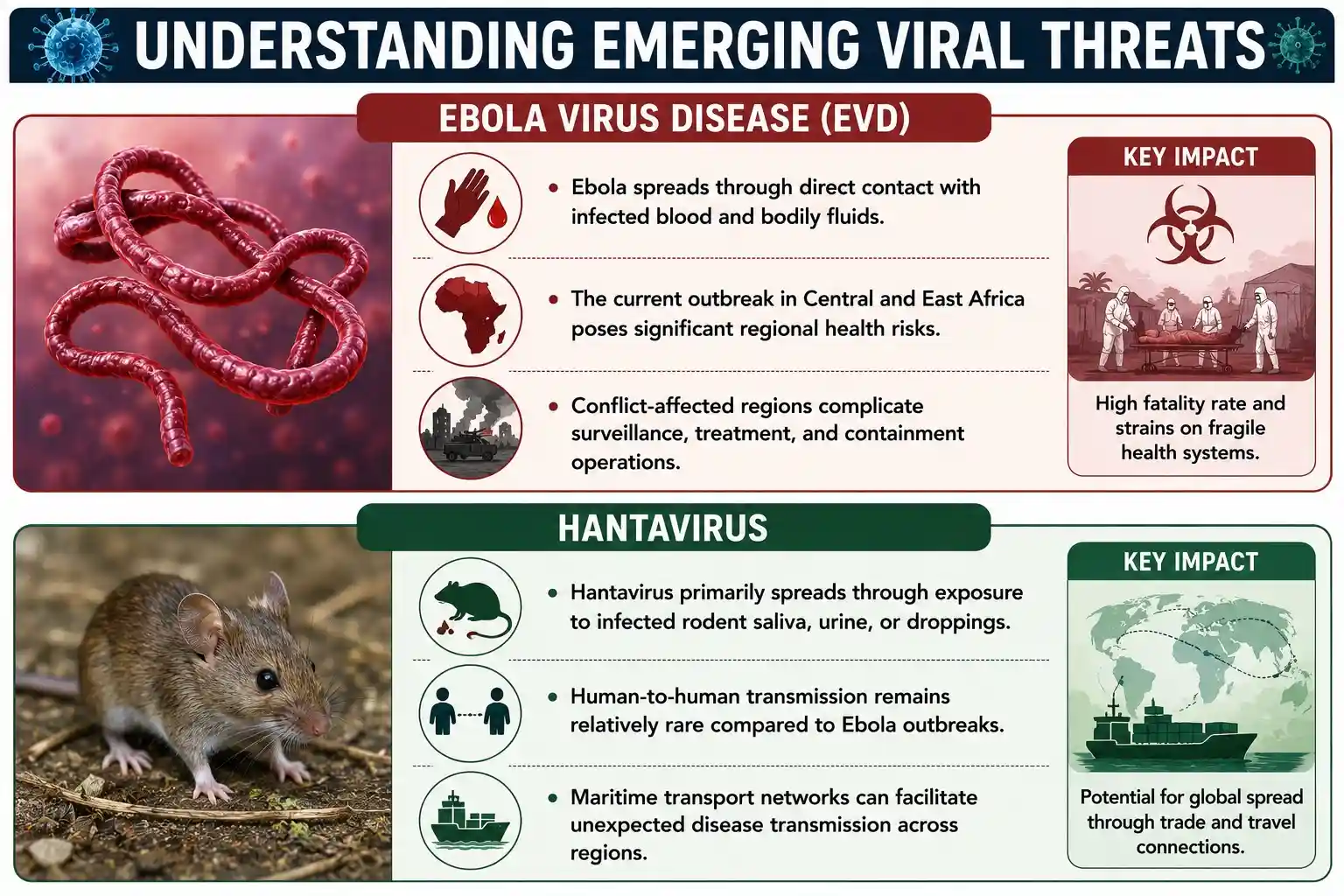
The resurgence of infectious diseases such as Ebola in Africa and Hantavirus in maritime settings highlights the growing challenges of global health security. In an interconnected world, disease outbreaks can quickly cross borders through migration, trade, and travel networks. These developments underline the importance of effective global health governance, strong surveillance systems, and coordinated international responses to emerging viral threats.
Challenges to Global Health Governance
Conflict and Disease Nexus
- Armed conflicts disrupt healthcare systems and weaken disease surveillance mechanisms internationally today significantly.
- Population displacement makes contact tracing and outbreak containment extremely difficult internationally today significantly.
- Healthcare workers and medical facilities often become targets during conflicts internationally today significantly.
Funding Constraints
- Financial pressures limit the World Health Organization’s capacity to manage emergencies effectively internationally today significantly.
- Developing countries remain heavily dependent upon external funding and medical assistance internationally today significantly.
Weak Health Infrastructure
- Many vulnerable nations lack adequate laboratories, hospitals, and diagnostic capabilities internationally today significantly.
- Dependence upon imported medicines and vaccines delays emergency outbreak responses internationally today significantly.
Socio-Economic Impacts of Viral Outbreaks
Trade and Tourism Disruptions
- Disease outbreaks often trigger travel advisories and restrictions affecting economic activities internationally today significantly.
- Tourism-dependent economies experience substantial revenue losses during major public health emergencies internationally today significantly.
Pressure on Healthcare Systems
- Resources are diverted from routine healthcare services toward emergency outbreak management internationally today significantly.
- Maternal healthcare, immunization programmes, and disease-control initiatives often suffer significantly internationally today significantly.
Economic Vulnerability
- Public health crises increase healthcare expenditure and reduce workforce productivity internationally today significantly.
- Weak economies face additional fiscal stress while responding to disease outbreaks internationally today significantly.
India’s Response and Preparedness
Border Health Security
- India strengthened screening measures at airports and ports to prevent disease importation nationally significantly today.
- Health declarations and thermal screening protocols were enhanced for high-risk travellers nationally today significantly.
Strengthening Research Capacity
- ICMR and national research institutions enhanced preparedness for detecting emerging viral strains nationally significantly today.
- Diagnostic capabilities are being upgraded to identify rare and evolving pathogens nationally today significantly.
Preventive Diplomacy
- India adopted precautionary measures while managing international engagements and public health risks nationally significantly today.
- Balancing global cooperation with domestic safety remains an important policy objective nationally today significantly.
Importance of Global Health Governance
Coordinated International Action
- Global health governance facilitates information sharing and coordinated outbreak responses internationally today significantly.
- International cooperation improves surveillance, emergency response, and resource mobilization internationally today significantly.
Role of WHO
- The WHO provides technical guidance, risk assessments, and emergency coordination internationally today significantly.
- Effective multilateral institutions remain essential for addressing transboundary health threats internationally today significantly.
International Health Regulations (IHR)
- International Health Regulations establish common standards for disease reporting and response internationally today significantly.
- Strong implementation improves global preparedness against future pandemics and epidemics internationally today significantly.
Way Forward
Adopt One Health Approach
- Human, animal, and environmental health systems should operate through integrated surveillance nationally significantly today.
- Early detection of zoonotic diseases can prevent future large-scale outbreaks internationally today significantly.
Strengthen WHO Financing
- Sustainable and predictable funding mechanisms are necessary for effective emergency responses internationally today significantly.
- Reduced dependence upon voluntary contributions can improve institutional stability internationally today significantly.
Expand Local Manufacturing
- Developing countries should strengthen domestic vaccine and diagnostic manufacturing capacities internationally today significantly.
- Technology transfer and regional production hubs can improve healthcare resilience internationally today significantly.
Improve Maritime and Border Health Systems
- Stronger sanitation and pest-control standards are required across ports and cruise networks internationally today significantly.
- Enhanced screening systems can reduce risks associated with global mobility internationally today significantly.
Emerging viral threats such as Ebola and Hantavirus demonstrate that public health security has become a critical component of national and global security. Disease outbreaks can rapidly disrupt economies, healthcare systems, and international mobility. For India and the wider international community, strengthening surveillance systems, supporting multilateral institutions, investing in scientific research, and adopting preventive health strategies are essential for building resilience against future biological threats. Effective global health governance remains the foundation of a safer and healthier world.
Prelims Boosters
Central Industrial Security Force (CISF)
Context:
Fishing harbours and landing sites may soon come under CISF security oversight.
About Central Industrial Security Force
- CISF is a Central Armed Police Force functioning under Ministry of Home Affairs.
- It provides security to critical infrastructure and strategic national installations.
- Headquarters of CISF is located in New Delhi officially.
- The motto of CISF is “Protection and Security” nationwide.
Establishment of CISF
- Need for specialized industrial security increased after 1965 Indo-Pak War.
- CISF was established through the CISF Act, 1968 officially enacted.
- The force became operational during the year 1969 nationally thereafter.
- Initially, CISF had sanctioned strength of only three battalions.
- Its original role was securing sensitive public sector undertakings nationwide.
- In 1983, the Act was amended strengthening CISF’s legal status.
- CISF was declared an Armed Force of the Union officially.
Organisational Structure
Leadership
- CISF is headed by a Director General from Indian Police Service.
- Director General is assisted by Additional Director General level officers.
Sectors
- The force is divided into seven operational sectors across India.
- These include Airport, North, North-East, East, West, South, and Training.
Fire Service Wing
- CISF has a dedicated Fire Service Wing for specialized protection.
Training Institutions
- CISF operates seven training institutions for capacity building nationwide.
- These include six Recruit Training Centres and National Industrial Security Academy.
- NISA serves as premier training institution of CISF nationally.
Functions of CISF
Protection of Critical Infrastructure
Protection of Important Institutions
|
Disaster Management
Fire Protection Services
|
Central Consumer Protection Authority (CCPA)
Context:
CCPA recently acted against several e-commerce entities for consumer rights violations.
About Central Consumer Protection Authority
- Central Consumer Protection Authority was established under Consumer Protection Act, 2019.
- It was constituted under Section 10 of the Consumer Protection Act.
- The authority protects and promotes consumer rights across India effectively.
- It serves as the central regulator for consumer protection matters.
Consumer Protection Act, 2019
- The Consumer Protection Act, 2019 replaced the earlier 1986 legislation.
- The Act was notified on 9 August 2019 officially nationwide.
- It came into force from 20 July 2020 across India.
Nodal Ministry
- CCPA functions under Ministry of Consumer Affairs, Food and Public Distribution.
Composition of CCPA
Chief Commissioner
- CCPA is headed by a Chief Commissioner appointed by government.
Other Commissioners
- Two Commissioners assist the Chief Commissioner in authority functions.
- One Commissioner deals with issues related to goods and products.
- Another Commissioner handles complaints related to services and service providers.
Functions of CCPA
Protection of Consumer Rights
- CCPA protects, promotes, and enforces rights of consumers collectively.
Prevention of Unfair Trade Practices
- It prevents unfair trade practices affecting consumers in marketplaces.
Action Against Misleading Advertisements
- CCPA curbs false and misleading advertisements issued by businesses.
- It ensures misleading advertisements are not published or circulated.
Class Action Measures
- It can initiate class-action proceedings on behalf of consumers.
- It may order product recalls when public interest demands action.
- It can direct refunds to affected consumers wherever necessary.
- It can recommend cancellation of licences in serious violations.
Investigation Powers
- CCPA conducts inquiries into violations of consumer protection laws.
- Investigations are carried out through dedicated Investigation Wing officially.
- The Investigation Wing is headed by a Director General.
Enforcement Powers
- CCPA can order discontinuation of unfair trade practices immediately.
- It can impose penalties on businesses violating consumer rights.
- It can enforce measures aimed at consumer welfare and protection.
Forest Advisory Committee (FAC)
Context:
Forest Advisory Committee recently granted in-principle approval for diversion of forest land.
About Forest Advisory Committee
- Forest Advisory Committee is a statutory body constituted under Forest Conservation Act, 1980.
- It functions under Ministry of Environment, Forest and Climate Change.
- FAC plays a crucial role in forest land diversion decisions nationally.
Functions of FAC
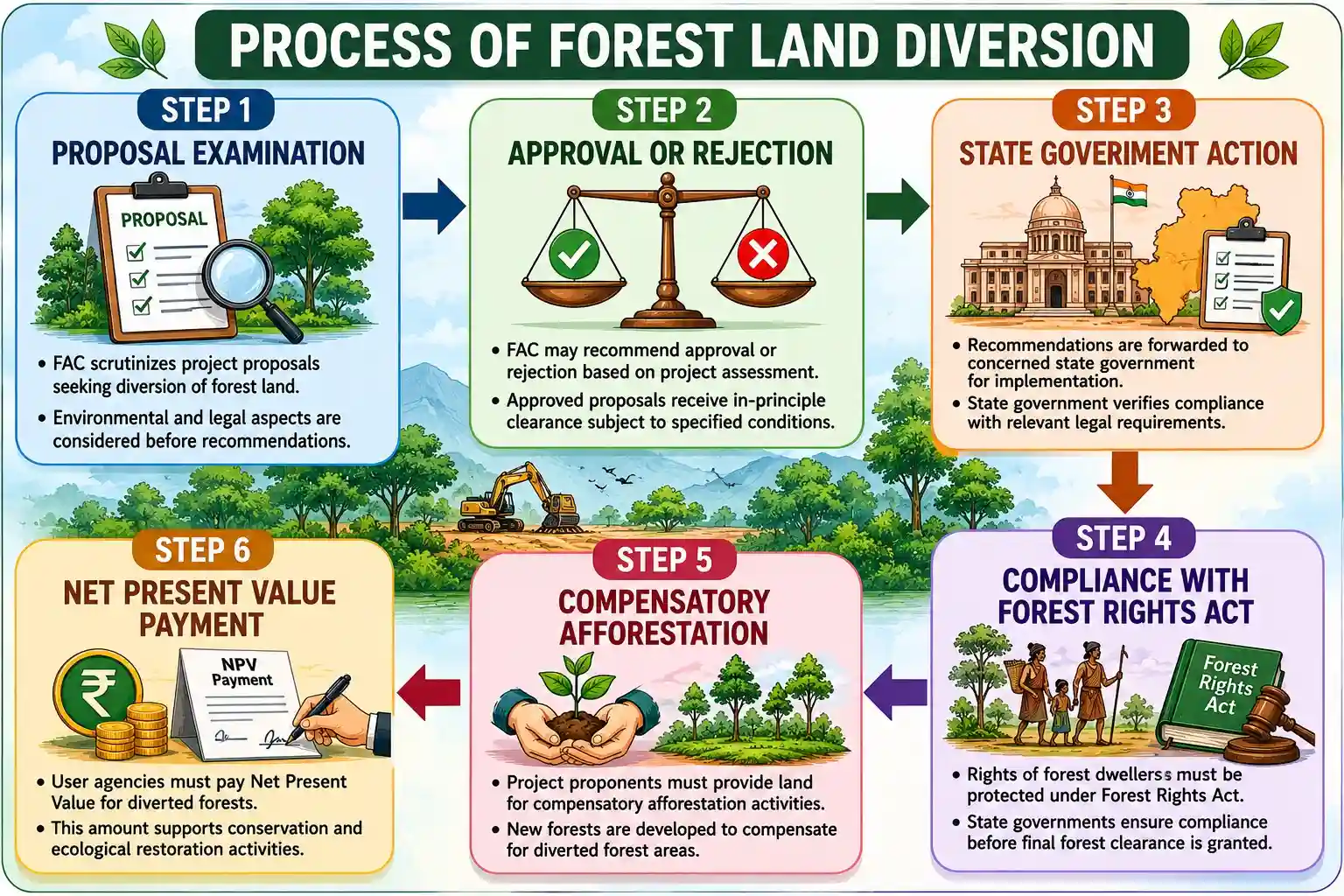
- FAC examines proposals involving diversion of forest land for projects.
- It considers requests for non-forest use of forest areas nationwide.
- The committee evaluates environmental implications before granting recommendations officially.
- It advises Central Government regarding approval or rejection of proposals.
Projects Considered by FAC
- Mining projects requiring forest land diversion are examined by FAC.
- Industrial projects involving forest areas are assessed by committee carefully.
- Township and infrastructure development proposals are also reviewed extensively.
- Other non-forest activities requiring forest land need FAC consideration.
Pradhan Mantri Awaas Yojana–Gramin (PMAY-G)
Context:
Union Government recently released over ₹10,000 crore to twelve states under PMAY-G.
About PMAY-G
- PMAY-G was launched in 2016 after restructuring Indira Awaas Yojana.
- It is the flagship rural housing scheme of Government of India.
- The scheme aims providing pucca houses with basic amenities to beneficiaries.
- It targets houseless families and households living in kutcha houses.
Objectives
- To provide affordable and durable housing for rural poor households.
- To improve living standards and housing security in rural areas.
- To ensure access to basic amenities through quality rural housing.
Eligible Beneficiaries
- Houseless rural families are eligible under the scheme provisions.
- Families living in zero, one, or two-room kutcha houses qualify.
- Selection is based on deprivation criteria under SECC 2011 data.
Target
First Phase
- Initial target was construction of 2.95 crore rural houses nationwide.
- This target covered period from 2016-17 to 2023-24 officially.
Extended Phase
- Scheme has been extended for five more years thereafter.
- Additional target of 2 crore houses approved under extension phase.
- Extended period covers financial years 2024-25 to 2028-29.
House Specifications
- Every house must have minimum area of 25 square metres.
- House must include a separate hygienic cooking space within structure.
Financial Assistance
Unit Assistance
- Beneficiaries receive ₹1.20 lakh assistance in plain area regions.
- Beneficiaries receive ₹1.30 lakh assistance in hilly area regions.
Hilly States Covered
- Higher assistance applies in Northeastern states and Himalayan regions.
- Jammu and Kashmir, Ladakh, Himachal Pradesh, and Uttarakhand included.
Funding Pattern
Plain AreasCentre and States share expenditure in ratio of 60:40. |
Northeastern and Himalayan StatesExpenditure is shared between Centre and States in ratio 90:10. |
Union TerritoriesUnion Territories without legislatures receive 100 percent central funding. |
Monitoring and Implementation
- Scheme implementation is monitored through AwaasSoft Management Information System.
- AwaasApp mobile application supports monitoring and beneficiary verification processes.
- E-governance tools ensure transparency and accountability in implementation nationwide.
Chief Minister and Powers
Context:
Karnataka Chief Minister Siddaramaiah recently resigned following prolonged political developments.
About Chief Minister
- Chief Minister is the real executive head of the state government.
- Governor acts as nominal executive head, while Chief Minister exercises authority.
- Chief Minister leads state administration, Council of Ministers, and government.
- He serves as principal advisor to the Governor on state affairs.
Constitutional Provisions
Article 163Provides Council of Ministers headed by Chief Minister to aid Governor. Governor generally acts on advice of Council of Ministers constitutionally. |
Article 164Governor appoints Chief Minister and ministers on constitutional provisions. Ministers are appointed by Governor on Chief Minister’s recommendation officially. Council of Ministers remains collectively responsible to Legislative Assembly always. |
Article 167Defines Chief Minister’s duties regarding communication with Governor officially. Chief Minister provides administrative and legislative information to Governor regularly. |
Powers and Functions
In Relation to Council of Ministers
- Recommends names of ministers for appointment by Governor officially.
- Allocates portfolios among ministers and reshuffles them whenever required.
- Presides over cabinet meetings and directs government policy decisions.
- Coordinates and supervises functioning of entire Council of Ministers effectively.
In Relation to Governor
- Acts as principal communication channel between Governor and government.
- Advises Governor regarding appointment of key constitutional functionaries officially.
- Recommends appointments of Advocate General and State Election Commissioner.
- Advises appointments related to State Public Service Commission leadership.
In Relation to State Legislature
- Advises Governor regarding summoning and proroguing Legislative Assembly sessions.
- Advises Governor regarding dissolution of Legislative Assembly when necessary.
- Announces major government policies on Assembly floor officially and publicly.
In Relation to State Administration
- Functions as chief spokesperson of state government before public.
- Leads ruling party and provides political direction to government.
- Coordinates activities of various departments for effective governance statewide.
Procedure for Resignation
Submission of Resignation
- Chief Minister submits formal resignation letter directly to Governor.
Dissolution of Council
- Resignation of Chief Minister dissolves entire Council of Ministers automatically.
- This occurs because of principle of collective ministerial responsibility.
Caretaker Government
- Governor may request outgoing Chief Minister continue as caretaker temporarily.
- Caretaker arrangement remains until new government assumes office officially.
Selection of New Chief Minister
Legislative Party Meeting
- Ruling party conducts Legislative Party meeting to elect leader.
Claim to Form Government
- Newly elected leader submits claim before Governor officially thereafter.
Invitation by Governor
- Governor invites leader having majority support to form government.
Floor Test
- If required, Governor directs Chief Minister to prove majority.
- Majority must be demonstrated through confidence vote in Assembly.