Fast-Tracking Judicial Judgments and Bail Deliveries
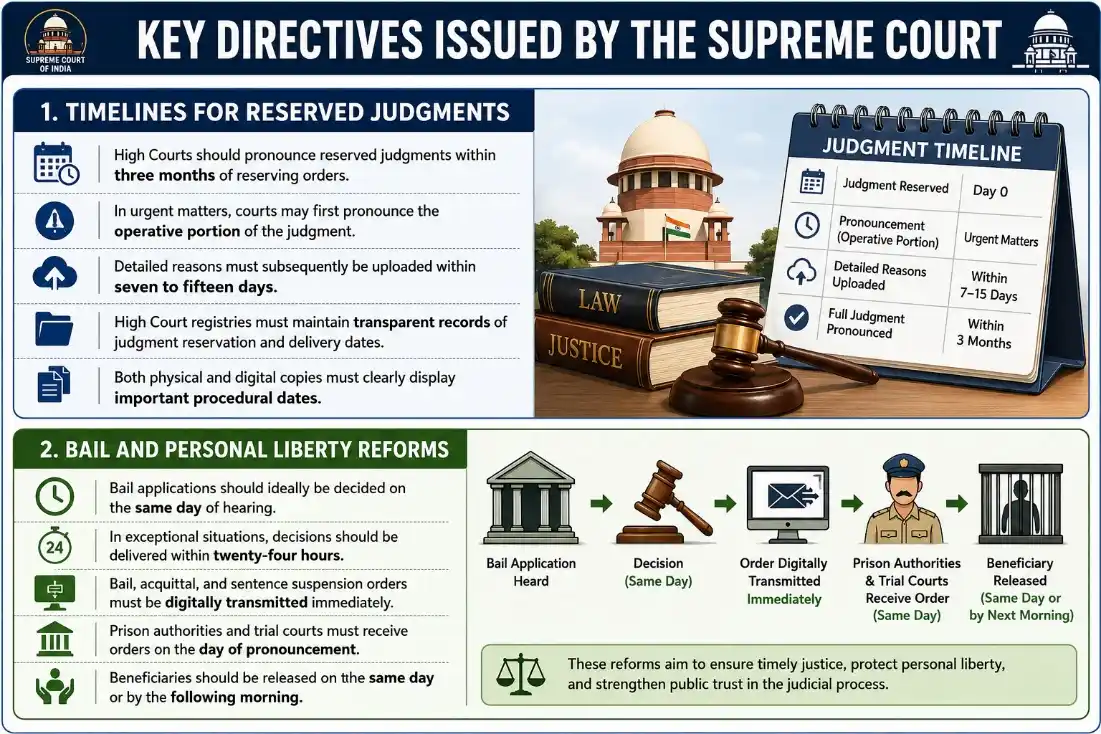
Institutional Accountability Framework
- Registries must automatically alert the Chief Justice when judgments remain pending beyond three months.
- The concerned bench receives a final two-week period to deliver the judgment.
- Continued non-compliance may result in withdrawal and reassignment of the case.
- The reassigned bench may conduct a fresh hearing if necessary.
- Litigants can file applications seeking early pronouncement of pending judgments.
- Such applications must be listed within two working days.
Constitutional Significance
Protection of Article 21
- Delayed judgments can violate the constitutional right to life and personal liberty.
- Speedy justice is an essential component of a fair legal process.
- Prolonged uncertainty undermines public confidence in the justice delivery system.
Use of Article 142
- The Supreme Court used Article 142 to ensure complete justice.
- The directions fill administrative gaps in the absence of specific legislation.
- The judgment reflects a proactive approach towards judicial reforms.
Human and Socio-Economic Importance
- A large majority of prisoners in India are undertrials awaiting legal outcomes.
- Delayed bail decisions disproportionately affect poor and marginalized communities.
- Prolonged detention often causes financial hardship for entire families.
- Delays contribute significantly to overcrowding in prisons across the country.
- Faster decisions help protect dignity, liberty, and livelihood opportunities.
Benefits for Judicial Efficiency
- Timely judgments prevent loss of judicial memory regarding complex arguments.
- Judges can write more accurate decisions when facts remain fresh.
- Faster disposal reduces unnecessary rehearing of cases.
- Improved efficiency enhances public trust in judicial institutions.
- Predictable timelines strengthen accountability within the judiciary.
Challenges in Implementation
Judicial Vacancies
Heavy Case Backlogs
|
Digital Infrastructure Constraints
System-Wide Delays
|
Way Forward
- Judicial vacancies should be filled through faster appointment processes.
- Retired judges may be appointed under Article 224A to reduce pendency.
- Courts should adopt modern case-management and tracking systems.
- Oral arguments should become more structured and time-efficient.
- The e-Courts Project should be expanded across all levels of the judiciary.
- Integration with the Interoperable Criminal Justice System should be accelerated.
- Similar timelines should gradually extend to district and subordinate courts.
After Maoism: Winning the Trust of India’s Adivasis

Beyond Welfare: Addressing Core Tribal Concerns
Infrastructure development remains important, but deeper structural concerns determine public trust.
Positive Developments
- Expansion of roads improves connectivity and market access.
- Mobile communication towers enhance digital inclusion.
- Welfare schemes improve access to healthcare, education, and livelihoods.
Persistent Concerns
However, tribal communities continue to focus on issues commonly summarized as:
- Jal (water), Jungle (forests) and Zameen (land)
These concerns directly affect identity, livelihoods, and cultural survival.
PESA Act: Foundation of Tribal Self-Governance
About PESA
The Panchayats (Extension to Scheduled Areas) Act, 1996, was enacted to strengthen self-governance in tribal regions.
Key Features
- Recognizes the Gram Sabha as the central institution of local governance.
- Protects tribal customs, traditions, and community resources.
- Enables local communities to participate in development decisions.
- Supports resolution of disputes through traditional practices.
- Provides safeguards against exploitation of tribal resources.
Challenges in PESA Implementation
Uneven Implementation
- Different states have interpreted and implemented PESA differently.
- Many provisions remain inadequately implemented.
- The spirit of decentralised governance is often diluted.
Weakening of Gram Sabha Authority
- State governments have sometimes attempted to reduce Gram Sabha powers.
- In certain cases, consultation has been prioritised over consent.
- Such changes weaken community participation in decision-making.
Concerns Over Consent
- Reports have emerged regarding fabricated or manipulated consent records.
- This undermines democratic legitimacy and public confidence.
Why Trust Matters
Security Success Alone Is Not Enough
|
Constitutional Guarantees Shape Expectations
|
Importance of Gram Sabha-Centred Governance
Empowering Local Communities
- Gram Sabhas provide a platform for direct community participation.
- They ensure decisions reflect local needs and priorities.
- They strengthen accountability and transparency.
Promoting Sustainable Development
- Community involvement improves implementation of welfare programmes.
- Local knowledge supports better natural resource management.
- Development becomes more inclusive and socially acceptable.
Way Forward
Strengthen PESA Implementation
- Ensure uniform and faithful implementation across all Scheduled Areas.
- Protect the decision-making authority of Gram Sabhas.
- Prevent dilution of tribal self-governance provisions.
Deepen Participatory Governance
- Involve tribal communities in planning and monitoring development projects.
- Encourage continuous dialogue between administration and local communities.
- Promote transparency in land, forest, and resource-related decisions.
Focus on Rights-Based Development
- Balance infrastructure expansion with protection of tribal rights.
- Improve access to education, healthcare, and livelihood opportunities.
- Respect traditional institutions and cultural practices.
Prelims Boosters
Eurozone
Context:
Eurozone inflation rose to 3.2% in May due to higher energy and service prices.
About Eurozone
- Eurozone is the group of European Union countries using euro.
- It is officially known as the Euro Area.
- Member countries have adopted the euro (€) as currency.
- It forms a major economic and monetary union globally.
Members
- As of January 2026, Eurozone consists of 21 countries.
- Austria, Belgium, Bulgaria, Croatia, Cyprus, and Estonia.
- Finland, France, Germany, Greece, Ireland, and Italy.
- Latvia, Lithuania, Luxembourg, Malta, and Netherlands.
- Portugal, Slovakia, Slovenia, and Spain are members.
Latest Member
- Bulgaria became the newest Eurozone member in 2026.
Countries in EU but Outside Eurozone
- Not all European Union countries use the euro. Some nations retain independent national currencies and policies.
Non-Euro EU Countries
- Czech Republic, Denmark, Hungary, Poland, Romania and Sweden.
European Central Bank (ECB)
Role
- ECB is the central bank of the Eurozone. It determines monetary policy for all Eurozone members.
- It decides key interest rates across the currency bloc. It has sole authority over euro note issuance.
- It also authorizes minting of euro coins.
Structure
- Headed by a President and Executive Board.
- Includes heads of participating national central banks.
European Stability Mechanism (ESM)
- ESM provides financial support during economic crises.
- It offers rescue loans under specific conditions.
- Helps maintain financial stability in the Eurozone.
How Countries Join the Eurozone?
Maastricht Criteria
- Countries must satisfy convergence criteria before joining.
- These conditions were established under Maastricht Treaty, 1992.
Main Conditions
Price Stability
Sound Public Finances
| Exchange Rate Stability
Durability of Convergence
|
Adoption Rules
- All EU members except Denmark must adopt euro eventually.
- Adoption occurs only after meeting required conditions.
- No fixed timetable exists for joining the Eurozone.
- Countries decide their own preparation strategy independently.
Who Decides Eligibility?
- European Commission evaluates candidate country’s preparedness.
- ECB also assesses compliance with convergence criteria.
- Both institutions jointly approve euro adoption eligibility.
Prime Minister Research Chair (PMRC) Scheme 2026
Context:
Ministry of Education opened applications for PMRC Scheme 2026.
About PMRC Scheme 2026
- PMRC is a prestigious national research and talent-repatriation programme.
- It attracts Indian-origin researchers working in leading global institutions.
- The scheme creates pathways for researchers to work in India.
- It strengthens India’s research and innovation ecosystem significantly.
Ministry
- Administered by the Department of Higher Education.
- Functions under the Ministry of Education, Government of India.
Aim
- To attract world-class Indian-origin scientists and researchers.
- To reverse the outflow of highly skilled talent abroad.
- To strengthen India’s scientific and technological capabilities.
- To promote international academic and research collaborations.
- To position India as a leading global research destination.
Three Tiers of Engagement
Young Research Fellows
|
Senior Research Fellows
|
Research Chairs
|
Priority Research Areas
Computing and Technology
- Advanced Computing including Artificial Intelligence and Quantum Computing.
- Semiconductor research and technology development initiatives.
- Next-generation communication technologies and infrastructure.
- Cybersecurity and digital security-related research activities.
Industrial and Infrastructure Sectors
- Manufacturing and Industry 4.0 technologies.
- Advanced Materials and Critical Minerals research.
- Space and Defence technology development.
- Atomic Energy and related scientific advancements.
Sustainability and Biological Sciences
- Energy technologies and sustainability solutions.
- Climate Change mitigation and adaptation research.
- Biotechnology and life science innovations.
- Healthcare and Medical Technology advancements.
- Agriculture and Food Technology research.
- Blue Economy and marine resource development.
Institutional Eligibility
Eligible Institutions
- Government Higher Education Institutions meeting NIRF criteria.
- Institutions ranked among Top 100 in NIRF Overall category.
- Institutions ranked among Top 100 in NIRF Engineering category.
- Institutions ranked among Top 50 in NIRF Research category.
- Selected national laboratories under DST, DBT, ICMR, and CSIR.
Seven Lead Hubs
- IIT Delhi, IIT Bombay, IIT Madras, IIT Kanpur, IIT Hyderabad, IIT (ISM) Dhanbad, IISc Bengaluru.
Governance and Selection
- Selection managed by an independent Empowered Committee.
- Committee is chaired by the Principal Scientific Advisor (PSA).
- Ensures transparent and merit-based evaluation processes.
Funding Support
- Estimated funding allocation is around ₹200 crore.
- Supports multi-year research grants for selected researchers.
- Provides relocation assistance for incoming global talent.
- Offers competitive fellowships and advanced laboratory facilities.
The Pavona clavus Colony (Potato Patch)
Context:
Researchers discovered a giant Pavona clavus coral colony near Kadmat Island.
About Pavona clavus Colony (Potato Patch)
- Potato Patch is a giant continuous hard coral colony.
- It belongs to the coral species Pavona clavus.
- Pavona clavus is commonly known as Potato Coral.
- The name comes from its potato-like underwater appearance.
- It forms dense columnar and club-shaped coral structures.
Location
- Located near Kadmat Island in the Lakshadweep archipelago.
- Found in southeastern coastal waters around the island.
- Lakshadweep is India’s only atoll island chain.
- The colony begins at a depth of about 5.2 metres.
- It extends down to nearly 20 metres depth.
Formation
Coral Polyps
- Built by tiny coral polyps over several centuries.
- Polyps continuously deposit calcium carbonate skeletons.
- This process gradually forms large coral reef structures.
Age
- Estimated age ranges between 700 and 1,800 years.
- It has likely existed since the medieval period.
- Exact age requires detailed scientific core analysis.
Adaptation and Survival
Hydrodynamic Resilience
- Located on a steep slope exposed to strong waves.
- Developed thick and heavy calcareous columns over time.
- This structure helps resist ocean currents and cyclones.
Key Features
Massive Size
- Covers approximately 4,250 square metres of area.
- It is among the world’s largest known coral colonies.
- Measures about 85 metres in length.
- Measures around 50 metres in width.
- Stands approximately 2.8 metres in height.
Live Coral Cover
- About 58.47% of colony tissue remains alive.
- Indicates remarkable health despite climate-related stresses.
Biodiversity Support
- Serves as habitat for numerous marine organisms.
- Functions as nursery and feeding ground for fishes.
- Supports the ecological balance of the atoll ecosystem.
Significance
Climate Change Research
Paleoclimate Record
|
Ecological Importance
Blue Economy
|
Agasthyamalai Ecological Landscape
Context:
Supreme Court ordered removal of illegal encroachments in the Agasthyamalai landscape.
About Agasthyamalai Ecological Landscape
- Agasthyamalai is a globally significant and ecologically fragile forest landscape.
- It is centered around the Agasthyamalai Biosphere Reserve (ABR).
- The region is known for exceptional biodiversity and endemic species.
Establishment and Recognition
- Agasthyamalai Biosphere Reserve was established in 2001.
- It was created by the Government of India.
- UNESCO included it in the World Network of Biosphere Reserves.
- It received UNESCO recognition in March 2016.
Location
- Located at the southernmost end of the Western Ghats. It lies across the states of Kerala and Tamil Nadu. Total area covers about 3,500.36 square kilometres.
Area Distribution
Kerala Component
|
Tamil Nadu Component
|
Key Physical Features
Agasthyamala Peak
- Agasthyamala is the highest and most prominent peak.
- The peak rises to about 1,868 metres elevation.
- Located within the Neyyar Wildlife Sanctuary region.
Diverse Forest Types
- Contains tropical wet evergreen forests in lower elevations.
- Includes moist deciduous forests across intermediate zones.
- Supports montane rainforests in higher altitude regions.
- Features Shola forests and grassland ecosystems.
Hydrological Importance
- Acts as a major watershed for southern India.
- Gives rise to several important river systems.
- Tambraparni River originates from this mountain landscape.
- Karamana River also originates from this ecological region.
- Provides drinking water and irrigation to nearby districts.
Biodiversity Significance
Medicinal Plants
|
Important Wildlife
|
Tribal Communities
Kanikaran (Kanikkar) Tribe
- Indigenous Kanikaran tribe inhabits the Agasthyamalai region.
- Known for traditional forest and medicinal plant knowledge.
- Their cultural heritage is closely linked with nature.
RudraM-II Missile
Context:
DRDO and IAF successfully conducted flight tests of the indigenous RudraM-II missile.
About RudraM-II Missile
- RudraM-II is an advanced indigenous Air-to-Surface missile system.
- It is classified as an anti-radiation missile (ARM).
- The missile targets enemy radar and air defence systems.
- It can detect, track, and destroy radio-emitting targets.
Developed By
- Developed by Defence Research and Development Organisation (DRDO).
- Research Centre Imarat (RCI), Hyderabad served as nodal laboratory.
- Developed through collaboration among multiple DRDO establishments.
Aim
- To provide Suppression of Enemy Air Defences (SEAD) capability.
- To neutralize enemy radar and missile defence infrastructure.
- To ensure safer operations for friendly fighter aircraft.
What is SEAD?
- SEAD means Suppression of Enemy Air Defences capability.
- It involves destroying enemy radars and missile systems.
- It creates safer airspace for military aircraft operations.
Key Features
Anti-Radiation Capability
Hypersonic Speed
Long Stand-Off Range
Warhead
|
Flexible Launch Capability
Guidance System
Passive Homing Head (PHH)
Launch Platform
|