Climate Finance and Development Capital
India’s commitment to achieving Net Zero emissions by 2070 requires unprecedented financial investments. Simultaneously, the country must sustain economic growth, create employment opportunities, strengthen infrastructure, and reduce poverty. Therefore, the challenge is not merely mobilizing climate finance but creating institutions capable of directing capital towards projects that deliver both developmental and environmental benefits.
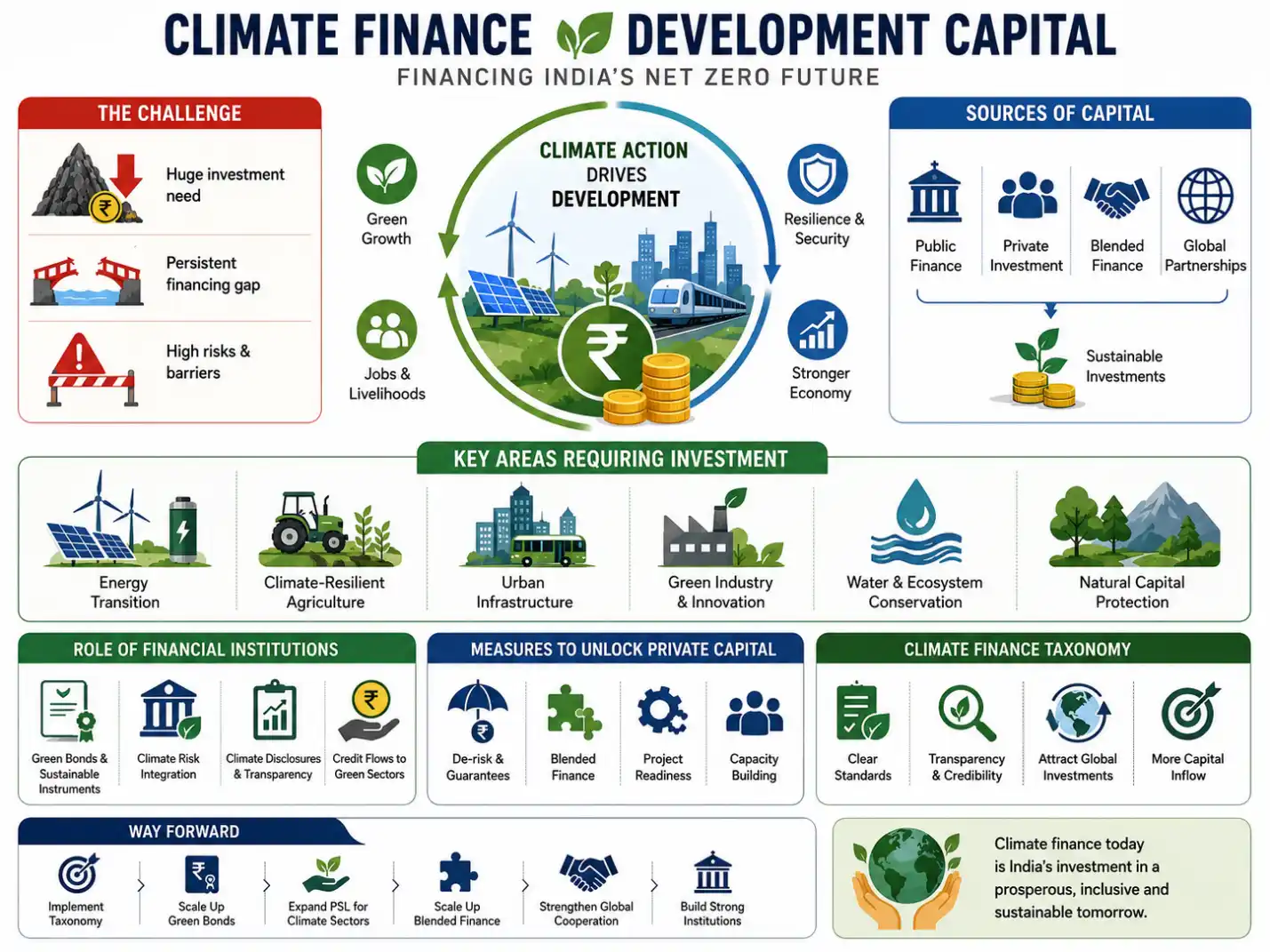
India’s Climate Finance Challenge
Massive Investment Requirements
- India requires nearly $10.1 trillion to achieve its long-term climate commitments.
- Sectors such as energy, transport, steel, cement, and infrastructure require substantial investments.
- Public expenditure alone cannot finance the scale of climate transition required.
- Private sector participation has become essential for achieving sustainability goals.
Persistent Financing Gap
- Existing climate finance flows remain significantly below India’s actual requirements.
- International climate finance commitments have not met developing countries’ expectations.
- Climate projects often struggle because investors perceive them as high-risk ventures.
- Institutional and regulatory barriers continue to limit large-scale capital mobilization.
Climate and Development as Complementary Objectives
Multiple Benefits from Single Investments
- Climate investments often generate economic, social, and environmental benefits simultaneously.
- Renewable energy projects create jobs while reducing dependence on fossil fuels.
- Sustainable infrastructure improves resilience while supporting long-term economic productivity.
- Green investments should therefore be viewed as development investments.
Economic Opportunities
- Climate action can create millions of jobs across manufacturing and service sectors.
- Green industries can improve India’s competitiveness in global export markets.
- Reduced energy imports can strengthen India’s external economic stability.
- Sustainable growth can improve both environmental and developmental outcomes.
Role of Financial Institutions
Expanding Green Finance
- Sovereign Green Bonds are helping mobilize resources for sustainable projects.
- Sustainable finance instruments are attracting environmentally conscious investors.
- Financial institutions are gradually integrating climate-related risks into decision-making.
- Green finance frameworks are improving transparency within financial markets.
Role of RBI
- RBI has started incorporating climate risks into financial sector regulations.
- Banks are increasingly encouraged to support environmentally sustainable investments.
- Climate-related disclosures can strengthen resilience across the financial system.
- Priority Sector Lending can help channel credit towards climate-sensitive sectors.
Importance of Climate Finance Taxonomy
Creating Clear Standards
- A climate taxonomy clearly identifies activities that qualify as sustainable investments.
- It reduces uncertainty for domestic and international investors.
- Standardised definitions help prevent misleading environmental claims.
- Greater transparency can improve investor confidence and capital inflows.
Attracting Global Investments
- Taxonomy frameworks can attract pension funds and sovereign wealth funds.
- International investors prefer markets with clear sustainability standards.
- Improved credibility can reduce borrowing costs for green projects.
- Strong frameworks can accelerate climate finance mobilization significantly.
Key Areas Requiring Investment
Energy Transition
- Renewable energy expansion requires substantial investments in generation capacity.
- Green hydrogen development requires long-term financial and policy support.
- Battery storage infrastructure remains critical for clean energy adoption.
- Transmission networks need modernization to support renewable integration.
Climate-Resilient Agriculture
- Farmers require investments in irrigation and climate-resilient technologies.
- Sustainable agriculture can improve productivity while reducing environmental degradation.
- Better financing can strengthen rural resilience against climate shocks.
- Agricultural adaptation remains essential for food security.
Urban Infrastructure
- Cities require investments in sustainable transport and waste management systems.
- Green buildings can reduce energy consumption and emissions significantly.
- Urban resilience measures can reduce climate-related vulnerabilities.
- Sustainable urbanization is critical for India’s future development.
Measures to Unlock Private Capital
Reducing Investment Risks
- Blended finance models can reduce risks for private investors.
- Government guarantees can improve investor confidence in climate projects.
- Credit enhancement mechanisms can attract long-term institutional capital.
- Risk-sharing frameworks can encourage greater participation from private investors.
Improving Project Readiness
- Smaller projects should be aggregated into larger investment portfolios.
- Local institutions require greater technical capacity for project preparation.
- Investment-ready projects are more likely to attract private funding.
- Strong implementation frameworks improve project viability and outcomes.
Way Forward
- India should finalize and implement a comprehensive Climate Finance Taxonomy.
- Sovereign Green Bond issuances should be expanded to mobilize larger resources.
- Priority Sector Lending should include more climate-sensitive activities.
- Blended finance mechanisms should be scaled up across sectors.
- Greater international cooperation is required for technology transfer and financing.
- Institutional capacities must be strengthened at national and local levels.
India’s climate transition is fundamentally a financing challenge as much as an environmental one. The country possesses the necessary economic potential, entrepreneurial capacity, and policy ambition, but these must be supported by robust financial institutions and innovative financing mechanisms. By integrating climate objectives with developmental priorities, India can transform climate action into a powerful driver of sustainable and inclusive growth.
Prelims Boosters
UN Mission in South Sudan (UNMISS)
Context:
565 Indian peacekeepers received the prestigious United Nations Medal of Honour.
About UNMISS
What is UNMISS?
- UNMISS is a United Nations peacekeeping mission in South Sudan.
- It deploys military, police, and civilian personnel for peacekeeping.
- Peacekeepers are popularly known as Blue Helmets
Establishment
- Established on 9 July 2011 after South Sudan’s independence.
- Created under UN Security Council Resolution 1996.
- Launched alongside the formation of South Sudan nation.
Aim
- To maintain peace and stability across South Sudan.
- To protect civilians from violence and conflict.
- To support nation-building and institutional development efforts.
- To strengthen political, judicial, and security systems.
- To promote long-term peace and economic development.
Key Features
Civilian Protection
|
Large Peacekeeping Mission
|
India’s Contribution
|
Community Development Activities
- Indian contingents organize veterinary and animal healthcare camps.
- They help build humanitarian supply and transport routes.
- Conduct self-defense training programs for women.
- Support campaigns against gender-based violence.
About United Nations Medal of Honour
What is It?
- It is a UN military decoration for peacekeepers.
- Awarded by the United Nations Secretary-General.
- Recognizes distinguished service in UN peacekeeping missions.
Eligibility
- Peacekeepers must complete required service period.
- Generally requires at least 90 days of service.
- Service must be under an active UN mission.
Features of the Medal
Design
|
Ribbon
|
Navachar Mantra Initiative
Context:
Navachar Mantra launched to support grassroots innovators and rural entrepreneurs.
About Navachar Mantra Initiative
- Navachar Mantra is a national innovation and entrepreneurship initiative.
- It supports grassroots innovators, startups, and micro-entrepreneurs nationwide.
- Focuses on solving local problems through innovative solutions.
- Helps convert local ideas into scalable business enterprises.
Ministry and Implementation
Ministry
- Implemented under the Ministry of Skill Development and Entrepreneurship.
- It is a flagship entrepreneurship promotion initiative of MSDE.
Implementing Agency
- Implemented by the National Institute for Entrepreneurship and Small Business Development.
- NIESBUD provides mentoring, incubation, and entrepreneurship support.
Aim
- To identify promising innovators from rural and smaller towns.
- To strengthen entrepreneurship beyond major metropolitan cities.
- To encourage innovation-driven economic and social development.
- To support creation of sustainable and scalable enterprises.
Target Beneficiaries
- Indian citizens aged between 18 and 55 years.
- Focuses on aspirational districts and underserved regions.
- Targets Tier-2, Tier-3 cities and rural areas.
- Supports early-stage entrepreneurs and grassroots innovators.
Eligibility
- Applicants need not have a registered company.
- Fully developed products are not mandatory for participation.
- Ideas at validation or prototype stage are eligible.
- Encourages participation from first-time innovators and entrepreneurs.
Priority Sectors
Agriculture and Food
Health Sector
Education Sector
|
Environment Sector
Rural Economy
MSME Sector
|
Incubation Support
One-Year Programme
- Selected innovators undergo a structured one-year incubation programme.
- Includes mentorship and capacity-building support throughout journey.
Business Development
- Provides guidance on fundraising and business expansion.
- Helps prepare long-term growth and sustainability plans.
Regulatory Support
- Offers assistance regarding regulatory and compliance requirements.
- Supports intellectual property and patent-related processes.
Visibility and Outreach
- Provides national-level exposure to selected innovators.
- Features innovators through podcasts and digital showcases.
- Organizes storytelling events highlighting successful grassroots innovations.
- Connects innovators with investors and institutional stakeholders.
Timeline
- Applications remain open through the official digital portal.
- Last date for application submission is 5 July 2026.
- Selection involves multiple stages of expert evaluation.
Significance
Inclusive Innovation
Atmanirbhar Bharat
|
Economic Development
Technology Advancement
|
June 3rd Declaration (Mountbatten Plan), 1947
Context:
3 June 2026 marks the 79th anniversary of the June 3rd Declaration.
About June 3rd Declaration
- Also known as the Mountbatten Plan of 1947.
- Announced by Lord Louis Mountbatten, the last Viceroy.
- Provided the framework for partition of British India.
- Outlined transfer of power to Indian leadership.
- Fixed an accelerated timeline for independence and partition.
Historical Background
Failure of Cabinet Mission Plan
- Cabinet Mission Plan of 1946 failed to achieve consensus.
- Differences widened between Congress and Muslim League leadership.
Direct Action Day
- Muslim League announced Direct Action Day in August 1946.
- Triggered large-scale communal violence across several regions.
- Great Calcutta Killings intensified Hindu-Muslim tensions significantly.
Mountbatten’s Appointment
- Lord Mountbatten became Viceroy in March 1947.
- British government directed him to transfer power quickly.
Deadline from Britain
- Prime Minister Clement Attlee fixed June 1948 deadline.
- Mountbatten later advanced the date considerably.
Rejection of Plan Balkan
- Mountbatten initially proposed the Plan Balkan scheme.
- It allowed provinces to choose independent status.
- Jawaharlal Nehru strongly opposed this proposal.
- Fear existed that India could fragment completely.
Key Features of June 3rd Plan
Acceptance of Partition
- British government formally accepted partition of British India.
- Creation of India and Pakistan as separate dominions approved.
Provincial Self-Determination
Punjab and Bengal
|
Sindh
|
NWFP and Sylhet
|
Boundary Commission
- Independent Boundary Commission was established under the plan.
- Responsible for demarcating borders between two dominions.
- Headed later by Sir Cyril Radcliffe.
Princely States
- British paramountcy over princely states was terminated.
- Over 560 princely states lost British protection.
- States had to join either India or Pakistan.
- Decision mainly depended on geographical contiguity.
Accelerated Transfer of Power
- Original independence deadline was June 1948.
- Mountbatten advanced it to 15 August 1947.
- Intended to prevent administrative collapse and violence.
Significance
End of British Rule
| Creation of Pakistan
| Partition Consequences
|
Base Year of Wholesale Price Index Revised from 2011–12 to 2022–23
Context:
Government revised the WPI base year from 2011–12 to 2022–23.
About the Revision
- India has updated the Wholesale Price Index base year.
- Base year changed from 2011–12 to 2022–23.
- The revision modernizes India’s inflation measurement framework.
- It updates commodity basket and statistical methodology.
- It aligns India’s practices with international standards.
Aim
- To improve accuracy of inflation measurement.
- To reflect current production and consumption patterns better.
- To remove distortions caused by outdated base years.
- To align with recommendations of international organizations.
- To gradually transition towards Producer Price Index (PPI).
Key Changes
Expanded Commodity Basket
|
Green Energy Inclusion
|
Fuel and Power Reclassification
|
New Weighting Method
Gross Value of Output (GVO)
- Item weights now based on Gross Value of Output.
- Replaces the earlier Net Traded Value methodology.
- Better reflects domestic production importance.
- Provides more realistic representation of economic activity.
Improved Calculation Method
Chain-Based Method
- Elementary indices calculated through chain-based methodology.
- Replaces older long-term fixed formulation approach.
- Makes the index more responsive to market changes.
Advanced Data Handling
Targeted Mean Imputation
- Missing prices handled using Targeted Mean Imputation.
- Replaces the old carry-forward method completely.
- Improves reliability and statistical accuracy of data.
Introduction of Producer Price Index (PPI)
Output Producer Price Index (OPPI)
- Measures prices received by producers for outputs.
- Released alongside the revised WPI series.
Input Producer Price Index
- Experimental index for manufacturing sector inputs.
- Measures prices paid by producers for inputs.
Service Producer Price Index
- Introduced for major service sectors.
- Covers banking and securities transactions.
- Includes insurance and pension fund management.
- Covers railways, air passenger transport, and telecom.
Price Concepts Used
Basic Price
|
Purchaser’s Price
|
India Launches UPI Payments in Cambodia
Context:
NPCI partnered with ACLEDA Bank to enable UPI payments in Cambodia.
About Cambodia
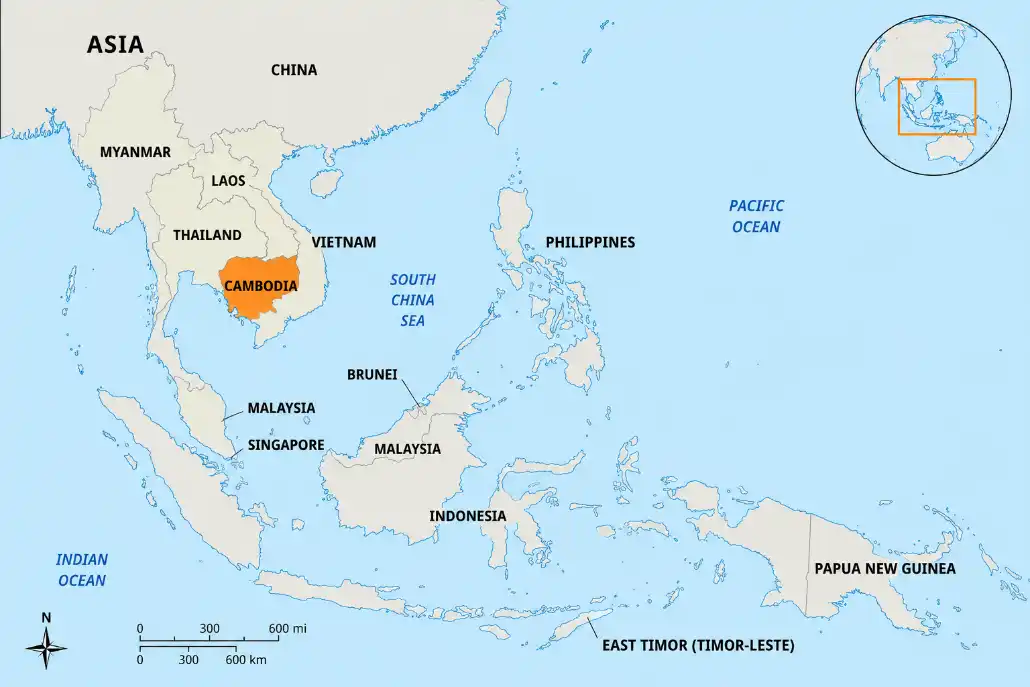
Location
- Cambodia is a country located in mainland Southeast Asia.
- It possesses a rich cultural and historical heritage.
- Civilization developed through influences from India and China.
Historical Importance
- Angkor Empire represented Cambodia’s historical golden age.
- The empire flourished between the 9th and 15th centuries.
- Famous for constructing the magnificent Angkor Wat temple.
Capital
- Capital city of Cambodia is Phnom Penh.
Borders
- Thailand lies to the west and northwest.
- Laos lies to the northeast of Cambodia.
- Vietnam lies to the east and southeast.
- Southwestern coast borders the Gulf of Thailand.
Physical Features
Central Alluvial Plain
|
Mountain Ranges
|
Mekong River
|
Tonle Sap Lake
|
UPI in Cambodia
Significance
- NPCI partnered with ACLEDA Bank for UPI acceptance.
- Enables Indian travelers to make digital payments easily.
- Strengthens India-Cambodia financial and digital cooperation.
- Expands international footprint of India’s digital payment system.
Countries Using UPI
- United Arab Emirates (UAE), Singapore, Bhutan, Cambodia, Nepal, Sri Lanka, France, Mauritius, Qatar.
About UPI
Full Form
- UPI stands for Unified Payments Interface.
Developed By
- Developed and operated by National Payments Corporation of India (NPCI).
Features
- Enables instant real-time digital fund transfers.
- Supports bank-to-bank transactions through mobile platforms.
- Operates round the clock throughout the year.