The UPSC Civil Services Examination is often called the toughest exam in the world, not just because of the syllabus, but because of the “Elimination” factor. Out of nearly 10 lakh applicants, only a tiny fraction sees their name in the final PDF, leading to failure of many aspirants in UPSC CSE.
But why do 95% of aspirants fail? Is it a lack of hard work? Usually, no. It’s a lack of strategic direction. At Educrat IAS Academy, we’ve analysed years of result data to pinpoint the exact traps that catch even the most brilliant minds.
About UPSC CSE:
UPSC Civil Services Examination: Overview
The UPSC Civil Services Examination is conducted in three stages:
- Preliminary Examination (Prelims) – MCQ based Screening test
- Main Examination (Mains) – Written descriptive examination
- Interview / Personality Test – Final stage evaluation
Only candidates who qualify each stage are allowed to appear for the next stage. The final merit list is prepared based on the marks obtained in the Mains Examination and the Interview, while the Prelims acts only as a screening stage.
Why UPSC Aspirants Fail?
1. Not Understanding the UPSC Exam Syllabus
Lack of depth of knowledge about UPSC Syllabus is why UPSC aspirants fail. To prepare effectively, aspirants must clearly understand the UPSC exam pattern and syllabus. Understanding the complete syllabus of the UPSC Prelims, Mains, and Interview stages along with the detailed syllabus for each paper, helps candidates build a structured preparation strategy for the UPSC CSE 2026.a. UPSC Prelims Syllabus
The syllabus for UPSC Prelims focuses on testing general awareness, analytical ability, and understanding of national and international issues.
General Studies Paper I (Generally conducted between 9:30 AM to 11:30 AM)
This paper evaluates the candidate’s knowledge in multiple subjects:
- Current events of national and international importance
- History
- Geography
- Indian Polity and Governance
- Economic and Social Development
- Environmental ecology, biodiversity, and climate change
- General Science
This paper plays the most important role in determining whether a candidate qualifies for the Mains stage.
CSAT (General Studies Paper II) (Generally conducted between 2:30 PM to 04:30 PM)
The Civil Services Aptitude Test (CSAT) evaluates the candidate’s logical and analytical skills.
Important topics include:
- English
- Mathematics
- Reasoning
Although the CSAT paper is qualifying, candidates should not ignore it, as failure to secure 33% marks will disqualify the candidate regardless of their GS score.
b. UPSC Mains Syllabus
The Mains syllabus focuses on evaluating the analytical ability, conceptual clarity, and writing skills of the candidates.
- Indian Language
- English
- Essay
- GS Paper I – Indian Heritage and Culture, History and Geography of the World and Society
- GS Paper II – Governance, Constitution, Polity, Social Justice and International Relations
- GS Paper III – Technology, Economic Development, Bio-diversity, Environment, Security and Disaster Management
- GS Paper IV – Ethics, Integrity & Aptitude
- Optional Subject: Paper I and Paper II
C. UPSC Interview (Personality Test)
Candidates who qualify the Mains examination are called for the UPSC Personality Test, conducted at the UPSC headquarters in New Delhi.
The panel evaluates:
- Personality and confidence
- Communication skills
- Leadership qualities
- Awareness of national and international issues
- Suitability for a career in public service
Unlike a traditional academic test, the interview focuses on overall personality and decision-making ability.
At Educrat IAS Academy, the Best UPSC Coaching in Kolkata, we provide a comprehensive counselling session which helps aspirants understand the UPSC syllabus with clarity and depth.
2. The “Resource Overload” Trap
Most aspirants start their journey by buying every book recommended on YouTube. They spend 80% of their time collecting materials and only 20% actually studying them. This is why most aspirants fail in UPSC CSE.
The Reality: UPSC doesn’t reward the person who reads 10 books once; it rewards the person who reads one book ten times. Minimum Resources, Multiple Revision is the key to becoming a UPSC Topper. At Educrat IAS Academy, the Best IAS institute in Kolkata, we provide all the required books and curated, high-yield study materials that eliminate the need for “material hopping.” Our mentors ensure you focus only on what is relevant for the 2026 exam cycle.
We provide Current Affairs and Current Affairs MCQ in forms of:
- Daily Current Affairs
- Daily Current Affairs MCQ
- Monthly Current Affairs Magazine
- Monthly Current Affair MCQ
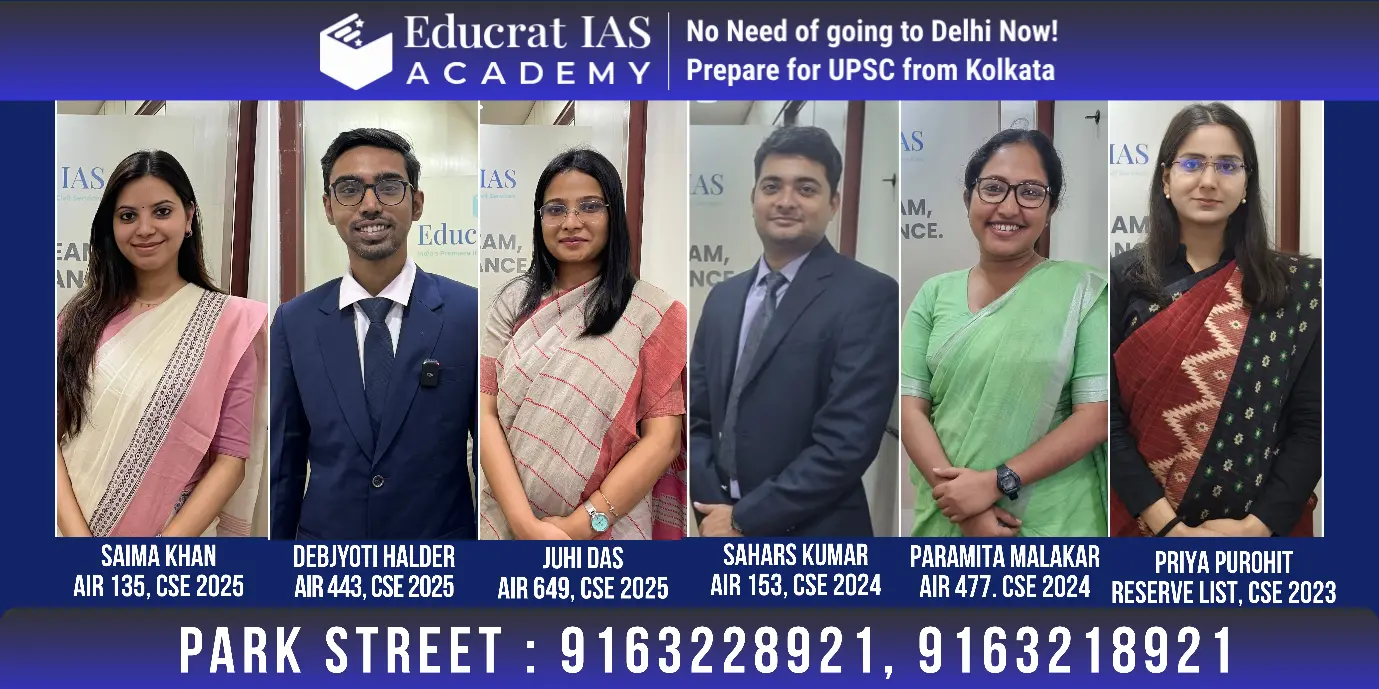
UPSC CSE 2025 Topper Talk: Winning Strategy of AIR 135, Saima Khan
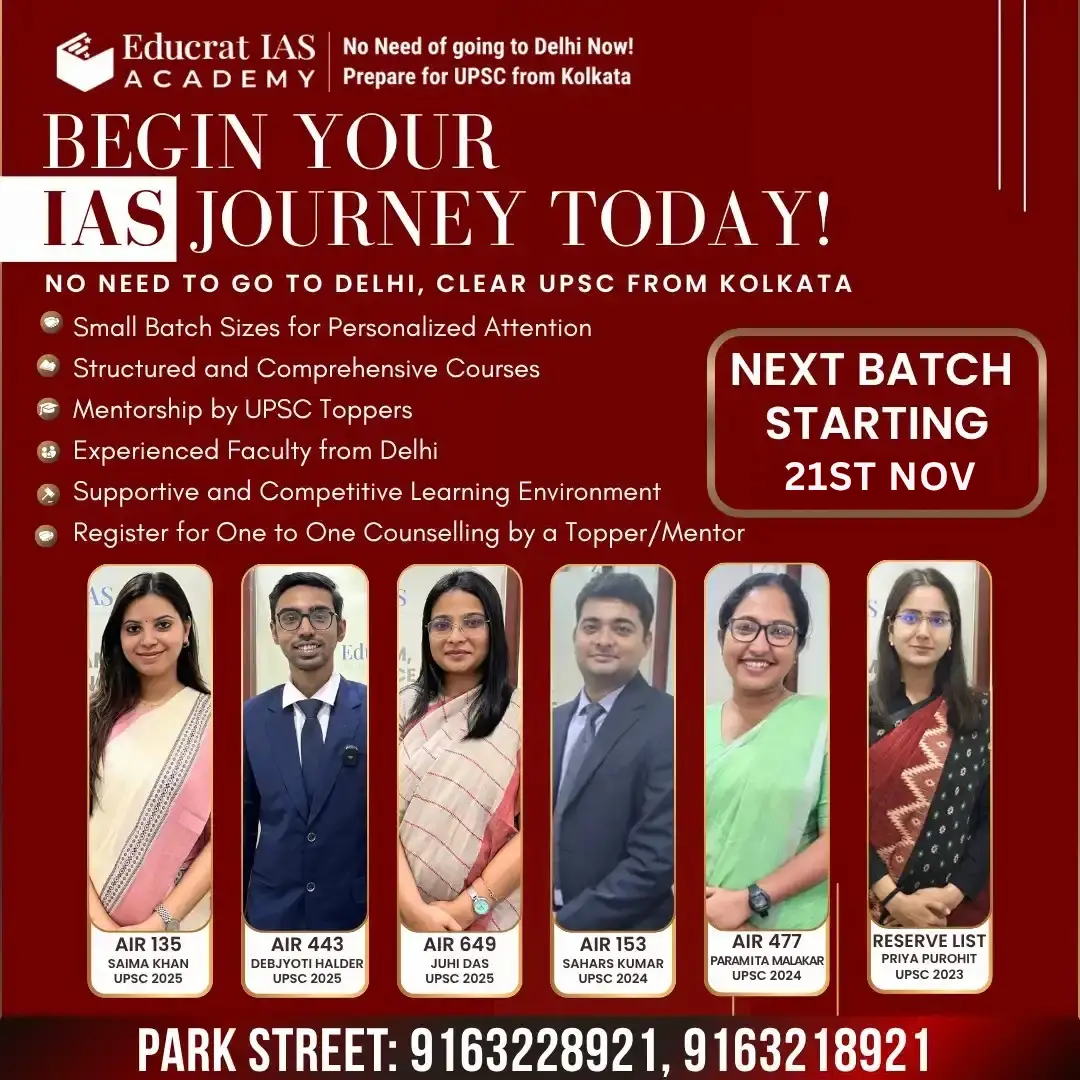
AIR 135, Saima Khan credits her success to a “Smart Work > Hard Work” philosophy. Her core pillars is Resource Management, Mastering a few standard books through multiple revisions rather than chasing new materials.
3. Ignoring the “Foundation” (The WBCS & UPSC Synergy)
Many aspirants in West Bengal dive into UPSC without a fall-back or a structured foundation. They often ignore the overlap between the UPSC and WBCS syllabi, leading to unnecessary pressure. To not fail in UPSC CSE, foundational knowledge in crucial.
The Reality: A strong foundation in NCERTs and state-level administrative nuances provides a safety net and builds the conceptual clarity needed for the IAS. Bridge the gap between regional excellence and national-level competition right here in Kolkata.
UPSC CSE 2025 Topper Talk: Mastering with Foundation AIR 443, Debjyoti Halder
AIR 443, Debjyoti Halder with a strong foundation secured his place not just as a UPSC CSE 2025 Topper but also as a Rank 2 WBPS 2023 Topper. Same strategy, strong foundation: acing both in State Civil Service Examination and in Central Civil Service Examination.
4. Lack of “Exam-Like” Answer Writing
Aspirants often wait until after Prelims to start practicing for Mains. This is a fatal mistake which is why aspirants fail in UPSC CSE. Knowledge is useless in UPSC if you cannot articulate it within a 150-word limit under intense pressure.
The Reality: The Mains exam is a test of writing stamina and analytical speed, not just memory. At Educrat IAS Academy, the Top UPSC Coaching institute in Kolkata, our UPSC courses are specially curated to fit answer writing in every class throughout the course. Integrated preparation in UPSC CSE is what UPSC Toppers utilize to not fail in UPSC CSE.
UPSC CSE 2025 Topper Talk: Game-Changer for AIR 649, Juhi Das
AIR 649, Juhi Das believes in Answer Writing as a Game-Changer. She practiced structured, point-wise answers aligned with the UPSC demand for clarity and depth. Through disciplined study and answer writing practice, she successfully cleared as AIR 649 in UPSC CSE 2025 Topper.
5. Choosing the Wrong Optional
Many students choose an Optional subject only because it’s “trending” or only because a previous year’s topper had it. Without a genuine understanding and interest in the subject, the vast syllabus becomes a burden.
The Reality: Your Optional accounts for 500 marks. If you don’t enjoy the subject, you won’t survive the deep-dive required to score 300+. There are several factors to consider while choosing Optional.
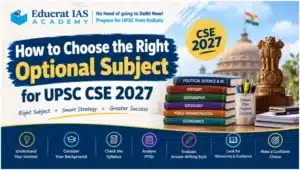
How to Choose Optional Subject in UPSC?
- Interest
- Overlap with General Studies
- Availability of Guidance & Resources
- Optional Subject Based on Graduation
- Answer Writing Nature
- Past Performance & Scoring Trend
Understand how UPSC Toppers Choose Optional Subject:
Saima Khan, AIR 135 (CSE 2025)
Optional Subject: Sociology
Reason for Choice: Graduation subject, B.A (Hons) in Sociology, St. Xavier’s College, Kolkata
Debjyoti Halder, AIR 443 (CSE 2025)
Optional Subject: Medical Science
Reason for Choice: Graduation subject, MBBS, R.G. Kar Medical College, Kolkata (WBUHS)
Juhi Das, AIR 649 (CSE 2025)
Optional Subject: Anthropology
Reason for Choice: Interest in society, culture, and human development, giving her preparation a multidimensional depth.
Sahars Kumar, AIR 153 (CSE 2024)
Optional Subject: Political Science and International Relations (PSIR)
Reason for Choice: Overlap with General Studies.
Paramita Malakar, AIR 477 (CSE 2024)
Optional Subject: Bengali Literature
Reason for Choice: Interest in Bengali Literature.
Ashish Kumar, AIR 338 (CSE 2023)
Optional Subject: Law
Reason for Choice: Graduation subject, B.A. LLB, Banaras Hindu University (BHU), 2019
Priya Purohit, Reserve List (CSE 2023)
Optional Subject: Political Science and International Relations (PSIR)
Reason for Choice: Interest and Overlap with General Studies.
6. Lack of Test Series Practice in UPSC-like Environment
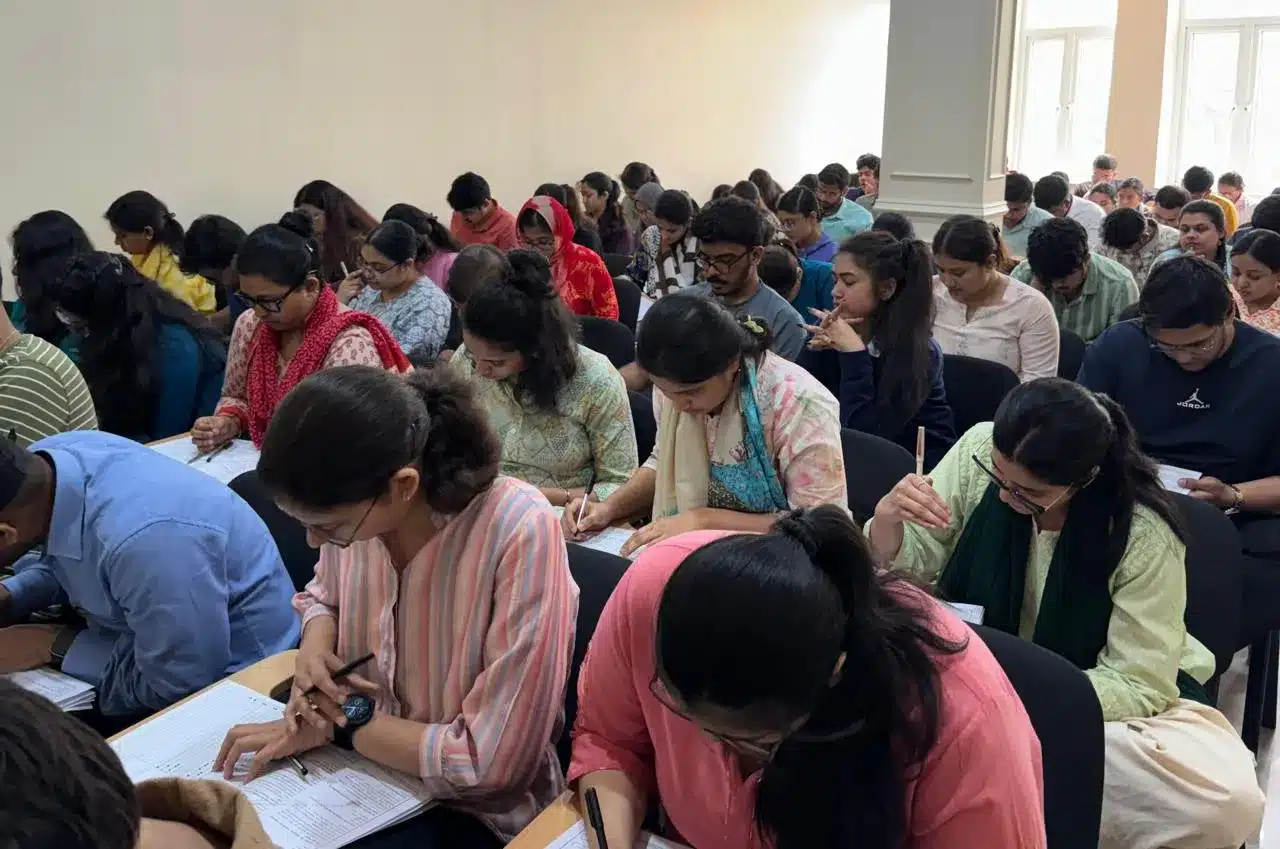
Most aspirants who fail in UPSC CSE attempt mock test either in online format or in informal environment. To succeed in UPSC it is important to negate the fear of examination. Sit in proper UPSC like stimulated environment with proper exam pattern to transition from UPSC aspirant to UPSC TOPPER. UPSC CSE 2025 Topper Talk: AIR 153, SAHARS KUMAR, UPSC CSE 2024 Listen to what UPSC Topper has to say:EDUCRAT IAS UPSC Test Series:
Aanklan (आकलन) Prelims Test Series
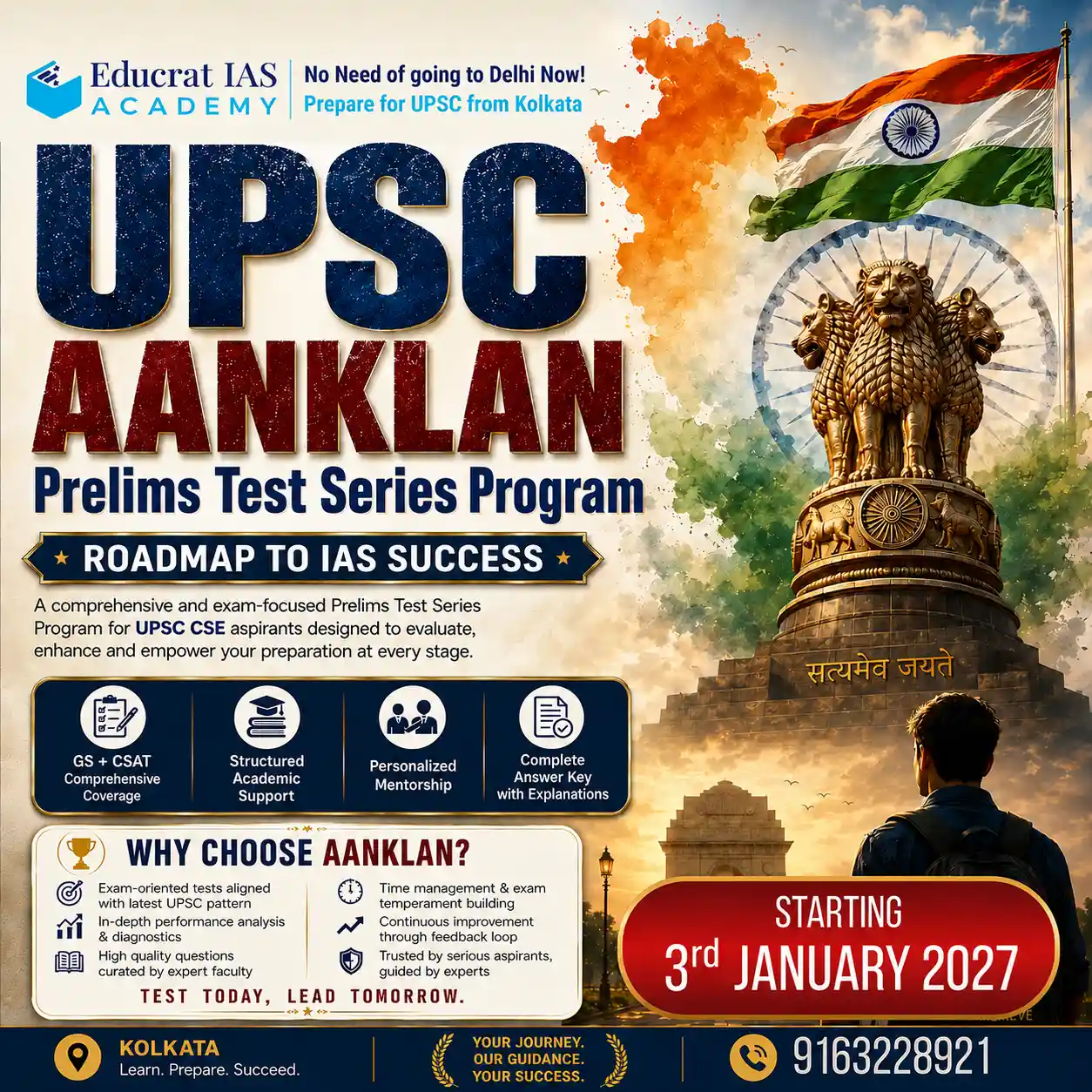
Our UPSC Prelims Test Series aims to cover the UPSC PYQs and emerging trends of UPSC Prelims MCQs, enabling the aspirants to prepare well in advance with the tricks and methods to solve UPSC level of MCQs.
The tests are conducted in UPSC like environment with strict invigilation. Detailed explanation, Answer Key, All India Ranking is provided to help students track their progress. These are all included in our UPSC Prelims Test Series Aanklan 2026.
- Compete with 200+ Aspirants from Eastern India in a UPSC-like simulated environment with a detailed answer key for each test.
- Comprehensive syllabus coverage for GS & CSAT: Covering all subjects and Current Affairs.
Manthan (मंथन) Mains Test Series
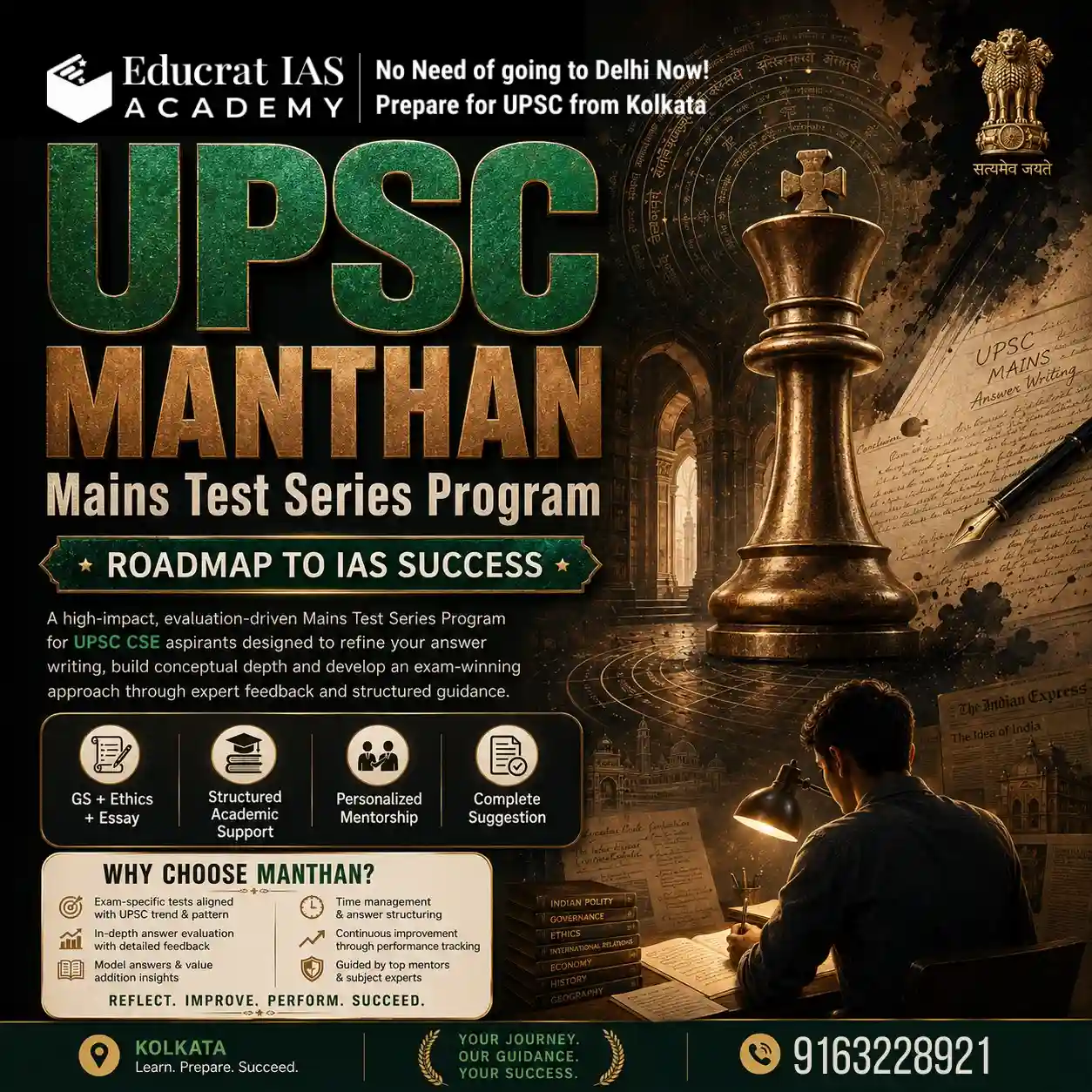
To ensure thorough preparation, our UPSC Mains Test Series Manthan covers UPSC Mock Tests on Essay, GS I, GS II, GS III, and GS IV papers. Practicing multiple UPSC Mains mocks is crucial for developing the art of UPSC Mains Answer Writing, Learning how to address demand of the Questions, effective time management etc.
At Educrat IAS, we take pride in our track record—over 5 essay topics from our test series appeared in UPSC 2024, and 30+ topics from our tests were reflected in the actual UPSC Mains paper.
Detailed Two Layered Evaluation & Feedback, Personalised SWOT Analysis, Mentorship on how to improve the weak areas, Model Answers will be a part of the UPSC Mains Test Series Manthan Program.
- Comprehensive Coverage: Includes GS I, GS II, GS III, GS IV, and Essay papers, covering the entire syllabus.
- UPSC-like stimulated environment and Expert personalized evaluations with doubt-clearing sessions.
Comprehensive test series to evaluate your preparation
Prepare. Perform. Succeed.
7. Psychological Burnout & Isolation
The UPSC journey is a marathon. 95% of candidates fail because they lose momentum after the first six months. Isolation and the lack of a competitive environment lead to stagnation. Stress due to vast syllabus, anxiety from mock test scores and fear of failure are the most common reasons.
Normalize It: Stress is Natural
It is important to understand that stress at any stage of UPSC CSE is normal. Almost every serious aspirant feels this pressure. A moderate level of stress actually improves performance. This is why proper UPSC exam stress management is important- not stress elimination.
How to manage stress in UPSC CSE?
- Focus on Minimum Resources, Multiple Revisions
- Smart Mock Test Strategy
- Routine Preparation: Daily targets
- Study in calm environment not isolated
- Stop comparison
- Focus on controllable factors
UPSC Preparation- Checklist
- Revise daily
Daily revision ensures you don’t forget what you’ve studied. It strengthens memory and improves recall speed.
- Practice mock tests
Mocks help you apply knowledge and prepare for real exam conditions.
- Sleep well
Proper rest keeps your mind fresh and improves performance.
- Stay consistent
Consistency matters more than studying for long hours occasionally.
Don’t Just Be an “Aspirant,” Be a “Candidate”
The difference between the 95% who fail in UPSC and the 5% who succeed in UPSC is consistency and correction. Are you ready to move into the top 5%? Visit Educrat IAS Academy in Kolkata. From cinematic classroom experiences to the most rigorous test series in West Bengal, we provide the ecosystem you need to stop dreaming and start achieving.