Rupee: More Than a Price Indicator, A Measure of Economic Credibility
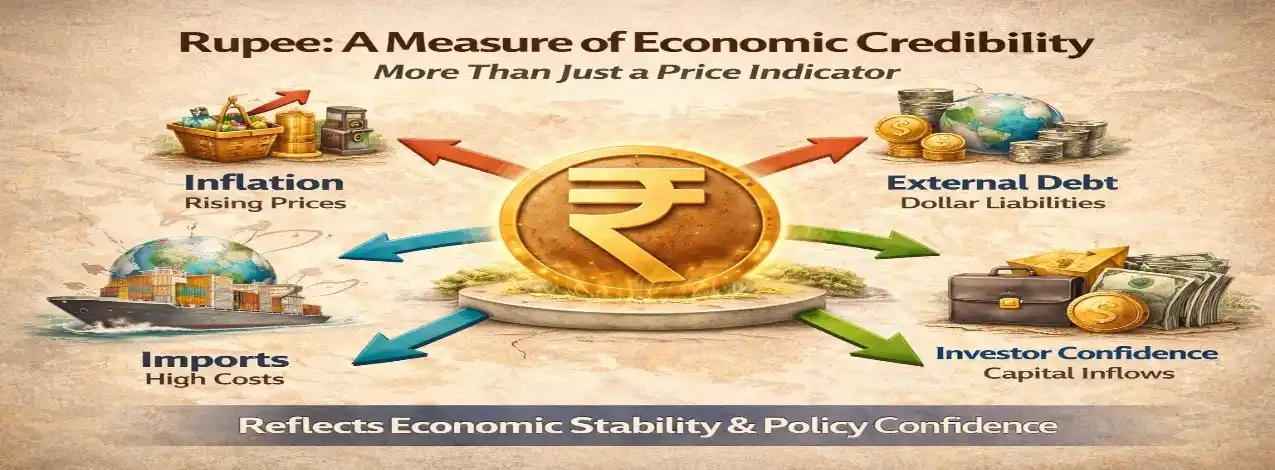
The value of the Indian Rupee is not just about exchange rate movements. It reflects economic stability, investor confidence, and policy credibility. Currency depreciation may provide short-term benefits but has long-term economic risks. Thus, the rupee acts as a barometer of credibility of the economy.
Concept: Exchange Rate and Depreciation
- Exchange rate refers to the value of one currency in terms of another.
- Depreciation means decline in value of domestic currency against foreign currencies.
- Some economists argue weaker currency boosts exports and competitiveness.
- However, excessive depreciation leads to inflation and economic instability.
Theoretical Perspective
- The Mundell-Fleming Model (open economy macro model) explains currency dynamics.
- It highlights the “impossible trinity”:
– Free capital movement
– Fixed exchange rate
– Independent monetary policy - Countries cannot achieve all three simultaneously, leading to policy trade-offs.
Why Currency Depreciation is Problematic
- Imports become expensive, increasing inflation (especially fuel and raw materials).
- External debt burden rises as liabilities are often denominated in dollars.
- It reduces purchasing power of citizens.
- It weakens investor confidence and capital inflows.
India’s Experience with Currency Volatility
- India faced major shocks during:
– Global Financial Crisis (2008–09)
– Taper Tantrum (2013) - During these periods, rupee depreciation led to capital outflows and macroeconomic instability.
- The Reserve Bank of India (RBI) intervened through monetary and liquidity measures.
Policy Measures Taken by India
- RBI raised interest rates and tightened liquidity to stabilise currency.
- Special windows for foreign currency deposits (e.g., FCNR deposits) were introduced.
- Government reduced fiscal deficit from 5 percent to about 4.8 percent of GDP.
- Measures included subsidy rationalisation, diesel deregulation, and inflation targeting.
Recent Currency Trends and Challenges
- Rupee depreciated by around 20 percent in recent global shocks.
- Global factors include:
– US Federal Reserve tightening
– Geopolitical tensions
– Supply chain disruptions - Capital flows have been volatile, with Foreign Direct Investment (FDI) and portfolio flows fluctuating.
Impact on Economy
- Inflation increases due to rising import costs, especially energy.
- Growth slows as cost of production rises for industries.
- Current Account Deficit (CAD) becomes harder to manage.
- Financial markets face uncertainty due to capital flow volatility.
Why Rupee Reflects Credibility
- A stable currency signals strong macroeconomic fundamentals.
- It reflects confidence in fiscal discipline and monetary policy.
- Investors prefer economies with predictable and stable currency regimes.
- Currency instability indicates policy weaknesses and economic vulnerabilities.
Key Structural Issues
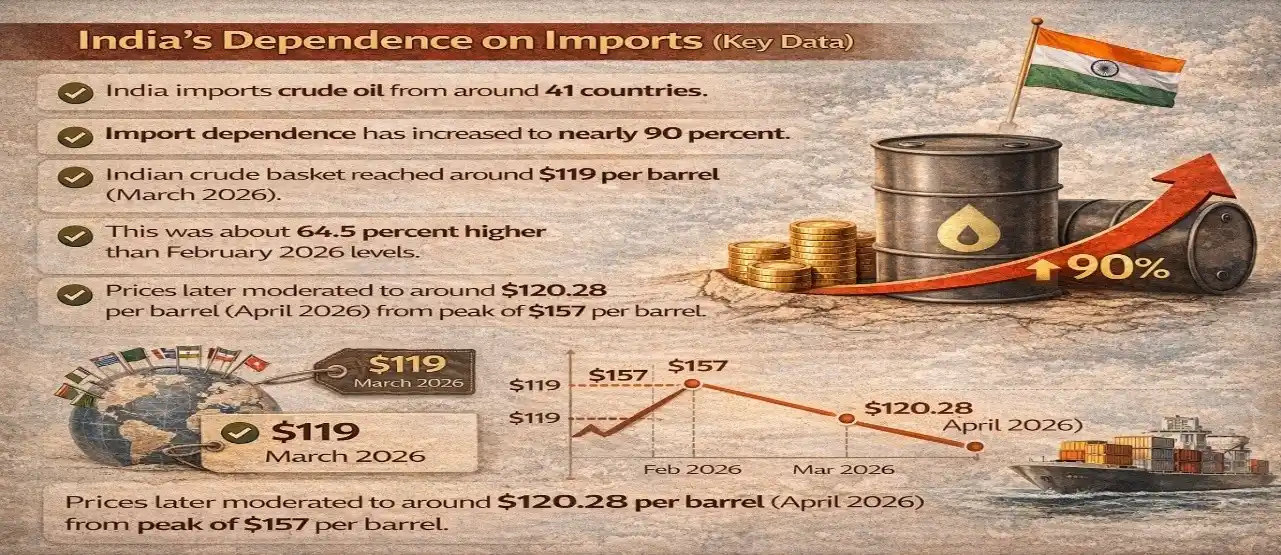
- Dependence on imports, especially crude oil, increases vulnerability.
- Limited export diversification reduces resilience.
- External shocks quickly transmit into domestic economy.
- Financial markets remain sensitive to global capital flows.
Way Forward
- Maintain fiscal discipline and control inflation through prudent policies.
- Strengthen export competitiveness and diversify export basket.
- Build adequate foreign exchange reserves for external stability.
- Encourage long-term capital inflows like FDI instead of volatile portfolio flows.
- Improve ease of doing business to attract sustained investments.
The rupee is not merely an exchange rate indicator but a reflection of economic strength. Currency depreciation may offer short-term relief but creates long-term structural risks. Stability of the rupee is essential for growth, investment, and macroeconomic balance. Ultimately, maintaining rupee stability requires credible and consistent economic policies.
Fallout of West Asia Crisis on India’s Economy
The ongoing crisis in West Asia (Middle East) has major implications for India’s economy. Disruptions in energy supply chains, logistics, and trade routes affect domestic stability. India, being heavily dependent on imports, is particularly vulnerable. The crisis impacts inflation, growth, fiscal balance, and external sector stability.
Background: Nature of the Crisis
- Conflicts have disrupted production, storage, and transport of crude oil, gas, and fertilizers.
- The Strait of Hormuz (critical oil transit route) has faced disruptions.
- This affects global supply chains, raising uncertainty and price volatility.
- Temporary ceasefires have reduced prices slightly, but uncertainty persists.
Transmission Channels: How Crisis Impacts India
Supply Disruptions
- Energy-intensive sectors like transport, fertilizers, textiles, and chemicals are affected.
- Fertilizer shortages impact agricultural output, especially Kharif season.
Logistics and Cost Push
- Storage and transport costs increase due to disruptions in global shipping routes.
- This leads to higher prices of final goods across sectors.
Trade Impact
- West Asia accounts for about 4 percent of India’s exports (2024–25).
- Economic slowdown in the region reduces export demand for Indian goods.
Exchange Rate Pressure
- Higher import bills increase demand for dollars, causing rupee depreciation.
- Remittances from Indian workers in Gulf countries may decline.
Macroeconomic Impact
Inflation
- Rising oil prices increase fuel, transport, and production costs.
- Leads to overall cost-push inflation in the economy.
Growth
- Real GDP growth may decline due to higher costs and reduced demand.
- Estimates suggest GDP growth may fall by around 15 basis points.
External Sector
- Current Account Deficit (CAD) widens due to higher import bills.
- Capital outflows increase due to global uncertainty.
Fiscal Impact
- Government may increase subsidies for oil and fertilizers.
- Loss of revenue due to reduction in excise duties on petroleum products.
- Fiscal deficit may increase, affecting macroeconomic stability.
Additional Economic Effects
- Inflation may rise by around 30 basis points due to fuel price transmission.
- Profit margins of firms decline due to higher input costs.
- State finances are affected due to lower tax devolution from Centre.
- Reduced consumption demand due to higher fuel and commodity prices.
Policy Responses
- Reduction in excise duties on petrol and diesel to control inflation.
- Increase in fertilizer and fuel subsidies to protect farmers and consumers.
- RBI may intervene through monetary policy measures to stabilise inflation and currency.
- Measures to attract FDI and maintain foreign exchange reserves.
Structural Concerns
- High dependence on imported energy exposes India to external shocks.
- Lack of diversification in energy sources increases vulnerability.
- Supply chain fragility due to global geopolitical tensions.
- Over-reliance on fossil fuels affects long-term sustainability.
Way Forward
- Diversify energy imports and promote renewable energy sources.
- Strengthen strategic petroleum reserves to manage supply shocks.
- Improve domestic production of fertilizers and alternative energy.
- Enhance export competitiveness to offset external demand shocks.
- Maintain fiscal discipline while providing targeted subsidies.
The West Asia crisis highlights India’s vulnerability to global energy and geopolitical shocks. It impacts multiple sectors through inflation, trade, and fiscal channels. A balanced approach combining short-term policy response and long-term structural reforms is essential. Strengthening resilience will be key to sustaining economic stability and growth.
PRELIMS BOOSTERS
Vitamin D (Calciferol)
Context:
- Study links vitamin D levels in early adulthood with brain health in later life
About
- Vitamin D is a fat-soluble vitamin. It is also called calciferol.
- It is produced in the body when sunlight (UV rays) hits the skin
- Also obtained from: Dietary sources & Fortified foods and supplements
Sources
- Natural sources: Egg yolk, Fish (like salmon, tuna), Liver
- Fortified foods: Milk, Cereals, Yogurt
- Stored in body fat and used when sunlight is limited
Functions
- Helps in absorption of calcium and phosphorus
- Essential for healthy bones and teeth
- Supports: Immune system, Muscle function and Cell growth and metabolism
Deficiency
- In children: Rickets (soft and weak bones)
- In adults: Osteomalacia (bone pain and muscle weakness)
- More common in: People with low sunlight exposure and Individuals with darker skin
Excess (Toxicity)
- High levels may cause: Nausea, vomiting; Kidney stones; Muscle weakness
- Severe cases may lead to: Kidney failure; Irregular heartbeat
Significance
- Crucial for bone health and immunity
- Emerging role in brain health and ageing
Lanjia Saora Community
Context:
- Community in news for preserving traditional tattoos and ornaments
About
- Lanjia Saora is a tribal community of Odisha. It belongs to the Saora (Soura) tribal group
- Recognised as a Particularly Vulnerable Tribal Group (PVTG)
Habitat
- Found mainly in Rayagada and Gajapati districts of Odisha
- Live in hilly and forested regions of Eastern Ghats
- Settlements are remote with mud and thatch houses
Livelihood
- Practice shifting cultivation (Podu farming)
- Depend on forest produce and small-scale agriculture
Culture and Beliefs
- Deeply connected with nature and forest spirits
- Perform rituals for ancestors and natural forces
- Mentioned in ancient texts like Ramayana and Mahabharata
Unique Features
- Traditional Ornaments: Large metal earrings in stretched earlobes
- Tattoos: Geometric and nature-based designs and believed to provide spiritual protection
- Art (Idital Paintings): Wall paintings using red ochre and rice paste and used for communication with spirit world
- Music and Dance: Integral to life events and rituals
- Social Structure: Egalitarian society with collective decision-making
Significance
- Represents ancient indigenous traditions of India
- Shows sustainable living with nature
- Saora art has global recognition
Exercise Dustlik (7th Edition)
Context:
- Indian Army contingent participated in the 7th edition of Exercise Dustlik
About
- Exercise Dustlik is a joint military exercise between India and Uzbekistan
- Conducted annually, alternately in India and Uzbekistan
Participants
- Indian contingent includes: MAHAR Regiment (Indian Army) & Personnel from Indian Air Force
- Conducted with Uzbekistan Armed Forces
Objective
- To enhance military cooperation and interoperability
- To improve joint operational capabilities
- To develop coordination in command and control systems
Key Features
- Training in semi-mountainous terrain
- Focus on: Land navigation, Strike operations on enemy bases & Capture of enemy-held areas
- Emphasis on:
- Joint planning and execution
- Tactics, Techniques and Procedures (TTPs)
Significance
- Strengthens India–Uzbekistan defence relations
- Improves joint combat readiness
- Enhances operational coordination and synergy
Judge Recusal
Context:
- Issue raised regarding recusal of a High Court judge in a case
About
- Judge recusal is the process where a judge withdraws from hearing a case
- It is done when there is a conflict of interest or likelihood of bias
- It ensures fairness, transparency, and impartial justice
- It is based on the doctrine that a judge appointed to hear a case may step down if required
Principles Behind Recusal
- It is based on natural justice principle: “Nemo judex in sua causa” (no one should be a judge in their own case)
- It also follows the principle: “Justice must not only be done but must also be seen to be done”
Grounds for Recusal
- It arises when there is a conflict of interest
- It includes situations like: Financial interest (e.g., holding shares in a company involved); Personal or prior association with a party and Previous involvement in the case as a lawyer or judge
- It also applies when: A judge hears an appeal of a case decided earlier by the same judge in a lower court
Process
- A judge may recuse voluntarily, based on conscience and discretion
- A party may request recusal, but the final decision rests with the judge
- There are no formal codified rules, though guided by judicial precedents
- Judges may or may not record reasons for recusal
Judicial Principles (Case Laws)
- In Ranjit Thakur v Union of India: It was held that bias must be judged from the perspective of the affected party
- In Supreme Court Advocates-on-Record Association v Union of India: It was held that pecuniary (financial) interest automatically disqualifies a judge
Can a Judge Refuse Recusal?
- A judge can refuse to recuse
- The decision always rests with the judge
- Courts have seen instances where judges declined recusal requests
Concerns
- Threat to judicial independence: Recusal requests may be used for forum shopping (choosing favourable judges)
- Delay in justice: Recusal may slow down court proceedings
- No uniform rules: Leads to inconsistency in decisions
Significance
- It ensures fair trial and impartial justice
- It maintains public confidence in judiciary
- It balances judicial ethics with independence
South Atlantic Anomaly (SAA)
Context:
- The South Atlantic Anomaly is splitting into two zones, increasing risks for satellites
About
- The South Atlantic Anomaly (SAA) is a region where Earth’s magnetic field is weaker
- It is often called the “Bermuda Triangle of Space”
- It allows charged particles and cosmic radiation to come closer to Earth
Location
- It lies between: Southeast of South America and Southwest of Africa
- Approximate extent: 5°–40° South latitude and 0°–80° West longitude
Why It Occurs
- Earth’s magnetic field acts as a protective shield against solar radiation
- In this region, the field is weaker and dips closer to Earth
- It happens because:
- The inner Van Allen radiation belt comes closer to Earth’s surface
- This increases the flow of high-energy charged particles
Van Allen Radiation Belts
- These are zones of charged particles trapped by Earth’s magnetic field
- Discovered by James Van Allen (1958)
- Two main belts:
- Inner belt: Formed by cosmic rays interacting with atmosphere
- Outer belt: Contains high-energy particles from the Sun
- They act as: Protective shield. But also a hazard for satellites and space missions
Impacts of SAA
- It can damage satellite electronics
- It causes data errors and signal disruptions
- It affects: Spacecraft systems & Navigation systems of aircraft and ships
Recent Development
- The SAA is splitting into two zones
- This increases complexity and risk for satellites in low Earth orbit
Significance
- Important for space missions and satellite safety
- Helps understand Earth’s magnetic field behavior
- Critical for navigation and communication systems