Governor’s Role in Government Formation and the Need for Constitutional Neutrality
Constitutional Position of the Governor
Article 164(1)
- Article 164(1) states that the Chief Minister is appointed by the Governor, while other ministers are appointed on the advice of the Chief Minister.
- Normally, the Governor acts on the aid and advice of the Council of Ministers.
- However, in situations where no party has a majority, the Governor exercises discretionary powers to identify who should form the government.
Role of the Governor in a Hung Assembly
- A hung Assembly arises when no single political party obtains an absolute majority.
- In such situations, the Governor must determine which leader is most likely to command majority support in the Assembly.
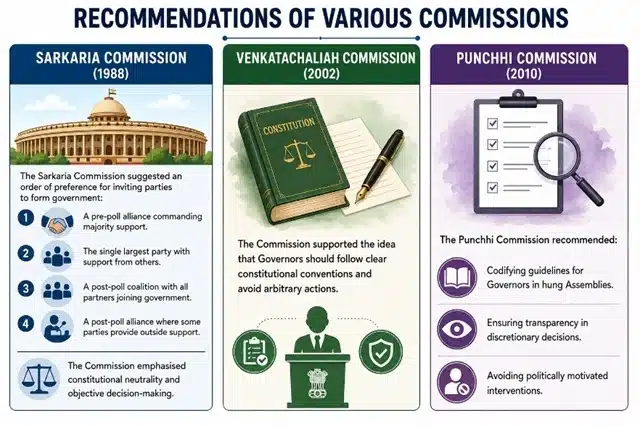
- The Governor may:
- Invite the single largest party.
- Invite a pre-poll alliance with majority support.
- Invite a post-poll coalition that demonstrates stable majority backing.
- Ask the claimant to prove majority through a floor test.
- The ultimate objective should be ensuring a stable government that enjoys legislative confidence.
Importance of Floor Test
The Supreme Court has repeatedly held that the proper place to determine majority support is the floor of the Legislative Assembly.
S.R. Bommai Case (1994) The Court ruled that majority must be tested on the floor of the House and not decided subjectively by the Governor. | Rameshwar Prasad Case (2006) The Court reaffirmed that democratic legitimacy flows from legislative majority. | Nabam Rebia Case (2016) The Court stressed that constitutional authorities must function within constitutional limits and conventions. |
Major Concerns Regarding Governors’ Conduct
a) Partisanship
- Governors are often accused of favouring the ruling party at the Centre.
- Decisions regarding invitations to form government sometimes appear politically motivated.
b) Ignoring Constitutional Conventions
- In several cases, Governors ignored established conventions regarding the order of preference.
- Invitations have sometimes been given to parties lacking immediate majority support.
c) Delays and Procedural Manipulation
- Delays in convening the Assembly may enable political defections or manipulation.
- Excessively short deadlines may also unfairly disadvantage rival claimants.
d) Weakening Federalism
- Misuse of gubernatorial discretion creates tension between States and the Union government.
- It weakens the federal spirit of the Constitution.
Recent Political Controversies
Several States such as Karnataka, Maharashtra, Goa, Manipur, and Tamil Nadu witnessed controversies over the Governor’s role in government formation.
The common issues included:
- Selection of preferred political parties.
- Delay in conducting floor tests.
- Questions regarding neutrality of the Governor’s office.
These incidents intensified debate regarding constitutional morality and democratic ethics.
Constitutional Morality and Democratic Conventions
The Governor is expected to act as:
- A neutral constitutional head.
- A protector of democratic processes.
- A facilitator of stable governance.
The office was never intended to function as a political instrument.
Constitutional morality requires:
- Respect for electoral mandates.
- Transparency in decision-making.
- Non-partisan conduct.
- Adherence to judicial principles and conventions.
Why Judicial Intervention Has Increased
Frequent political disputes have compelled courts to intervene repeatedly in matters related to:
- Floor tests, Government formation, Legislative majorities & Defections and resignations.
This indicates growing institutional distrust in the impartial exercise of gubernatorial powers.
Need for Reforms
a) Codification of Guidelines
Clear constitutional or statutory rules should govern the Governor’s actions in hung Assemblies.
b) Time-Bound Floor Tests
Floor tests should be conducted quickly to prevent political manipulation.
c) Neutral Appointment Process
Debate continues regarding reforms in the appointment and removal of Governors to improve impartiality.
d) Strengthening Constitutional Conventions
Political actors must respect democratic norms rather than exploit procedural loopholes.
Broader Significance for Indian Democracy
The issue is not merely procedural but deeply connected to:
- Federalism.
- Democratic legitimacy.
- Separation of powers.
- Constitutional governance.
If constitutional offices lose neutrality, public trust in democratic institutions weakens significantly.
The Governor’s discretionary role in government formation is meant to preserve constitutional stability, not political advantage. The repeated controversies in hung Assemblies highlight the urgent need for greater constitutional clarity, institutional neutrality, and adherence to democratic conventions. Strengthening the credibility of the Governor’s office is essential for protecting federalism, parliamentary democracy, and the spirit of the Constitution.
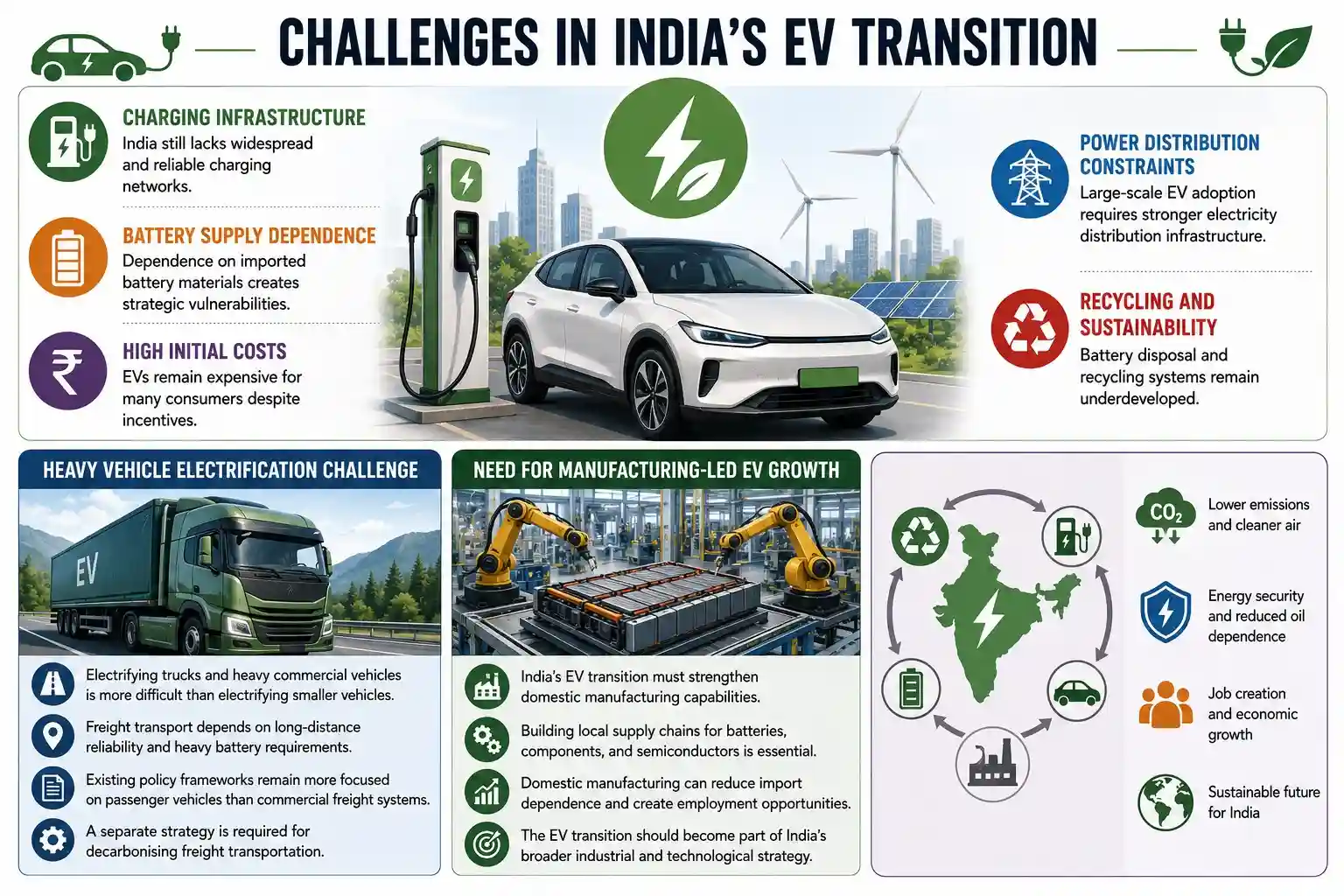
India’s EV Transition Must Move Beyond Subsidies
India’s EV Journey So Far
- India’s EV sector has expanded rapidly over the last few years, especially in two-wheelers and three-wheelers.
- Government subsidies helped reduce initial purchase costs and encouraged adoption.
- Policies such as FAME (Faster Adoption and Manufacturing of Electric Vehicles) created early market momentum.
- State-level EV policies also supported charging infrastructure and manufacturing ecosystems.
Role of Subsidies in EV Expansion
- Subsidies were important during the early stages of EV adoption because EV technology was expensive and market confidence was low.
- Incentives encouraged manufacturers to invest in production and supply chains.
- Consumers benefited from reduced upfront vehicle costs.
- Subsidies helped create economies of scale and improve industry confidence.
Why Subsidy-Driven Growth Has Limits
- Fiscal Burden
- Long-term subsidies place pressure on government finances.
- Market Distortion
- Excessive dependence on incentives may prevent genuine market competitiveness.
- Delayed Technological Efficiency
- Manufacturers may rely more on subsidies than innovation and efficiency improvements.
- Uneven Adoption
- Subsidies alone cannot solve issues such as charging infrastructure, battery supply chains, or consumer confidence.
Shift Toward Structural Transformation
- India is increasingly moving toward regulation-based EV adoption rather than purely subsidy-driven expansion.
- Policies are beginning to focus on:
- Fuel efficiency norms, Emission standards, Manufacturing capability, Electrification targets and Clean mobility ecosystems
- This reflects a transition from short-term market creation to long-term industrial strategy.
Importance of Delhi’s EV Policy Approach
- Delhi’s evolving EV policy reflects a more comprehensive approach to clean mobility.
- The policy attempts to combine incentives with clear timelines for reducing dependence on internal combustion engine vehicles.
- It signals greater policy certainty and long-term direction for manufacturers and consumers.
- Such approaches encourage industries to prepare for structural transition rather than temporary subsidy benefits.
Need for Strong Regulatory Framework
CAFE Norms
- Corporate Average Fuel Efficiency (CAFE) norms are becoming an important regulatory tool for improving vehicle efficiency and reducing emissions.
- Stronger fuel-efficiency standards push manufacturers toward cleaner technologies.
- Regulatory pressure can often drive innovation more effectively than subsidies alone.
Importance of Policy Stability
- EV manufacturers require long-term policy certainty for investment decisions.
- Frequent policy reversals or inconsistent subsidy structures create uncertainty.
- Stable regulations encourage private investment in infrastructure, manufacturing, and innovation.
Environmental Significance
- Transport is a major source of urban pollution and carbon emissions.
- EV adoption can help improve urban air quality and reduce fossil fuel dependence.
- However, environmental benefits depend on cleaner electricity generation and sustainable battery systems.
Economic and Strategic Importance
- EVs are not only an environmental issue but also an economic and strategic opportunity.
- India can emerge as a major clean mobility manufacturing hub if policies remain consistent and innovation-driven.
- Reducing oil import dependence can strengthen energy security and reduce external vulnerabilities.
Way Forward
- Strengthen Charging Networks
- Expand reliable public charging infrastructure across urban and rural regions.
- Build Domestic Battery Ecosystem
- Encourage local battery manufacturing, recycling, and mineral security partnerships.
- Improve Regulatory Standards
- Gradually tighten fuel-efficiency and emission norms.
- Focus on Public Transport Electrification
- Electrify buses, shared mobility, and urban transport systems.
- Support Research and Innovation
- Invest in battery technology, hydrogen mobility, and energy storage systems.
Prelims Boosters
International Organisation for Standardisation (ISO)
Context:
The Bureau of Indian Standards organized the 35th Plenary and Working Groups meetings of ISO TC 20 / SC 14 on Space Systems and Operations in New Delhi.
About ISO
- The International Organisation for Standardisation (ISO) is an independent and non-governmental international organisation.
- It develops and publishes voluntary international standards.
- ISO is a global network of national standards bodies, with one member representing each country.
- In India, the Bureau of Indian Standards (BIS) represents ISO.
Establishment and Headquarters
- ISO was established on 23 February 1947.
- Its headquarters is located in Geneva, Switzerland.
Objective
- ISO aims to promote international coordination and standardisation across industries and services.
- It helps ensure quality, safety, efficiency, and interoperability of products and systems.
Key Functions
Development of Standards
Promoting Interoperability
|
Ensuring Quality and Safety
Facilitating International Trade
|
About ISO TC 20 / SC 14
- ISO TC 20 / SC 14 is a subcommittee related to Space Systems and Operations.
- It develops standards covering the design, launch, operation, and safety of space systems.
- The recent meeting in New Delhi focused on space sustainability, debris mitigation, and mission safety.
Significance
- ISO standards improve global trade, industrial efficiency, and consumer confidence.
- Space-related standards help ensure safe and sustainable use of outer space.
Teesta River
Context:
Recently, Bangladesh sought China’s involvement and support for the Teesta restoration project.
About Teesta River
- The Teesta River is a major tributary of the Brahmaputra River.
- In Bangladesh, the Brahmaputra River is known as the Jamuna River.
- The river flows through both India and Bangladesh.
Origin
- The Teesta River originates from Tso Lhamo Lake in North Sikkim at an elevation of about 5,280 metres.
- It is a glacier-fed river.
- Major glacial sources include the Pauhunri Glacier, Khangse Glacier, and Chho Lhamo Lake.
Course
- The river flows through Sikkim and passes through deep gorges in the Siwalik Hills near Darjeeling in West Bengal.
- It then flows through the Sivok Khola pass and enters the plains of West Bengal.
- After entering Bangladesh, it joins the Brahmaputra River.
Tributaries
Left Bank Tributaries
| Right Bank Tributary
|
Basin Distribution
- About 83 percent of the Teesta basin lies in India.
- Around 17 percent lies in Bangladesh.
Somnath Temple
Context:
The Prime Minister is set to visit Somnath Temple in Gujarat to mark the 75th anniversary of the temple’s inauguration in 1951 by President Rajendra Prasad.
About Somnath Temple
- Somnath Temple is a famous Hindu temple dedicated to Lord Shiva.
- It is located at Prabhas Patan near Veraval in the Saurashtra region of Gujarat.
- It is considered the first among the 12 Jyotirlingas of Lord Shiva in India.
Historical Importance
- The Somnath site has been an important pilgrimage centre since ancient times.
- It is located near the Triveni Sangam of the Kapila, Hiran, and Saraswati rivers.
- The temple is believed to have ancient origins dating back to at least 649 BC.
Invasions and Reconstruction
- The temple faced repeated invasions, including the famous attack by Mahmud of Ghazni in the 11th century.
- It was rebuilt several times by rulers such as the Chalukyas, Paramaras, and Marathas.
- The present temple was reconstructed after independence under the leadership of Sardar Vallabhbhai Patel.
- The reconstruction was completed in May 1951.
Architecture
- The temple is built in the Chalukya style of Hindu temple architecture.
- It has intricate carvings and a seven-storied structure.
- The temple rises to a height of about 155 feet.
- A massive Kalash is placed on top of the Shikhara.
Unique Feature
- The temple is positioned in such a way that there is no landmass visible in a straight line between the Somnath coast and Antarctica.
Significance
- Somnath Temple is one of the most sacred pilgrimage sites for Hindus.
- It symbolizes cultural resilience and the revival of India’s civilizational heritage after independence.
Grievance Redressal Assessment and Index (GRAI)
Context:
According to the Department of Administrative Reforms and Public Grievances, the Insurance Division of the Department of Financial Services topped the GRAI rankings for March 2026 in Group A category.
About GRAI
- Grievance Redressal Assessment and Index (GRAI) is developed by the Department of Administrative Reforms and Public Grievances (DARPG).
- The first edition of GRAI 2022 was released on 21 June 2023.
Objective
- GRAI evaluates ministries and departments on the effectiveness and timeliness of grievance redressal.
- The assessment is carried out through the Centralized Public Grievance Redress and Monitoring System (CPGRAMS).
Assessment Parameters
- GRAI is based on 4 major dimensions and 11 indicators.
- The dimensions include efficiency, feedback, domain, and organisational commitment.
About CPGRAMS
- CPGRAMS is an online platform through which citizens can lodge grievances related to public service delivery.
- It is available 24×7 for citizens.
- The platform is monitored and maintained by DARPG under the Ministry of Personnel, Public Grievances and Pensions.
Key Features of CPGRAMS
- It is connected to all ministries, departments, and states.
- Citizens can track complaints using a unique registration ID.
- Grievances are expected to be resolved within a maximum period of 21 days.
Significance
- GRAI improves accountability and transparency in public administration.
- It encourages ministries and departments to strengthen citizen-centric governance and timely grievance resolution.
Maharana Pratap
Context:
The Prime Minister paid floral tributes to Maharana Pratap on his birth anniversary.
About Maharana Pratap
- Maharana Pratap was the 54th ruler of the Kingdom of Mewar in present-day Rajasthan.
- He belonged to the Sisodia Rajput clan.
- He is remembered for his resistance against Mughal Emperor Akbar and his commitment to protecting the independence of Mewar.
Early Life
- Maharana Pratap was born on 18 May 1540 to Rana Udai Singh II and Jaiwanta Bai.
- After the death of his father in 1572, he became the ruler of Mewar at Gogunda.
Conflict with the Mughals
- Akbar sent several diplomatic missions to bring Mewar under Mughal control.
- Maharana Pratap refused to accept Mughal suzerainty or enter matrimonial alliances with the Mughals.
Battle of Haldighati
- The Battle of Haldighati was fought in 1576 between Maharana Pratap and the Mughal forces led by Raja Man Singh.
- Maharana Pratap’s army included Rajput warriors and Bhil archers.
- Although he was forced to retreat, the Mughal forces failed to capture him.
Guerrilla Warfare
- Maharana Pratap effectively used guerrilla warfare tactics in the Aravalli hills against the larger Mughal army.
- His military strategies later inspired leaders such as Chhatrapati Shivaji Maharaj.
Reconquest of Mewar
- Between 1585 and 1597, Maharana Pratap recaptured large parts of Mewar, including Udaipur and Gogunda.
- However, Chittorgarh remained under Mughal control.
Patronage of Art and Culture
- He promoted the Chavand school of art and supported poets and scholars at his capital, Chavand.
Death
- Maharana Pratap died in 1597 due to injuries suffered during a hunting accident.