Hate Speech and the Challenge Before Indian Constitutional Democracy
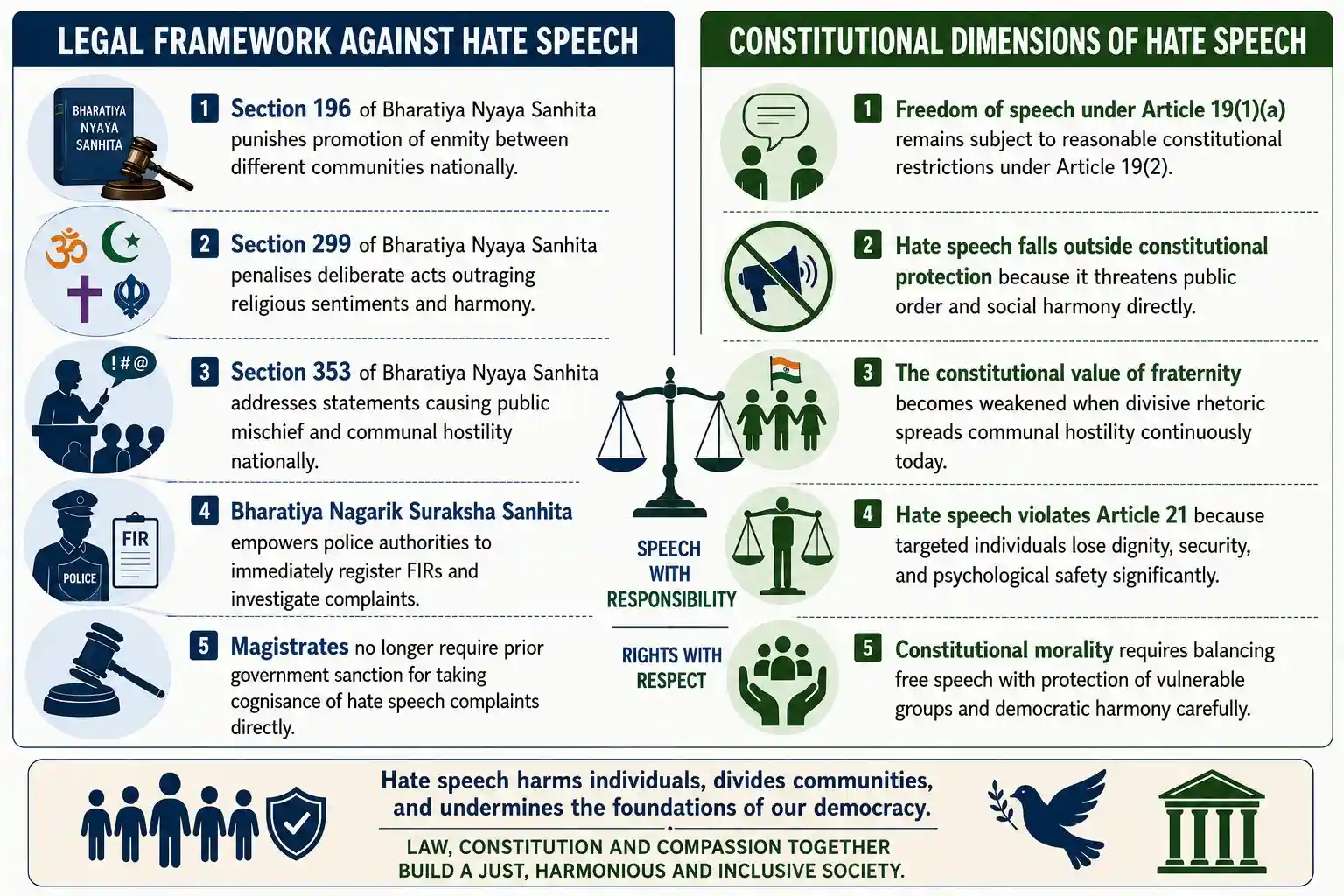
Failure of Implementation and Enforcement
- The Supreme Court highlighted that implementation failure, not legal deficiency, remains the core challenge today.
- Police authorities often hesitate to act against politically influential individuals accused of hate speech nationally.
- Despite judicial directives, many states have failed to register suo motu FIRs consistently against offenders.
- Weak investigations and poor evidence collection frequently result in low conviction rates across India today.
- Executive authorities were reminded that public figures carry greater responsibility while addressing sensitive societal issues.
Challenges in Defining and Regulating Hate Speech
- India still lacks a single clear legal definition explaining the precise scope of hate speech.
- Ambiguity often allows selective enforcement, misuse against dissenters, or inaction against influential individuals nationally.
- Context plays an important role because identical statements may carry different meanings across situations nationally.
- Courts frequently struggle distinguishing legitimate criticism from speech that intentionally incites communal hatred and violence.
- Social media platforms rapidly amplify hate speech beyond the immediate control of law enforcement agencies.
Judiciary, Separation of Powers, and Institutional Limits
- The Supreme Court emphasized that law-making primarily remains the constitutional responsibility of Parliament today nationally.
- Judicial restraint prevents courts from creating entirely new statutory frameworks beyond existing legislative provisions nationally.
- Critics argue that judicial observations alone cannot effectively reduce hate speech without executive accountability mechanisms.
- Repeated court directions have produced limited results because enforcement agencies remain institutionally and politically constrained.
- Effective governance requires coordination between judiciary, legislature, police institutions, and administrative authorities consistently today.
Social and Democratic Impact of Hate Speech
- Hate speech gradually normalises prejudice, intolerance, and hostility against vulnerable social and religious communities nationally.
- Persistent divisive rhetoric weakens democratic debate and encourages emotional polarization within society significantly today.
- Communal mistrust generated through hate speech damages national unity and constitutional secularism deeply over time.
- Online radicalisation increasingly transforms digital platforms into spaces spreading intolerance and social fragmentation nationally today.
- Democratic societies require respectful disagreement rather than dehumanising language targeting identities and communities continuously today.
Measures Needed for Effective Enforcement
- Police reforms must reduce political interference in investigations involving influential public personalities and organisations nationally.
- Specialized cyber and social media monitoring units should handle digital hate speech cases professionally nationwide.
- Fast-track courts should ensure quicker trials and stronger deterrence against repeated hate speech offences nationally today.
- Senior administrative officers must face accountability when blatant hate speech complaints remain deliberately ignored consistently.
- Digital literacy programmes should educate citizens against misinformation, propaganda, and communal online mobilisation effectively today.
- Civil society initiatives promoting inter-faith dialogue can strengthen social resilience against divisive political rhetoric nationally.
Balancing Human Safety and Animal Rights in India’s Stray Dog Debate
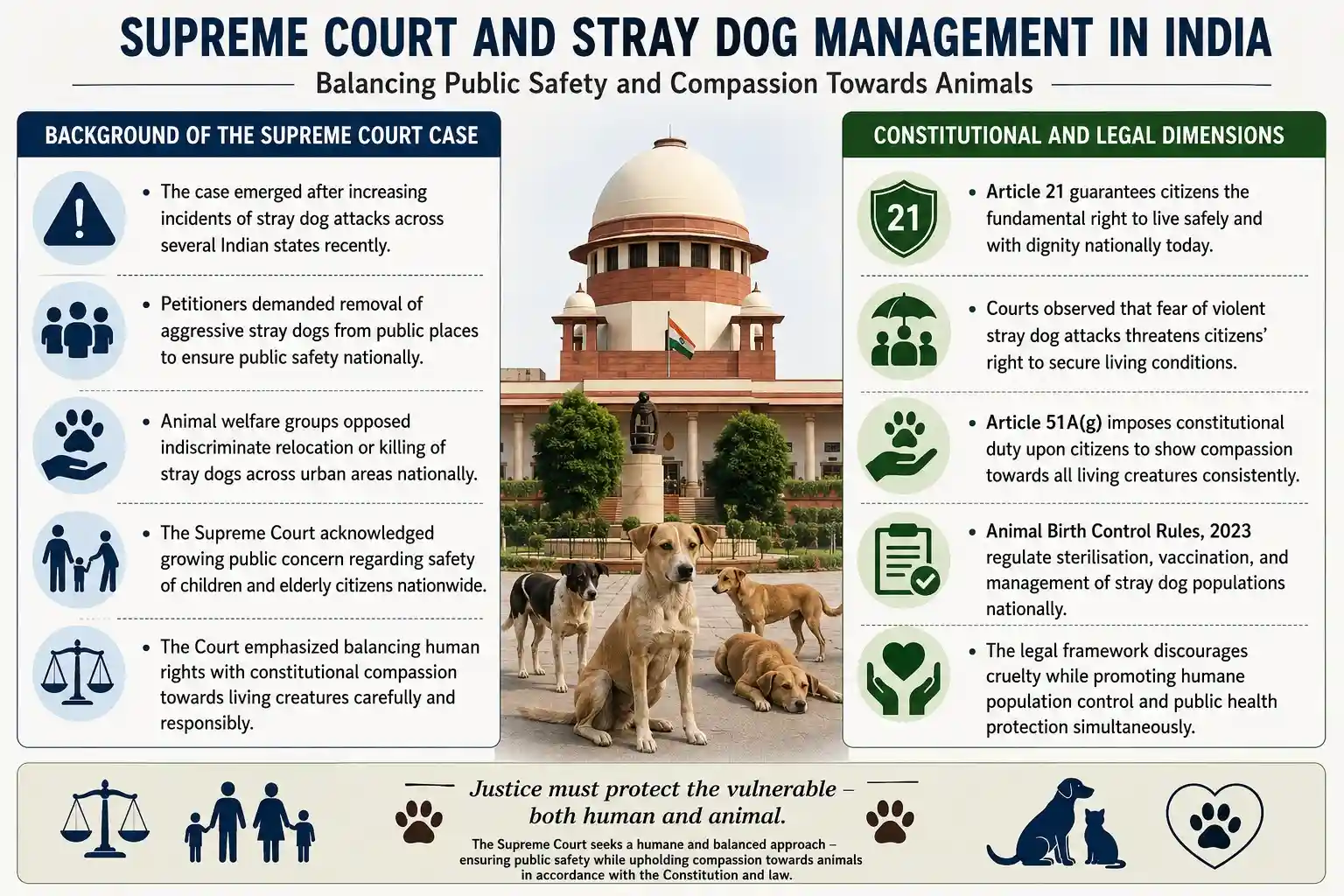
Animal Birth Control Rules and Their Objectives
- Animal Birth Control Rules primarily focus upon sterilisation and vaccination of stray dogs across India nationally.
- The rules discourage indiscriminate killing or relocation of stray animals from their territorial habitats significantly.
- Local authorities must establish adequate shelters, sterilisation centres, and vaccination infrastructure for implementation effectively today.
- Feeding of stray animals remains permitted only within regulated and designated public areas under guidelines.
- The rules aim balancing animal welfare concerns with public health and urban administrative responsibilities carefully.
Public Safety and Administrative Challenges
- Rising stray dog populations have increased incidents of bites, injuries, and public fear across urban regions.
- Children, elderly citizens, and pedestrians remain especially vulnerable to aggressive stray dog attacks nationally today.
- Many municipal bodies lack sufficient sterilisation infrastructure, funding, and trained veterinary personnel for effective implementation.
- Poor waste management practices indirectly encourage uncontrolled growth of stray animal populations within cities nationally.
- Weak coordination between local authorities and animal welfare organisations further complicates stray dog management efforts.
Ethical and Social Debate
- Animal welfare groups argue that stray animals deserve humane treatment and constitutional legal protection consistently today.
- Public safety advocates emphasize that human life and security must receive highest administrative priority nationally today.
- Emotional polarization often prevents balanced discussion regarding practical and humane long-term solutions nationwide today significantly.
- Urban citizens increasingly face conflict between compassion for animals and fear regarding violent attacks nationally.
- Ethical governance requires protecting both vulnerable citizens and animals without adopting extreme approaches irresponsibly today.
Role of Judiciary and Governance
- The Supreme Court directed authorities to ensure effective implementation of Animal Birth Control Rules nationally today.
- Courts stressed that local governments cannot avoid responsibility regarding rising stray dog related incidents nationwide.
- State governments were asked strengthening sterilisation, vaccination, shelter facilities, and monitoring mechanisms urgently nationwide.
- Judicial intervention reflects administrative failures in implementing existing legal and municipal welfare obligations effectively today.
- Effective governance requires scientific planning rather than reactive measures following tragic stray dog incidents nationally.
Way Forward for Sustainable Stray Animal Management
- Municipal bodies should establish modern sterilisation and vaccination centres across cities and semi-urban regions nationally.
- Scientific population control measures must replace emotionally driven and legally questionable responses to stray animals.
- Waste management systems should improve because open garbage directly encourages stray dog population growth nationally.
- Public awareness campaigns should promote responsible feeding practices and humane community participation regarding stray animals.
- Dedicated funding and veterinary infrastructure remain essential for implementing Animal Birth Control Rules effectively nationwide.
- Coordination between municipalities, resident associations, and animal welfare groups can improve long-term management outcomes nationally.
Prelims Boosters
Public Health Emergency of International Concern (PHEIC)
Context:
Recently, the World Health Organization declared the Ebola outbreak in the Democratic Republic of the Congo and Uganda a Public Health Emergency of International Concern.
About PHEIC
- A Public Health Emergency of International Concern (PHEIC) is a formal emergency declaration made by the World Health Organization (WHO).
- It is declared when a disease outbreak or public health event poses a serious international health risk.
- It is the highest level of global health alert issued by WHO.
Objective
- To ensure rapid international coordination and response to prevent cross-border spread of diseases.
Legal Basis
- PHEIC operates under the International Health Regulations (IHR).
- Countries are expected to cooperate and take timely action during such emergencies.
Who Declares It?
- The WHO Director-General declares a PHEIC based on recommendations of the IHR Emergency Committee.
- The committee consists of international public health experts.
Key Features
Global Health AlertIndicates that the outbreak requires urgent global attention and coordinated action.Periodic ReviewThe declaration is reviewed every three months and may be extended if necessary. |
Wider ScopePHEIC may be declared for:
|
International Health Regulations (IHR)
Adoption
- IHR was first adopted in 1969 by the World Health Assembly.
Revision
- After the SARS outbreak (2002–2004), IHR was revised.
- The updated IHR 2005 was adopted at the 58th World Health Assembly.
Members
- It includes 196 countries committed to global health security.
Coordinating Body
- WHO acts as the coordinating authority under the IHR framework.
IN–SPACe
Context:
Recently, Indian space-tech companies participating under the IN–SPACe delegation signed several partnerships during Space Meetings Veneto 2026 in Italy.
About IN–SPACe
- IN–SPACe stands for Indian National Space Promotion and Authorisation Centre.
- It is an autonomous and independent agency functioning under the Department of Space (DoS).
- It acts as a single-window agency for promoting and regulating private sector participation in India’s space sector.
Background
- IN–SPACe was created after India’s space sector reforms to encourage private companies and non-governmental entities (NGEs) in space activities.
Objective
- To promote, enable, authorise, and supervise space activities carried out by private entities in India.
Functions of IN–SPACe
Promotion of Private Participation
- Encourages private companies to participate in: Satellite manufacturing, Launch vehicle development and Space-based services
Infrastructure Sharing
- Facilitates sharing of ISRO and Department of Space infrastructure with private entities.
Approval and Supervision
- Grants authorization and supervises activities of non-governmental entities in the space sector.
New Infrastructure Development
- Supports establishment of private space infrastructure and facilities.
Coordination Role
- Acts as an interface between ISRO and private players.
- Assesses the requirements of startups, industries, and research institutions in the space sector.
Headquarters
- IN–SPACe headquarters is located in Ahmedabad, Gujarat.
Organisational Structure
IN–SPACe has three main directorates:
Promotion Directorate (PD)
| Technical Directorate (TD)
| Programme Management and Authorization Directorate (PMAD)
|
SMILE Mission
Context:
The European Space Agency and the Chinese Academy of Sciences are jointly launching the SMILE mission to study Earth’s protection system against solar activity.
About SMILE Mission
- SMILE stands for Solar wind Magnetosphere Ionosphere Link Explorer.
- It is a joint mission of: European Space Agency (ESA) and Chinese Academy of Sciences (CAS)
Objective
- The mission aims to study the interaction between: Solar wind, Earth’s magnetosphere and Earth’s ionosphere
- It seeks to capture the first X-ray images of Earth’s magnetic shield as it deflects harmful charged particles from the Sun.
Mission Details
- The spacecraft will be positioned around 1.21 lakh km above Earth’s north pole.
- This location will allow it to observe the entire boundary of the magnetosphere.
Mission Life
- Weight: Around 2,600 kg and Expected mission duration: About 3 years
Scientific Instruments
The mission carries four scientific instruments:
Developed by ESA
| Developed by China
|
Working Mechanism
- The instruments will observe Earth using: X-ray wavelengths and Ultraviolet wavelengths
- The mission will combine: Remote sensing observations and In-situ (on-site) measurements near Earth.
Significance
- SMILE will improve understanding of Space weather, Solar storms and Interaction between solar wind and Earth’s magnetic field
- It will help scientists forecast solar disturbances that can affect Satellites, Communication systems, Navigation systems, Power grids
Matua Community
Context:
Many members of the Matua community who migrated from Bangladesh are facing difficulties in applying for citizenship under the Citizenship Amendment Act (CAA) due to lack of documents.
About Matua Community
- The Matua community is a socio-religious Hindu sect mainly concentrated in West Bengal and Bangladesh.
- It emerged during the 19th century as a movement against caste discrimination and social inequality.
Founder
- The Matua movement was founded by Harichand Thakur in the 1860s.
- He worked for social equality, dignity, education, and upliftment of marginalized communities.
Social Background
- Most followers belong to the Namashudra community, traditionally regarded as a lower caste within Hindu society.
Religious Beliefs
Monotheism
Rejection of Ritualism
Religious Scripture
| Devotional Practices
Equality
|
Historical Background
Post-Partition Migration
- After the Partition of Bengal in 1947, many Matua families migrated from East Pakistan (now Bangladesh) to India due to religious and political persecution.
Present Status
- Today, the Matua community forms the second-largest Scheduled Caste population in West Bengal.
Significance
- The Matua movement became an important social reform movement against caste oppression in Bengal.
- The community also plays a major role in the social and political landscape of West Bengal.
National One Health Mission
Context:
Recently, the Fifth Meeting of the Scientific Steering Committee on the National One Health Mission was held in New Delhi.
About National One Health Mission
- The National One Health Mission was launched in 2024.
- It follows a collaborative and multidisciplinary approach linking:
- Human health, Animal health and Environmental health
- The mission recognizes that these sectors are interconnected and must work together for better health outcomes.
Objective
- The mission aims to strengthen national health security through integrated disease surveillance and pandemic preparedness.
- It seeks to improve coordination among human, animal, and environmental health systems for effective disease control.
Nodal Agency
- The mission is coordinated by the Indian Council of Medical Research (ICMR).
- It functions under the Office of the Principal Scientific Adviser (PSA).
Governance Structure
The mission has a two-tier governance mechanism.
Executive Committee
- Chaired by the Ministry of Health and Family Welfare.
- Principal Scientific Adviser acts as Vice-Chairperson.
- Member (Health), NITI Aayog is a permanent invitee.
- Secretaries of stakeholder ministries and representatives of two states are members.
Functions
- Provides overall policy guidance and direction for implementation of the mission.
Scientific Steering Committee
- Chaired by the Principal Scientific Adviser.
- Includes Secretaries and Director Generals of stakeholder departments and representatives from states.
Functions
- Provides scientific guidance, oversight, and technical direction to the mission.
Significance
- The mission strengthens India’s preparedness against zoonotic diseases (diseases spreading between animals and humans).
- It supports integrated monitoring of emerging diseases, antimicrobial resistance, and environmental health risks.
- It promotes coordination among multiple sectors for better public health management.
Prelims Facts
- National One Health Mission was launched in 2024.
- ICMR is the nodal agency.
- It works under the Office of the Principal Scientific Adviser.
- The mission integrates human, animal, and environmental health systems.