Impact of Heatwaves and Fertilizer Shortages on Indian Agriculture
Indian agriculture is facing a serious “twin crisis” involving extreme heatwaves and fertilizer shortages. Rising temperatures are damaging crops across multiple regions, while geopolitical conflicts are disrupting global fertilizer supply chains. Since agriculture directly affects food security, inflation, and rural livelihoods, these challenges have become major threats to India’s economic and agricultural stability.
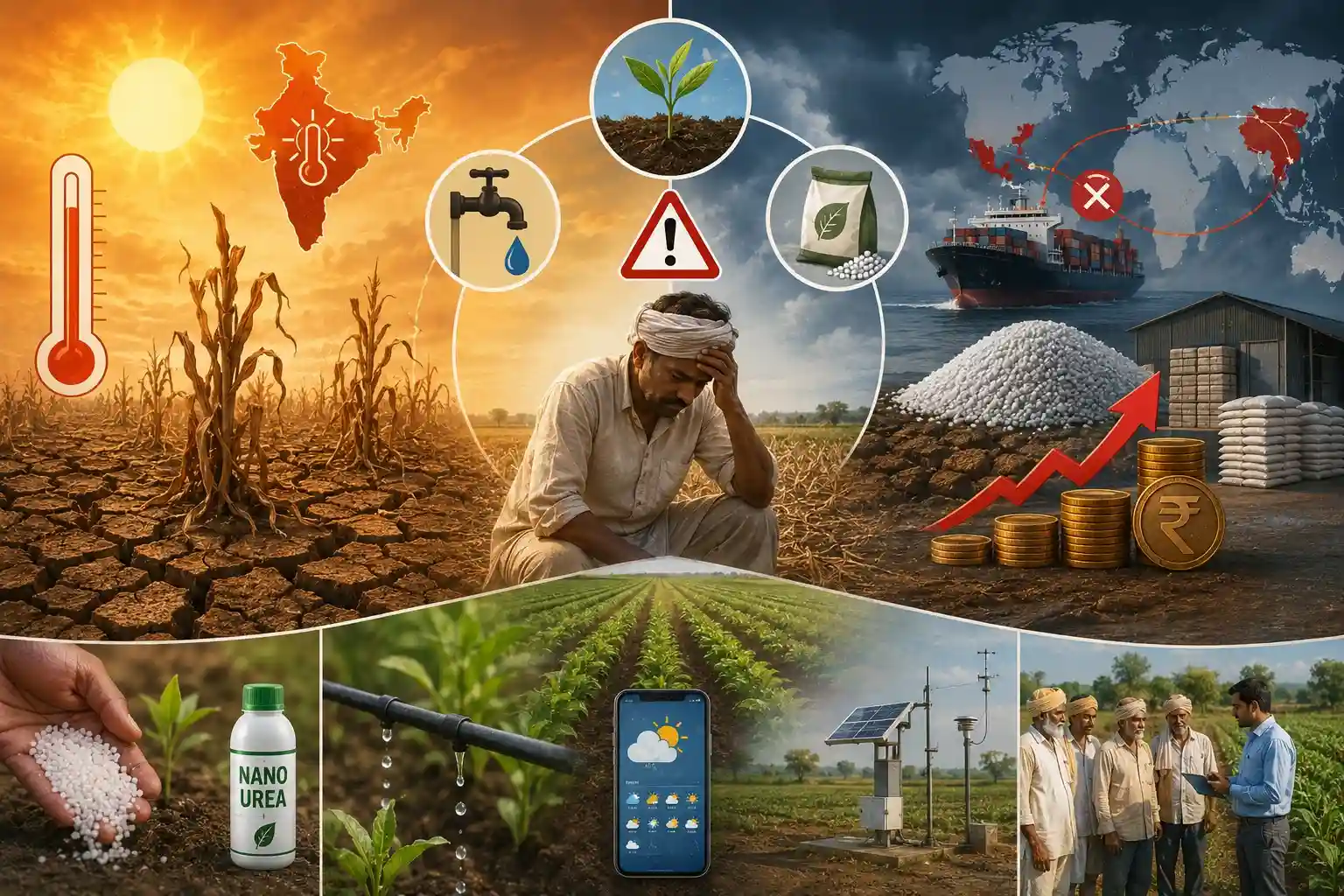
Impact of Heatwaves on Agriculture
- Heatwaves are becoming more frequent and affecting wider climatic regions across India today.
- Extreme temperatures damage crop growth, flowering, grain formation, and agricultural productivity significantly further.
- Terminal heat has reduced wheat grain quality in Punjab, Haryana, and Uttar Pradesh significantly.
- Heatwaves during Kharif season threaten rice nurseries, seed germination, and transplantation schedules seriously.
Water Stress and Irrigation Challenges
- Heatwaves increase evapotranspiration, causing faster soil moisture loss across agricultural regions nationwide significantly.
- Crops require more frequent irrigation during prolonged periods of extreme temperatures and dry weather.
- Increased irrigation demand is placing pressure on India’s already declining groundwater reserves continuously today.
- Rain-fed agricultural areas remain highly vulnerable because irrigation infrastructure remains inadequate across districts nationwide.
Fertilizer Shortages and Geopolitical Risks
- Global conflicts have disrupted fertilizer production, transportation routes, and international supply chains extensively today.
- Natural gas shortages have affected production of urea and ammonia-based fertilizers significantly further globally.
- China and Russia have restricted fertilizer exports to prioritise their domestic agricultural requirements strategically today.
- India’s dependence on imported fertilizers increases vulnerability to global geopolitical and supply disruptions significantly.
Economic Impact on Farmers and Consumers
- Rising fertilizer prices increase cultivation costs for small and marginal farmers across India significantly further.
- Farmers using fewer fertilizers often experience lower productivity and declining agricultural incomes substantially further today.
- Reduced wheat and rice production contributes to food inflation and rising consumer prices nationally today.
- Crop losses and expensive inputs are increasing rural debt and financial distress among farmers continuously.
Structural Weaknesses in Agriculture
- India’s agricultural system still lacks adequate long-term climate resilience and adaptation mechanisms nationwide today.
- Government responses largely remain reactive instead of building preventive climate-resilient farming systems strategically further.
- Adoption of heat-resistant seeds remains limited because awareness and distribution systems remain weak significantly.
- Agricultural extension services often fail to guide farmers regarding changing climatic and farming realities effectively.
Need for Climate-Resilient Agriculture
- Climate-smart agriculture can improve productivity while reducing vulnerability to climate-related disruptions significantly further today.
- Drip and sprinkler irrigation systems can improve water efficiency during heatwave conditions substantially further.
- India should diversify fertilizer imports and strengthen domestic production capacities strategically for long-term security.
- Promotion of nano-urea, bio-fertilizers, and organic manure can reduce import dependence significantly further today.
- Hyper-local weather forecasting and mobile advisories can help farmers make better agricultural decisions effectively.
The combined challenge of heatwaves and fertilizer shortages highlights the growing vulnerability of Indian agriculture to climate change and geopolitical instability. Rising temperatures, water stress, and supply disruptions are threatening food security, farmer incomes, and economic stability. India now requires a long-term strategy focused on climate-resilient agriculture, scientific innovation, efficient irrigation, and sustainable farming practices to secure its agricultural future effectively.
Prelims Boosters
Euphrates River
Context:
Recently, concerns have grown over the shrinking and drying of the Euphrates River, one of the world’s oldest historic rivers.
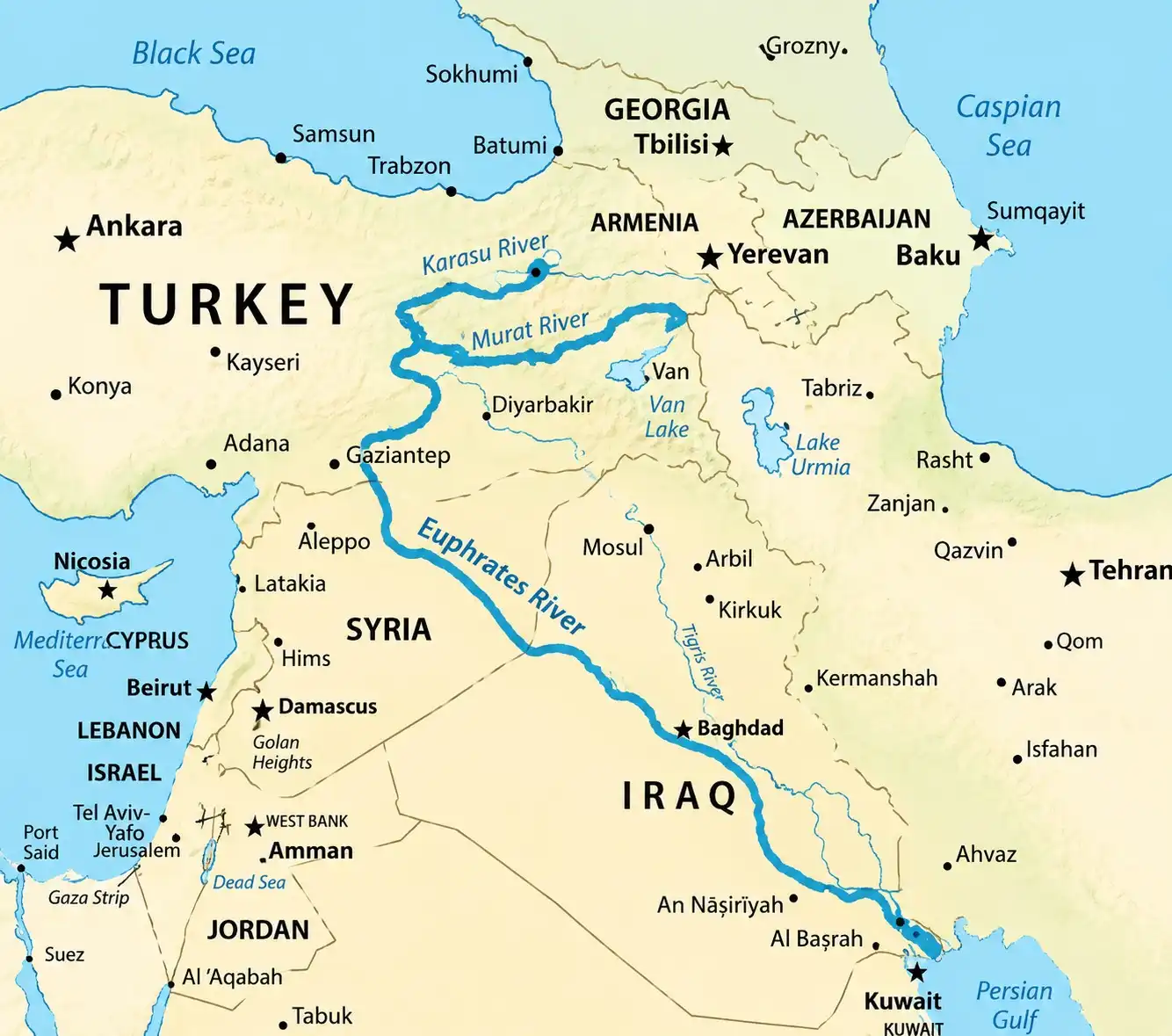
About Euphrates River
- The Euphrates is the longest river in Western Asia.
- Its total length is around 2,800 kilometres.
Origin and Course
- The river originates in the Armenian Highlands of southeastern Turkey.
- It flows through:Turkey, Syria and Iraq
- In Iraq, it joins the Tigris River.
- The combined waters ultimately drain into the Persian Gulf.
Tigris–Euphrates River System
- The Euphrates and Tigris rivers, along with their tributaries, form the Tigris–Euphrates river system.
- This river system supported the rise of ancient civilizations in Mesopotamia.
Historical Importance
Fertile Crescent
- Ancient Mesopotamia developed between the Tigris and Euphrates rivers.
- The region is often called the “Fertile Crescent.”
Ancient Civilizations
- Some of the world’s earliest civilizations emerged along these rivers thousands of years ago.
Babylon
- The famous ancient city of Babylon was located on the banks of the Euphrates River.
Strategic Importance
- The river often served as a boundary between ancient kingdoms and was the site of many historical battles.
Source of Water
- The Euphrates mainly receives water from winter rainfall and mountain snowfall.
- Much of the surrounding region through which the river flows is dry and semi-arid.
Polyendocrine Metabolic Ovarian Syndrome (PMOS)
Context:
Medical experts, including doctors from AIIMS Delhi, highlighted the global shift from the term Polycystic Ovary Syndrome (PCOS) to Polyendocrine Metabolic Ovarian Syndrome (PMOS).
What was PCOS?
- Polycystic Ovary Syndrome was earlier considered mainly a reproductive disorder.
- It was associated with irregular menstruation, excess male hormones, and cyst-like structures in ovaries.
- However, these structures are not true cysts but immature follicles that fail to mature properly.
What is PMOS?
- PMOS is the updated medical term for the condition.
- It recognizes the disorder as a multisystem disease affecting hormonal, metabolic, reproductive, and psychological health.
- The new term provides a more accurate understanding of the condition.
Causes of PMOS
Insulin Resistance
- Body cells respond poorly to insulin, leading to high insulin levels and increased androgen production.
Hormonal Imbalance
- Increased androgen and luteinizing hormone levels disturb normal ovulation.
Genetic Factors
- The condition often runs in families and has a strong hereditary link.
Low-Grade Inflammation
- Chronic low-level inflammation may stimulate excess androgen production.
Symptoms and Effects
Reproductive Effects
Metabolic Effects
|
Skin and Hair Problems
Psychological Effects
|
Difference Between PCOS and PMOS
PCOS
|
PMOS
|
Agarwood
Context:
Recently, the Assam government carried out the first legally approved export of agarwood chips to Saudi Arabia and the United Arab Emirates.
About Agarwood
- Agarwood is a tree species belonging to the Thymelaeaceae family.
- Its scientific name is Aquilaria malaccensis.
- It is also known as Oud, Gaharu, or Agar.
Characteristics
- The Aquilaria tree is a fast-growing subtropical forest tree.
- Agarwood resin is formed as a defence response when the tree gets infected by a particular type of mould.
- The infection causes stress in the tree, leading to the production of dark aromatic resin.
Distribution
- Agarwood is mainly found in the Himalayan foothills of South Asia, Southeast Asia, and parts of Papua New Guinea.
Distribution in India
It grows naturally in:
- Assam, Tripura, Arunachal Pradesh, Nagaland, Mizoram, Manipur
Soil Requirement
- Aquilaria trees can grow in different types of soils, including poor sandy soils.
Uses of Agarwood
Perfumes and Incense
| Cosmetics and Traditional Products
|
Conservation Status
- According to the IUCN Red List, Agarwood is classified as Critically Endangered.
- It is listed under Appendix II of CITES.
Project Garud
Context:
Hyderabad-based Dhruva Space recently received ₹105 crore under the Research, Development and Innovation Fund to support Project Garud.
About Project Garud
- Project Garud is a satellite platform programme launched by the Hyderabad-based startup Dhruva Space.
- It focuses on developing a flat-pack 500 kg-class satellite platform for scalable and large-scale manufacturing.
Objective
- The project aims to strengthen India’s private-sector satellite manufacturing capabilities.
- It seeks to bridge the gap between small experimental satellites and larger conventional satellites.
Key Features
Standardised Satellite Platform
- The platform is designed as a standardised spacecraft capable of supporting multiple mission types.
Flat-Pack Architecture
- The satellite uses a flat-pack design that enables efficient stacking during launches.
- This architecture supports faster integration and deployment.
Multi-Purpose Applications
- The platform can support:
- Telecommunications, National security, Earth observation, Data-driven space applications
High-Volume Manufacturing
- Dhruva Space plans to establish infrastructure and industrial systems for mass satellite production.
- The target production capacity is around 500 to 600 satellites annually.
Significance
- Project Garud is an important step in strengthening India’s private space sector.
- It supports indigenous satellite manufacturing and enhances India’s capabilities in the global space economy.
- The project also aligns with India’s goal of increasing private participation in the space sector.
ABHAY System
Context:
Recently, the Central Bureau of Investigation launched an AI-based helpbot named ABHAY for verification of CBI notices.
About ABHAY System
- ABHAY stands for Artificial Intelligence-Based Helpbot for Authentication of Your Notice.
- It is an AI-powered notice verification system launched by the Central Bureau of Investigation (CBI).
Objective
- The main aim of the system is to help citizens identify fake CBI notices and protect them from “digital arrest” scams.
- It has been developed to tackle cyber fraud and impersonation scams involving fake law enforcement documents.
Key FeaturesAI-Based Verification
Real-Time Authentication
Protection Against Deepfakes
|
How the System WorksUploading Notices
OTP Verification
Authenticity Check
Accessibility
|