Fixing Structural Deficits in India’s Public Health System
Expansion of Medical Education in India
- The government has significantly expanded medical education capacity in recent years through the establishment of new medical colleges and additional MBBS and postgraduate seats.
- This expansion aims to improve doctor availability and strengthen the healthcare workforce.
- However, merely increasing the number of seats does not automatically ensure equitable healthcare delivery across regions.
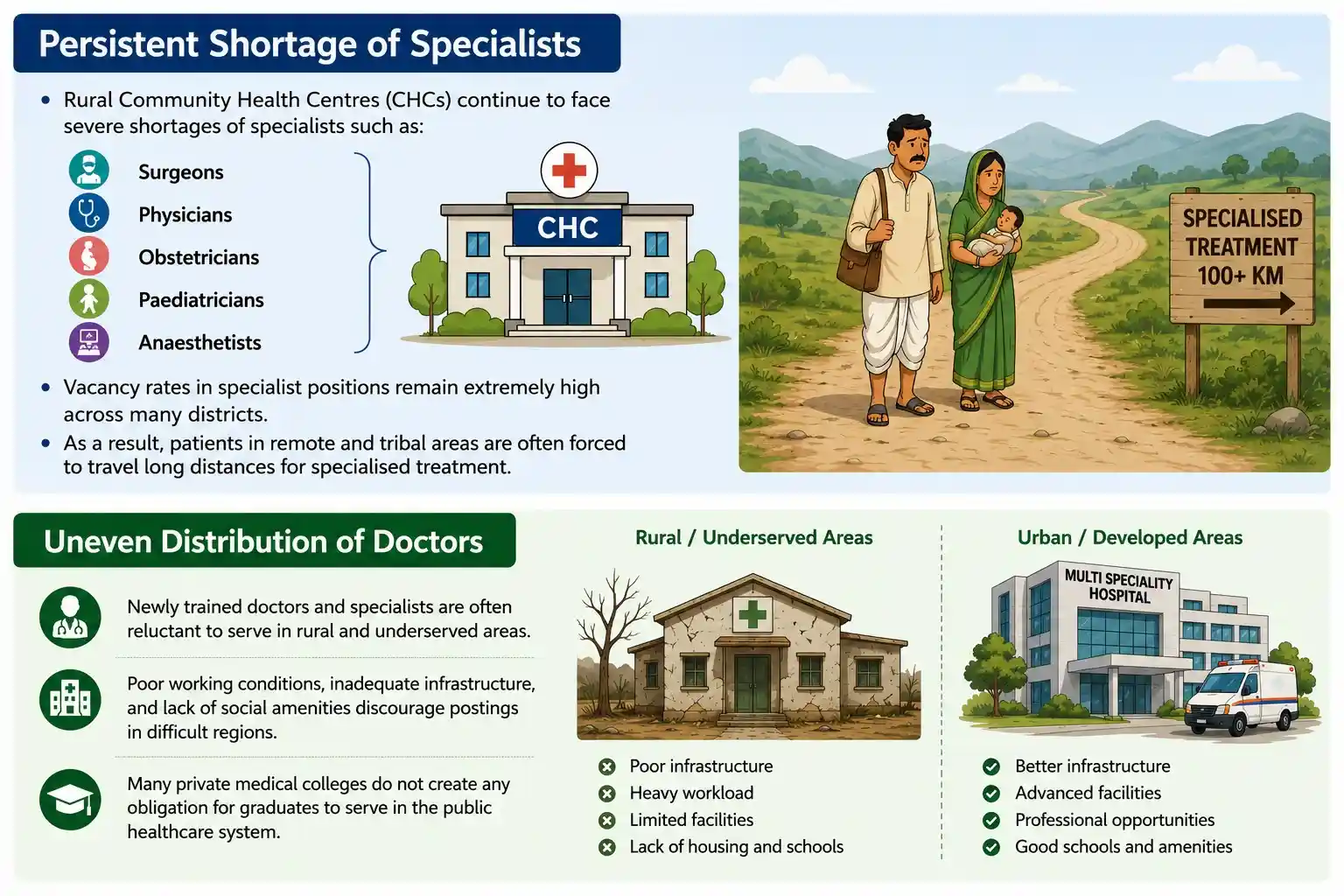
Infrastructure Alone Cannot Solve the Problem
- Merely constructing new hospitals and medical colleges cannot ensure better healthcare outcomes.
- Several medical institutions continue to suffer from shortages of faculty, research capacity, equipment, and operational support.
- Without adequate staffing and functioning systems, physical infrastructure remains underutilised.
Weaknesses in Community Health Centres (CHCs)
- CHCs are expected to function as first referral units for rural populations.
- Ideally, CHCs should provide specialist care closer to local communities.
- However, many CHCs remain dysfunctional due to:
- Lack of specialists and Inadequate equipment
- Poor emergency facilities and Insufficient support staff
- This weakens the entire referral chain in public healthcare.
Flawed Budgetary Priorities
- Public health spending often prioritises capital expenditure and announcements over operational efficiency.
- Insufficient allocations are made for:
- Medicines, Diagnostics, Ambulance services, Emergency care and Salaries for temporary staff
- As a result, hospitals may exist physically but remain poorly functional.
Lack of Alignment Between Medical Education and Public Service
- Medical education policies are often disconnected from actual public health requirements.
- Publicly funded medical education does not always translate into public healthcare service delivery.
- There is limited institutional linkage between postgraduate training and vacancy fulfilment in government facilities.
Problems in Rural Healthcare DeliveryPoor Living Conditions
Lack of Professional Support
High Workload
|
Need for Better Workforce Planning
|
Importance of Incentives
- Difficult-area postings require strong incentive structures.
- Incentives can include:
- Higher financial allowances, Better housing facilities, Priority in promotions.
- Educational support for children, Additional academic opportunities.
- Such measures can improve retention in rural and tribal regions.
Strengthening Public Health Governance
- Public healthcare reforms require better coordination between:
- Medical education institutions, State governments and Public health administration
- Operational efficiency and accountability must receive equal importance alongside infrastructure expansion.
- Health workforce planning should be based on long-term population needs rather than short-term political announcements.
Need for Functional Healthcare Ecosystems
- Effective healthcare delivery depends on a complete ecosystem that includes:
- Doctors, Nurses, Diagnostics, Emergency care, Medicines and Referral systems
- Fragmented improvements in one area cannot compensate for weaknesses in the overall system.
Way Forward
- Link Medical Education with Public Service: Publicly funded medical training should be connected to mandatory or incentivised service in underserved areas.
- Improve Rural Infrastructure: Governments must strengthen housing, schools, connectivity, and healthcare equipment in remote regions.
- Focus on Operational Funding: Greater emphasis should be placed on staffing, medicines, diagnostics, and emergency services.
- Strengthen CHCs: Functional CHCs can reduce pressure on district hospitals and improve rural healthcare access.
- Develop Team-Based Healthcare: Deploying specialists in coordinated teams can improve efficiency and reduce professional isolation.
Understanding Inequality in India’s Growth Story
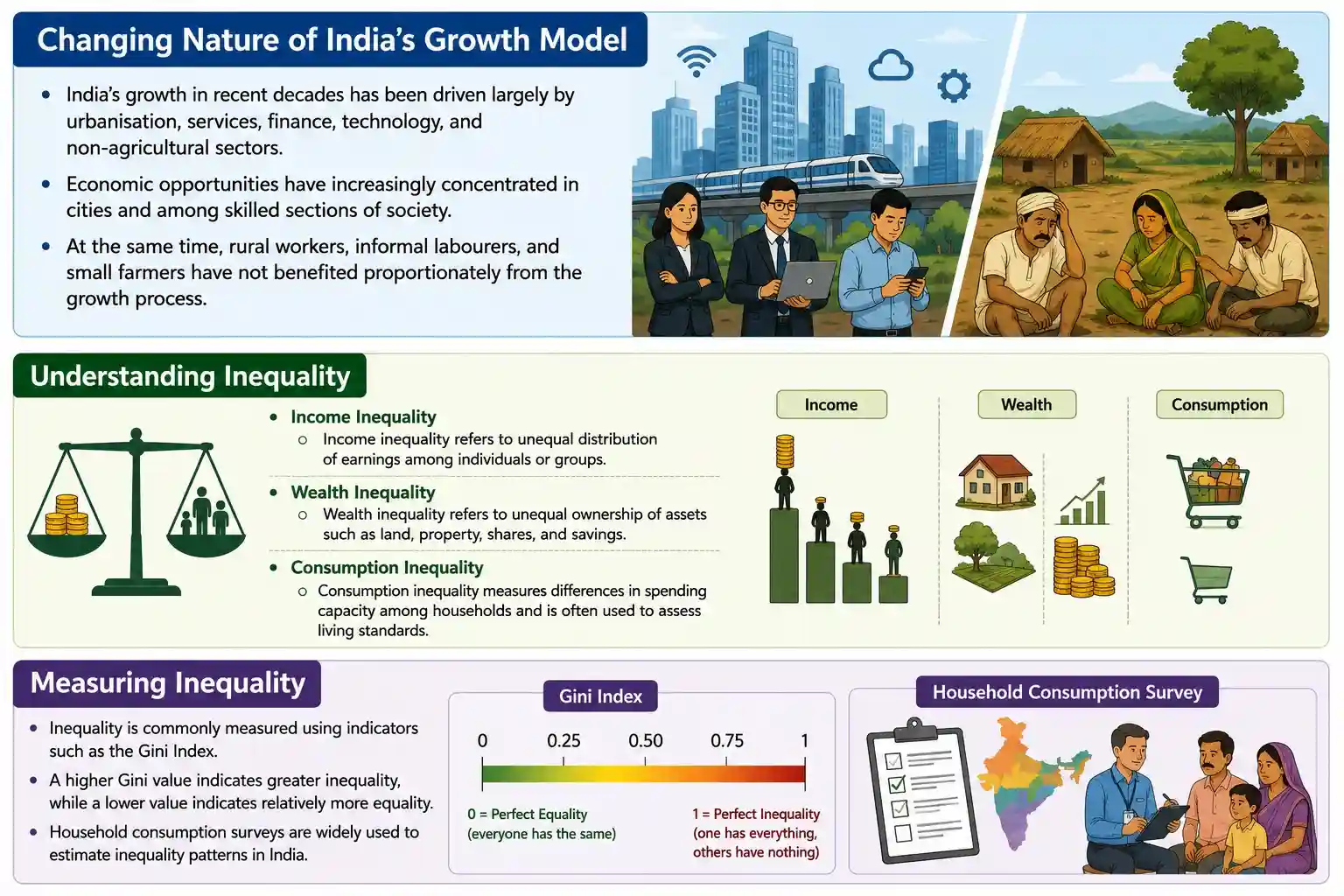
Urban-Rural Inequality
- Urban India is significantly more unequal than rural India.
- Urban growth has generated high incomes for professionals, business owners, and service-sector workers, while many low-skilled workers remain economically insecure.
- Rural regions continue to suffer from lower incomes, weaker infrastructure, and dependence on agriculture.
- The gap between urban and rural consumption levels remains substantial.
Food vs Non-Food Consumption Inequality
- Inequality is relatively lower in food expenditure because basic food consumption is necessary across income groups.
- Inequality becomes much sharper in non-food expenditure such as:
- Education, Healthcare, Housing, Transport, Digital access and Lifestyle goods
- Higher-income households spend disproportionately more on these sectors, widening quality-of-life differences.
Rise of Consumption-Led Inequality
- India’s consumption boom has been driven largely by upper-income urban groups.
- Affluent households account for a disproportionately high share of non-food spending.
- Luxury consumption, private education, advanced healthcare, and digital services are increasingly concentrated among the top economic classes.
Structural Drivers of Inequality
- Unequal Access to Education
- Better education opportunities remain concentrated among privileged groups and urban populations.
- Skill-Based Growth
- Modern sectors reward higher skills, leaving low-skilled workers behind.
- Informal Employment
- A large share of India’s workforce remains in insecure and low-paying informal jobs.
- Unequal Asset Ownership
- Land, capital, and financial assets remain concentrated among a smaller section of society.
- Regional Disparities
- States and districts differ significantly in industrialisation, infrastructure, and employment opportunities.
Social Dimensions of Inequality
- Inequality in India is not only economic but also social.
- Caste, class, gender, religion, and regional identity influence access to opportunities and resources.
- Historically marginalised communities often remain concentrated in low-income occupations and insecure employment.
Class-Based Inequality
- Economic reforms and market-led growth have benefited business owners, professionals, managers, and skilled urban workers more than agricultural and informal workers.
- The rise of the middle and upper-middle classes has occurred alongside continuing distress among vulnerable populations.
- This has contributed to widening class inequality in Indian society.
Limits of Welfare Measures
- Welfare schemes have reduced extreme poverty and improved access to basic services.
- However, welfare programmes alone have not fundamentally reduced structural inequality.
- Many households continue to face:
- Income insecurity
- Debt dependence
- Low-quality employment
- Poor social mobility
Data and Measurement Challenges
- Measuring inequality in India remains difficult because:
- Different surveys use different methodologies
- Consumption surveys may underestimate top incomes
- Wealth data is limited
- Informal economic activity is difficult to capture
- As a result, actual inequality levels may be higher than officially estimated.
Why Rising Inequality Matters
- Weakens Social Cohesion
- Large inequalities can increase social tensions and reduce trust in institutions.
- Limits Economic Mobility
- Poor households may remain trapped across generations due to unequal opportunities.
- Reduces Inclusive Growth
- Growth becomes concentrated among a smaller section of society instead of benefiting the wider population.
- Creates Political and Economic Instability
- Persistent inequality can fuel dissatisfaction, unemployment pressures, and regional imbalance.
Need for Inclusive Growth
- Economic growth must generate broad-based opportunities rather than concentrated prosperity.
- India needs stronger investment in:
- Public education, Healthcare, Rural infrastructure, Skill development and Employment-intensive sectors
- Greater support for small farmers, informal workers, and rural enterprises is essential.
Importance of Employment-Centric Development
- Sustainable reduction in inequality requires creation of productive and secure jobs.
- Labour-intensive manufacturing and rural non-farm employment can help distribute growth more widely.
- Social security protections for informal workers must also be strengthened.
Policy Approach for Reducing Inequality
- Improve Human Capital
- Better education and healthcare can improve long-term social mobility.
- Expand Social Protection
- Stronger welfare safety nets can reduce vulnerability among poorer households.
- Reduce Regional Gaps
- Backward regions require targeted investment and infrastructure support.
- Promote Financial Inclusion
- Access to banking, credit, and digital services can improve economic participation.
- Strengthen Data Systems
- Better inequality measurement is necessary for informed policymaking.
Prelims Boosters
Samarth Panchayat Portal
Context:
The central government is expanding the Samarth Panchayat Portal to states such as Assam, Uttar Pradesh, and Maharashtra.
About Samarth Panchayat Portal
- Samarth Panchayat Portal is a unified digital platform created for Panchayati Raj Institutions.
- The portal is designed to improve governance and administrative efficiency at the grassroots level.
Aim of the Portal
- The portal aims to digitally empower Panchayats.
- It helps Panchayats efficiently collect and monitor their Own Source Revenue (OSR).
- It seeks to improve transparency and simplify administrative procedures for both citizens and government officials.
- It also aims to strengthen local governance and improve the quality of life in rural areas.
Nodal Ministry
- The Ministry of Panchayati Raj is the nodal ministry for the Samarth Panchayat Portal.
Features of the Portal
Digital Governance
Revenue Monitoring
| Transparency and Accountability
Citizen-Friendly Administration
Own Source Revenue (OSR) of Panchayats
|
Sources of OSR
- Taxes collected at the local level.
- Service charges and fees.
- Income from rents and leases.
Significance of OSR
- A strong OSR provides financial independence to Panchayats.
- It helps Panchayats improve local infrastructure, sanitation, water supply, and public services.
- It strengthens grassroots democracy and local self-governance.
Lake Chad
Context:
Recently, at least 23 Chadian soldiers were killed in a Boko Haram attack in the Lake Chad region.
About Lake Chad
- Lake Chad is a freshwater lake located in the semi-arid Sahel region of west-central Africa.
- The lake is mainly situated in western Chad, but parts of it also extend into Cameroon, Nigeria, and Niger.
Geographical Features
Endorheic Lake
Shrinking Size
Shallow Nature
|
Drainage System
Physical Characteristics
|
Jim Corbett National Park
Context:
Uttarakhand recently witnessed the death of Vikram, a 21-year-old Bengal tiger and one of the most famous tigers of Jim Corbett National Park.
About Jim Corbett National Park
- Jim Corbett National Park is located in the foothills of the Himalayas in the Nainital district of Uttarakhand.
- The park spreads over more than 1,300 square kilometres and forms part of the Corbett Tiger Reserve.
History
- The park was established in 1936 as Hailey National Park.
- In 1957, it was renamed Jim Corbett National Park in memory of Jim Corbett, who was a famous hunter turned conservationist.
- Jim Corbett played an important role in the establishment and conservation efforts of the park.
- It is the first national park established in India.
- It was also the first national park brought under Project Tiger.
Geographical Features
Drainage System
|
Vegetation
Flora
Fauna
|
Increase in Supreme Court Judge Strength to 37
Context:
The Union Cabinet has approved the proposal to introduce the Supreme Court (Number of Judges) Amendment Bill, 2026.
The proposal aims to increase the sanctioned strength of the Supreme Court from 33 to 37 judges, excluding the Chief Justice of India.
About the Proposal
- This is a legislative measure to increase the judicial capacity of the Supreme Court of India.
- The proposal seeks to amend the Supreme Court (Number of Judges) Act, 1956.
- After the amendment, the total strength of the Supreme Court, including the Chief Justice of India, will become 38 judges.
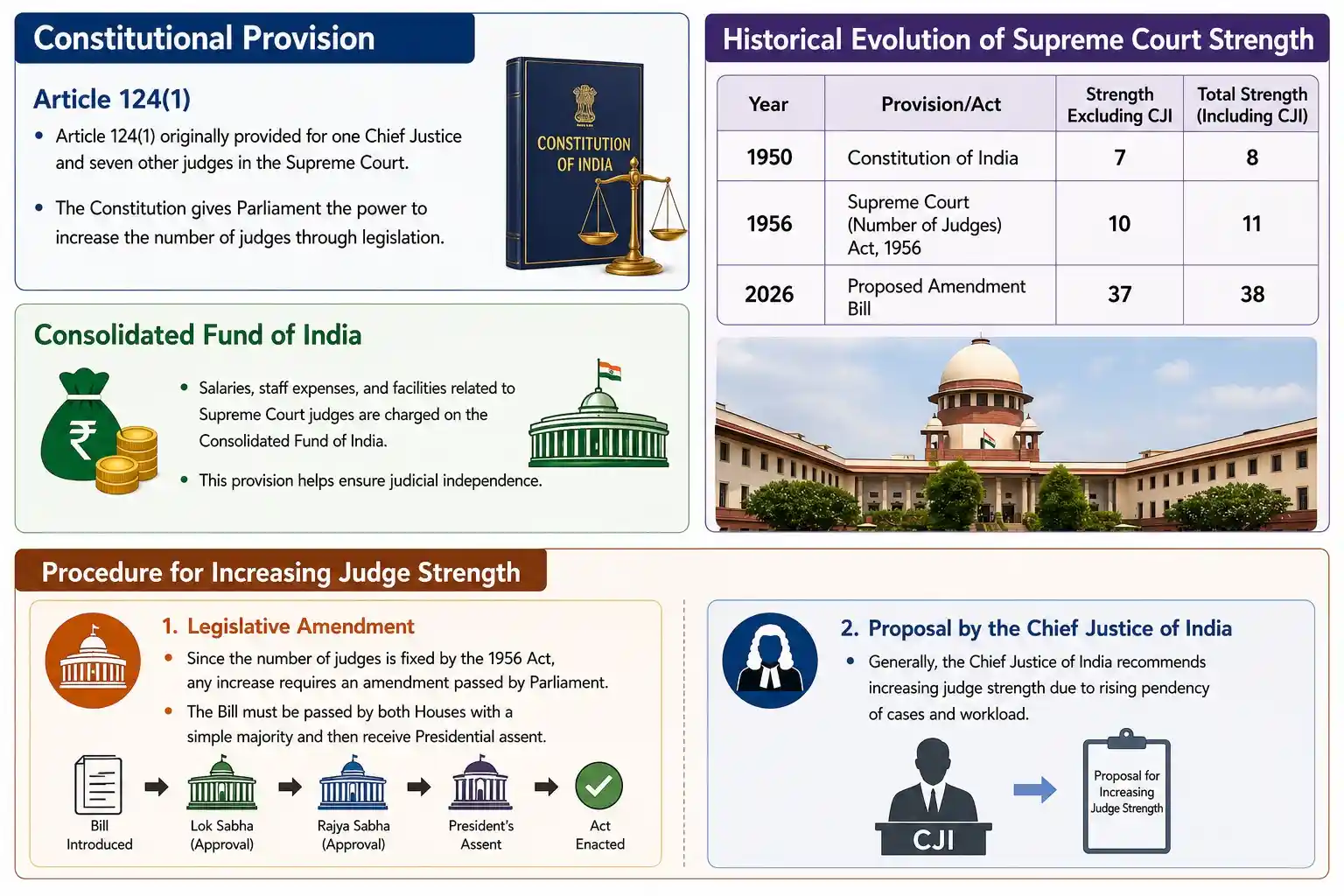
Appointment Process
Supreme Court Collegium
| Government Procedure
Final Appointment
|
Significance
- Reducing Pendency of Cases
- The Supreme Court currently faces a very large backlog of pending cases.
- Increasing the number of judges will help in faster disposal of cases.
- More Constitution Benches
- Constitutional matters require a minimum bench strength of five judges.
- A larger number of judges will allow Constitution Benches to function without affecting regular court work.
- Strengthening Judicial Efficiency
- The move will improve the efficiency and functioning of the Supreme Court.
OLED (Organic Light Emitting Diodes)
Context:
OLED technology is currently dominating the high-end electronics market, with global production reaching nearly one billion screens annually.
About OLED
- OLED stands for Organic Light Emitting Diodes.
- It is a modern display technology made using thin layers of organic (carbon-based) compounds placed between two conductors.
- Unlike LCD displays, OLED screens do not require a separate backlight because each pixel produces its own light when electric current is applied.
How OLED Works
- Thin organic layers made of carbon and hydrogen compounds are placed between an anode and a cathode.
- When electricity passes through these layers, the organic molecules become excited.
- As the molecules return to their original state, they release energy in the form of visible light.
- Since every pixel generates its own light, OLED displays can completely switch off certain pixels to create true black colour and very high contrast.
Key Features of OLED
Self-Emissive Nature
Superior Image Quality
High Performance
|
Flexible Displays
Energy Efficiency
Durability
Environmental Benefits
|
Applications of OLED
- Consumer Electronics: OLED technology is widely used in smartphones, tablets, laptops, and premium computer monitors.
- OLED Televisions: Companies such as LG, Samsung, Sony, and Panasonic use OLED technology to manufacture ultra-thin televisions with very high image quality.
- Foldable and Rollable Devices: OLED technology powers foldable smartphones and rollable display systems.
- Wearables and Health Devices: OLEDs are used in smartwatches, e-tattoos, and skin patches for health monitoring.
- Automotive Sector: Transparent OLEDs are increasingly used in vehicle windshields and automotive lighting systems such as taillights.