Nuclear Restraint Depends More on Diplomacy Than Military Force
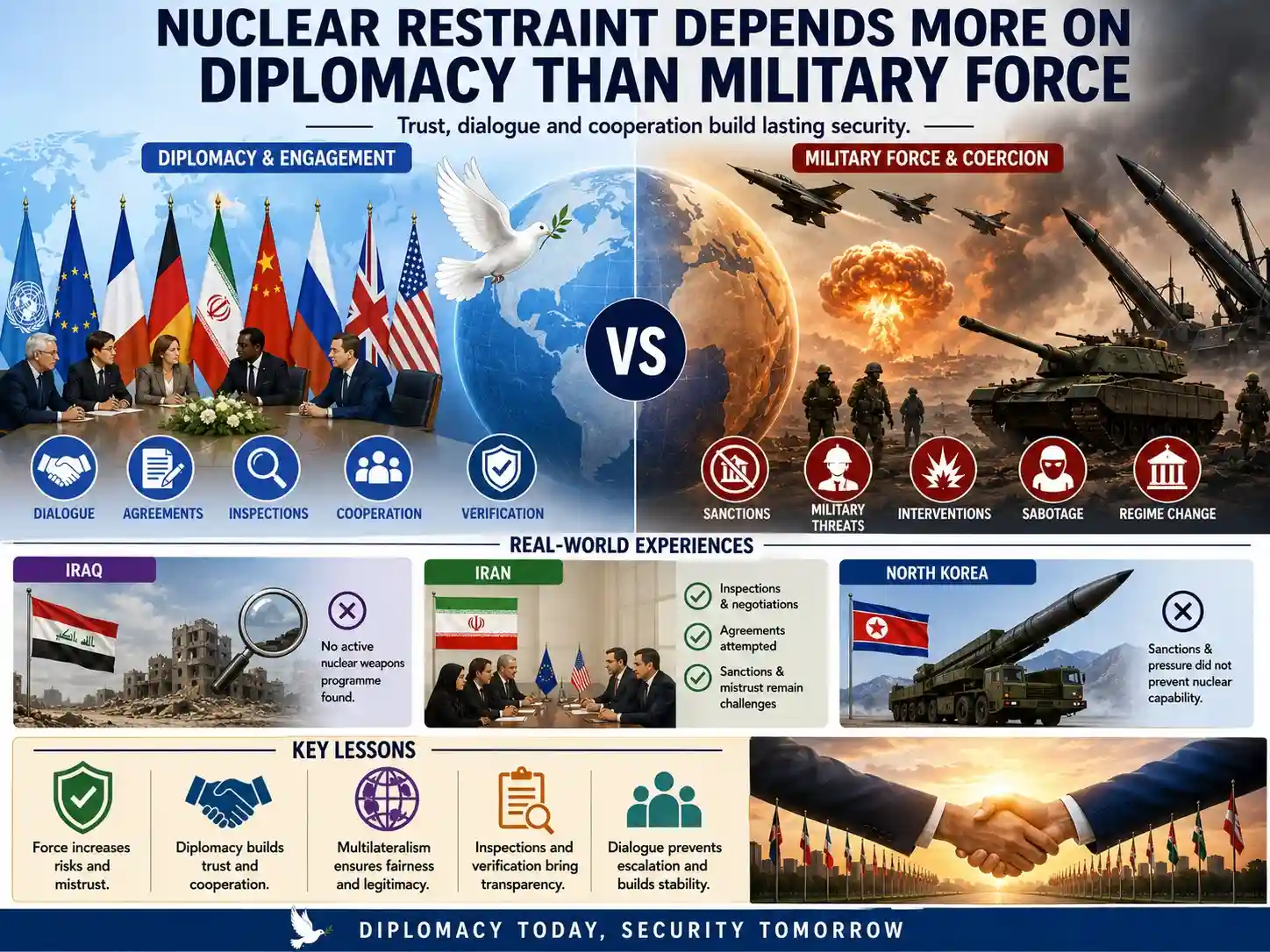
Since the emergence of nuclear weapons, the international system has attempted to prevent the spread of nuclear arms through treaties, inspections, and diplomatic engagement. Over time, however, the global non-proliferation framework has increasingly shifted toward coercive counterproliferation strategies involving sanctions, military threats, and interventions. Experiences from countries such as Iraq, Iran, and North Korea show that military force alone has often failed to stop nuclear ambitions and, in some cases, may even have accelerated them. This highlights the importance of diplomacy, trust-building, and multilateral engagement in sustaining nuclear restraint.
Understanding Non-Proliferation and Counterproliferation
Non-Proliferation
- Non-proliferation aims to prevent the spread of nuclear weapons through international treaties, safeguards, inspections, and diplomacy.
- The Nuclear Non-Proliferation Treaty (NPT) is the central framework governing this system.
Counterproliferation
- Counterproliferation involves coercive measures such as sanctions, military pressure, sabotage, and pre-emptive actions to stop nuclear programmes.
- It focuses more on force and strategic pressure than diplomatic consensus.
Shift Toward Coercive Approaches
- During the 1990s and post-9/11 period, major powers increasingly treated nuclear proliferation as a security threat linked to terrorism and regional instability.
- This led to greater use of:
- Economic sanctions
- Military threats
- Regime-change strategies
- Intelligence-based operations
- Counterproliferation gradually overshadowed traditional diplomatic engagement.
Iraq: Limits of Military Intervention
- The 2003 invasion of Iraq was justified partly on allegations that Iraq possessed weapons of mass destruction (WMDs).
- The United States and its allies claimed that Iraq was rebuilding nuclear capabilities.
- However, no active nuclear weapons programme was ultimately found after the invasion.
- The episode damaged the credibility of intelligence-based military interventions and raised concerns about pre-emptive warfare.
Iran and the Nuclear Dispute
- Iran has consistently maintained that its nuclear programme is intended for peaceful civilian purposes.
- Iran allowed inspections by the International Atomic Energy Agency (IAEA) and engaged in negotiations with major powers.
- Diplomatic agreements such as the Tehran Declaration, Paris Agreement, and later the Joint Comprehensive Plan of Action (JCPOA) attempted to regulate Iran’s nuclear activities.
- However, repeated sanctions, mistrust, and withdrawal from agreements weakened diplomatic progress.
North Korea’s Example
- Despite sanctions and international pressure, North Korea successfully developed nuclear weapons capability.
- Diplomatic engagement and economic negotiations were often preferred over direct military confrontation because of the high risks involved.
- The North Korean case demonstrated that coercion alone does not necessarily prevent nuclearisation.
Problems with Selective Application
- Global non-proliferation policies have often been applied inconsistently.
- Some states faced intense pressure, while others received strategic accommodation due to geopolitical considerations.
- Such selective treatment weakens the legitimacy and credibility of the international non-proliferation system.
Role of the IAEA
- The International Atomic Energy Agency (IAEA) acts as the principal international body for nuclear inspections and safeguards.
- Its effectiveness depends heavily on cooperation, transparency, and political neutrality.
- Distrust between states and international agencies can reduce the effectiveness of monitoring mechanisms.
Risks of Over-Reliance on Force
Escalation Risks
- Military action against nuclear facilities can trigger wider regional conflicts.
Incentive for Secrecy
- States under threat may accelerate covert nuclear activities rather than abandon them.
Erosion of Trust
- Excessive coercion weakens international cooperation and diplomatic credibility.
Undermining International Norms
- Frequent unilateral actions weaken multilateral institutions and treaty systems.
Importance of Diplomacy
- Diplomacy creates space for negotiation, verification, compromise, and long-term confidence-building.
- Nuclear restraint depends not only on enforcement but also on mutual trust and incentives for compliance.
- Sustained dialogue reduces misunderstandings and lowers escalation risks.
- Diplomatic agreements can create monitoring mechanisms that military action alone cannot achieve.
Challenges Facing the NPT System
- The Nuclear Non-Proliferation Treaty faces growing pressures because of:
- Geopolitical rivalry
- Unequal nuclear privileges
- Modernisation of nuclear arsenals
- Weakening multilateralism
- Non-nuclear states increasingly question the fairness of a system where major powers continue expanding nuclear capabilities while demanding restraint from others.
Need for Restoring Global Consensus
- Strengthening the global non-proliferation regime requires rebuilding trust between nuclear and non-nuclear states.
- Major powers must demonstrate commitment to arms control and strategic stability.
- Multilateral institutions need greater credibility and consistency.
- Diplomatic engagement should become the primary instrument for resolving nuclear disputes.
Lessons for Global Security
- Sustainable nuclear restraint cannot be achieved through force alone.
- Coercive strategies may produce temporary pressure but rarely create durable solutions.
- International security depends on rules-based cooperation, verification systems, and diplomatic engagement.
- Nuclear governance ultimately requires political trust as much as military capability.
The history of nuclear disputes demonstrates that diplomacy remains more effective and sustainable than coercion in preventing nuclear escalation. Military interventions and sanctions have often failed to eliminate nuclear ambitions, while negotiated agreements have provided greater stability and transparency. In an increasingly fragmented global order, preserving nuclear restraint will require renewed commitment to diplomacy, multilateralism, and credible international institutions rather than excessive reliance on force and unilateral action.
Preliims Boosters
Project Freedom
Context:
U.S. President Donald Trump recently paused Project Freedom, a naval escort mission in the Strait of Hormuz, shortly after its launch.
About Project Freedom
- Project Freedom is a U.S.-led military initiative aimed at providing armed naval escorts to commercial ships passing through the Strait of Hormuz.
- The project was launched in response to rising tensions and disruptions in maritime trade routes in West Asia.
Objective
- The main objective of Project Freedom is to ensure the free flow of global energy supplies through the Strait of Hormuz.
- It aims to protect commercial vessels from interference and maintain maritime security in the region.
Key Features
Naval Escort Operations
- U.S. military vessels are deployed to escort merchant ships through contested waters.
Air Protection
- The operation depends on regional airbases, including facilities in Saudi Arabia, for air cover and logistical support.
Strategic Importance
- The project represents direct U.S. involvement in safeguarding one of the world’s busiest oil trade routes.
Strait of Hormuz
- The Strait of Hormuz is one of the most important maritime chokepoints in the world.
- A significant share of global crude oil and LNG trade passes through this route.
- It connects the Persian Gulf with the Gulf of Oman and the Arabian Sea.
Implications
- The project exposed differences among Gulf countries regarding regional security cooperation.
- Saudi Arabia and the UAE reportedly adopted different approaches towards the mission.
- The development highlights growing geopolitical tensions in West Asia.
Great Nicobar Island
Context:
The government recently clarified that the Great Nicobar Project is a strategic initiative to strengthen India’s presence in the Andaman Sea.
About Great Nicobar Island
- Great Nicobar Island is the largest and southernmost island of the Nicobar group in the Andaman and Nicobar Islands.
- It is separated from the Andaman Islands by the Ten Degree Channel.
- Geographically, it is closer to Sumatra in Indonesia than to mainland India.
Geographical Features
- The island has more than 100 kilometres of coastline with coral reefs and clear waters.
- Indira Point, the southernmost point of India, is located on this island.
- Mount Thullier is the highest peak with a height of about 2,105 feet.
- Major rivers include Galathea, Alexandra, and Dagmar.
- Dense tropical rainforests cover more than 85 percent of the island.
Tribes
- The major tribes inhabiting the island are the Shompens and the Nicobarese.
Great Nicobar Biosphere Reserve
- The island is home to the Great Nicobar Biosphere Reserve, which is recognized by UNESCO.
Flora and Fauna
- The island has rich biodiversity with hundreds of plant species including rare orchids and tree ferns.
- Important wildlife species include Dugong, Nicobar Megapode, saltwater crocodile, marine turtles, and Reticulated Python.
- Several species found here are endemic and endangered.
Strategic Importance
- Its location near the Malacca Strait gives it major strategic importance for India in the Indian Ocean region.
- It strengthens India’s maritime security and connectivity in the Andaman Sea region.
JANANI Platform
Context:
Recently, the Ministry of Health and Family Welfare launched the JANANI platform.
About JANANI Platform
- JANANI stands for Journey of Antenatal, Natal and Neonatal Integrated Care.
- It is a service-oriented digital platform designed to monitor and maintain digital health records of women during their reproductive age.
- The platform is an upgraded version of the existing Reproductive and Child Health (RCH) portal.
Objective
- The platform aims to ensure seamless tracking of maternal and child healthcare services.
- It covers antenatal care, delivery, postnatal care, newborn care, immunization, and family planning services.
Key Features
Digital MCH Cards
- JANANI introduces QR-enabled digital Mother and Child Health cards for easy access and portability of records.
Smart Tracking and Alerts
- The platform provides automated alerts for high-risk pregnancies.
- It also generates due lists and real-time dashboards for monitoring and timely interventions.
Interoperability
- JANANI can integrate with other national platforms such as U-WIN and POSHAN.
Beneficiary Registration
- Beneficiaries can register using ABHA, Aadhaar, or mobile numbers.
- The platform also supports self-registration through web and mobile applications.
Scheduling and Reminders
- It provides reminders for antenatal care visits, immunization schedules, and other important health services.
Significance
- JANANI strengthens digital maternal and child healthcare management in India.
- It helps improve monitoring, timely intervention, and healthcare delivery for women and children.
Prime Minister’s Employment Generation Programme (PMEGP)
Context:
The Prime Minister’s Employment Generation Programme has helped establish more than 4 lakh micro-enterprises and generated employment for over 36 lakh people during the 15th Finance Commission cycle.
About PMEGP
- PMEGP is a Central Sector Scheme launched in August 2008.
- It is a credit-linked subsidy scheme administered by the Ministry of Micro, Small and Medium Enterprises (MSME).
- The scheme aims to generate self-employment opportunities for first-generation entrepreneurs.
- It promotes sustainable livelihoods in manufacturing and service sectors, especially in rural areas.
Implementation Agency
- The scheme is implemented by the Khadi and Village Industries Commission (KVIC).
Eligibility
- Any individual above 18 years of age is eligible under the scheme.
- There is no income ceiling for availing assistance under PMEGP.
- Applicants must have at least VIII standard qualification for:
- Manufacturing projects above ₹10 lakh.
- Service sector projects above ₹5 lakh.
Eligible Institutions
- Self Help Groups (SHGs).
- Societies registered under the Societies Registration Act, 1860.
- Production Cooperative Societies.
- Charitable Trusts.
Exclusions
- Existing units that have already availed government subsidy under any other scheme are not eligible.
Significance
- PMEGP promotes entrepreneurship and rural employment generation.
- It supports micro-enterprises and strengthens the MSME sector in India.
Western Disturbances
Context:
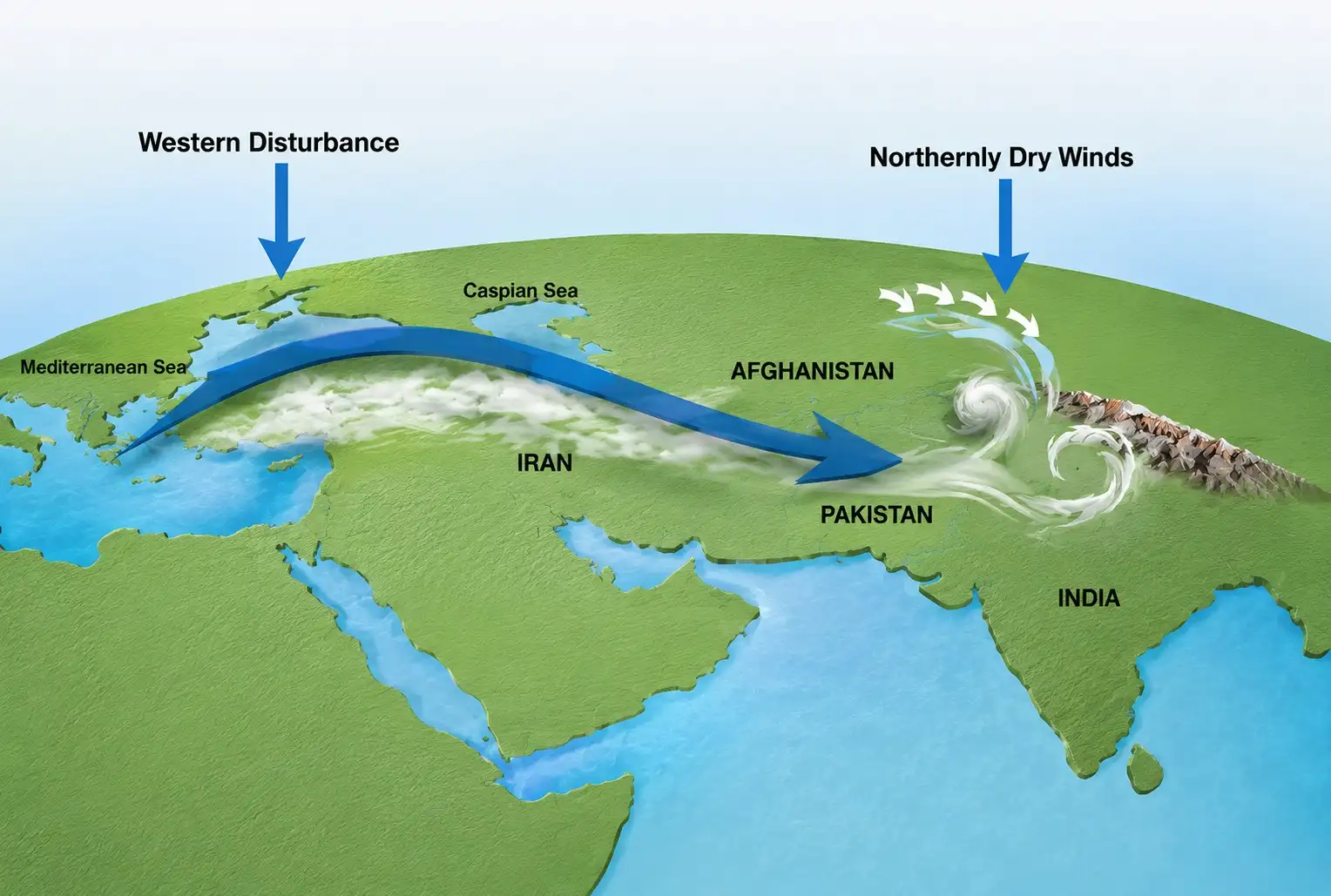
Northwest India recently witnessed relief from rain and thunderstorms after a Western Disturbance weakened and moved eastward.
About Western Disturbances
- Western Disturbances are extratropical storm systems that originate over the Mediterranean Sea.
- They move eastward towards the Indian subcontinent carrying moisture-laden winds.
- These systems interact with the subtropical jet stream and influence weather over Pakistan, India, Nepal, and Bangladesh.
Seasonal Occurrence
- Western Disturbances mainly affect India during the winter season from November to March.
Importance
- They bring winter rainfall and snowfall to northwestern India.
- The rainfall is highly important for Rabi crops such as wheat and mustard in states like Punjab, Haryana, Rajasthan, and Uttar Pradesh.
- Snowfall in the Himalayas helps maintain glaciers and river flow.
Why are They Called Western Disturbances?
- They are called “Western” because they originate from the western regions near the Mediterranean Sea.
- They are called “Disturbances” because they disturb normal weather patterns by bringing sudden rain, snowfall, and storms.
Impacts
Positive Impacts
- Beneficial for agriculture, especially Rabi crops.
- Recharges water resources and supports Himalayan glaciers.
Negative Impacts
- Can cause hailstorms, landslides, flash floods, and damage to crops.
- Intense rainfall may disrupt transport and daily life in northern India.