India’s AI Question: Becoming a Producer of Intelligence Rather Than Just a User
Artificial Intelligence is emerging as the defining technological force of the 21st century, shaping economies, security systems, productivity, and global power structures. India today stands at a critical crossroads. While the country is rapidly becoming a major destination for AI infrastructure and data centres, the deeper challenge is whether India can become a true producer of intelligence and innovation rather than merely a consumer or service provider for technologies created elsewhere.
India’s Emerging AI Infrastructure Push
- Major investments are being made in AI infrastructure across India, including large-scale data centres and AI hubs.
- Global technology companies are increasingly viewing India as an important location for AI operations because of its market size, energy availability, and digital ecosystem.
- India is contributing land, electricity, operational support, and infrastructure for global AI systems.
- However, much of the core technology, advanced chips, and frontier AI models continue to be designed and controlled abroad.
Historical Parallel with India’s IT Revolution
- India experienced a similar trajectory during the IT services boom of the 1990s and 2000s.
- Indian firms became globally successful in software services, outsourcing, and back-end operations.
- Cities such as Bengaluru and Hyderabad emerged as important global technology centres.
- However, India largely specialised in deploying and maintaining technologies developed elsewhere rather than creating foundational technologies itself.
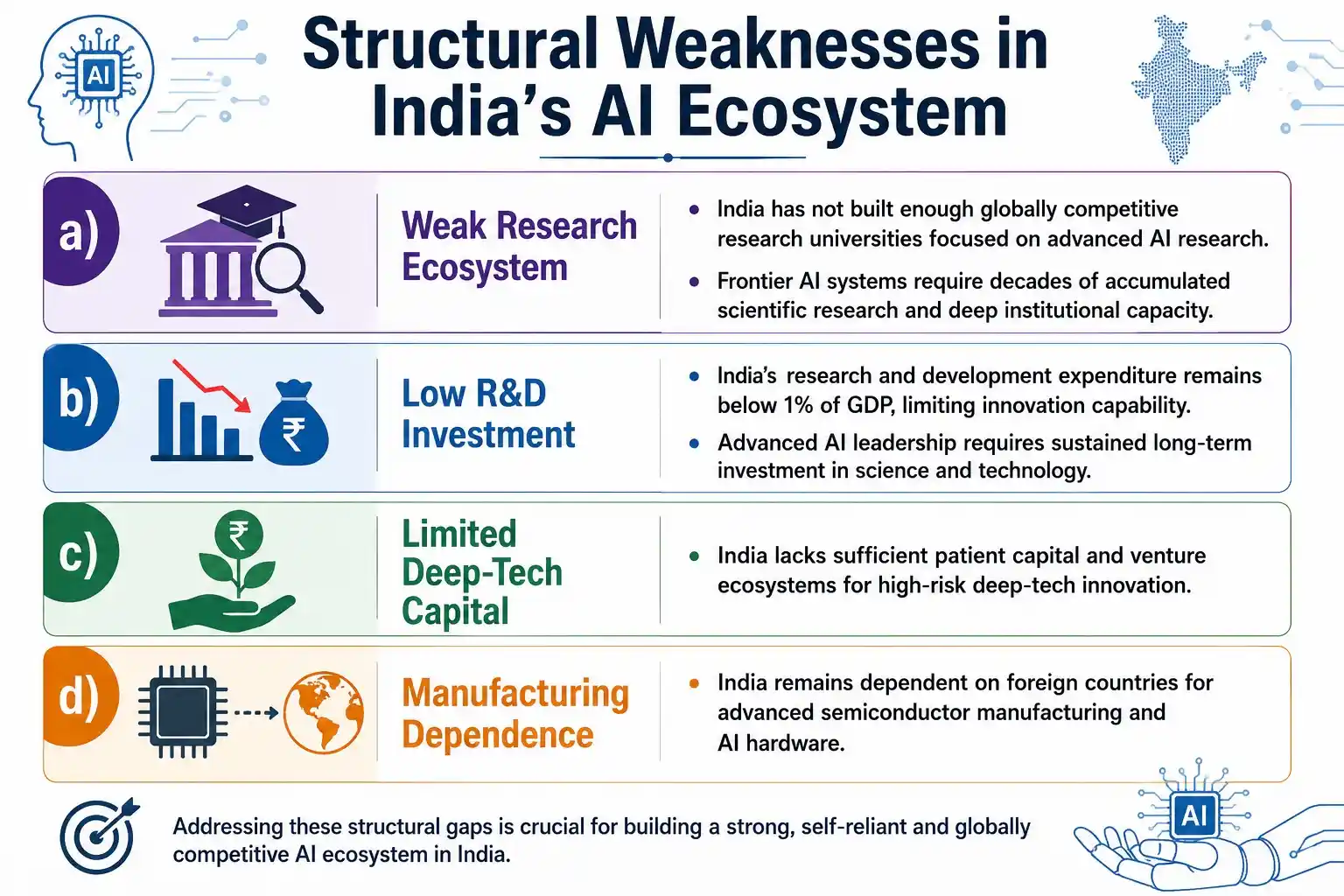
Why Frontier AI Matters
- Frontier AI systems require:
- Massive computational power
- Highly skilled scientific talent
- Advanced semiconductor ecosystems
- Strong research institutions
- Countries leading in AI today possess integrated ecosystems linking universities, industry, finance, and government support.
- Without these foundations, countries risk becoming only low-value participants in the AI economy.
The Risk of Becoming an “AI Tenant”
- India may become a host for infrastructure while remaining dependent on foreign intelligence systems and AI models.
- Data centres and cloud infrastructure may generate economic activity, but they do not automatically create technological sovereignty.
- If India only provides operational support while others control the algorithms, chips, and intellectual property, strategic dependence will deepen.
- This creates a situation where India rents out infrastructure but does not own the core intelligence driving the future economy.
Diffusion vs Creation Debate
- Some experts argue that India’s strength lies in rapidly diffusing AI across society rather than competing at the frontier immediately.
- India’s digital public infrastructure, such as UPI and Aadhaar, demonstrates strong capability in large-scale technological adoption.
- Diffusion can improve productivity in sectors such as:
- Agriculture
- Healthcare
- Education
- Governance
- However, relying only on diffusion without building innovation capacity may create long-term strategic dependence.
Strategic and Geopolitical Implications
- AI is increasingly linked to military systems, cyber security, intelligence gathering, and strategic decision-making.
- Countries that control advanced AI systems may shape future global power balances.
- Dependence on foreign AI systems can weaken strategic autonomy in critical sectors.
- Therefore, AI capability is no longer only an economic issue; it is also a national security concern.
India’s Existing Strengths
a) Large Talent Pool
- India possesses a large number of engineers, programmers, and digital professionals.
b) Strong Digital Infrastructure
- Platforms such as UPI, Aadhaar, and Digital India have demonstrated India’s ability to build scalable public digital systems.
c) Large Market
- India’s vast population and growing digital economy create strong demand for AI applications.
d) Startup Ecosystem
- India has an expanding startup ecosystem that can support AI innovation if backed by stronger research and funding.
What India Needs to Do
a) Build World-Class Research Institutions
b) Increase R&D Spending
c) Develop Semiconductor Capacity
|
d) Create Long-Term Talent Pipelines
e) Promote Sovereign AI Capability
f) Encourage Industry–Academia Collaboration
|
Beyond Infrastructure: Building Cognitive Capacity
- Building AI capability is not only about constructing data centres or attracting foreign investment.
- It requires creating ecosystems that support:
- Scientific curiosity
- Innovation culture
- Long-term research
- Institutional excellence
- Physical infrastructure alone cannot substitute for intellectual and technological capacity.
India’s AI future will not be determined merely by how many data centres it hosts, but by whether it can build the scientific, technological, and institutional foundations needed to create intelligence itself. Becoming a producer rather than a passive user of AI requires long-term investment in research, talent, manufacturing, and innovation ecosystems. If India succeeds, AI can become a pillar of strategic autonomy and economic transformation; if it fails, the country risks remaining dependent on technologies designed and controlled elsewhere.
Renewable Energy Meets Global Electricity Demand Growth for the First Time
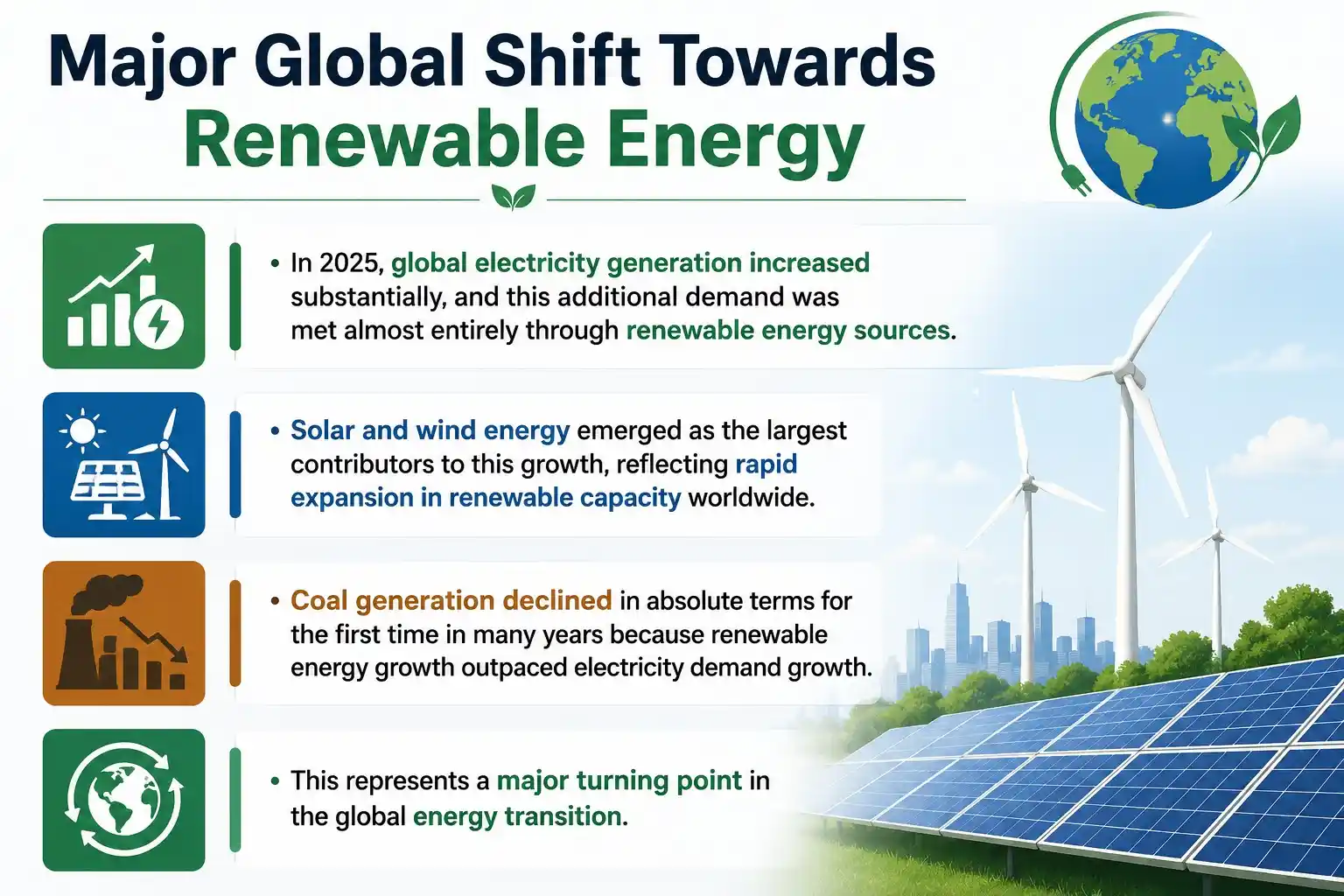
The global energy transition has entered a significant phase, as renewable energy sources have, for the first time, met the entire increase in global electricity demand without requiring additional fossil fuel generation. This marks an important structural shift in the global energy system. However, geopolitical disruptions and continued dependence on fossil fuel imports reveal that the transition remains uneven and incomplete, particularly for countries like India that continue to rely heavily on imported oil and gas.
Reasons Behind the Renewable Energy Expansion
a) Falling Costs
- The cost of solar and wind power has declined sharply over the past decade.
- Battery storage and grid integration technologies have also improved significantly.
b) Policy Support
- Many countries are actively supporting clean energy expansion through subsidies, incentives, and climate commitments.
c) Energy Security Concerns
- Geopolitical conflicts and fuel price volatility have encouraged countries to reduce dependence on imported fossil fuels.
India’s Renewable Energy Progress
- India has emerged as one of the fastest-growing renewable energy markets in the world.
- Solar and wind energy contributed significantly to India’s rising electricity demand in recent years.
- Renewable energy accounted for a major share of India’s new power capacity additions.
- Government initiatives such as: National Solar Mission, PM-KUSUM, Renewable Purchase Obligations (RPOs), Green Hydrogen Mission have accelerated clean energy adoption.
Continued Dependence on Fossil Fuels
- Despite renewable growth, India’s energy system remains heavily dependent on fossil fuels.
- Coal still constitutes the largest share of India’s energy mix.
- India imports a very large proportion of its: Crude oil, LNG (Liquefied Natural Gas) and LPG
- This dependence exposes India to global price shocks and supply disruptions.
Impact of West Asia Conflict
- The closure or disruption of the Strait of Hormuz highlighted India’s energy vulnerability.
- India imports a major share of its crude oil and gas from West Asian countries such as: Saudi Arabia, UAE and Qatar
- Supply disruptions led to:
- Rising import costs
- Higher LPG prices
- Pressure on inflation and fiscal stability
Limits of Renewable Energy in the Short Term
- Renewable energy expansion improves long-term energy security but cannot immediately replace fossil fuels.
- Renewable infrastructure requires:
- Time for installation
- Grid modernisation
- Storage capacity development
- During sudden geopolitical disruptions, countries still depend on existing coal, oil, and gas infrastructure for immediate energy needs.
India’s Response to Energy Disruptions
- India accelerated renewable approvals and attempted to maximise domestic energy production.
- Refinery output was increased to manage supply pressures.
- LNG and LPG imports were diversified towards alternative suppliers.
- Oil marketing companies were financially supported to cushion consumer price shocks.
Structural Challenges in India’s Energy Transitiona) Coal Dominance
b) Import Dependence
c) Storage Constraints
d) Rising Energy Demand
|
Opportunities for Indiaa) Energy Security
b) Green Industrial Growth
c) Climate Commitments
d) Technological Leadership
|
Way Forward for India
a) Accelerate Renewable Deployment
- India must rapidly expand solar, wind, hydro, and green hydrogen capacity.
b) Strengthen Energy Storage
- Investment in battery storage and smart grids is essential for reliable renewable integration.
c) Diversify Energy Imports
- India should reduce excessive dependence on a few regions for oil and gas imports.
d) Improve Domestic Manufacturing
- Domestic production of solar panels, batteries, and clean energy equipment should be strengthened.
e) Build Strategic Reserves
- Strategic petroleum and gas reserves should be expanded to handle future disruptions.
The fact that renewable energy has met the growth in global electricity demand for the first time signals an important transformation in the world energy system. However, India’s experience shows that clean energy progress alone does not automatically eliminate vulnerability to fossil fuel shocks. A balanced strategy that combines rapid renewable expansion, energy diversification, storage infrastructure, and long-term energy security planning will be essential for building a resilient and sustainable energy future.
Prelims Boosters
Electronic Gold Receipts (EGRs)
Context:
- NSE launched Electronic Gold Receipts (EGRs) as a new trading segment
About EGRs
- EGRs are: Dematerialised securities representing physical gold
- Similar to: Shares and ETFs
- Gold is stored in: SEBI-regulated vaults
- Investors hold EGRs in: Demat accounts
Key Features
1. Backed by Physical Gold
2. SEBI Regulation
| 3. Vault Manager
4. Tradable on Exchange
|
How EGR Works
Step 1: Physical gold deposited in accredited vaults
Step 2: Gold converted into EGR units
Step 3: Units credited to demat account
Step 4: Investors can: Trade EGRs and Convert back into physical gold
Participants
– Jewellers, Refiners, Traders, Retail investors, Institutional investors
Significance
- Promotes: Transparent gold trading, Standardisation and Secure storage
- Reduces risks linked to: Physical handling of gold
Apnoea Test
Context:
- Supreme Court is examining concerns regarding the safety and reliability of the apnoea test used for determining brain death
About
- The Apnoea Test is a medical test used to confirm brain death
- It checks whether the: Brainstem is functioning or not
- Brainstem controls automatic functions like: Breathing and Heart regulation
Aim of the Test
- To check if the patient can: Breathe independently when CO₂ levels rise
- If no breathing effort occurs → indicates: Permanent loss of brainstem function
How the Test Works
1. Pre-Oxygenation
2. Ventilator Removal
3. CO₂ Threshold Check
|
4. Observation
5. Safety Measures
|
Significance
Brain Death Confirmation
- Important test for: Declaring brain death
Organ Donation
- Brain death certification allows: Organ retrieval/transplantation
Concerns
- Ventilator withdrawal may: Increase CO₂ & acidity and Worsen brain injury
- Debate exists on: Safety and conclusiveness of the test
Project Deepak
Context:
- Project Deepak of the BRO celebrated its 66th Raising Day in Shimla
About Project Deepak
- Started in: 1962
- Under: Border Roads Organisation (BRO)
- Works in difficult Himalayan terrain of:
- Himachal Pradesh– Shimla, Kinnaur, Kullu, Lahaul-Spiti
Major Contributions
Strategic Roads
- Developed: Hindustan–Tibet Road and Important stretches of Manali–Leh Highway
Border Connectivity
- Improved transport in: Remote border regions and High-altitude areas
Disaster Relief
- Active in: Landslide clearance, Emergency restoration and Humanitarian assistance
Border Roads Organisation (BRO)About
Functions
Motto
|
Significance
- Strengthens: Border security, Military logistics and Regional connectivity
- Supports: Tourism, Disaster response and Local economy
Philippines
Context:
- A magnitude 6.0 earthquake struck Samar Island in the PhilippinesAbout Philippines
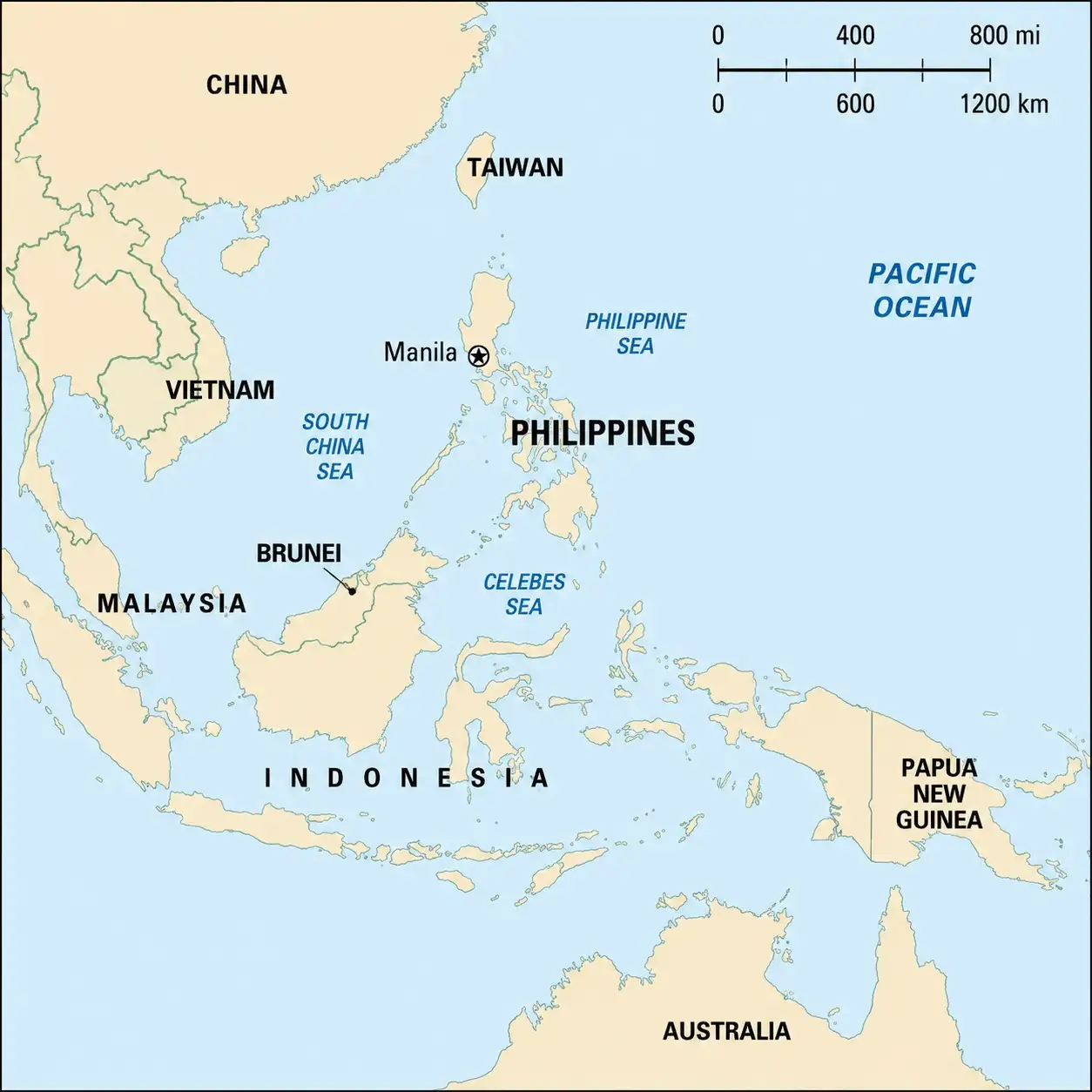
- Country in: Southeast Asia
- Type: Island nation in western Pacific Ocean
- Capital: Manila
Surrounding Water Bodies
- South China Sea → North & West
- Philippine Sea → East
- Celebes Sea → South
- Sulu Sea → Southwest
Geographical Features
1. Climate
2. Highest Peak: Mount Apo3. Major Rivers
|
4. Major Lake
5. Volcanoes
|
Natural Resources
- Timber, Petroleum, Nickel, Cobalt, Copper, Gold, Silver
Important Fact
- Philippines is the: 3rd largest producer of geothermal energy
- After: USA and Indonesia
Germanium (Ge)
Context:
- India developed its first germanium-free thermal imaging payload for drones
About
- Germanium is a chemical element
- Symbol: Ge and Atomic Number: 32
- Nature: Metalloid (shows properties of both metals & non-metals)
- Appearance: Silvery-grey
Key Properties
1. Crystal Structure
|
2. Chemical Stability
|
3. Occurrence
|
Applications
Electronics & Semiconductors
- Used in: Transistors and Semiconductor devices
Fiber Optics
- Important in: Fiber optic communication systems
Thermal Imaging
- Used in: Infrared optics & thermal sensors
Major Producers
- China → ~60% production
- Others: Canada, Finland, Russia and USA
Significance
- Critical mineral for: Defence technology, Electronics and Communication systems
- Reducing dependence on germanium can improve: Strategic self-reliance