Women’s Reservation and Delimitation: Constitutional Transformation of Representation
Government has proposed Constitutional Amendment Bills based on 2011 Census data framework. Lok Sabha strength proposed to increase from 543 seats to 850 members. One-third reservation for women introduced in Lok Sabha and State Assemblies. Delimitation to be undertaken before implementation of women’s reservation provisions nationwide.
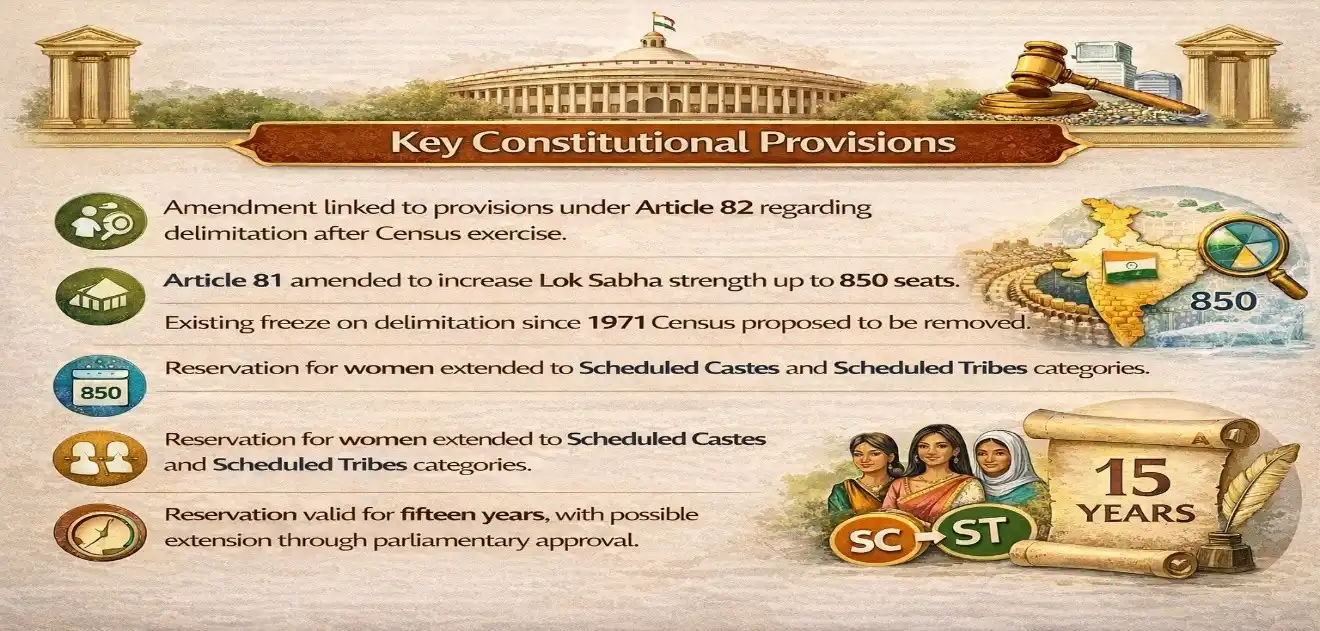
Shift in Delimitation Framework
- Earlier system mandated delimitation after every Census exercise compulsorily across states.
- New proposal removes mandatory periodic delimitation linked strictly with Census cycles.
- Parliament empowered to decide timing and necessity of delimitation exercises flexibly.
- Latest published Census data, currently 2011 Census, will be basis for delimitation.
- Ensures stability while allowing periodic adjustments when required by legislative decision.
Institutional Mechanism
- Delimitation Commission to be constituted with powers equivalent to civil courts.
- Commission headed by Supreme Court judge with Election Commission representation included.
- Orders of Commission will have force of law and cannot be challenged in courts.
- Process includes public consultations, draft proposals, and final notification of constituencies.
Rationale Behind the Reform
- Delimitation required to reflect demographic changes and evolving population distribution patterns.
- Women’s reservation linked to delimitation to ensure equitable geographical representation.
- Aims to correct historical under-representation of women in legislative institutions.
- Ensures fair distribution of seats across states based on updated population data.
- Attempts to balance democratic equality with federal considerations across regions.
Political and Federal Concerns
- Southern states fear reduction in representation due to lower population growth rates.
- Northern states may gain higher seat share due to larger population increases.
- Debate over fairness between population-based representation and development performance indicators.
- Concerns regarding political consensus and federal balance in seat redistribution process.
- Demand for consultations and consensus-building before implementing delimitation reforms.
Implications for Representation
- Women’s reservation may significantly increase female participation in legislatures.
- Enhances inclusiveness and diversity in democratic decision-making processes across governance levels.
- Could transform policy priorities towards gender-sensitive governance outcomes nationwide.
- May lead to emergence of new political leadership at grassroots and national levels.
- Changes electoral dynamics by altering constituency composition and political competition patterns.
Administrative and Practical Challenges
- Delay in conducting next Census creates uncertainty regarding updated population data usage.
- Complex exercise requiring mapping, data verification, and stakeholder consultations across states.
- Potential legal and political disputes despite limited judicial review provisions.
- Ensuring fairness in boundary delimitation while maintaining administrative convenience remains challenging.
- Need for transparency to avoid allegations of political bias in constituency restructuring.
Way Forward
- Build political consensus through consultations with states to maintain cooperative federalism principles.
- Use updated and accurate Census data to ensure fairness and legitimacy of delimitation exercise.
- Ensure transparency in Commission proceedings to build public trust and acceptance.
- Strengthen institutional capacity for efficient and timely delimitation implementation process nationwide.
- Complement women’s reservation with capacity building and leadership development initiatives.
Reform represents significant constitutional shift in representation, federal balance, and gender inclusion. Balancing population-based representation with regional equity remains key policy challenge. Effective implementation will determine success of women’s reservation and delimitation reforms. Marks a transformative step towards inclusive and representative democratic governance in India.
Digital Payments in India: Growth, Challenges and Safety Mechanisms
India’s digital payments ecosystem has expanded rapidly, led by Unified Payments Interface innovation. It has transformed financial inclusion, enabling seamless, real-time, and low-cost digital transactions nationwide. However, rapid expansion has increased cyber fraud risks and security concerns significantly. Ensuring safe, secure, and inclusive digital payments has become a major policy priority.
Evolution of Digital Payments in India
- India is now one of the largest digital payments markets globally today.
- Growth driven by Digital India Programme and JAM Trinity integration initiatives nationwide.
- Expansion of smartphones and affordable internet boosted adoption across rural and urban areas.
- UPI dominates with billions of transactions, becoming backbone of retail payment systems.
Key Components of Digital Payment Ecosystem
- Unified Payments Interface enables instant bank transfers for peer and merchant transactions.
- Developed by National Payments Corporation of India ensuring interoperability and scalability benefits.
- Other systems include IMPS, NEFT, RTGS, Aadhaar Payment System, and BBPS platforms
- Multi-layered ecosystem ensures resilience, flexibility, and continuity in digital financial transactions.
Impact of Digital Payments
- Financial inclusion improved through Jan Dhan accounts and Direct Benefit Transfers integration.
- Digital payments accessible even in rural areas, bridging urban-rural financial divide significantly.
- Provides convenience through instant, twenty-four-hour transactions at minimal transaction costs.
- Promotes formal economy, improves tax compliance, and reduces leakages in welfare delivery.
- Empowers MSMEs through digital transaction history enabling easier access to formal credit.
- Enhances transparency by creating digital audit trails and reducing informal cash transactions.
- Positions India as global leader in real-time payments and digital public infrastructure.
Challenges and Risks
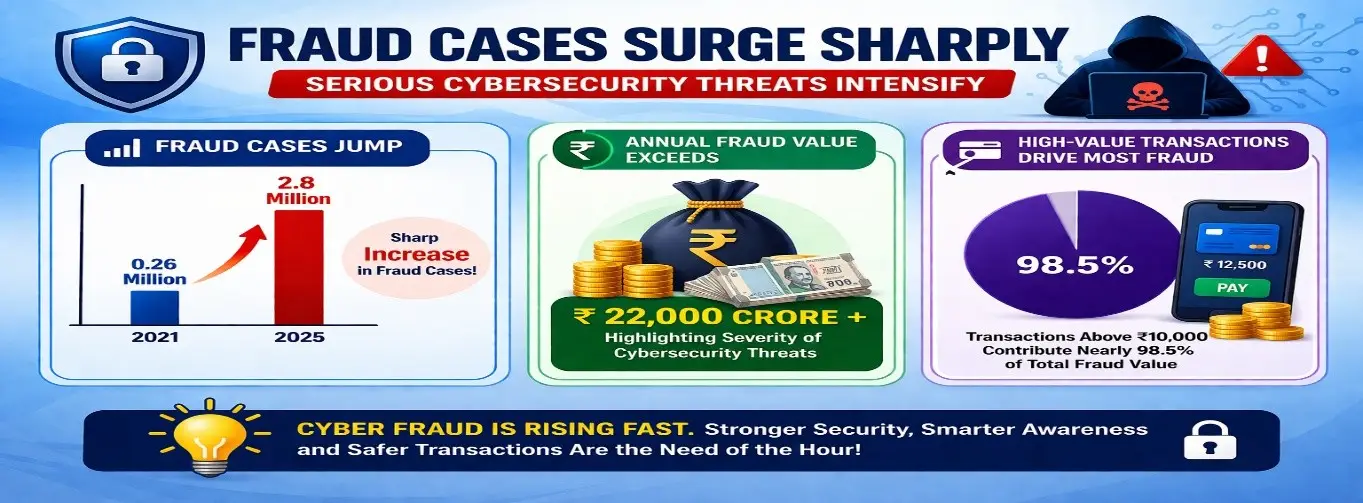
- Rising cyber fraud includes phishing, fake applications, identity theft, and social engineering scams.
- Authorised Push Payment frauds exploit user trust, leading to voluntary but manipulated transfers.
- Data privacy concerns persist due to risks of breaches and misuse of financial information.
- Digital divide limits access for rural populations, elderly users, and digitally illiterate citizens.
- Infrastructure issues like network failures and outages affect reliability of digital payments.
- Regulatory coordination gaps exist between RBI, banks, and fintech ecosystem stakeholders.
Safety Mechanisms and Regulatory Measures
- RBI has introduced robust cybersecurity guidelines, audits, and compliance monitoring frameworks.
- Fraud prevention proposals include cooling-off periods and additional authentication for high-value transactions.
- Transaction caps and beneficiary whitelisting reduce risks associated with suspicious accounts.
- Artificial intelligence tools enable real-time fraud detection and behavioural anomaly identification.
- Tokenization and encryption techniques protect sensitive financial data from unauthorized exposure risks.
- Real-time monitoring systems generate alerts for suspicious transactions, enhancing user protection.
- Regulatory sandbox allows testing of fintech innovations while ensuring consumer protection safeguards.
- Zero liability protection ensures customers are safeguarded against unauthorized digital transactions.
- Grievance redress mechanisms ensure timely resolution of disputes and compensation for losses.
- Awareness campaigns like RBI Kehta Hai educate users about safe digital practices nationwide.
- Cyber awareness drives improve digital literacy and reduce vulnerability to fraud risks.
- Central Bank Digital Currency provides secure alternative to private digital payment platforms.
Way Forward
- Focus on targeted safeguards instead of imposing blanket restrictions on digital payment usage.
- Enhance digital literacy programmes to empower users against fraud and cybersecurity threats.
- Strengthen coordination between RBI, banks, fintech companies, and law enforcement agencies.
- Promote user-centric, technology-driven frameworks ensuring security without compromising innovation growth.
- Maintain balance between inclusion, innovation, and security in expanding digital payment ecosystem.
Digital payments have transformed India into a global model of financial inclusion and innovation. However, rising fraud risks require continuous strengthening of regulatory and technological safeguards. A balanced approach combining technology, awareness, and regulation is essential for sustainability. Ensuring security and trust will determine long-term success of India’s digital payment ecosystem.
Prelims Boosters
Bonus Issue (Scrip Issue / Capitalisation Issue)
Context:
- Life Insurance Corporation of India announced its first-ever bonus issue
About
- A bonus issue is when a company gives free additional shares to existing shareholders
- It is also called a scrip issue or capitalisation issue
- It is issued from company reserves (retained profits), not fresh capital
How It Works
- The company decides a fixed ratio for issuing bonus shares
- Example:
- In a 2:1 bonus issue, a shareholder gets 2 shares for every 1 share held
- If a person has 10 shares → it becomes 30 shares
- However: Share price falls proportionally and Total investment value remains same
Key Features
- It increases share capital of the company
- It does not change market capitalisation
- Market Capitalisation: Price × total shares remains unchanged
- No dilution of ownership: Shareholders’ proportionate ownership remains same
- Face value of shares remains unchanged
Objective
- To reward existing shareholders
- To improve market image and investor confidence
- To make shares more affordable (by reducing price per share)
Taxation
- Bonus shares are not taxed at the time of issue
- Capital gains tax applies when shares are sold
Bonus Issue vs Stock Split
- Bonus Issue: Shares given free from reserves
- Stock Split: Existing shares are divided into smaller units and Done to increase liquidity when price is high
- In both cases: Market cap remains unchanged
Significance
- It enhances liquidity of shares
- It attracts more investors
- It reflects company’s strong financial position
Baisakhi (Vaisakhi) Festival
Context:
- Celebrated with devotion and enthusiasm in Punjab
About
- Baisakhi is a spring harvest festival of Northern India
- It is mainly celebrated by the Sikh and Punjabi community
- It marks the Sikh New Year
- It is observed on 13th or 14th April every year
Agricultural Importance
- It is a harvest festival
- Farmers celebrate successful crop yield
- It represents: Prosperity, Hard work and New beginnings
Religious Significance (Sikhism)
|
Cultural Significance
|
Pan-India Variations
- It coincides with regional New Year festivals:
- Pohela Boishakh (West Bengal)
- Vishu (Kerala)
- Bohag Bihu (Assam)
- Puthandu (Tamil Nadu)
Significance
- It highlights agricultural prosperity and cultural unity
- It has deep religious importance in Sikh history
- It reflects India’s diversity through regional celebrations
Arachnids
Context:
- Fossil evidence shows extinct arachnid species existed in Europe
About
- Arachnids are a group of arthropods (jointed-legged animals)
- They belong to the phylum Arthropoda
- They are wingless, mostly carnivorous, and have 8 legs
Key Characteristics
- They have: Segmented body, Hard exoskeleton (outer covering) and Jointed appendages (legs)
- Body is divided into two segments and they do not have jaws
Respiration
- They breathe using: Book lungs (layered structures for gas exchange) and Tracheal tubes
Feeding Mechanism
- They inject digestive fluids into prey. Then they suck liquefied food
Examples
- Spiders, Scorpions, Ticks, Mites
- Some species are venomous (e.g., black widow spider)
Habitat
- Found mainly in terrestrial environments
- Present on all continents
- Some species live in freshwater habitats
Lifestyle
- They may be: Predatory, Parasitic and Free-living
Arachnids vs Insects
Body segments:
|
Number of legs:
|
Significance
- Play an important role in ecosystem balance (pest control)
- Some species are medically important (venomous/parasitic)
Raimona National Park
Context:
- A new gecko species Cyrtodactylus raimonaensis discovered near the park
About
- Raimona National Park is a protected area in Assam
- It serves as a gateway to the Eastern Himalayan biodiversity hotspot
- It is the 6th National Park of Assam (declared in 2021)
Location
- Located in Kokrajhar district (Bodoland Territorial Region – BTR), Assam
- Lies near: Bhutan border. Around 53 km from Kokrajhar. Around 253 km from Guwahati
History
- Declared National Park on 5 June 2021 (World Environment Day)
- Earlier part of Ripu Reserved Forest
- Created to restore degraded forest ecosystem
Geographical Features
- Located in foothills of Eastern Himalayas
- Altitude ranges from 85 m to 1042 m
- Rivers: Sankosh River (west boundary) and Saralbhanga River (east boundary)
- Ecosystem: Moist deciduous forests, Terai-Duar grasslands and Evergreen patches
Transboundary Importance
- Forms a transboundary landscape with:
- Phibsoo Wildlife Sanctuary (Bhutan)
- Buxa Tiger Reserve (West Bengal)
Fauna and Importance
- Important habitat of Golden Langur (endangered primate)
- Acts as an elephant corridor between Assam and Bhutan
- Rich biodiversity due to location at two hotspots (Eastern Himalaya + Indo-Burma)
Significance
- Enhances biodiversity conservation in Northeast India
- Supports rare and endemic species
- Strengthens India–Bhutan ecological connectivity
e-SafeHER Programme
Context:
- Launched to train one million rural women in cybersecurity
About
- e-SafeHER is a cybersecurity awareness programme for rural women
- It is implemented under the Information Security Education and Awareness (ISEA) framework
- It is anchored by the Ministry of Electronics and Information Technology
- It follows a peer-led, community-based model
Aim
- It aims to train one million women by 2029
- It seeks to ensure safe participation in digital platforms
- It focuses on cyber safety in digital payments and livelihoods
Key Features
- Cyber Sakhi Model: Women are trained as Cyber Sakhis (peer educators). They spread awareness within their communities
- Multilingual Content: Training is provided in local languages using audio-visual tools
- Use of SHGs: It works through Self-Help Groups (SHGs) to reach rural areas
- Phased Implementation: It starts in Madhya Pradesh and Odisha and then expands
- Blended Learning: Combines training + community outreach
Significance
- It helps women become digitally secure and aware
- It protects against cyber fraud, scams, and identity theft
- It promotes digital inclusion and financial empowerment
- It supports the vision of Cyber Secure Bharat