India-UAE Partnership and India’s Strategic Interests in West Asia
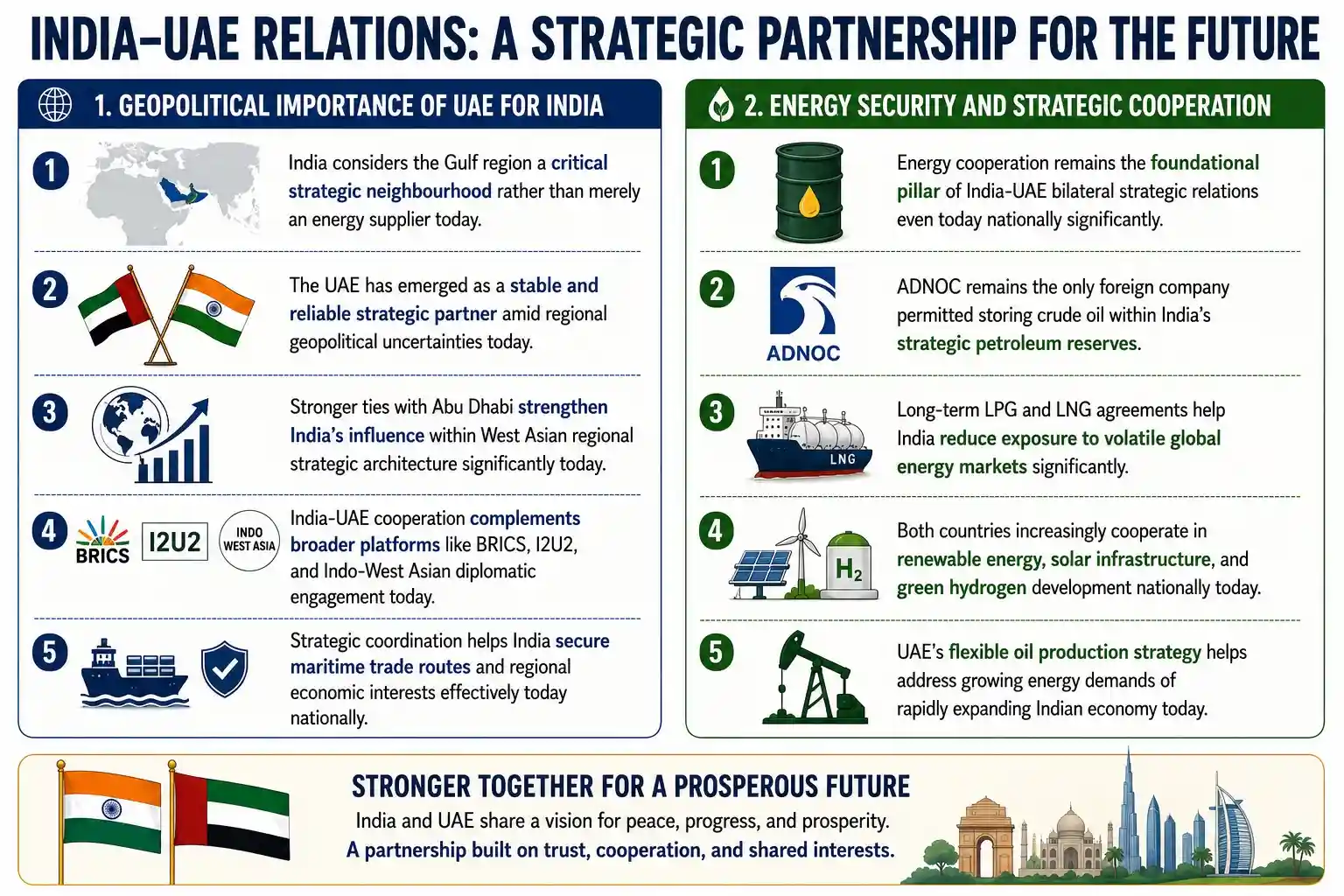
India-UAE relations have evolved from a traditional energy partnership into a comprehensive strategic relationship spanning trade, defence, technology, infrastructure, and regional security. The partnership now forms a central pillar of India’s “Link West” policy and reflects India’s growing engagement with West Asia as part of its extended strategic neighbourhood. Amid rising geopolitical instability in the Gulf region, the India-UAE partnership has emerged as an important stabilizing force supporting India’s economic and strategic interests.
Trade and Economic Integration
- Comprehensive Economic Partnership Agreement significantly expanded bilateral trade and economic integration between both countries nationally.
- India-UAE bilateral merchandise trade recently crossed the important milestone of over one hundred billion dollars.
- Both nations have set ambitious targets for expanding bilateral trade volumes by the year 2032.
- Bilateral Investment Treaty improves investor confidence by providing stronger legal protection for foreign investments today.
- UAE sovereign wealth funds increasingly invest within Indian infrastructure, banking, logistics, and housing finance sectors nationally.
Financial and Digital Connectivity
- Local Currency Settlement system enables direct trade settlements using Indian Rupees and UAE Dirhams today.
- Reduced dependence upon dollar-based settlements lowers transaction costs and foreign exchange related financial risks nationally.
- Integration of India’s UPI with UAE digital payment platforms simplifies cross-border retail transactions significantly today.
- Digital financial connectivity strengthens remittance flows benefiting millions of Indians working within the UAE today nationally.
- Expanding fintech cooperation reflects modernization of India-UAE economic and commercial partnership frameworks significantly today nationally.
Defence and Maritime Cooperation
- Defence cooperation increasingly focuses upon co-development, technology sharing, and long-term strategic collaboration nationally today.
- Joint naval exercises strengthen maritime security across the Persian Gulf and Strait of Hormuz region today.
- Maritime cooperation protects crucial sea lanes carrying significant portions of India’s international trade nationally today.
- Counter-terrorism coordination between both countries has expanded significantly in recent years across security domains nationally.
- Ship repair and industrial infrastructure agreements strengthen India’s maritime and defence manufacturing capabilities nationally today.
Technology, Space, and Educational Cooperation
- Space cooperation includes satellite development, launch support, and sharing remote sensing related technological capabilities today.
- Collaboration between IN-SPACe and UAE Space Agency strengthens advanced scientific and commercial partnerships significantly today.
- IIT Delhi-Abu Dhabi campus represents an important milestone within India’s educational diplomacy efforts internationally today.
- Educational collaboration supports talent development in artificial intelligence, sustainability, and advanced technological research nationally today.
- Expanding innovation partnerships strengthen long-term people-to-people and knowledge-based bilateral engagement significantly today nationally.
Role of Indian Diaspora and Cultural Diplomacy
- The Indian diaspora in UAE represents the country’s largest expatriate community contributing significantly economically today.
- Indian workers and professionals send substantial remittances supporting families and economic growth within India nationally.
- Cultural and social links strengthen mutual understanding and political trust between both countries significantly today nationally.
- Inauguration of BAPS Hindu Mandir symbolized growing religious tolerance and deeper diplomatic confidence internationally today.
- Diaspora communities continue functioning as an important bridge connecting societies, economies, and cultural relations nationally.
Challenges Within the Partnership
- Regional conflicts in West Asia threaten maritime trade routes and energy supply chains significantly today nationally.
- Any escalation within Gulf tensions directly affects safety of millions of Indian expatriates residing there today.
- India must carefully balance relations with UAE alongside ties with Iran and Saudi Arabia strategically today.
- Large infrastructure projects like IMEC face delays because of geopolitical instability and regulatory coordination challenges today.
- Dependence upon regional stability remains a major vulnerability affecting long-term strategic and economic cooperation nationally today.
Measures for Strengthening Bilateral Relations
- India and UAE should institutionalize stronger maritime security coordination and joint naval operational mechanisms nationally.
- Non-oil trade sectors including pharmaceuticals, agritech, startups, and technology should receive greater attention today.
- Both countries should accelerate digital trade infrastructure supporting future India-Middle East-Europe Economic Corridor development nationally.
- Renewable energy and green hydrogen collaboration can deepen long-term sustainability and climate cooperation nationally today.
- Greater educational, scientific, and innovation partnerships can further strengthen multidimensional bilateral engagement nationally today significantly.
India-UAE relations today represent far more than a conventional bilateral partnership centered upon oil and trade. The relationship has evolved into a multidimensional strategic partnership supporting India’s energy security, economic growth, defence preparedness, technological modernization, and regional influence. In an increasingly uncertain global environment, stronger India-UAE cooperation not only advances mutual national interests but also contributes toward stability, connectivity, and strategic balance across the wider West Asian region.
Rupee Depreciation and India’s Economic Stability
The recent depreciation of the Indian rupee against the US dollar has revived debates regarding whether market forces alone should determine exchange rates. While some economists support limited intervention and a freely adjusting currency, others warn that uncontrolled depreciation can fuel inflation, worsen external vulnerability, and destabilize investor confidence. For an import-dependent economy like India, managing currency stability remains closely linked with inflation control, trade balance, and macroeconomic stability.
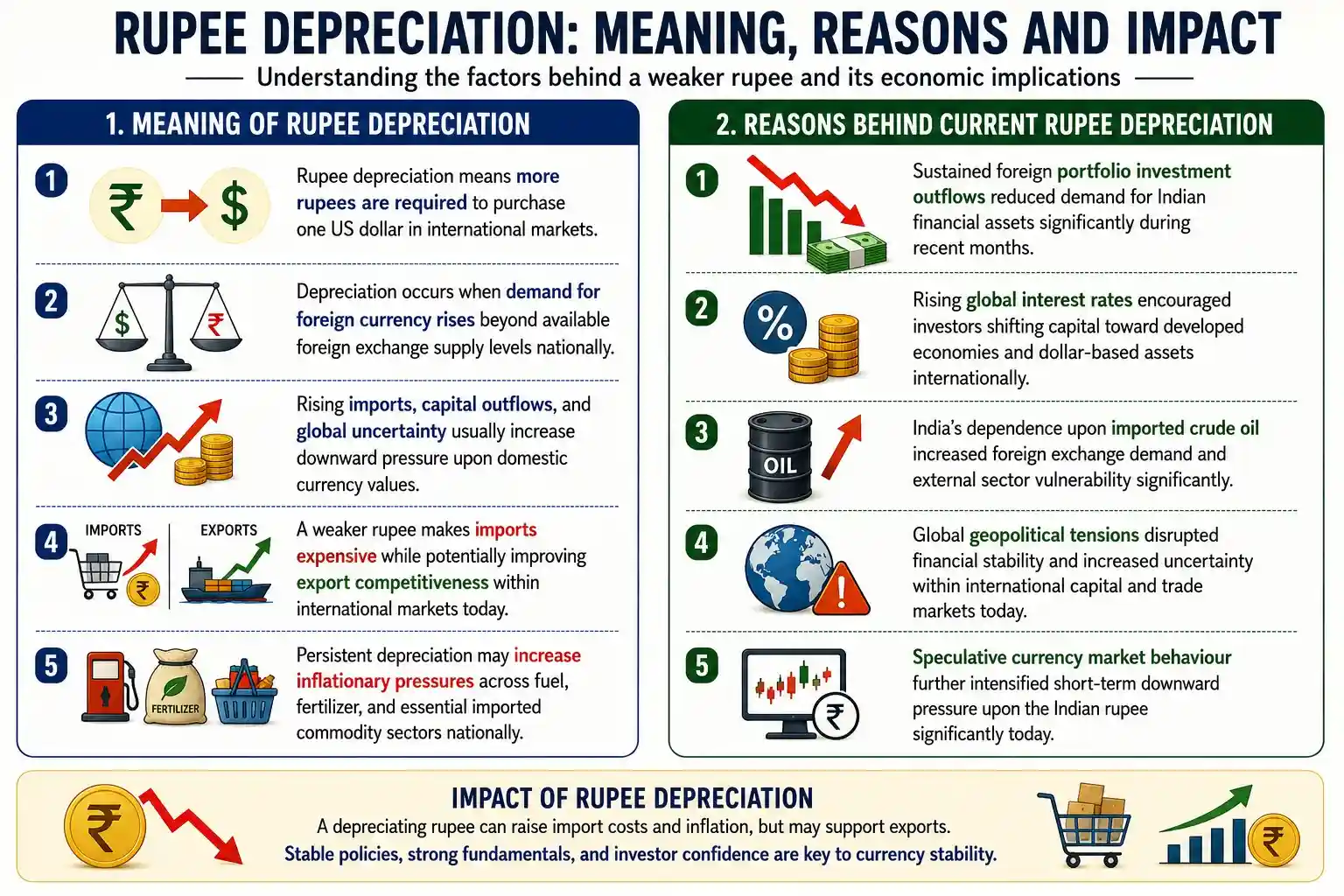
Economic Effects of Rupee Depreciation
Positive Effects
|
Negative Effects
|
Difference Between Weak Rupee and Falling Rupee
- A weak rupee may reflect long-term economic fundamentals and structural external sector realities within India today.
- A falling rupee indicates rapid and continuous depreciation caused by panic or speculative market behaviour nationally.
- Weak currency can support exports gradually, whereas sudden currency collapse creates macroeconomic instability risks significantly.
- Falling rupee increases inflation expectations as consumers and firms anticipate future price increases across markets today.
- Persistent depreciation may create self-reinforcing cycles where expectations themselves drive further currency weakening nationally today.
Role of Current Account Deficit and Capital Flows
- Current account deficit arises when imports exceed exports creating higher foreign exchange demand within economy today.
- Foreign capital inflows often finance India’s current account deficit and stabilize external sector conditions significantly today.
- Sudden withdrawal of foreign investment creates pressure upon exchange rates and foreign exchange reserve positions nationally.
- Speculative investment behaviour often influences short-term currency movements beyond underlying economic fundamentals significantly today.
- Dependence upon volatile capital flows increases vulnerability of emerging economies during periods of global uncertainty today.
Should RBI Intervene in Currency Markets?
Arguments Supporting Intervention
|
Arguments Against Excessive Intervention
|
Policy Measures for Managing Currency Stability
- Strengthening export competitiveness can reduce dependence upon volatile foreign capital inflows over longer periods nationally today.
- Reducing unnecessary imports, especially gold and luxury goods, can improve current account balance significantly today.
- Stable macroeconomic policies and controlled inflation strengthen investor confidence within Indian financial markets nationally today.
- Diversifying energy sources and expanding renewable energy can reduce crude oil import dependence significantly today nationally.
- RBI should maintain balanced intervention preventing panic while avoiding excessive distortion of market mechanisms nationally today.
Rupee depreciation is not merely a currency issue but a reflection of broader structural realities involving trade deficits, capital flows, inflation, and global economic uncertainty. While limited depreciation may improve export competitiveness, uncontrolled weakening can destabilize prices and investor confidence. Therefore, India requires a balanced strategy combining prudent RBI intervention, stronger domestic production, export expansion, and macroeconomic stability to ensure that exchange rate movements support long-term economic growth rather than create financial vulnerability.
Prelims Boosters
Sperm Whales
Context:
A recent study found that sperm whale clicks have a complex sound structure similar to human speech patterns.
About Sperm Whales
- The sperm whale (Physeter macrocephalus) is the largest toothed whale in the world.
- It has the largest brain of any known animal in Earth’s history.
Habitat and Distribution
- Sperm whales are found in deep, ice-free oceans across the world.
- They usually inhabit waters deeper than 1,000 metres.
Distribution Pattern
- Adult males travel to colder polar waters.
- Females and calves remain mainly in tropical and subtropical waters.
Physical Features
Large Square Head
Spermaceti Organ
|
Other Features
Deep Diving Ability
|
Main Food
- Giant squid and other deep-sea organisms.
Social Structure
- They live in highly social family groups.
- Groups are generally matriarchal (led by females).
- Different whale groups develop distinct cultural behaviours passed across generations.
Communication System
Acoustic Clicks
- Sperm whales communicate using powerful sound clicks.
- These click patterns are called codas.
Earlier Understanding
- Scientists earlier believed codas were based mainly on rhythm and timing.
New Discovery
- Research now shows whales also change the tonal quality of clicks.
- These sound variations resemble human vowel patterns such as: “ah” and “ee”
Importance
- This suggests sperm whales may possess a more advanced communication structure similar to language systems.
Significance of the Discovery
- Shows possible convergent evolution: Humans and whales independently developed complex communication systems.
- Indicates advanced: Social interaction, Learning behaviour, Structured communication in whales
Conservation Status
- IUCN Red List: Vulnerable
Sweden joins India’s Shukrayaan Mission
Context:
During the Prime Minister’s visit to Sweden, ISRO and the Swedish National Space Agency signed an MoU for Sweden’s participation in India’s Venus mission, Shukrayaan.
About Shukrayaan Mission
- Shukrayaan, officially called the Venus Orbiter Mission (VOM), is India’s first dedicated mission to Venus. “Shukrayaan” means Venus Craft.
Mission Details
- Approved by the Union Cabinet with a budget of around ₹1,236 crore.
- The mission will carry 19 scientific payloads.
Launch Details
- Planned launch date: 29 March 2028 and Launch vehicle: LVM-3 rocket of ISRO
Journey
- The spacecraft is expected to take around 112 days to reach Venus.
- Venus orbit insertion is planned for 19 July 2028.
Objective of Shukrayaan
The mission aims to study:
- Venusian atmosphere, Surface and volcanic activity, Cloud movement and weather patterns, Subsurface layers, Atmospheric evolution, Possibility of ancient water presence on Venus
Special Technique
- The spacecraft will use aerobraking: A method where atmospheric drag is used to gradually reduce spacecraft speed and adjust orbit.
Sweden’s Contribution
Venusian Neutrals Analyser (VNA)
- Sweden will contribute a scientific instrument called: Venusian Neutrals Analyser (VNA)
Part of VISWAS Payload
- The VNA instrument will be integrated into: VISWAS (Venus Ionospheric and Solar Wind particle AnalySer)
Role of the Swedish Instrument
The Swedish payload will study:
- Energetic Neutral Atoms (ENAs), Plasma boundaries around Venus and Interaction between solar wind and Venusian ionosphere
Importance of the Study
- Venus does not have a strong magnetic field like Earth.
- Solar winds gradually strip away its atmosphere.
- Data from the mission will help scientists understand:
- Atmospheric loss, Climate evolution of planets and Space weather interactions
International Collaboration
- Sweden joins other international partners: Russia and Germany
- This highlights growing global confidence in ISRO’s deep-space missions.
Asian Productivity Organization (APO)
Context:
The 68th Session of the Asian Productivity Organization (APO) Governing Body is being hosted by India in New Delhi.
About Asian Productivity Organization (APO)
- The Asian Productivity Organization (APO) is an intergovernmental organization established in 1961.
- It works to improve productivity and promote sustainable socio-economic development among member countries.
Objective
- To enhance productivity through: Mutual cooperation, Knowledge sharing, Capacity building, Innovation and technology exchange
Membership
- APO membership is open to countries in the Asia-Pacific region that are members of UN ESCAP (United Nations Economic and Social Commission for Asia and the Pacific).
Members
- APO currently has 21 member economies.
These include:
- India, Japan, South Korea, Bangladesh, Sri Lanka, Nepal, Pakistan, Thailand, Vietnam, Indonesia, Malaysia, Singapore, Iran, Mongolia, Philippines, etc.
India and APO
- India is a founding member of APO.
National Productivity Organization (NPO)
- The National Productivity Council (NPC) under the Ministry of Commerce and Industry acts as India’s designated NPO.
Headquarters
- APO headquarters is located in Tokyo, Japan.
Organisational Structure
Governing Body
- It is the highest decision-making authority of APO.
- Meets annually to: Set strategic direction, Approve proposals and Review performance of the Secretariat
Secretariat
- Managed by the Secretary-General.
- Responsible for implementation of APO programmes and activities.
National Productivity Organizations (NPOs)
- Member countries coordinate with APO through their respective NPOs.
Key Areas of Work
- Industrial productivity, Green productivity, Digital transformation, MSME development, Agriculture productivity, Skill development and innovation
South Korea
Context:
Recently, the Defence Ministers of India and South Korea held bilateral discussions in Seoul.
About South Korea
- South Korea occupies the southern half of the Korean Peninsula in East Asia.
Bordering Country
- It shares a land border with North Korea.
Maritime Boundaries
South Korea is surrounded by seas on three sides:
- East: East Sea (Sea of Japan), West: Yellow Sea, South: East China Sea
Korea Strait
- The Korea Strait separates South Korea from the Japanese island of Tsushima.
Capital
- Seoul is the capital and largest city of South Korea.
Geographical Features
Climate
Major Rivers
Major Islands
Mountain Ranges
|
Highest Peak
Natural ResourcesImportant mineral resources include:
|
Strategic Importance
- South Korea is an important economic and technological power in East Asia.
- It plays a major role in: Indo-Pacific security, Semiconductor manufacturing and Global trade and technology supply chains
India–South Korea Relations
- India and South Korea share a Special Strategic Partnership.
- Cooperation areas include: Defence, Trade and investment, Technology, Shipbuilding, Electronics
Ammonium Sulphate
Context:
Recently, ICAR suggested the use of ammonium sulphate for paddy cultivation as a cost-effective fertilizer option.
About Ammonium Sulphate
- Ammonium sulphate is an inorganic sulphate salt.
- It is produced by reacting: Sulphuric acid and Ammonia
Chemical Composition
- It contains: 21% Nitrogen (N) and 24% Sulphur (S)
- These are essential nutrients required for plant growth.
Properties of Ammonium Sulphate
- White coloured solid, Odourless in nature, Highly soluble in water and Has a high melting point
Importance in Agriculture
Fertilizer Use
- Widely used as a nitrogen fertilizer, especially for alkaline soils.
Nutrient Supply
- Provides: Nitrogen for vegetative growth and Sulphur for protein synthesis and crop quality
Paddy Cultivation
- Considered an affordable fertilizer option for paddy crops.
Sources
Ammonium sulphate is obtained:
- As a by-product from the steel industry, Especially from coke oven gas
- From certain metallurgical and chemical industries
Applications of Ammonium Sulphate
Agriculture
Water Treatment
Food Industry
|
Pharmaceutical Industry
Textile and Leather Industry
|