Child Safety and Youth Vulnerability in India
A recent global study published in The Lancet has revealed the alarming scale of child sexual abuse worldwide. Covering data from 204 countries between 1990 and 2023, the report highlights that millions of children face abuse before adulthood. India presents a deeply concerning picture, with nearly one-third of girls and one-seventh of boys experiencing sexual abuse before the age of 18. These findings underline the urgent need for stronger legal protection, social awareness, institutional accountability, and community-based intervention mechanisms.
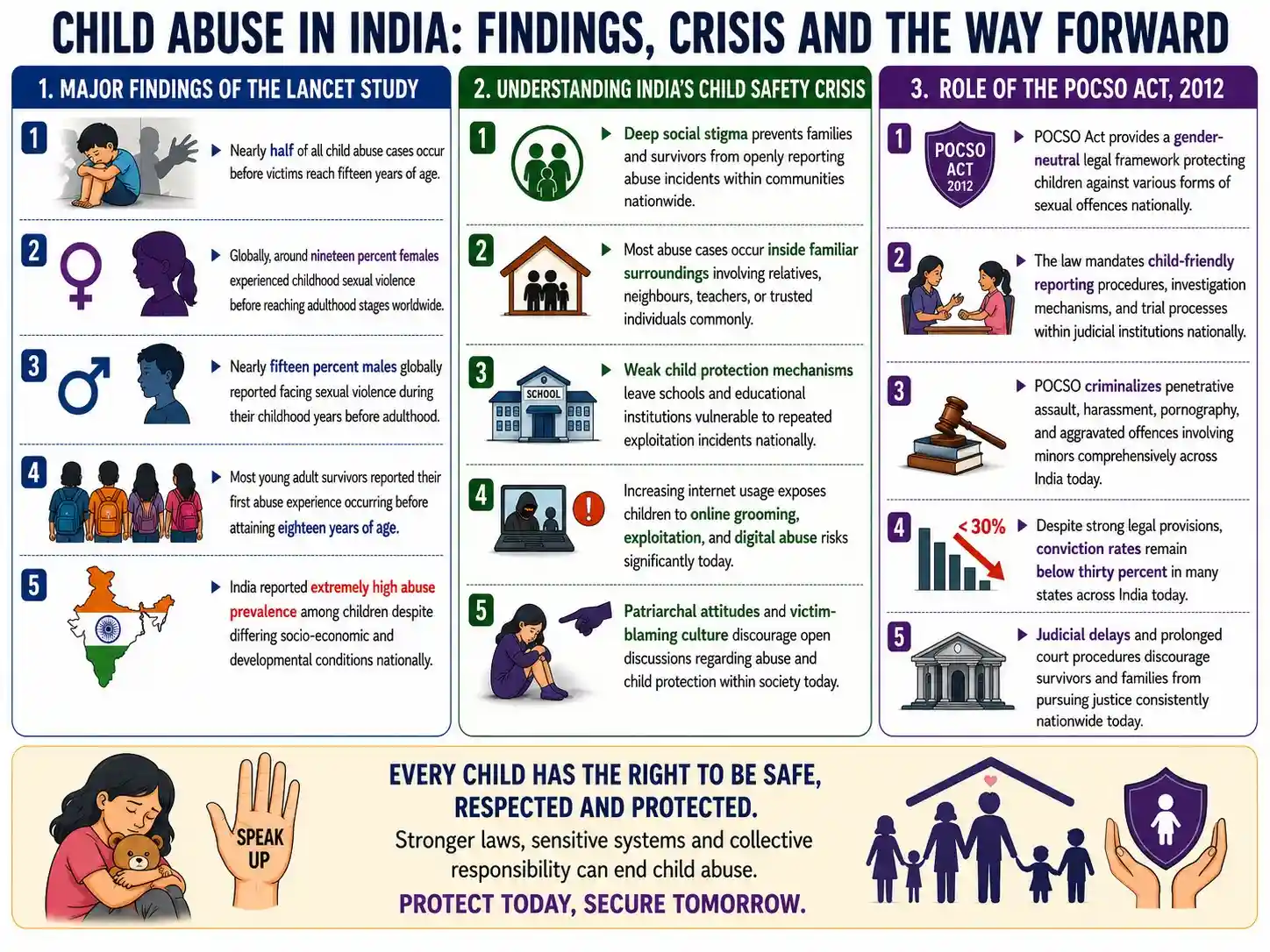
Major Findings of The Lancet Study
- Nearly half of all child abuse cases occur before victims reach fifteen years of age.
- Globally, around nineteen percent females experienced childhood sexual violence before reaching adulthood stages worldwide.
- Nearly fifteen percent males globally reported facing sexual violence during their childhood years before adulthood.
- Most young adult survivors reported their first abuse experience occurring before attaining eighteen years of age.
- India reported extremely high abuse prevalence among children despite differing socio-economic and developmental conditions nationally.
Understanding India’s Child Safety Crisis
- Deep social stigma prevents families and survivors from openly reporting abuse incidents within communities nationwide.
- Most abuse cases occur inside familiar surroundings involving relatives, neighbours, teachers, or trusted individuals commonly.
- Weak child protection mechanisms leave schools and educational institutions vulnerable to repeated exploitation incidents nationally.
- Increasing internet usage exposes children to online grooming, exploitation, and digital abuse risks significantly today nationally.
- Patriarchal attitudes and victim-blaming culture discourage open discussions regarding abuse and child protection within society today.
Role of the POCSO Act, 2012
- POCSO Act provides a gender-neutral legal framework protecting children against various forms of sexual offences nationally.
- The law mandates child-friendly reporting procedures, investigation mechanisms, and trial processes within judicial institutions nationally.
- POCSO criminalizes penetrative assault, harassment, pornography, and aggravated offences involving minors comprehensively across India today.
- Despite strong legal provisions, conviction rates remain below thirty percent in many states across India today.
- Judicial delays and prolonged court procedures discourage survivors and families from pursuing justice consistently nationwide today.
Causes Behind Rising Abuse Statistics
- Increased awareness and stronger reporting systems have encouraged more families to report abuse cases nationally today.
- Rural areas suffer from poor legal awareness and weak institutional support mechanisms for survivors significantly today.
- Social taboos continue forcing victims into silence due to fear of stigma and humiliation within communities.
- Gender inequality and patriarchal norms create environments where abuse often remains normalized or deliberately hidden socially.
- Weak coordination between police, schools, healthcare systems, and welfare departments worsens child protection failures nationally today.
Regional and Social Variations
- States with stronger enforcement mechanisms often report higher abuse numbers because reporting systems function effectively today.
- Kerala and Maharashtra demonstrate comparatively better awareness and institutional responsiveness toward child protection issues nationally.
- Bihar and Uttar Pradesh continue facing challenges involving low awareness and weak enforcement capacity significantly today.
- Urban regions increasingly face online exploitation and cyber-based child abuse through digital platforms and applications today.
- Rural communities witness greater familial abuse combined with severe underreporting and institutional neglect issues nationally today.
Impact Upon Survivors
- Survivors frequently experience depression, anxiety, trauma, and long-term psychological distress after abuse incidents significantly today.
- Many children withdraw socially and struggle academically because abuse affects emotional stability and concentration levels greatly.
- Childhood trauma often creates difficulties in forming healthy relationships and stable careers during adulthood phases later.
- Victims may experience suicidal thoughts, low self-esteem, and severe emotional insecurity throughout their lives afterward.
- Lack of timely counselling worsens trauma and delays emotional recovery among vulnerable child survivors significantly today.
Weaknesses in Existing Support Systems
- India faces severe shortages of specialized mental healthcare services for child abuse survivors across regions nationally.
- Children often lack safe, transparent, and confidential mechanisms for reporting abuse incidents without fear nationally today.
- Schools rarely provide comprehensive sex education or awareness regarding bodily autonomy and personal safety concepts nationally.
- Teachers and institutional staff frequently lack training to identify behavioural indicators of trauma among children effectively.
- Child welfare systems remain underfunded and overstretched despite rising abuse cases across the country today nationally.
Role of Civil Society and NGOs
- Organizations like Save the Children actively support rescue, rehabilitation, and awareness campaigns for vulnerable children nationally.
- Kailash Satyarthi Children’s Foundation advocates stronger child rights protection and prevention mechanisms across India today nationally.
- NGOs provide counselling, legal assistance, and rehabilitation support for survivors lacking institutional protection mechanisms nationally today.
- Public-private partnerships can strengthen preventive infrastructure and improve access to child support services nationally today.
- Community participation remains essential for breaking silence and encouraging safer environments for vulnerable children nationally today.
International Lessons for India
- Nordic countries reduced abuse rates through compulsory sex education and high social awareness programmes nationally implemented.
- Australia adopted centralized offender registries and strong preventive community awareness systems against child abuse nationally today.
- International experiences highlight importance of prevention rather than relying only upon punitive legal mechanisms after abuse.
- Coordination between healthcare, education, legal, and welfare sectors improves child protection outcomes significantly across societies today.
- India can adapt global best practices according to local cultural and socio-economic realities effectively nationwide today.
Way Forward
Justice System Reforms
- Establish dedicated fast-track courts exclusively handling POCSO cases for quicker justice delivery nationwide across India today.
- Create child-friendly police stations and specialized forensic units for sensitive handling of survivors nationally today consistently.
- Mandatory sensitivity training should be introduced for police, judges, and medical professionals handling abuse cases nationally.
Educational Reforms
- Schools should introduce age-appropriate sex education focusing upon safety, consent, and digital awareness comprehensively nationwide today.
- Teachers must receive training to identify behavioural warning signs linked with trauma and abuse incidents nationally.
- Educational curricula should promote gender equality and challenge harmful patriarchal stereotypes within society systematically nationwide.
Community and Digital Safety
- Panchayats and local welfare groups should conduct awareness campaigns regarding child protection and reporting mechanisms nationally.
- Childline services and emergency helplines require expansion for faster and broader accessibility across regions nationally today.
- Parents should receive guidance regarding online monitoring tools and safe internet practices for children nationally today.
Data and Research
- India requires a centralized database tracking child abuse patterns and regional vulnerability trends comprehensively nationwide today.
- Collaboration between governments, universities, and NGOs can strengthen evidence-based child protection policies nationally today consistently.
The Lancet study clearly demonstrates that child sexual abuse is not merely an isolated criminal issue but a widespread societal crisis requiring urgent structural reform. Laws such as the POCSO Act provide an important foundation, but legal mechanisms alone cannot eliminate abuse without social awareness, institutional accountability, and community participation. India must adopt a preventive, empathetic, and data-driven child protection framework that safeguards children within homes, schools, digital spaces, and society at large.
PRELIMS BOOSTERS
Agni-1 Missile
Context:
India recently successfully tested the Agni-1 ballistic missile from the Integrated Test Range at Balasore, Odisha.
About Agni-1 Missile
- Agni-1 is a single-stage, solid-fuel ballistic missile.
- It is part of India’s Agni missile series developed under the Integrated Guided Missile Development Programme (IGMDP).
Type of Missile
- It is mainly classified as a:Short-Range Ballistic Missile (SRBM)
- With lighter payloads, its range extends enough to also qualify as a:Medium-Range Ballistic Missile (MRBM)
Range
- Operational range:Around 700 km to 1,200 km
Propulsion
- Powered by a solid-propellant booster.
- The technology is based on ISRO’s SLV-3 launch vehicle programme.
Launch Platforms
Agni-1 can be launched from:
- Road-mobile Transporter Erector Launchers (TELs)
- Rail-mobile platforms
Nuclear Capability
- Agni-1 is a nuclear-capable missile.
- It was inducted into service by the Strategic Forces Command (SFC) in 2007.
Agni Missile Series
India’s Agni missile family includes:
- Agni-I, Agni-II, Agni-III, Agni-IV, Agni-V, Agni Prime
Most Advanced
- Agni-V is currently the most advanced operational missile in the series.
Background
- The missile originated from the Integrated Guided Missile Development Programme (IGMDP) launched in 1983.
Sickle Cell Disease (SCD)
Context:
A recent study by AIIMS Bhopal highlighted the need for early and advanced health screening in children suffering from Sickle Cell Disease.
About Sickle Cell Disease (SCD)
- Sickle Cell Disease is a group of inherited blood disorders affecting hemoglobin in red blood cells (RBCs).
- Hemoglobin is the protein that carries oxygen throughout the body.
Most Severe Form
- The most common and severe type is:Sickle Cell Anemia
How Does It Affect the Body?
Normal RBCs
- Normally, red blood cells are:Disc-shaped, Flexible and Able to move smoothly through blood vessels
In SCD
- Abnormal hemoglobin called Hemoglobin S changes RBCs into:Sickle-shaped and Crescent-shaped cells
Impact on Blood Flow
- These sickle-shaped cells:Become rigid, Block blood vessels, Reduce oxygen supply to body tissues
- They may also stick to blood vessel walls, slowing or stopping blood flow.
Causes of SCD
- SCD is caused by a defective sickle cell gene.
Inheritance
- A person develops SCD only if:
- One defective gene is inherited from the mother
- One defective gene is inherited from the father
Sickle Cell Trait
- If a person inherits only one defective gene:It is called Sickle Cell Trait
- Such individuals are usually healthy but can pass the gene to children.
Symptoms
Early Symptoms
|
Later Complications
|
Treatment Options
Bone Marrow Transplant
- Stem cell or bone marrow transplant can potentially cure SCD.
Other Treatments
- Medicines to reduce symptoms
- Blood transfusions
- Pain management
- Infection prevention
Gene Therapy
- Gene therapy is emerging as a promising treatment.
- The UK became the first country to approve gene therapy for SCD.
Significance
- Early diagnosis and screening help prevent serious complications.
- Important for improving child health and reducing mortality.
India and SCD
- SCD is common among several tribal populations in India.
- The Government of India launched the:
- National Sickle Cell Anaemia Elimination Mission
- Goal:Eliminate SCD as a public health problem by 2047.
India–Africa Forum Summit (IAFS)
Context:
The fourth India–Africa Forum Summit (IAFS-IV) was recently postponed due to the Ebola virus outbreak.
About India–Africa Forum Summit
- The India–Africa Forum Summit is the highest institutional platform for dialogue and cooperation between India and African nations.
- It was established in 2008.
Objective
The summit aims to strengthen:
- Political relations, Economic cooperation, Trade and investment, Technology transfer, Capacity building, People-to-people ties between India and Africa
Broader Vision
- The summit reflects commitment towards:
- South–South cooperation, Inclusive development, Sustainable partnerships, Multilateral cooperation
Previous Summits
IAFS-I
|
IAFS-II
|
IAFS-III
|
Major Objectives of IAFS
Diplomatic and Strategic Cooperation
- Strengthening India–Africa political and strategic ties.
Economic Partnership
- Increasing trade, investment, and industrial cooperation.
Technology and Innovation
- Promoting:Technology transfer, Innovation, Industrial development
Development Cooperation
- Expanding cooperation in:Health, Agriculture, Education, Infrastructure
Sustainable Development
- Supporting sustainable growth and regional integration in Africa.
Youth and Skill Development
- Encouraging:Entrepreneurship, Skill development and Youth empowerment
Security Cooperation
- Enhancing:
- Peace and security cooperation
- Maritime security collaboration
Fort St. George
Context:
The Tamil Nadu Chief Minister recently visited the Secretariat campus and important locations within Fort St. George in Chennai.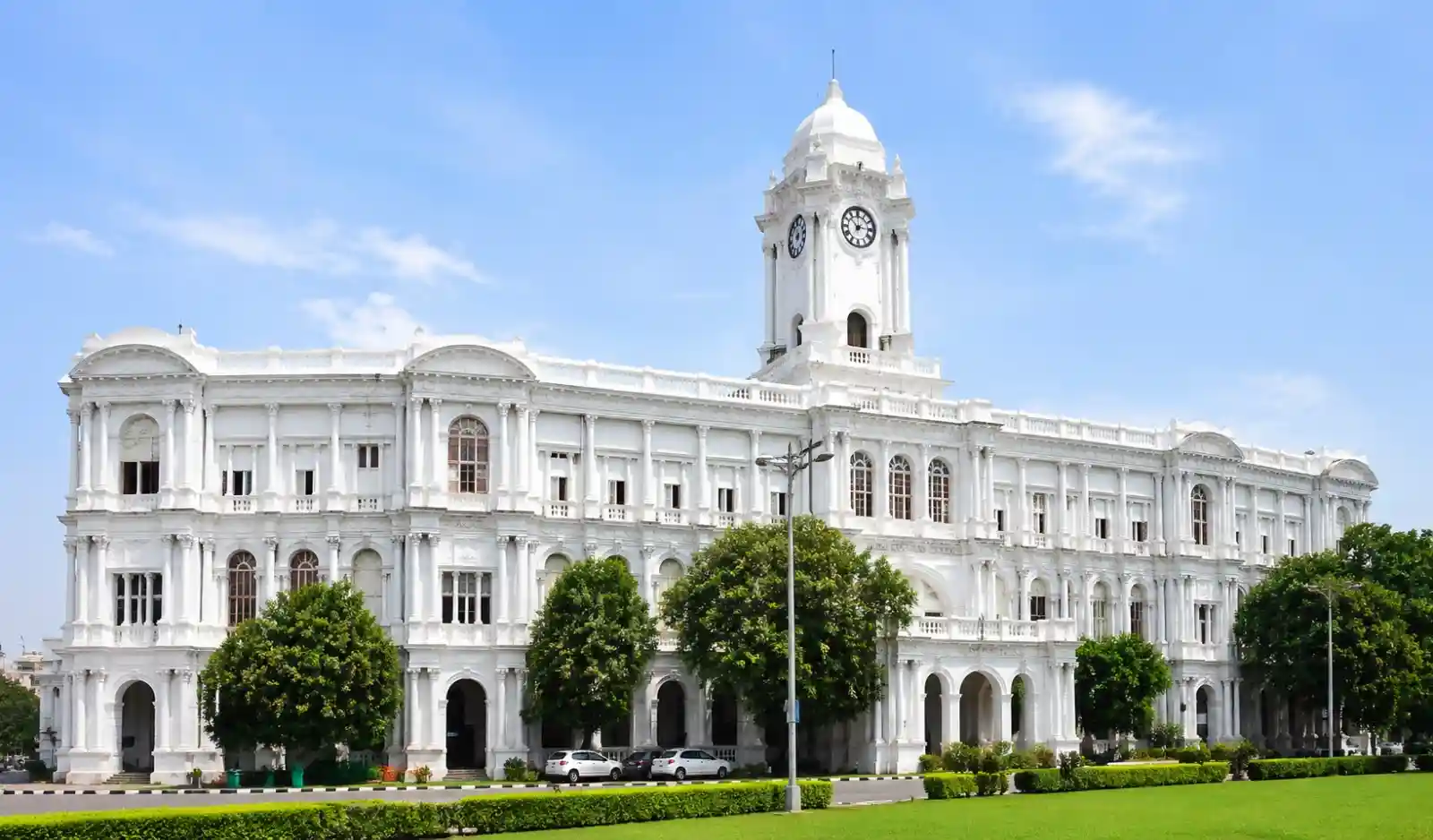
About Fort St. George
- Fort St. George is a historic fort located in Chennai, Tamil Nadu.
- It was built by the British East India Company in 1644.
- It is regarded as the first English fortress in India.
Purpose of Construction
- The fort was established as:A trading centre and A defensive military outpost
- It helped the British protect their commercial interests along the Coromandel Coast.
Architectural Features
- Built mainly using:Brick and Stone
- It has:Thick defensive walls, Tall entrance gates, Rectangular fort design
Important Structures Inside the Fort
St. Mary’s Church
- Located within the fort complex.
- It is considered the oldest Anglican church in India.
Fort Museum
- Displays colonial-era artifacts, weapons, uniforms, paintings, and historical records.
Historical Importance
- The fortified settlement around Fort St. George became the foundation of:Madras city, Present-day Chennai
- The fort played a major role in:British expansion in South India, Colonial administration and trade
Present Role
- Today, Fort St. George functions as the administrative headquarters of Tamil Nadu.
Government Institutions Located Here
- Tamil Nadu Secretariat, Legislative Assembly, Other important government offices
Sanghmitra Patrol Vessel
Context:
The Indian Navy recently launched the next-generation offshore patrol vessel ‘Sanghmitra’ at GRSE, Kolkata.
About Sanghmitra Patrol Vessel
- Sanghmitra is an indigenously built Next Generation Offshore Patrol Vessel (NGOPV).
- It has been constructed by:Garden Reach Shipbuilders & Engineers (GRSE), Kolkata.
Background
- The vessel is part of the Indian Navy’s programme to build 11 Next Generation Offshore Patrol Vessels simultaneously at two shipyards.
Naming
- The ship is named after Sanghamitra, the daughter of Emperor Ashoka.
- Sanghamitra is historically known for spreading Buddhism to Sri Lanka.
Crest Design
The ship’s crest includes:Ursa Major constellation and A red and white lighthouse symbol
Physical Specifications
- Length: Around 113 metres
- Width: Around 14.6 metres
- Displacement: About 3,000 tonnes
Speed and Endurance
- Cruising endurance:Around 8,500 nautical miles at 14 knots speed
- Maximum speed:Around 23 knots
Capabilities of Sanghmitra
The vessel is designed for multiple maritime operations:
Surveillance and DefenceMonitoring and securing maritime areas of interest. |
Search and Rescue (SAR)Rescue operations during emergencies at sea. |
Protection of Offshore AssetsSafeguarding offshore installations and economic assets. |
Humanitarian Assistance and Disaster Relief (HADR)Relief and rescue support during natural disasters. |
Anti-Piracy OperationsTackling piracy and maritime security threats. |