Differentiating Welfare and Development
In contemporary democratic politics, development has become a central electoral promise, often framed to appeal broadly across voters. However, this political usage frequently blurs the distinction between welfare (short-term relief) and development (long-term structural change). This confusion can mask inequalities, oversimplify complex socio-economic challenges, and create unrealistic expectations about the pace and nature of development outcomes.
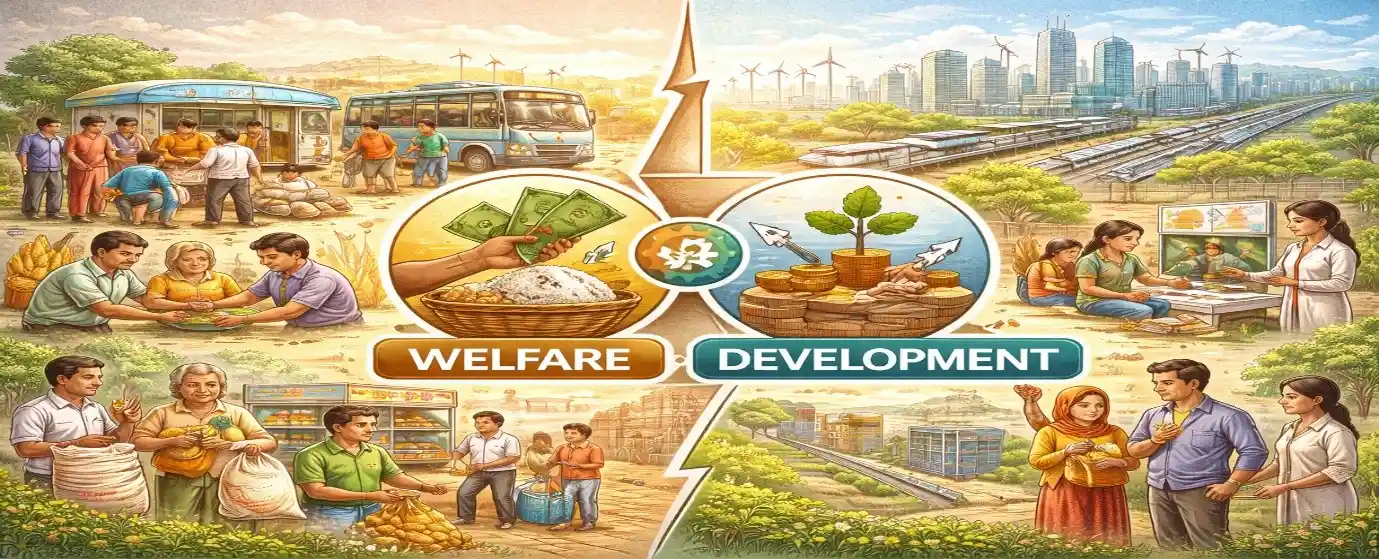
Conceptual Difference: Welfare vs Development
Welfare (Immediate Support)
|
Development (Long-Term Transformation)
|
Why Confusion Occurs
- Political discourse often overlaps welfare and development narratives for electoral appeal
- Development is projected through visible outputs like roads, housing, infrastructure
- Distributional concerns and inequalities get obscured under broad development claims
- Welfare programmes coexist with growth policies, creating blurred boundaries in practice
- Difference in time horizon—welfare short-term, development long-term—adds to confusion
Nature of Development Process
- Development is a gradual, cumulative process, not a series of quick achievements
- It involves institution-building, human capital formation, and technological adoption
- Requires policy continuity, stable governance, and strong state capacity
- Influenced by ideas like capability approach (expanding freedoms via education and health)
- Not driven by immediate electoral cycles, but by long-term investments and reforms
Tensions Between Welfare and Development
- Fiscal constraints create trade-offs between redistribution and productive investment
- Excessive welfare may crowd out investment and reduce efficiency
- Poorly designed welfare schemes lead to leakages, exclusion errors, and low impact
- Overemphasis on short-term results distorts development priorities
Dangers of Welfare Populism
- Populist measures like free electricity, loan waivers, cash transfers target quick gains
- These policies may prioritise electoral success over long-term economic capacity
- Can strain public finances and reduce funds for infrastructure and public goods
- Often fail to enhance productivity or create durable economic transformation
Positive Role of Welfare (If Designed Well)
- Welfare is not inherently problematic; it can support development if complementary
- Schemes like nutrition support, employment guarantees, and basic income floors
- Help in building human capital, reducing vulnerability, and improving productivity
- Act as a foundation for inclusive and sustainable development
Need for Balanced Approach
- Welfare and development must be seen as complementary, not interchangeable
- Policies should aim for both immediate relief and long-term transformation
- Emphasis on quality design, targeting, and fiscal sustainability of welfare schemes
- Align welfare programmes with long-term development goals and productivity gains
Way Forward
- Shift political discourse from “quick development” to realistic long-term transformation
- Strengthen institutions, governance, and policy continuity across electoral cycles
- Ensure welfare is productive, targeted, and fiscally sustainable
- Prioritise public goods like education, healthcare, infrastructure, and rule of law
A clear distinction between welfare and development is essential for sound policymaking. While welfare ensures immediate social protection, development drives sustained economic and human progress. The challenge lies not in choosing one over the other, but in designing policies where welfare complements and strengthens development, rather than substituting it.
Meghalaya’s Response to Classroom Crisis: A Model for Early Childhood Development
A silent crisis is unfolding in classrooms globally, where a large proportion of children are unable to achieve basic learning outcomes. Nearly 70% of children in low- and middle-income countries cannot read simple text by age 10, highlighting deep systemic gaps beyond schooling. Meghalaya’s approach recognises that learning begins much before formal schooling, and focuses on early childhood development as the foundation for long-term human capital formation.
Understanding the Crisis
- Learning crisis reflects failure of foundational skills, not just schooling systems
- Literacy and cognition are shaped in early childhood, not only classrooms
- Traditional education systems often ignore early years (0–6 age group)
- Shift required from education governance to early childhood development focus
Why Early Childhood Matters
- Brain development is most rapid in first five years of life
- Early experiences shape language, cognition, emotional and social skills
- Development occurs sequentially—from simple neural connections to complex functions
- Strong early foundation determines future learning, productivity, and health outcomes
Meghalaya’s Early Childhood Development (ECD) Model
Context-Specific Challenges
- High maternal mortality, anaemia, and low institutional deliveries
- Gaps in antenatal care, poverty, remoteness, and weak health trust
- Nearly one-fifth population below six years, making ECD critical
- Recognises interlinkages of health, nutrition, and developmental delays
Systems-Based Approach
- Meghalaya adopted integrated ECD Mission combining multiple sectors
- Focus on early, coordinated intervention for long-term human capital outcomes
- Moves beyond fragmented schemes toward holistic child development strategy
Key Innovation: GMCD Framework
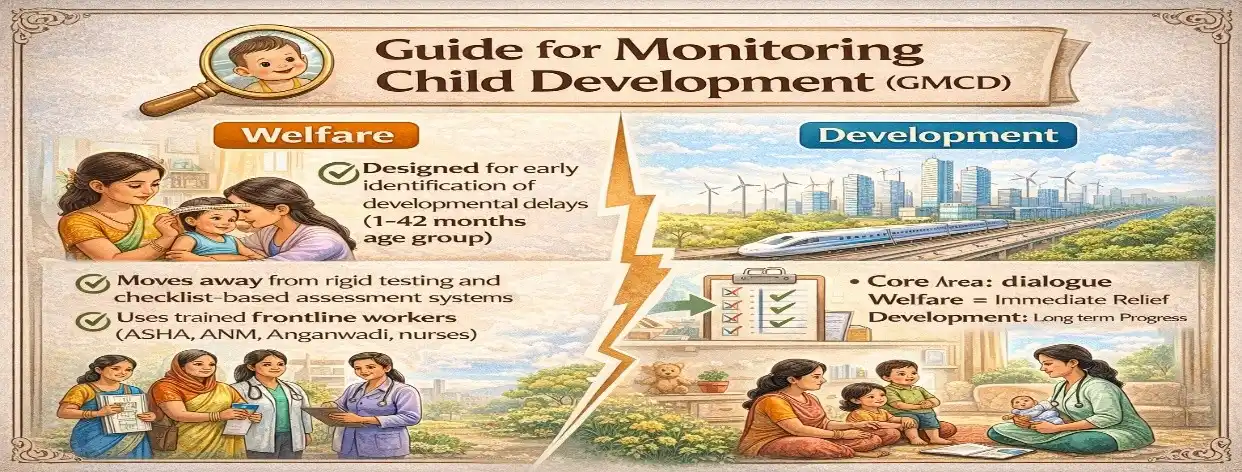
Core Features of the Approach
-
Caregiver-Centric Model
- Parents treated as co-observers and experts of child behaviour
- Focus on natural settings—play, communication, daily activities
-
Early Identification & Intervention
- Enables low-cost, home-based interventions at early stages
- Prevents escalation of developmental delays into long-term disadvantages
-
Five Integrated Pillars
- I. Health
- II. Adequate nutrition
- III. Responsive caregiving
- Iv. Safety and security
- v. Early learning opportunities
Impact and Evidence
- Preliminary data shows over 80% children had no visible developmental delays
- Around 12% identified for follow-up support and monitoring
- Demonstrates effectiveness of early screening and intervention approach
- Builds evidence-based policy rooted in developmental science
Governance and Implementation Shift
- Moves from top-down delivery to decentralised, community-driven model
- Frontline workers empowered as key agents of change
- Community institutions like Village Health Councils and SHGs involved
- Ensures ownership, trust, and sustainability of interventions
Why Meghalaya Model Works
- Integrates neuroscience, health, nutrition, and education into one framework
- Ensures convergence of services rather than fragmented delivery
- Focus on timely, culturally sensitive, and scalable interventions
- Aligns policy with real-life child development environments
Way Forward
- Scale similar models across India through Anganwadi and health systems integration
- Strengthen capacity of frontline workers through training and digital tools
- Promote caregiver awareness and community participation in early learning
- Ensure policy convergence between education, health, and nutrition sectors
Meghalaya’s approach highlights that solving the classroom crisis requires shifting focus to the earliest years of life. By prioritising early childhood development through integrated, community-driven, and evidence-based interventions, it offers a replicable model for improving learning outcomes. Investing in early years is not just a social policy choice but a strategic necessity for building a more equitable and productive future.
Prelims Boosters
National Mineral Exploration and Development Trust (NMEDT / NMET)
Context:
- A Parliamentary Committee highlighted offshore mineral exploration potential.
About
- The National Mineral Exploration and Development Trust (NMET) is a central government body for mineral exploration.
- It is set up to fund regional and detailed exploration of minerals.
- It was established under the Mines and Minerals (Development & Regulation) Amendment Act, 2015.
Structure
- It has a two-tier structure:
- Apex Body (Governing Body): It is chaired by the Minister of Mines. It provides overall policy direction and control.
- Executive Committee: It is chaired by the Secretary, Ministry of Mines. It manages day-to-day functioning and implementation.
Funding
- The Trust operates through the NMET Fund.
- The fund receives 2% of royalty paid by: Mining lease holders and Prospecting licence-cum-mining lease holders
Functions
- It funds exploration of deep-seated and concealed mineral deposits.
- It supports studies on sustainable mining and advanced technologies.
- It undertakes: Regional and detailed exploration of minerals and Focus on strategic and critical minerals
- It promotes: Research in earth sciences and Creation of a national mineral data repository
Significance
- It helps in scientific and systematic mineral exploration.
- It supports self-reliance in critical minerals.
- It strengthens resource security and economic development.
Bharat Maritime Insurance Pool (BMI Pool)
Context:
- The Government has created the BMI Pool to protect maritime trade during global disruptions
About
- The Bharat Maritime Insurance Pool (BMI Pool) is a domestic maritime insurance scheme.
- It is designed to ensure uninterrupted and affordable insurance coverage for the shipping sector.
- It is a Centre-backed mechanism that supports India’s seaborne trade and shipping interests.
Key Features
- The scheme is backed by a sovereign guarantee of ₹12,980 crore.
- It will operate for an initial period of 10 years, with a possible extension of 5 years.
- It will provide coverage to: Indian-flagged vessels, Indian-controlled ships and Ships carrying cargo to or from India
Risk Coverage
- The scheme will cover multiple risks such as: Hull and machinery damage, Cargo-related risks, Protection and indemnity (liability risks) and War risk insurance
Purpose
- It aims to ensure availability of insurance during geopolitical tensions and conflicts.
- It helps in reducing dependence on foreign insurance providers.
Significance
- It strengthens India’s self-reliance in marine insurance.
- It ensures continuity of trade even during global disruptions or sanctions.
- It helps in developing domestic expertise in insurance and risk management.
Pradhan Mantri Gram Sadak Yojana (PMGSY)
Context:
- The Union Cabinet approved continuation of PMGSY-III till March 2028
About
- The Pradhan Mantri Gram Sadak Yojana (PMGSY) is a flagship rural road development programme.
- It was launched on 25 December 2000. It aims to provide all-weather road connectivity to rural areas.
- Nodal Ministry: Ministry of Rural Development
Objective
- It aims to connect unconnected rural habitations
- It ensures single all-weather road connectivity
Eligibility Criteria
- In plain areas: Habitations with population ≥ 500
- In North-Eastern, Himalayan States/UTs: Habitations with population ≥ 250
- Criteria is based on 2001 Census
Implementation Mechanism
- It is implemented by State Governments / UT Administrations. They appoint Executing Agencies
- At district level: Implemented through Programme Implementation Units (PIUs) and PIUs have technical personnel
- Coordination with: District Rural Development Agencies (DRDAs)
- Funds are released to DRDAs
PMGSY Phases
- PMGSY-I: Focus on basic connectivity
- PMGSY-II: Focus on upgradation of existing roads
- PMGSY-III: Focus on consolidation and rural connectivity to key facilities
Significance
- It improves rural connectivity and accessibility
- It boosts economic development and market access
- It enhances education, healthcare, and mobility in villages
India Slips to 6th Largest Economy (IMF WEO 2026)
Context:
- According to the IMF World Economic Outlook (WEO), India is now the 6th largest economy
- India’s GDP is estimated at $4.15 trillion (2026)
How Rankings Are Calculated
- The IMF ranks economies based on nominal GDP (in US dollars)
- It depends on: GDP in local currency and Exchange rate (currency vs US dollar)
- Any change in these factors can change rankings without real growth change
Reasons for India’s Rank Decline
Revision of GDP Data
- India revised GDP base year in 2026
- GDP reduced from ₹357 lakh crore → ₹345 lakh crore
- This lowered GDP in dollar terms
Rupee Depreciation
- Indian rupee weakened against US dollar
- This reduced India’s GDP value in dollar terms
Exchange Rate Advantage of Others
- UK (pound) and Japan (yen) strengthened
- This helped them overtake India despite slower growth
Close Competition
- Economies ranked 3rd–6th are around $4 trillion range
- Small changes can shift rankings easily
Implications
No Major Economic Weakness
- India’s fundamentals remain strong
- Growth projections: ~7.4% (FY26) and ~6.5% (FY27 IMF)
Perception Impact
- Rankings influence investor confidence
- It may create a temporary negative perception
Delay in Future Milestones
- India may take longer to become Top 3 economy
- Expected to become 3rd largest by 2031
Significance
- Shows importance of exchange rate in global rankings
- Highlights difference between: Nominal GDP (ranking) and Real GDP growth (actual performance)
Amchang Wildlife Sanctuary
Context:
- The Gauhati High Court raised concerns over tree felling without forest clearance
About
- The Amchang Wildlife Sanctuary is located on the eastern fringe of Guwahati, Assam.
- It was formed by merging: South Amchang Reserve Forest, Amchang Reserve Forest, Khanapara Reserve Forest
- It forms a continuous forest belt from the Brahmaputra River to Meghalaya forests.
Location & Extent
- It stretches from Brahmaputra River (north) To Meghalaya hills (south)
- It connects with Meghalaya’s Maradakdola Reserve Forest
Vegetation
- It consists of diverse forest types such as: Khasi Hill Sal Forests, East Himalayan Mixed Deciduous Forests, Semi-evergreen forests, Sal forests
Flora
- The sanctuary has trees like: Teak, Terminalia, Arjun, Beechwood, Wild jamun (java plum), Champa, Cluster fig
Fauna
- It supports rich wildlife including:
- Mammals: Asian elephant, Leopard, Fishing cat, Gaur (Indian bison), Sambar, barking deer, wild pig, Porcupine, mongoose, flying squirrel
- Birds: Hornbill, kingfisher, woodpecker, Jungle fowl, egrets, teals
- Others: Tree yellow butterfly (Gancana harina)
Significance
- It acts as an important ecological corridor between Assam and Meghalaya
- It supports high biodiversity near an urban area (Guwahati)
- It is important for elephant movement and conservation