Parliamentary Pushback and Democratic Lessons: Women’s Reservation, Delimitation and Political Accountability
The recent parliamentary setback to the constitutional amendment linking women’s reservation with delimitation marks a significant political moment in India’s democratic journey. While the commitment to women’s reservation remains intact in law, the failure to pass the linked framework reflects deeper institutional, federal, and political concerns. It highlights that even strong governments must operate within the limits of parliamentary consensus, and that democratic processes cannot be bypassed through speed or majoritarian confidence alone.
What Happened
- Government attempted to link women’s reservation with Lok Sabha expansion and delimitation.
- Proposal included increase in seats and fresh delimitation after Census.
- Bill failed to secure required support despite broad agreement on women’s reservation itself.
- Opposition acted in unison, raising procedural and structural concerns.
Key Issues Raised in Parliament
-
Procedural Concerns
- Opposition questioned haste and lack of wider consultation before introducing the Bill.
- Demand to wait for updated Census data, including caste enumeration.
- Concern over sudden shift from earlier government positions on implementation.
-
Trust Deficit in Delimitation Process
- Doubts raised about credibility and neutrality of delimitation mechanism.
- Fear that exercise may disturb balance between representation and federal fairness.
- Risk of states being politically pitted against each other.
-
Federal Balance and Representation
- Concerns over North–South divide due to population-based seat redistribution.
- Smaller or better-performing states may lose relative influence in Parliament.
- Raises question of equity versus numerical representation in federal democracy.
Political Implications
-
Setback for Government
- Failure to pass own constitutional amendment reflects limits of centralised decision making.
- Demonstrates that numbers alone cannot replace political trust and consensus.
- Highlights risks of pursuing transformative reforms without institutional dialogue.
-
Opportunity for Opposition
- Unified Opposition demonstrated collective bargaining power in Parliament.
- Created space for larger constitutional and democratic debate.
- However, must go beyond resistance and offer clear alternative vision.
-
Narrative Politics
- Government may attempt to frame Opposition as anti-women or obstructionist.
- Opposition must communicate substantive concerns, not just political opposition.
- Political messaging becomes critical in shaping public perception of the reform.
Deeper Constitutional Concerns
-
Representation vs Federalism
- Debate reflects tension between “one person, one vote” and federal equity.
- Population-based delimitation may conflict with regional balance and fairness.
-
Institutional Integrity
- Frequent structural changes risk weakening credibility of constitutional institutions.
- Delimitation must be seen as neutral, transparent, and rule-based process.
-
Electoral System Challenges
- Attempt to produce proportional outcomes within first-past-the-post system creates distortions.
- Raises questions about design of representation in Indian democracy.
Concerns on Implementation Strategy
- Linking reservation with delimitation creates uncertainty and delays in execution.
- Risk of politicisation of Census and delimitation processes.
- Complex sequencing may lead to administrative and political deadlocks.
Way Forward
-
Build Consensus-Based Reform
- Engage all stakeholders including states, opposition, and civil society.
- Ensure reforms reflect collective political agreement, not unilateral action.
-
Decouple Key Issues
- Consider implementing women’s reservation independently of delimitation.
- Avoid unnecessary linkage that delays social justice outcomes.
-
Strengthen Institutional Trust
- Ensure delimitation process is transparent, data-driven, and impartial.
- Establish safeguards against political misuse or manipulation.
-
Address Federal Concerns
- Explore balanced criteria beyond population alone.
- Prevent regional polarisation such as North versus South narratives.
-
Improve Democratic Discourse
- Move debate from political slogans to constitutional reasoning and public dialogue.
- Focus on long-term democratic strengthening rather than short-term political gains.
The parliamentary pushback on the women’s reservation-linked delimitation proposal serves as a powerful reminder that democracy thrives on dialogue, trust, and institutional balance. While the objective of enhancing women’s representation enjoys wide support, the method of implementation must align with constitutional principles and federal sensitivities. This moment is not merely a political setback but an opportunity to recalibrate reforms through consensus, ensuring that transformative change strengthens rather than strains India’s democratic foundations.
India’s Obesity Crisis: A Growing Public Health Challenge
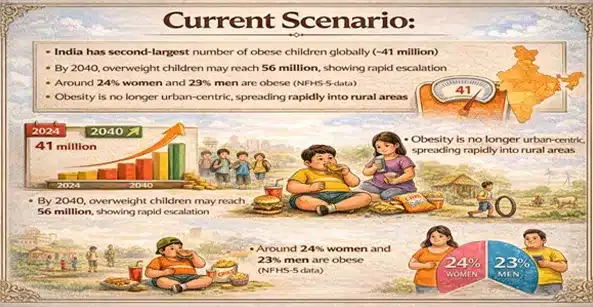
India is witnessing a significant shift in its public health landscape, moving from a primary focus on undernutrition to confronting a “double burden” of malnutrition and obesity. Rising incomes, urbanisation, and lifestyle changes have contributed to a surge in obesity across both urban and rural areas. This transition is alarming because obesity is no longer limited to affluent populations but is increasingly affecting children, adolescents, and economically weaker sections, posing long-term risks to health systems and economic productivity.
Causes of Rising Obesity
-
Dietary Transition
- Increasing consumption of ultra-processed foods (junk food high in sugar, salt, fat)
- These foods are often cheap, convenient, and aggressively marketed
-
Sedentary Lifestyle
- Around 74% adolescents do not meet required physical activity levels
- Rise in screen time (mobiles, TV, gaming) reduces outdoor activities
-
Urbanisation & Infrastructure Gaps
- Lack of parks, walking paths, cycling tracks discourages physical activity
- Cities promote car-dependent and sedentary living patterns
-
Early Life Factors
- Inadequate breastfeeding increases risk of childhood obesity
- Early nutrition influences metabolism and long-term health outcomes
-
Socio-economic Factors
- Poor households rely on cheap calorie-dense but nutrient-poor food
- Leads to paradox of “obesity with malnutrition”
Health Implications1. Non-Communicable Diseases (NCDs)
2. Cardiovascular Risks
3. Mental Health Issues
4. Long-term Diseases
Economic & Social Impact
|
Policy Challenges1. Weak Regulation
2. Aggressive Marketing
3. School Environment Issues
4. Biological Factors
|
Way Forward
-
Fiscal Measures
- Impose “sin taxes” on sugary drinks and junk food
- Discourage unhealthy consumption patterns
-
Strong Regulation
- Introduce simple color-coded food labeling (traffic light system)
- Restrict advertisements targeting children and adolescents
-
School-Level Interventions
- Ensure healthy mid-day meals with proper nutrition balance
- Make physical education compulsory in schools
-
Public Awareness
- Promote traditional Indian diets (millets, pulses, vegetables)
- Conduct campaigns like Eat Right India
-
Early Life Interventions
- Promote exclusive breastfeeding for first 6 months
- Educate parents about healthy child nutrition practices
India’s obesity crisis is a silent but rapidly escalating threat that can undermine both public health and economic growth. Addressing it requires a coordinated, multi-sectoral approach combining regulation, awareness, lifestyle changes, and institutional reforms. If tackled early and effectively, India can prevent this emerging epidemic from overwhelming its healthcare system and ensure a healthier, more productive population in the decades ahead.
Prelims Boosters
RELIEF Scheme (Resilience & Logistics Intervention for Export Facilitation)
Context:
- Scheme expanded to include Egypt and Jordan
About
- RELIEF Scheme is a time-bound support scheme for exporters
- It helps reduce financial and logistics risks during conflicts
- It provides a buffer against high freight, insurance, and war-risk costs
- Launched: 19 March 2026
- Under: Export Promotion Mission (EPM) and Nodal Agency: ECGC Limited
Aim
- It aims to protect exports during geopolitical tensions
- It aims to prevent order cancellations and job losses
- It supports MSMEs exporting to high-risk regions
Key Features
- Total Outlay: ₹497 crore
- Structured into 3 components
Component I: Existing Exporters
|
Component II: New Exporters
|
Component III: MSMEs (Non-insured)
|
Coverage Area
- Covers countries in West Asia and nearby regions:
- UAE, Saudi Arabia, Qatar, Oman, Bahrain
- Iraq, Iran, Israel, Yemen
- Egypt and Jordan (newly added)
Significance
- It ensures continuity of exports during conflicts
- It protects small exporters from cost shocks
- It helps maintain India’s trade stability
Foot-and-Mouth Disease (FMD)
Context:
- WOAH raised concern over global spread of FMD (SAT-1 strain)
About
- Foot-and-Mouth Disease (FMD) is a highly contagious viral disease
- It affects cloven-hoofed animals like: Cattle, pigs, sheep, goats, buffalo, deer
- It is caused by aphthovirus (Picornaviridae family)
- It is rarely fatal in adults, but causes huge economic losses
Transmission
- It spreads through:
- Direct contact: saliva, urine, dung, blisters
- Indirect contact (fomites): clothes, vehicles, equipment
- Animal products: milk, meat, semen
- Airborne spread: can travel long distances by wind
Spread Factors
- Unregulated animal movement
- Livestock markets (mixing points)
- Informal trade networks
Key Features / Symptoms
- High fever initially
- Formation of blisters (vesicles) on:Mouth, tongue, lips and Hooves
- Other effects:Lameness, Excess salivation and Sharp fall in milk production
- Young animals may die suddenly (heart complications)
Special Features
- 7 serotypes: O, A, C, SAT-1, SAT-2, SAT-3, Asia-1
- Immunity to one does NOT protect against others
- Carrier state:Animals can carry virus even after recovery
Treatment & Control
- No specific cure available
- Control measures include:Vaccination (serotype-specific), Strict biosecurity measures, Quarantine and movement control and Culling (in severe outbreaks)
Significance
- It causes major economic losses in livestock sector
- It affects international trade of animals and products
- It is a key concern for food security and rural economy
Austria
Context:
- India and Austria signed agreements to deepen bilateral cooperation
About
- Austria is a landlocked country in south-central Europe. It is largely mountainous (Alpine region); Capital: Vienna
Location & Borders
- It shares borders with 8 countries:North: Czech Republic, Northeast: Slovakia, East: Hungary, South: Slovenia, Southwest: Italy, West: Switzerland, Liechtenstein and Northwest: Germany
Physical Features
- Around 70% area covered by Alps
- It has temperate and alpine climate
- Major river:Danube River (important for trade and transport)
People & Language
- Major ethnic group: Germans. Other groups: Turks, Serbs, Croats, etc.
- Official language: German. Other languages: Croatian, Hungarian, Slovene
Political System
- It is a federal parliamentary republic. President: Head of State. Chancellor: Head of Government
Historical Background
- Region was part of Roman Empire (Noricum). Conquered by Charlemagne (788 AD)
- Ruled by Habsburg dynasty (major European power). Became Austria-Hungary (1867)
- Empire collapsed after World War I (1918). Republic established in 1919
Cultural Significance
- Vienna was a centre of classical music
- Associated with musicians like:Wolfgang Amadeus Mozart, Ludwig van Beethoven and Joseph Haydn
Significance
- Important partner in Europe for India
- Known for culture, music, and strategic location in Europe
CAR-T Cell Therapy (Chimeric Antigen Receptor T-Cell Therapy)
Context:
- Used to treat multiple autoimmune diseases resistant to treatment
About
- CAR-T therapy is an advanced immunotherapy (immune-based treatment)
- It modifies a patient’s own immune cells to fight disease
- It is mainly used for blood cancers. It is used when other treatments fail
Key Concept
- T-cells (white blood cells) identify and destroy harmful cells
- CAR-T therapy enhances this ability using genetic modification
How It Works
- Step 1: T-cells are collected from patient’s blood
- Step 2: In lab, T-cells are modified to add CAR (special receptors)
- Step 3: Modified cells (CAR-T cells) are multiplied
- Step 4: These are infused back into the body
- CAR helps T-cells:Recognize cancer cells (antigens) and Attack and destroy them
- These cells can multiply and provide long-term protection
Applications
- Used in blood cancers, such as:Leukemia, Lymphoma, Multiple myeloma
- Now being explored for:Autoimmune diseases
Advantages
- It is highly targeted treatment. It can provide long-lasting effects. It may cure some cancers
Side Effects
- Hyperinflammation (cytokine storm)
- Low blood cell counts are a common concern, where a decrease in red blood cells (RBCs) can lead to fatigue, a reduction in platelets increases the risk of bleeding, and a lower number of neutrophils raises the susceptibility to infections.
Significance
- It is a breakthrough in cancer treatment
- It opens new possibilities for autoimmune disease treatment. It supports personalised medicine
Astra Mk2 Missile
Context:
- India plans to equip Mirage 2000 jets with Astra Mk2 for long-range interception
About
- Astra Mk2 is a Beyond Visual Range (BVR) air-to-air missile
- It is developed by DRDO (Defence Research and Development Organisation)
- It is an upgraded version of Astra Mk1
- It enhances India’s air combat capability
Key Concept
- BVR missile means it can hit targets beyond visible range
- It allows aircraft to attack enemy jets from long distances
Development
- Developed by DRDO
- Supported by:Hindustan Aeronautics Limited (HAL)&Multiple public and private industries
Range & Capability
- Range: 200–240 km (high altitude). Provides long-range interception advantage
- Earlier version:Astra Mk1 → ~90–100 km range
Key Features
- Dual pulse solid rocket motor: Improves range and performance during final attack
- Indigenous seeker (BEL): Equipped with ECCM (anti-jamming capability)
- Two-way datalink: Allows real-time guidance updates
- Better:Accuracy&Resistance to electronic warfare
Platform Integration
- Already integrated (Mk1):LCA Tejas and Su-30 MKI
- Planned integration:Mirage 2000 (Mk2)
Significance
- It strengthens India’s air superiority. It enhances long-range combat capability
- It reduces dependence on foreign missiles. It has potential for defence exports