West Asia Crisis & India’s Energy Vulnerability (Oil + LPG)
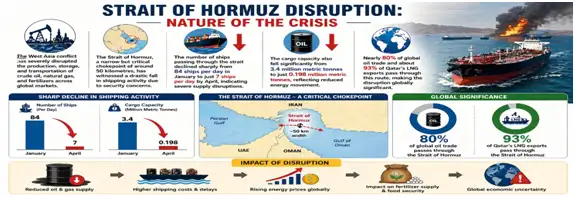
The ongoing crisis in West Asia has exposed the deep dependence of the global economy on fragile energy supply chains, especially chokepoints like the Strait of Hormuz. For India, this disruption is not merely a short-term supply shock but a structural warning that highlights vulnerabilities in both crude oil logistics and LPG supply systems, thereby necessitating a comprehensive rethink of energy security strategies.
Impact on India’s Economy
Supply-Side Effects
- The disruption in energy supplies has increased input costs for energy-intensive sectors such as fertilizers, chemicals, and transportation.
- These increased costs are passed on across the economy, resulting in higher prices for final goods through cascading effects.
Demand-Side Effects
- India’s exports are affected due to disruptions in West Asia as well as a broader slowdown in global demand conditions.
- West Asia accounts for around 16.4% of India’s total merchandise exports, making the region critically important for trade.
Exchange Rate Pressures
- Rising import bills increase the demand for foreign currency, which leads to depreciation pressure on the Indian rupee.
- Additionally, remittances from Indian workers in Gulf countries may decline, further weakening the rupee.
Inflation and Fiscal Impact
- Higher crude oil prices result in cost-push inflation across multiple sectors of the economy.
- The government may need to increase subsidies or reduce taxes, thereby increasing fiscal pressure and widening the fiscal deficit.
- According to estimates, a 10% increase in crude oil prices can reduce GDP growth by about 15 basis points and increase inflation by about 30 basis points.
Why LPG Vulnerability is More Serious
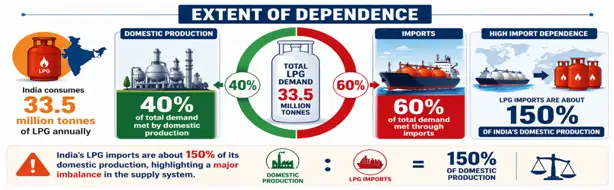
- Unlike crude oil, LPG in India is primarily used for household cooking, which makes demand highly essential and non-negotiable.
- Industrial users can reduce consumption or switch fuels, but households cannot easily substitute LPG, making the system highly sensitive to disruptions.
Dependence on Hormuz
- Nearly 90% of India’s LPG imports pass through the Strait of Hormuz, making it a critical vulnerability point.
- The crisis demonstrates that this route can no longer be considered a reliable and secure energy corridor.
Comparison with Other Countries
- India’s LPG consumption is largely household-based, which increases vulnerability compared to other countries.
- Countries like Japan, China, and South Korea have diversified energy use and better storage systems, which reduce their risk exposure.
Storage Constraints
- India currently has only about 15 days of LPG storage capacity, which is insufficient for handling prolonged disruptions.
- Underground cavern storage is extremely limited and accounts for only about 5 days of national demand, indicating weak strategic reserves.
Global LPG Market Constraints
- LPG is not a freely flexible global commodity, as much of the exportable supply is already tied up in long-term contracts or domestic uses.
- A large portion of the global LPG export pool is controlled by a few Asian countries, limiting quick supply adjustments during crises.
Core Structural Problem
- India’s LPG issue is not just about supply shortage but about a mismatch between production patterns and consumption needs.
- The LPG that India produces does not align with the type and scale of LPG required for household consumption, increasing dependence on imports.
Way Forward
Separate Demand Streams
- India should reserve domestically produced LPG primarily for household cooking needs and divert imported LPG towards industrial and petrochemical uses.
Build Strategic Reserves
- The country should aim to build at least two to three weeks of LPG buffer stocks to enhance resilience against disruptions.
Promote Energy Transition
- There should be a sustained push towards electric cooking solutions and increased adoption of piped natural gas (PNG) in urban areas.
Diversify Supply Sources
- India should diversify its import sources beyond the Gulf region to reduce overdependence on a single chokepoint.
Undertake Structural Reforms
- Long-term reforms should focus on correcting the mismatch between LPG demand and supply while reducing excessive dependence on imports.
The West Asia crisis has clearly demonstrated that India’s energy vulnerability is deeply structural rather than merely situational. While oil shocks primarily affect macroeconomic stability, LPG disruptions directly impact households, making them socially and politically more sensitive. Therefore, India must adopt a long-term strategy that combines diversification, storage expansion, and systemic reforms to ensure a resilient and secure energy future.
India–South Korea Relations: From Economic Complementarity to Strategic Partnership
India–South Korea relations have evolved from limited diplomatic engagement into a multidimensional strategic partnership over the past three decades. Today, the relationship is increasingly shaped by strategic convergence, shared developmental priorities, and alignment in the Indo-Pacific region, making it a crucial pillar in Asia’s emerging geopolitical and economic architecture.
Evolution of Bilateral Relations
- Diplomatic relations between India and South Korea were established in 1973, marking the beginning of formal engagement.
- The partnership deepened after India’s 1991 economic reforms, which opened avenues for trade, investment, and industrial collaboration.
- India’s transition from Look East Policy to Act East Policy further accelerated engagement with East Asian economies, including South Korea.
- Institutional frameworks strengthened ties through CEPA (2010), Special Strategic Partnership (2015), and regular summit-level dialogues.
From Economic Complementarity to Strategic Convergence
- India and South Korea have moved beyond simple trade relations to become “strategic mirrors” with aligned long-term interests.
- Both countries follow technology-driven growth models with strong emphasis on manufacturing and infrastructure development.
- South Korea’s past industrial transformation mirrors India’s current aspirations of becoming a global manufacturing hub.
- Shared democratic values and commitment to a rules-based international order create natural alignment in global governance.
- Both nations support a free, open, and inclusive Indo-Pacific, strengthening regional cooperation.
Economic Cooperation and Trade Dynamics
- Bilateral trade between India and South Korea has crossed $28 billion, reflecting steady economic engagement.
- South Korea is among significant FDI investors in India.
- Key sectors of collaboration include automobiles, electronics, heavy industries, and shipbuilding.
- South Korean companies like Hyundai, Samsung, and LG have become major contributors to India’s manufacturing ecosystem.
Defence and Strategic Cooperation
- India and South Korea share concerns regarding regional security threats such as North Korea and the China–Pakistan axis.
- Both countries are aligned in the Indo-Pacific strategy, focusing on maritime security and freedom of navigation.
- Cooperation is expanding in defence production, naval exercises, and cyber security frameworks.
Technology and Emerging Sector Collaboration
- Emerging areas of cooperation include semiconductors, artificial intelligence, electric vehicles, batteries, and clean energy.
- South Korea’s expertise in advanced manufacturing complements India’s large market and skilled workforce.
- Policy initiatives such as India’s Semiconductor Mission and PLI schemes provide opportunities for deeper collaboration.
Key Challenges in the Relationship
- India faces a persistent trade deficit with South Korea, creating domestic concerns regarding trade balance.
- The CEPA agreement (2010) has been underutilised, with limited benefits for Indian MSMEs and services sector.
- Indian exporters encounter non-tariff barriers such as stringent standards and certification requirements in Korea.
- Korean firms in India face bureaucratic hurdles, regulatory uncertainty, and compliance challenges.
- There is limited progress in high-technology collaboration, especially in semiconductors and advanced R&D ecosystems.
- Structural differences between Korea’s advanced industrial base and India’s developing manufacturing sector create unequal competitiveness.
- Weak people-to-people ties, limited academic exchanges, and cultural familiarity restrict deeper engagement.
- Geopolitical constraints arise due to Korea’s economic dependence on China and India’s strategic tensions with China.
- Supply chain integration remains incomplete due to lack of institutional coordination and industrial linkages.
- Absence of a dedicated framework for joint innovation and co-manufacturing limits technology cooperation.
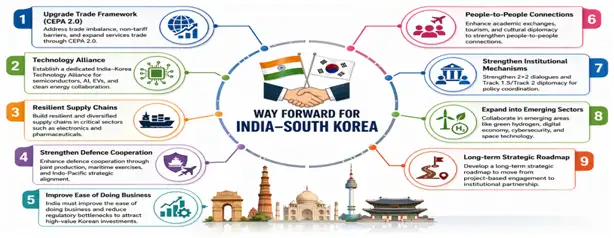
India–South Korea relations are transitioning into a comprehensive strategic partnership grounded in shared values, economic complementarity, and geopolitical alignment. In an era of shifting global power dynamics and technological competition, this partnership has the potential to emerge as a key pillar of Indo-Pacific stability, innovation-driven growth, and resilient global supply chains.
Prelims Boosters
Vishwa Sutra
Context:
- The Vishwa Sutra collection was showcased at the 61st Femina Miss India (Bhubaneswar)
About
- Vishwa Sutra is a designer handloom initiative that blends Indian textiles with global design elements.
- It showcases 30 Indian handloom weaves, each inspired by 30 different countries.
Launched By
- It is launched by the Office of Development Commissioner (Handlooms) under the Ministry of Textiles
- It is developed in collaboration with the National Institute of Fashion Technology (NIFT)
Aim
- It aims to promote Indian handlooms in global fashion markets
- It seeks to use textiles for cultural exchange and storytelling
- It aims to support weavers and rural artisans economically
Key Features
- It follows a 30–30 framework:30 Indian weaves + 30 global inspirations
- Examples of fusion:
- Odisha Ikat + Greek design
- Kanchipuram + Norwegian style
- Muga Silk + Egyptian elements
- Patola + Spanish influence
- Banarasi + UAE design
- It was showcased on a large platform (Miss India event) to reach global audience
Significance
- It promotes “Vocal for Local to Global”
- It strengthens the handloom sector and rural livelihoods
- It supports the 5F vision:Farm → Fibre → Factory → Fashion → Foreign
- It helps in modernizing traditional textiles for global markets
Super El Niño
Context:
- Experts warn of a possible Super El Niño, which may raise global temperatures and extreme events
What is El Niño?
- El Niño is a climate phenomenon involving warming of Pacific Ocean waters
- It is part of the ENSO cycle (El Niño–Southern Oscillation)
- It occurs every 3–7 years and disrupts global weather patterns
How El Niño Forms
- Normally, trade winds push warm water westward
- During El Niño:Winds weaken or reverse and Warm water moves eastward
- This leads to:Reduced upwelling (cold water rise); Warmer ocean surface and Changes in rainfall and jet streams
What is Super El Niño?
- A Super El Niño is an extremely strong El Niño event
- It occurs when ocean temperature anomaly is ≥ 2°C above normal
- Such events are rare and highly impactful
Causes of Super El Niño
- Subsurface heat buildup in oceans
- Strong westerly wind bursts
- Global warming raising baseline temperatures
Global Impacts
- It can lead to:Record high global temperatures and Changes in jet streams
- Weather effects include:Floods (Peru, Middle East); Droughts (Africa) and Altered hurricane patterns
Impact on India
- It causes weak or deficient monsoon
- It leads to:Drought conditions and Agricultural losses
- It may result in:Heatwaves, Food inflation and Economic stress
Significance
- It affects global climate systems
- It has major impact on agriculture and economy
- It shows link between climate variability and global warming
NBA Revised Guidelines under Biological Diversity Act, 2002
Context:
- The National Biodiversity Authority (NBA) has revised guidelines for ABS funds and biological repositories
About
- The revised guidelines are a policy framework for managing bio-resources and benefit sharing
- They regulate:Access and Benefit Sharing (ABS) funds and Designated repositories (biological samples storage)
- They are issued under the Biological Diversity Act, 2002
Aim
- It aims to ensure fair and transparent distribution of ABS funds
- It ensures benefits reach local communities
- It promotes biodiversity conservation and sustainable use
Key Features
Standardised Fund Sharing
- Identifiable Source:25–40% → Institutions/repositories and 60–75% → Local communities (via State Biodiversity Boards)
- Non-identifiable Source:30% → Institutions and 70% → NBA/SBBs
Widely Distributed Resources
- Funds from such resources are used for collective biodiversity management
- It follows Section 27 of the Act
Digital Repositories
- It promotes digitisation of biological samples (voucher specimens)
- It reduces risks of physical transfer and misuse
Provenance and Documentation
- Repositories must maintain proper records of origin (provenance)
- It ensures legal tracking and accountability of bio-resources
Flexibility in Sharing
- Benefit sharing can be adjusted based on value addition
- It considers research, innovation, and processing efforts
Significance
- It ensures equitable sharing of benefits with local communities
- It prevents biopiracy (illegal use of biological resources)
- It strengthens biodiversity governance and conservation
- It promotes transparency and accountability in resource use
‘Yellow Line’ Security Strategy
Context:
- Israel has expanded the Yellow Line strategy to southern Lebanon, up to the Litani River
About
- The Yellow Line is a military demarcation used by Israel
- It creates a buffer zone inside hostile territory
- It is not an international border but a military-controlled zone
- It acts as a free-fire zone under Israeli control
Where Implemented
- Gaza Strip (2025): First introduced
- Southern Lebanon (2026): Extended after ceasefire with Hezbollah
Aim
- It aims to prevent militant attacks near Israeli borders
- It helps in maintaining a forward defensive military position
Key Features
Static Defense Strategy
- It involves permanent military presence and fortified posts
- It marks a shift from mobile warfare to fixed control
Territorial Division
- It divides the region into:Israeli-controlled zone and Local civilian areas
- In Gaza:Around 58% under Israeli control
Physical Marking
- It is marked by:Yellow concrete bollards and 3.5-meter poles
- Markers are placed at regular intervals (~200 m)
Military Control
- The zone is treated as a restricted military area
- It allows:Control over movement and Destruction of infrastructure if needed
Mansar Lake
Context:
- Security arrangements were reviewed at Mansar Lake (Jammu & Kashmir)
About
- Mansar Lake is a freshwater lake located in the Samba district of Jammu & Kashmir
- It lies in the foothills of the Shivalik Range
- It is located about:62 km from Jammu city and 19 km from Samba town
Physical Features
|
Religious Importance
Ecological Importance
|
Ramsar Status
- It is designated as a Ramsar Site (Wetland of International Importance)
- It is listed along with Surinsar Lake
- Year of designation: 2005