Pahalgam Attack: Security Shift and Its Wider Impact on Kashmir
A year after the Pahalgam attack, Jammu and Kashmir reflects a transition from reactive counterterrorism to a dispersed, intelligence-driven security grid. While operational capabilities have improved through technology and terrain-based deployment, the deeper social and economic scars of the attack continue to shape Kashmir’s reality, highlighting the limits of a security-centric approach without parallel recovery.
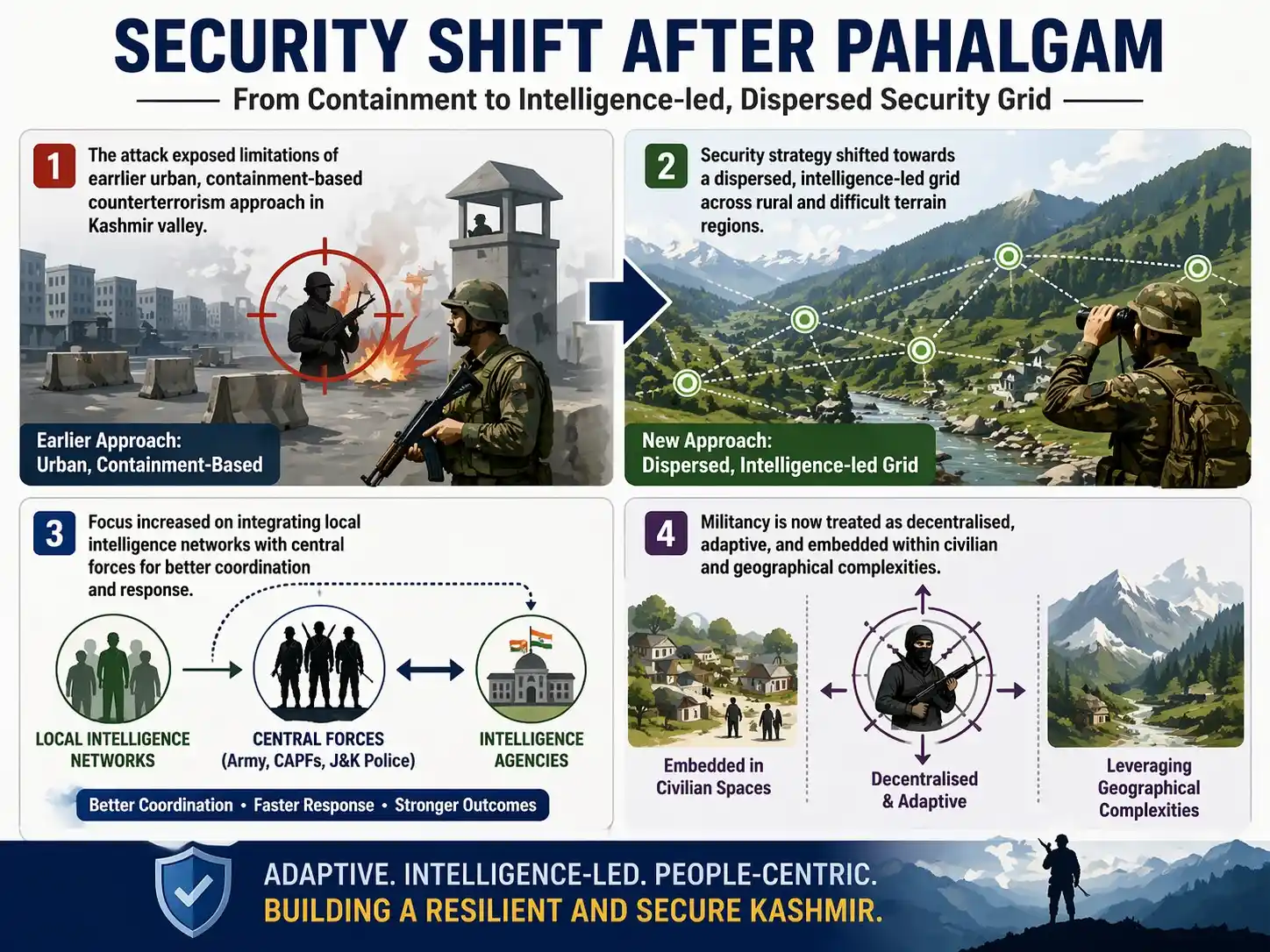
Security Shift After Pahalgam
- The attack exposed limitations of earlier urban, containment-based counterterrorism approach in Kashmir valley.
- Security strategy shifted towards a dispersed, intelligence-led grid across rural and difficult terrain regions.
- Focus increased on integrating local intelligence networks with central forces for better coordination and response.
- Militancy is now treated as decentralised, adaptive, and embedded within civilian and geographical complexities.
Recognition of Intelligence and Terrain Gaps
- The attack revealed serious gaps in human intelligence, terrain understanding, and inter-agency coordination mechanisms.
- Earlier assumptions ignored how militants exploited forest areas, ridges, and less-monitored remote locations effectively.
- Security forces acknowledged that threats were not fully disappearing but becoming less visible and more mobile.
- This led to a re-evaluation of deployment patterns, surveillance coverage, and intelligence gathering processes.
From Roads to Ridges: Tactical Reorientation
- Security forces expanded presence into higher-altitude zones and ridge areas for strategic dominance and surveillance.
- Camps were shifted from visible road-based positions to concealed, elevated locations for operational advantage.
- Deployment increased across Army, police, and CRPF for both operational and static security duties.
- This shift ensured that areas once unmonitored became integral parts of the security grid architecture.
Technology Integration and Human Firewall
- Over 50,000 individuals linked to tourism were digitally verified and integrated into security databases.
- QR-based identification and Aadhaar-linked systems improved identity verification and movement monitoring capabilities.
- Surveillance expanded using drones, sensors, facial recognition, and real-time monitoring technologies across regions.
- Local population networks were strengthened to create a “human firewall” supporting intelligence and security efforts.
Intelligence-led Precision Operations
- Security operations shifted from large deployments to targeted, intelligence-based actions with minimal collateral damage risks.
- Real-time communication improved coordination between agencies, ensuring faster response to emerging threats and incidents.
- Focus increased on dismantling overground worker networks and hybrid militant structures within local ecosystems.
- This approach improved efficiency while maintaining greater operational precision and accountability in counterterrorism measures.
Emerging Threat: Drone Warfare
- Increased use of drones for surveillance and smuggling created new and evolving security challenges for forces.
- Procurement of anti-drone systems and technologies has begun to counter unmanned aerial threats effectively.
- Modern conflict dynamics require continuous technological adaptation and preparedness against asymmetric warfare tools.
Limits of Security Adaptation
- Despite improvements, gaps remain in dense forests, remote terrain, and hard-to-access operational areas.
- Militancy has evolved into low-intensity, hybrid forms that are difficult to detect and neutralise quickly.
- Continuous adaptation is required as adversaries constantly innovate tactics to bypass security frameworks.
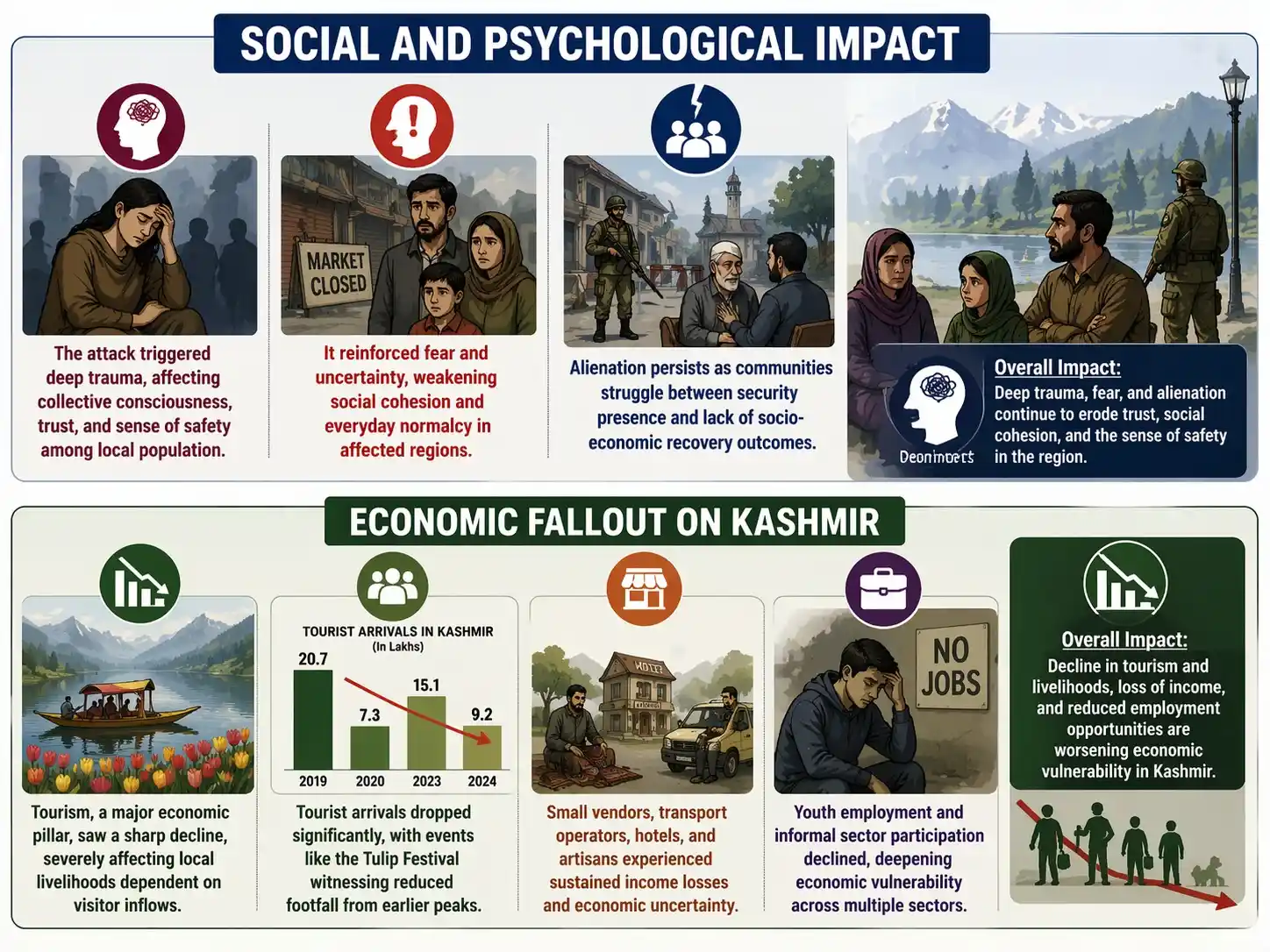
Long-term Economic Concerns
- Economic slowdown has created uncertainty in investment, job creation, and sustainable livelihood opportunities in Kashmir.
- Key sectors like horticulture also face indirect pressures due to market disruptions and reduced economic activity levels.
- Rising unemployment and weak growth contribute to long-term instability and reduced economic resilience in the region.
Gap Between Narrative and Ground Reality
- Claims of integration and development have not translated into visible economic empowerment for local populations.
- Administrative changes remain largely procedural without delivering tangible improvements in livelihoods and opportunities.
- This gap risks increasing alienation and weakening public trust in governance and institutional frameworks over time.
Way Forward
- Security strategy must be complemented with inclusive development, livelihood generation, and economic revitalisation efforts.
- Greater investment in tourism revival, infrastructure, and local industries is needed to restore economic confidence in Kashmir.
- Strengthening community engagement and trust-building measures will ensure better cooperation between citizens and security agencies.
- Continued technological upgradation and intelligence coordination are essential to counter evolving threats and hybrid warfare tactics.
- A balanced approach integrating security, governance, and socio-economic development is necessary for sustainable stability.
The Pahalgam attack has reshaped Kashmir’s security architecture, making it more adaptive, technology-driven, and intelligence-oriented. However, the persistence of economic distress and social unease highlights that lasting peace cannot be achieved through security measures alone. A comprehensive strategy that combines security with development, trust-building, and inclusive growth is essential to ensure long-term stability and resilience in the region.
Prelims Boosters
SMILE Scheme
Context:
The Government allocated ₹390 crore (2021–2026) for the SMILE Scheme(Support for Marginalized Individuals for Livelihood and Enterprise)
About
- The SMILE Scheme is a Central Sector Scheme
- It was launched on 12 February 2022
- It aims to support: Transgender persons, Persons engaged in begging
Components (Sub-Schemes)
- It has two sub-schemes: Rehabilitation of Transgender Persons & Rehabilitation of Persons engaged in Begging
Aim
- It aims to ensure social inclusion and dignity
- It promotes livelihood, rehabilitation, and welfare
Key Features
Scholarships
- It provides education support from Class IX to Post-Graduation for transgender students
Skill Development & Livelihood
- It supports skill training under PM-DAKSH scheme
- It promotes employment and self-reliance
Healthcare Support
- It provides medical assistance including gender-affirmation surgery
- It is linked with PM-JAY (Ayushman Bharat)
Garima Greh (Shelter Homes)
- It provides safe housing for transgender persons
- It ensures dignified living conditions
Transgender Protection Cells
- It ensures monitoring of crimes and legal support
- It helps in timely investigation and justice delivery
National Portal & Helpline
- It provides information, support, and grievance redressal
Significance
- It promotes inclusion of marginalized communities
- It ensures dignity, livelihood, and social security
- It supports rehabilitation and mainstream integration
R-37M Missile (AA-13 Axehead)
Context:
- Russia has approved the sale of R-37M missiles to India
About
- The R-37M is a long-range air-to-air missile developed by Russia
- It is designed for Beyond Visual Range (BVR) combat
- It is capable of targeting: Fighter jets, Drones, High-value aircraft (AWACS, tankers)
- It is often called an “AWACS Killer”
Platform (India)
- It is expected to be integrated with: Su-30MKI fighter aircraft
Key Features
1. Range
2. Speed
3. Size & Payload
|
4. Guidance System
5. Advanced Trajectory
6. Booster Mechanism
|
Significance
- It enhances India’s air superiority capability
- It allows engagement of targets at very long distances
- It strengthens deterrence against high-value enemy assets
Scarlet Fever (Scarlatina)
Context:
- DNA evidence shows scarlet fever bacteria existed in the Americas before European arrival
About
- Scarlet fever is a bacterial infection
- It is caused by Group A Streptococcus bacteria
- It is the same bacteria that causes: Strep throat, Skin infections (impetigo) and Rheumatic fever
Affected Group
- It mainly affects children aged 5–15 years
Symptoms
- It causes: Red rash over body, High fever, Sore throat
- Other symptoms include: Strawberry tongue (red bumps); Headache, nausea, vomiting; Swollen glands; Muscle pain and chills
Transmission
Complications-If untreated, it can affect: Heart, Kidneys and Other organs |
Treatment
|
Significance
- It highlights the importance of early diagnosis and treatment
- It shows historical presence of infectious diseases
- It is important for public health surveillance
Jute Crop
Context:
- The Government has reduced jute stock limits for traders and balers to zero
About
- Jute is the second most important fibre crop in India after cotton
- It is a natural fibre crop grown in tropical regions
- It is widely used for: Ropes, gunny bags, carpets, rugs, tarpaulins
Climatic Conditions
- Climate: It requires humid tropical conditions
- Temperature: It grows between 17°C to 41°C
- Rainfall: It requires >1200 mm well-distributed rainfall
- Humidity: It requires 40–90% relative humidity
Soil Requirements
- It grows best in fertile alluvial (riverine) soil
- It can also grow in other soil types, but productivity is higher in loamy soil
Cropping Pattern
- It is generally: Sown: February and Harvested: October
- Crop duration: 8–10 months
Distribution in India
- More than 99% production is concentrated in: West Bengal (≈81%), Bihar, Assam, Odisha, Andhra Pradesh
Significance
- It is an eco-friendly and biodegradable fibre
- It supports rural employment and agro-based industries
- It is important for packaging and export sector
Samriddh Gram Initiative
Context:
- The Samriddh Gram Initiative has been nominated for WSIS Prizes 2026
About
- The Samriddh Gram Initiative is a phygital (physical + digital) rural service delivery model
- It is developed by the Department of Telecommunications (DoT)
- It uses the BharatNet broadband network to deliver services in rural areas
Launch
- It was implemented in pilot phase (2024–25)
- First Samriddhi Kendra was launched in Umri village (Madhya Pradesh)
Aim
- It aims to bridge the rural digital divide
- It provides one-stop access to essential services
- It promotes inclusive socio-economic development
Key Features
Samriddhi Kendras (SKs)
- It establishes physical service centres in villages
- It provides multiple digital and assisted services
Healthcare (Telemedicine)
- It enables online doctor consultations (e-Sanjeevani)
- It provides basic health diagnostics
Education & Skill Development
- It uses AR/VR-based smart classrooms
- It offers courses via DIKSHA and SWAYAM platforms
Smart Agriculture
- It uses IoT sensors for soil monitoring
- It supports drone-based farming and smart irrigation
E-Governance & Commerce
- It provides access to government services and schemes
- It connects rural businesses to ONDC platforms
Public Safety
- It installs CCTV surveillance and drone monitoring
Connectivity Expansion
- It promotes Fiber-to-the-Home (FTTH)
- It supports PM-WANI public Wi-Fi hotspots
About WSIS Prizes 2026
|
Significance
- It strengthens digital inclusion in rural India
- It improves access to health, education, and governance
- It promotes technology-driven rural development
First Battle of Panipat (1526)
Context:
- April 21, 2026 marks 500 years of the First Battle of Panipat
About
- The First Battle of Panipat (1526) marked the end of the Delhi Sultanate and the beginning of the Mughal Empire in India.
- It was fought on April 21, 1526 at Panipat (Haryana)
Forces Involved
- Babur (Timurid forces): Around 12,000 soldiers
- Ibrahim Lodi (Delhi Sultanate): Around 100,000 soldiers + war elephants
Background
- Babur was invited by discontented Lodi nobles
- Key figures: Daulat Khan Lodi and Alam Khan
- Babur aimed to establish a permanent kingdom in India
Key Features / Military Innovations
- Tulughma Tactic: It involved flanking and surrounding the enemy
- Use of Gunpowder: Babur used cannons and matchlocks (guns) in open battle. It was first effective large-scale use in India
- Rumi (Ottoman) Strategy: It involved defensive carts + artillery positioning. It increased firepower efficiency
- Infantry Advantage: Babur’s soldiers fought on foot with better accuracy. Lodi army relied on elephants, which became ineffective
Outcome
|
Aftermath
|
Significance
- It marked the end of 320-year Delhi Sultanate
- It established the Mughal Empire (300+ years rule)
- It showed technology and strategy > numbers