For True Nari Shakti, Take Jobs Where Women Workers Are
Women’s empowerment in India cannot rely only on political representation or symbolic measures. True “nari shakti” (women’s empowerment) requires meaningful economic participation, especially through employment opportunities. Without addressing structural barriers in jobs, skills, and mobility, empowerment remains incomplete and largely symbolic.
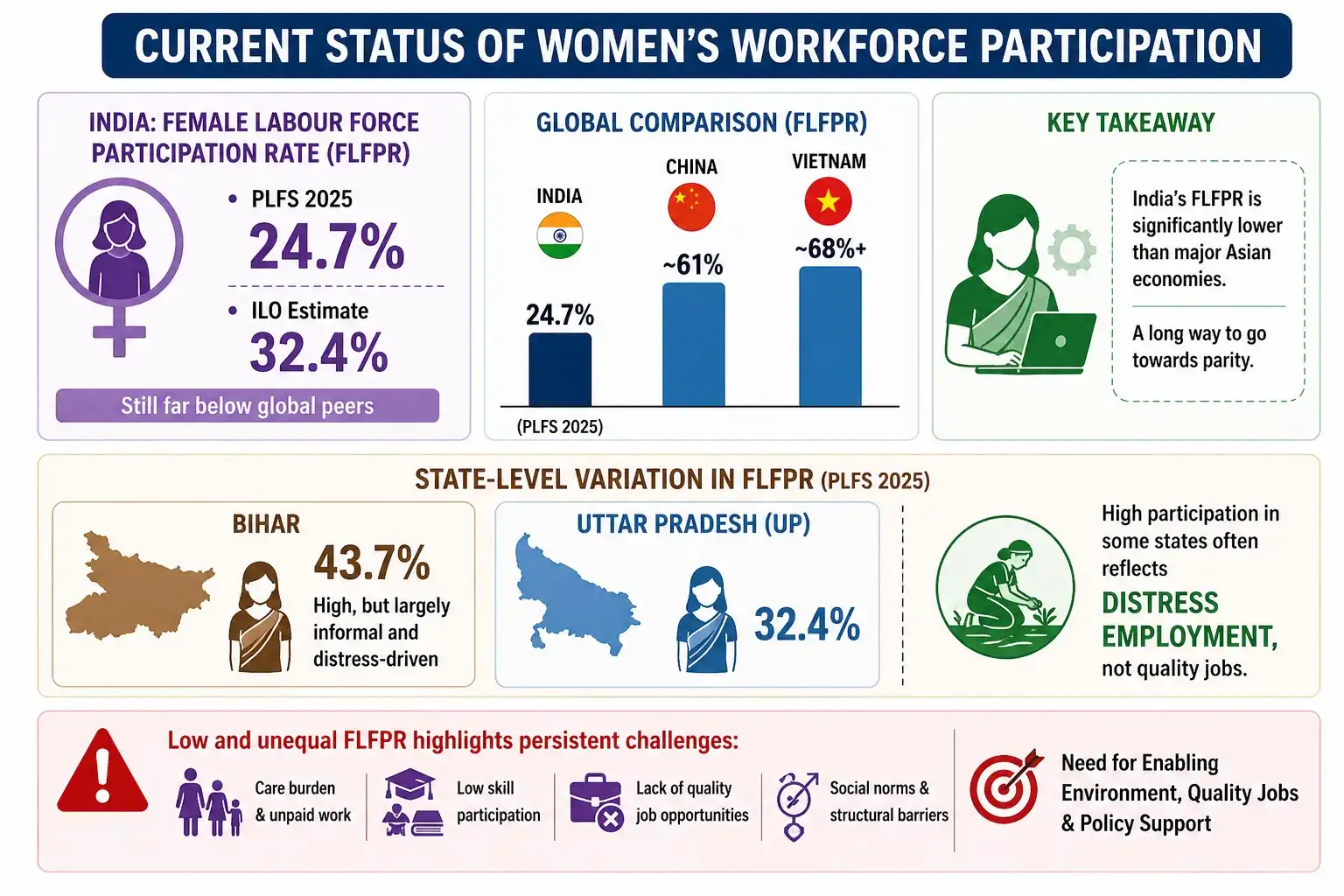
Education and Dropout Challenge
- Female education remains a constraint:
- Dropout rates in Bihar: ~8.7% (primary), 25.9% (secondary), 25.1% (higher secondary)
- Lower education limits access to formal and skilled employment opportunities.
Skilling as the Foundation of Empowerment
- Government initiatives like PMKVY (Pradhan Mantri Kaushal Vikas Yojana) aim to provide skills training.
- Budget allocation (~₹9,886 crore for skill development in 2026–27) reflects focus.
- However:
- Skill training often not aligned with industry needs
- Many women remain unemployed despite certification
Importance of Labour-Intensive Sectors
- Sectors like garments and textiles are crucial:
- Generate ~135 jobs per ₹1 crore investment
- Compare with other sectors:
- Automobiles and steel generate far fewer jobs per investment
- These sectors are women-intensive and suitable for large-scale employment generation.
Regional Employment Model (Case Example)
- In Muzaffarpur (Bihar), a garment unit:
- Started with ~650 workers (2026)
- Expected to scale to ~3,000 workers
- ~90% workforce = women, mostly first-time workers
- Shows that local employment creation reduces migration and empowers women economically.
Challenges in Women Employment
- Lack of nearby job opportunities forces migration or withdrawal from workforce.
- Social norms and safety concerns limit mobility of women workers.
- Absence of support systems (hostels, transport, childcare) increases dropout from jobs.
- Skill mismatch between training and industry demand persists.
Role of Industrial Policy
- Schemes like PM MITRA Parks aim to create large textile clusters with plug-and-play infrastructure.
- These clusters can:
- Generate large-scale employment
- Provide shared infrastructure → lower costs → higher participation
- However, regional imbalance exists (limited presence in labour-rich states like Bihar, Jharkhand).
Limitations of Incentive-Based Policies
|
Global Lessons
|
Way Forward
- Focus on job creation where women are located (local employment ecosystems).
- Invest in industry-aligned skilling and vocational training systems.
- Develop labour-intensive manufacturing clusters in high-population states.
- Provide support infrastructure (hostels, safety, childcare facilities).
- Align incentives with actual employment outcomes, not just policy announcements.
True empowerment of women lies not just in representation but in meaningful economic participation. Creating accessible, local, and suitable employment opportunities—especially in labour-intensive sectors—can transform women’s role in the economy. A shift from symbolic policies to structural job creation is essential to realise the vision of genuine nari shakti.
The Case for Regional Benches of the Supreme Court
The demand for regional benches of the Supreme Court arises from a fundamental concern—justice should be accessible, not distant. When citizens must travel long distances to seek justice, it creates inequality in access. The debate is not just administrative but deeply linked to constitutional rights, fairness, and efficiency in the judicial system.
Constitutional Basis (Article 130)
- Delhi is the permanent seat of the Supreme Court as per the Constitution.
- However, Article 130 allows the Chief Justice of India (CJI), with President’s approval, to establish benches elsewhere.
- This power is discretionary, not mandatory, meaning courts cannot force its use.
Problem: Pendency and Accessibility Crisis
- Supreme Court has over 92,000 pending cases (2026) → huge backlog.
- Citizens from distant regions face a “distance penalty”:
- Travel to Delhi
- High litigation costs
- Need for multiple lawyers
- Result: Unequal access to justice across regions.
Regional Inequality in Appeals
- States closer to Delhi (Punjab, Haryana, UP) have higher appeal rates.
- Southern and northeastern states show lower appeal rates (≈10%) despite high case disposal.
- Reason: Cost + distance discourage litigation at Supreme Court level.
Legal and Constitutional Dimensions
- Article 21 (Right to Life) includes Right to Access Justice.
- If distance restricts access → violation of fundamental rights.
- Article 39A (Directive Principle) mandates equal justice and free legal aid.
- Regional benches help fulfill constitutional commitment to equality.
Socio-Economic Dimension
- Current system creates class-based justice:
- Only wealthy litigants can afford Delhi litigation
- Poor and marginalised groups face economic exclusion from justice system.
- Regional benches would reduce cost burden and improve inclusivity.
Structural Issue: Dual Role of Supreme Court
- Supreme Court currently acts as:
- Constitutional Court (interprets Constitution)
- Appellate Court (hears routine appeals)
- This dual role leads to overburdening and inefficiency.
- Solution: Separate roles for better functioning.
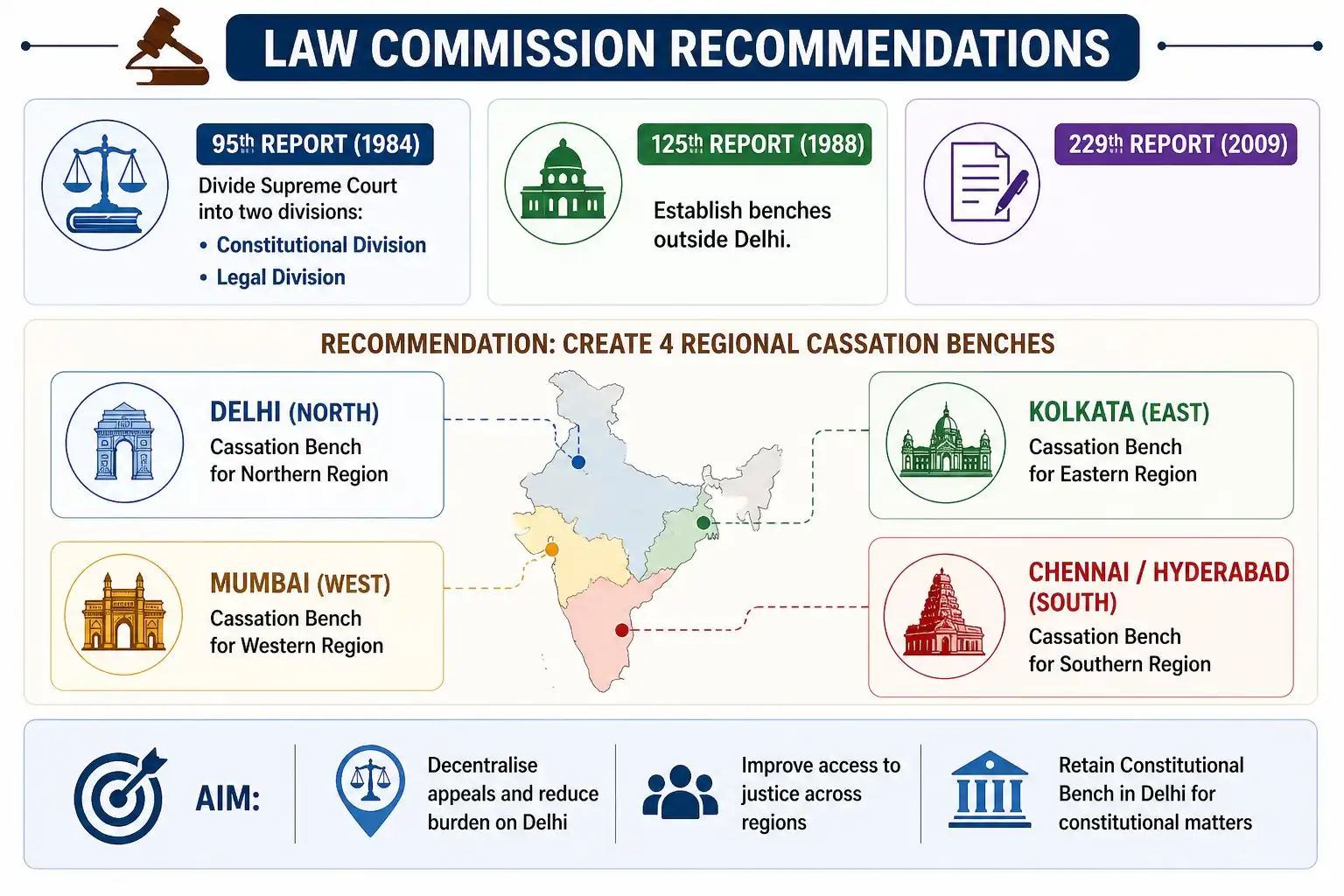
Arguments Against Regional Benches
- Fear of conflicting judgments across benches.
- Concern about weakening unity of Supreme Court.
- High infrastructure and administrative costs.
- Possibility of increased delays due to coordination issues.
Global Perspective
- USA: Centralised SC but handles very few cases (~80/year).
- Germany & South Africa:
- Separate constitutional and appellate courts
- India’s SC handles thousands of cases, making centralisation impractical.
Way Forward
- Implement Cassation Bench model (229th Report).
- Expand virtual hearings (video conferencing) to reduce distance barriers.
- Introduce circuit benches (temporary sittings in regions).
- Consider National Court of Appeal to handle routine appeals.
The issue of regional benches is not about weakening the Supreme Court but about strengthening access to justice. A decentralised approach can reduce pendency, ensure equality, and make the judiciary more citizen-friendly. Ultimately, justice must not depend on geography—it must reach every citizen, wherever they are.
Prelims Boosters
Banking Regulation Act, 1949
Context:
- The RBI cancelled Paytm Payments Bank licence under this Act
About
- The Banking Regulation Act, 1949 is the main law regulating banks in India
- It was earlier called the Banking Companies Act, 1949 (renamed in 1966)
Aim
- It aims to:
- Protect depositors’ money
- Ensure stability of banking system
- Prevent mismanagement and risky practices
- Give RBI regulatory powers
Key Features
1. Licensing of Banks (Section 22)
2. Definition of Banking (Section 5b)
3. Restriction on Trading (Section 8)
|
4. Capital Requirements
5. Inspection Powers
6. Control over Management
7. Winding Up & Amalgamation
|
Significance
- It ensures safe and reliable banking system
- It strengthens RBI’s control over banks
- It prevents bank failures and financial instability
Project DANTAK
Context:
- Project DANTAK has celebrated its 66th Raising Day in Thimphu, Bhutan
About
- Project DANTAK is an infrastructure development project by India in Bhutan
- It operates under the Border Roads Organisation (BRO)
- It was established in April 1961
Aim
- It aims to:
- Develop connectivity infrastructure in Bhutan
- Strengthen India–Bhutan relations
- Support socio-economic development of Bhutan
Key Features
1. Road Construction
2. Strategic Highways
3. Aviation Infrastructure
|
4. Institutional Development
5. Modernisation Works
6. Disaster Response
|
Significance
- It strengthens India–Bhutan strategic partnership
- It improves trade, healthcare, and education access in Bhutan
- It reflects India’s neighbourhood-first policy
Credit Guarantee Fund Trust for Micro and Small Enterprises (CGTMSE)
Context:
- CGTMSE organised a Global Symposium on Credit Guarantees
About
- CGTMSE is a credit guarantee scheme for MSMEs
- It was established in 2000
- It is jointly set up by:
- Ministry of MSME (Government of India)
- SIDBI (Small Industries Development Bank of India)
Objective
- It aims to:
- Improve credit access for Micro & Small Enterprises (MSEs)
- Reduce dependence on collateral (security)
Funding Structure
- The fund is contributed in ratio: Government of India : SIDBI = 4 : 1
Key Features
Credit Guarantee Coverage
- It provides guarantee cover of 75% to 85% of loan
- It reduces risk for banks
Collateral-Free Loans
- It allows loans without collateral security
- It encourages small businesses to borrow easily
Eligible Lending Institutions
- It includes:
- Scheduled Commercial Banks (PSBs, Private, Foreign)
- Regional Rural Banks (RRBs)
- SIDBI, NSIC, NEDFi
- Small Finance Banks & NBFCs
Significance
- It boosts MSME sector growth
- It promotes entrepreneurship and job creation
- It strengthens financial inclusion
Wheat Crop
Context:
- The government has stated that the wheat crop (2025–26) remains resilient despite weather variations
About
- Wheat is the second most important staple crop in India after rice
- It is a temperate crop (grows in cool climate)
- It is grown as a Rabi crop
- Sown: Winter
- Harvested: Spring
Climatic Conditions Required
1. Temperature
2. Rainfall
|
3. Sunlight
4. Frost & Hail
5. Soil
|
Major Producers
Global Level- China, India, Russia and USA
India (States)- Punjab, Haryana, Uttar Pradesh and Bihar
Significance
- It is a major food security crop
- It supports livelihood of farmers
- It is important for food grain buffer stocks
Artemis Accords
Context:
- Jordan has recently signed the Artemis Accords at NASA Headquarters
About
- The Artemis Accords are a set of non-binding principles for space exploration
- They were launched in 2020
- They aim to guide the peaceful and responsible use of outer space
Leadership & Members
- It is co-led by: NASA (USA) and U.S. Department of State
- Founding members include: USA, Australia, Canada, Italy, Japan, Luxembourg, UAE, UK
- India is also a signatory
Aim
- It aims to:
- Ensure safe and sustainable space exploration
- Promote international cooperation in space
- Create common rules for future missions (like Moon exploration)
Key Principles
1. Peaceful Use
2. Transparency
3. Interoperability
|
4. Emergency Assistance
5. Space Heritage Protection
6. Resource Utilisation
7. Space Debris Management
|
Significance
- It sets global norms for space governance
- It supports future Moon and Mars missions
- It reduces conflicts in outer space