India’s Post-LWE Future: From Red Sun to New Dawn
India’s journey from intense Left Wing Extremism (LWE) violence to relative stability marks a major internal security achievement. However, the transition from conflict to peace is incomplete unless governance, development, and trust-building replace coercive state presence. The post-LWE phase must therefore focus not just on eliminating violence, but on creating inclusive, rights-based, and community-driven transformation in affected regions.
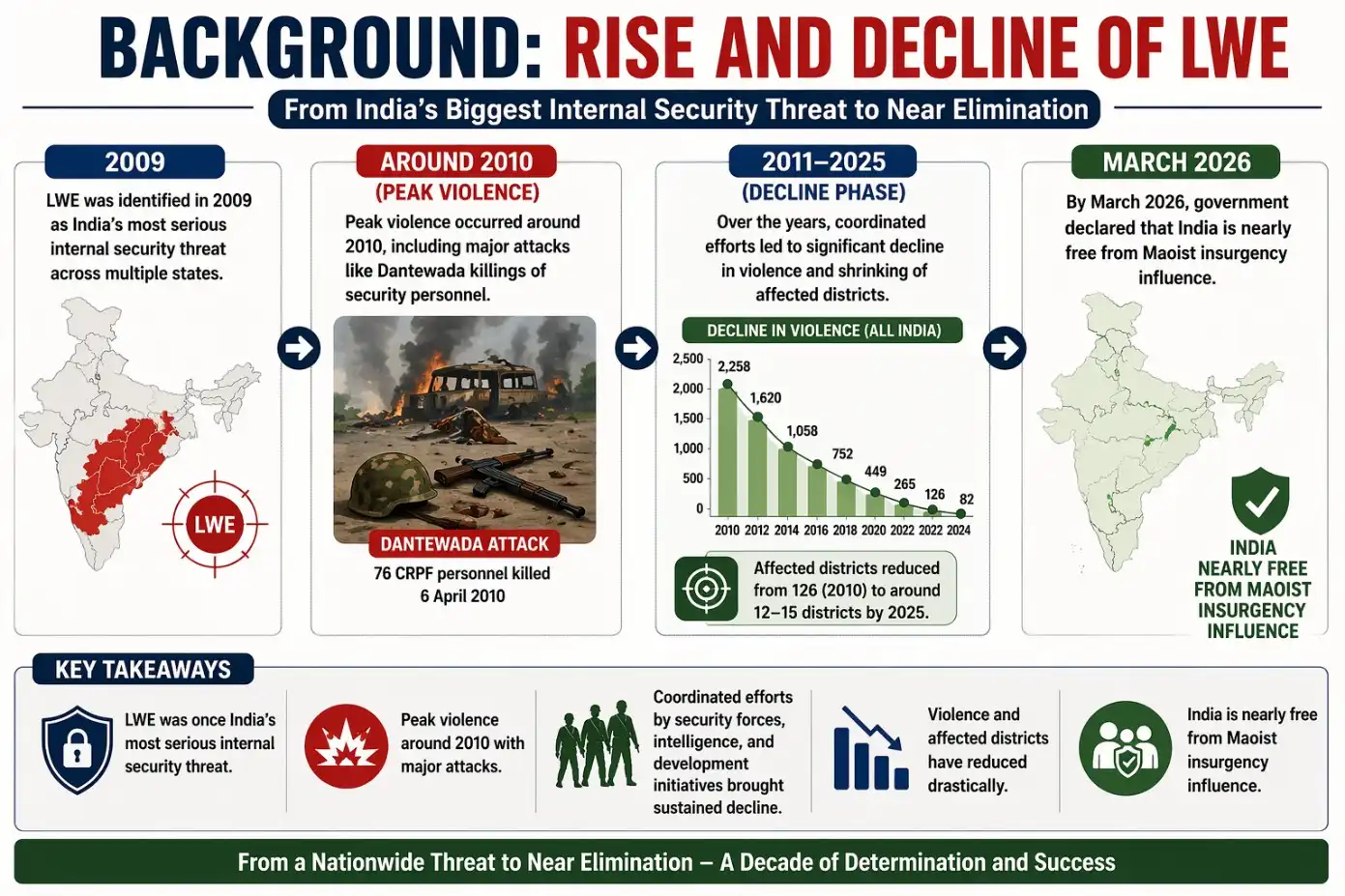
Governance Shift: From Security to Development
- Initial approach focused on security operations, area domination, and elimination of insurgent networks.
- Gradually, emphasis shifted towards governance delivery, infrastructure development, and administrative outreach in LWE regions.
- District-level planning and schemes improved state presence in previously neglected and conflict-affected areas.
- However, long-term peace depends on trust, inclusion, and institutional responsiveness beyond security success.
Need for a Post-LWE Transformation Model
- Security success must translate into sustainable peace through governance, development, and community participation.
- Post-conflict regions require continuous state engagement rather than episodic intervention-based approaches.
- The focus should shift from control of territory to empowerment of people and local economies.
Economic Foundations for Stability
- Strengthening local economies is essential through forest-based produce, agroforestry, and minor forest produce value chains.
- Promotion of community-led enterprises, eco-tourism, and regional economic clusters can generate livelihoods.
- Infrastructure investments must ensure market access, connectivity, and integration with broader economic systems.
- Economic independence reduces vulnerability to insurgent recruitment and instability in tribal regions.
Governance Deficit and Trust Gap
- LWE regions historically suffered from administrative neglect, lack of services, and weak institutional presence.
- Even after conflict decline, citizens often face limited access to justice, welfare schemes, and basic services.
- Trust deficit persists due to past experiences of violence, coercion, and inadequate governance outreach.
- Governance must shift towards citizen-centric, accountable, and empathetic institutional frameworks.
From Area Domination to Citizen Empowerment
- Earlier strategies focused on territorial control rather than addressing socio-economic grievances of communities.
- Post-LWE phase requires recognising citizens as rights-bearing stakeholders, not merely security subjects.
- Policies should emphasise participation, dignity, and local ownership in development processes.
- This transition is essential to prevent re-emergence of alienation and conflict conditions.
Framework for Post-LWE Regions
Rights-Based Governance
- Ensure access to justice, welfare entitlements, and accountable public institutions across affected districts.
- Strengthen legal frameworks such as Fifth Schedule provisions and decentralised governance structures.
Structured Development Planning
- Implement region-specific plans through Aspirational Districts Programme and tribal-focused missions.
- Integrate schemes like PM Janman, Adarsh Gram, and tribal livelihood initiatives for holistic development.
Humane Policing and Justice Delivery
- Shift towards community-sensitive policing, faster justice mechanisms, and reduction of undertrial burdens.
- Strengthen legal aid, grievance redressal systems, and institutional transparency in governance.
Youth Empowerment and Social Integration
- Invest in education, skill development, sports, and employment opportunities for tribal youth.
- Expand access to higher education, scholarships, residential schooling, and digital connectivity.
Psychological and Social Dimensions
- The transition from conflict to peace is also psychological, requiring restoration of dignity and trust in institutions.
- Communities previously caught between state forces and insurgents need reassurance of security and fairness.
- Healing requires consistent engagement, respectful dialogue, and inclusive governance practices.
Challenges in Post-LWE Phase
- Risk of policy complacency after decline in violence, leading to weakening of governance momentum.
- Structural issues like poverty, exclusion, and lack of opportunities still persist in many tribal regions.
- Inadequate coordination between Centre, States, and local institutions may slow development outcomes.
Way Forward
- Adopt a community-centric development model that integrates governance, livelihoods, and social justice frameworks.
- Strengthen cooperative federalism to ensure coordinated action between central and state governments.
- Ensure continuous monitoring and evaluation to maintain momentum of development initiatives in former LWE areas.
- Build institutional capacity for inclusive governance, transparency, and long-term sustainability of peace.
India’s transition from LWE violence to relative peace represents a major milestone, but the journey is far from complete. The real success lies in transforming former conflict zones into spaces of opportunity, dignity, and inclusive growth. A sustained focus on governance, economic empowerment, and trust-building will determine whether this transition becomes a lasting “new dawn” or remains an incomplete chapter in India’s internal security story.
Delimitation Debate: Value of Vote vs Fiscal Balance
The ongoing delimitation debate in India reflects a deeper constitutional dilemma between ensuring equal representation and maintaining federal balance. While the principle of “one person, one vote” demands redistribution of seats based on population, it also risks penalising states that successfully controlled population growth. This tension makes delimitation not just a technical exercise, but a politically and economically sensitive issue.
What is Delimitation and Why It Matters
- Delimitation refers to the redrawing of parliamentary and assembly constituencies based on population changes over time.
- It aims to ensure equal representation so that each vote carries similar weight across regions.
- The process is guided by constitutional provisions under Articles 82 and 170, and carried out by Delimitation Commission.
- India has frozen delimitation based on population since 1971, extended until 2026 to encourage population control efforts.
Core Principle: One Person, One Vote
- Democracy requires that each citizen’s vote has equal value irrespective of geography or region.
- Population-based seat allocation ensures fair representation in legislative bodies like Lok Sabha.
- However, strict adherence to this principle can create regional imbalances in political power.
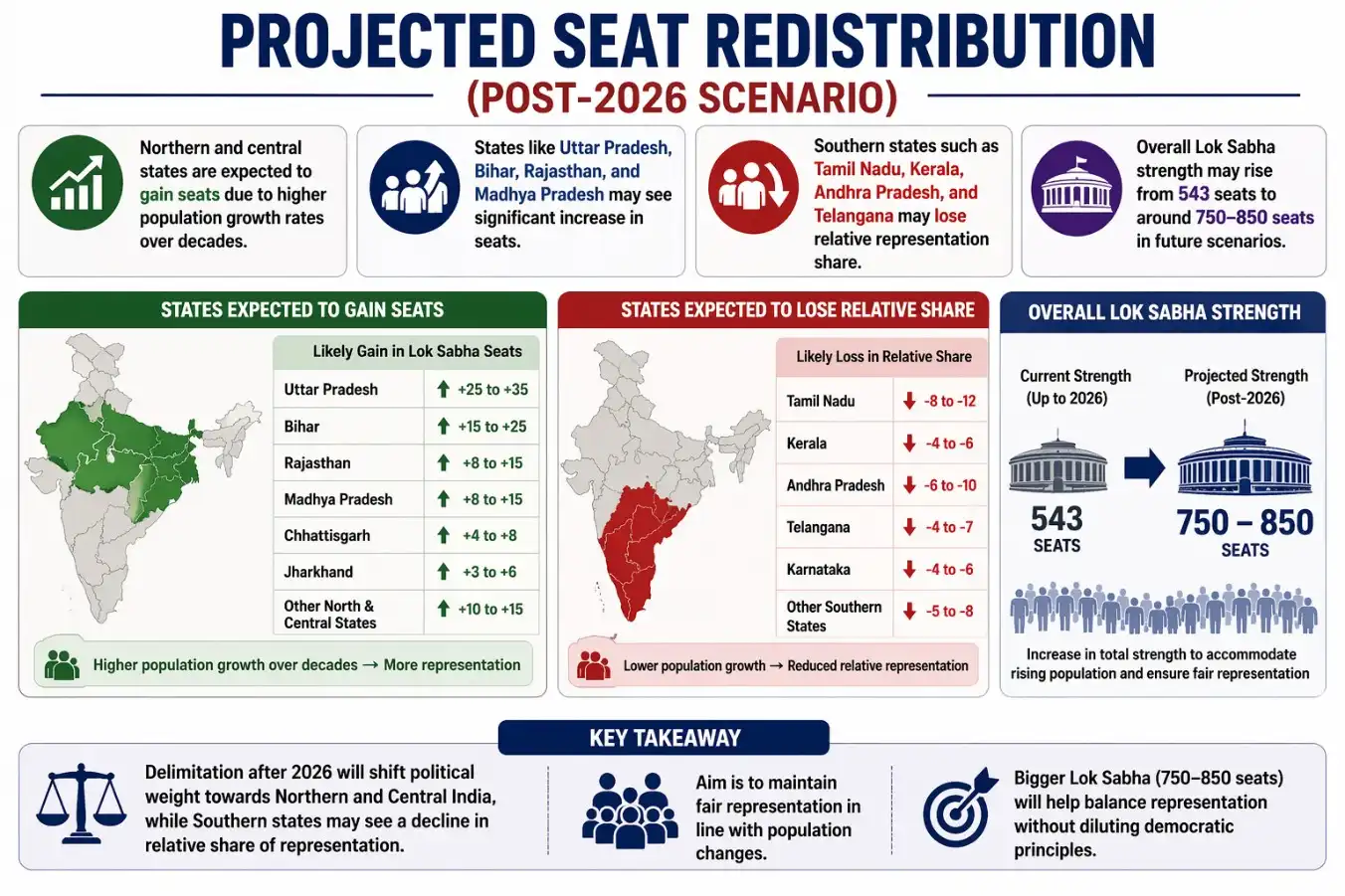
Projected Seat Redistribution (Post-2026 Scenario)
- Northern and central states are expected to gain seats due to higher population growth rates over decades.
- States like Uttar Pradesh, Bihar, Rajasthan, and Madhya Pradesh may see significant increase in seats.
- Southern states such as Tamil Nadu, Kerala, Andhra Pradesh, and Telangana may lose relative representation share.
- Overall Lok Sabha strength may rise from 543 seats to around 750–850 seats in future scenarios.
Fiscal and Political Imbalance Concerns
- States that controlled population growth may face reduced political influence despite better governance outcomes.
- Northern states gaining seats could dominate national policy decisions and legislative priorities.
- This creates tension between demographic representation and fiscal contribution to the national economy.
- Wealth-generating states may feel disadvantaged if political power shifts away from them.
Impact on Federalism
- Delimitation can alter the balance of power between Centre and States within India’s federal structure.
- Southern states fear marginalisation in national decision-making and resource allocation processes.
- It raises concerns about cooperative federalism and equitable voice for all regions.
- The debate reflects a conflict between numerical democracy and balanced federal representation.
Constitutional and Policy Challenges
- The Constitution emphasises both equal representation and federal fairness, creating inherent tension in delimitation exercise.
- The freeze until 2026 was meant to avoid penalising states that adopted population control measures early.
- Post-2026 delimitation must balance demographic realities with policy incentives for responsible governance.
Economic Dimension of the Debate
- Richer states contribute more to national GDP and tax revenues, but may lose relative representation post-delimitation.
- Poorer states with higher population growth may gain greater political influence without proportional economic contribution.
- This raises concerns about fiscal transfers, resource allocation, and economic equity among states.
Political Consequences
- Increased representation of northern states could influence electoral outcomes and coalition dynamics at national level.
- Regional parties in southern states may lose bargaining power in central politics.
- This could deepen regional divides and political polarisation across India.
Key Dilemma
- Should representation strictly follow population (democratic equality)?
- Or should it consider performance factors like population control and economic contribution (federal fairness)?
- Balancing these competing principles is the core challenge of delimitation debate.
Way Forward
- India needs a balanced formula that combines population with other indicators like development and fiscal contribution.
- Consider mechanisms such as weighted representation or multi-factor criteria for seat allocation.
- Strengthen Rajya Sabha’s role to protect interests of states within federal structure.
- Ensure broad political consensus to avoid regional tensions and legitimacy issues in delimitation exercise.
- Promote cooperative federalism through transparent dialogue and institutional safeguards.
Delimitation is not merely a technical redrawing of boundaries but a defining moment for India’s democratic and federal structure. The challenge lies in reconciling the principle of equal representation with the need for regional balance and fairness. A carefully designed, consensus-driven approach is essential to ensure that India’s democracy remains both representative and cohesive in the years ahead.
Prelims Boosters
Prajna System
Context:
- The Ministry of Home Affairs received the AI-based Prajna satellite imaging system
About
- The Prajna System is an indigenously developed AI-enabled satellite imaging system
- It is designed to provide real-time decision support for security agencies
Developed By
- It is developed by: DRDO (Defence Research and Development Organisation) and Centre for Artificial Intelligence and Robotics (CAIR)
Aim
- It aims to strengthen internal security
- It helps in monitoring sensitive regions and counter-terrorism operations
Key Features
1. AI-Enabled Analysis
|
2. Real-Time Insights
|
3. High Data Processing
|
4. Situational Awareness
|
Significance
- It strengthens India’s internal security framework
- It improves counter-terrorism capabilities
- It promotes use of AI in defence and surveillance
Germany
Context:
- India is focusing on defence industrial cooperation with Germany
About
- Germany is a country located in Central Europe. Capital: Berlin
Location & Boundaries
- It shares borders with: Denmark (North), Poland, Czech Republic (East), Austria, Switzerland (South) & France, Belgium, Netherlands, Luxembourg (West)
- It is bordered by: North Sea (northwest) and Baltic Sea (northeast)
Geographical Features
- Climate- It has a temperate climate
- Mountain Ranges- Alps (south) and Bavarian Highlands
- Major Rivers- Rhine, Elbe, Danube
- Lakes- Lake Constance (shared with Austria and Switzerland)
Natural Resources- like: Lignite (brown coal); Coal, natural gas; Iron ore, copper, nickel; Potash, uranium
Significance
- It is a major industrial and economic power in Europe
- It plays a key role in EU economy and global trade
- It is an important partner for India in defence and technology
United Nations Economic and Social Commission for Asia and the Pacific (UN ESCAP)
Context:
- UN ESCAP released its 2026 Economic Survey, highlighting impact of West Asia conflict on energy and food prices
About
- The UN ESCAP is a regional commission of the United Nations. It is the largest intergovernmental platform in the Asia-Pacific region
- It has: 53 member states and 9 associate members. It represents nearly two-thirds of the world’s population
Establishment
- It was established in 1947 as ECAFE (Economic Commission for Asia and the Far East)
- It was renamed ESCAP in 1976. Headquarters: Bangkok, Thailand
Aim
- It aims to promote regional cooperation and development
- It supports achieving the Sustainable Development Goals (SDGs)
- It helps countries deal with economic, social, and environmental challenges
Key Functions
Knowledge & Research
- It publishes reports like Economic and Social Survey
- It helps policymakers understand global economic trends
Technical Assistance
- It provides capacity-building and policy support to member countries
Infrastructure Connectivity
- It promotes regional projects like: Asian Highway Network and Trans-Asian Railway
Financial Cooperation
- It contributed to creation of institutions like: Asian Development Bank (ADB)
Disaster Risk Reduction
- It promotes disaster management and early warning systems
Social Policy Advocacy
- It works on issues like: Gender equality, Urbanization, Aging population
Significance
- It supports the fastest-growing developing region
- It helps in policy coordination and regional stability
- It promotes clean energy transition and sustainable growth
Druzhba Pipeline (Friendship Pipeline)
Context:
- The Druzhba Pipeline has been repaired and is resuming oil supply to Europe
About
- The Druzhba Pipeline is one of the largest crude oil pipeline networks in the world
- It was built in the 1960s by the Soviet Union
- It transports Russian (and Kazakh) oil to Europe
Route & Structure
- Origin: It begins at Almetyevsk (Russia)
- It flows to Mozyr (Belarus) where it splits into two branches:
Northern Branch
- It runs through: Belarus → Poland → Germany
Southern Branch
- It runs through: Ukraine → Slovakia → Hungary → Czech Republic
- It further splits into: Druzhba 1 and Druzhba 2
Length & Capacity
- Total length: ~5,500 km
- Capacity: 1.2–1.4 million barrels/day and Expandable up to ~2 million barrels/day
Significance
- It is a major energy supply route for Europe. It highlights Europe’s dependence on Russian oil
- It is strategically important due to: Geopolitical tensions (Russia–Ukraine conflict) and Energy security concerns in Europe
Adi Shankaracharya
Context:
- The Prime Minister paid tribute on the 1,200th birth anniversary (Jayanti) of Adi Shankaracharya
About
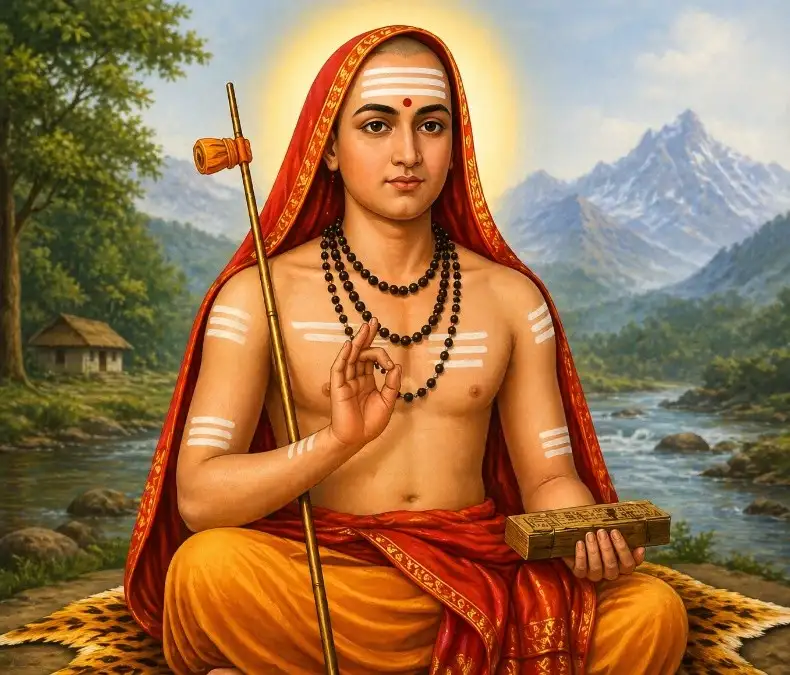
- Adi Shankaracharya was a philosopher, theologian, and saint
- He lived around 788–820 CE. He was born in Kalady, Kerala
- He is known for: Reviving Hindu philosophy & Promoting knowledge (Jnana) over ritualism
Early Life & Education
- He left home at a young age in search of knowledge
- He became a disciple of Guru Govindapada near the Narmada River
- He: Mastered Vedic scriptures by age 12 and Completed major works by age 16
Philosophical Contribution
1. Advaita Vedanta (Non-dualism)
|
2. Concept of Maya
|
3. Unity of Worship (Shanmata System)
|
Literary Contributions
- Commentaries (Bhashyas)- On: Brahma Sutras, Bhagavad Gita, Upanishads
- Important Texts- Viveka Chudamani; Atma Bodha
- Devotional Works- Nirvana Shatakam; Soundarya Lahari; Sivananda Lahari
Institutional Contributions
- He established four Maths (monasteries) across India:
| Direction | Place | Math | Veda |
| North | Badrinath | Jyotir Math | Atharva Veda |
| South | Sringeri | Sringeri Math | Yajur Veda |
| East | Puri | Govardhan Math | Rig Veda |
| West | Dwarka | Sarada Math | Sama Veda |
Other Contributions
- He organized monks into Dasanami Sampradaya
- He promoted intellectual debate and spiritual reform
Significance
- He unified India culturally and spiritually
- He shifted focus from rituals to knowledge
- He strengthened Vedantic philosophy