The UPSC Civil Services Examination is not merely a test of how much an aspirant knows. Particularly at the Mains stage, it is a test of how effectively an aspirant can understand a question, organise knowledge, analyse an issue and communicate a balanced argument within a strict word limit. Thousands of candidates read similar books, newspapers, government reports and current affairs sources, yet their Mains scores can differ substantially. The difference often lies in the ability to convert knowledge into a well-structured answer. For an aspirant preparing for the Civil Services Examination, therefore, answer writing must not be treated as something to be practised only after completing the syllabus. It is a core UPSC skill that needs to be developed alongside conceptual preparation.
At Educrat IAS Academy, the Best IAS coaching institute in Kolkata, one of the central principles of Mains preparation is that aspirants should learn not merely what to study, but also how to use what they study in an examination answer. A candidate may know every aspect of federalism, social justice, climate change or governance, but the marks ultimately depend on whether that knowledge is relevant to the question asked. Effective answer writing is therefore an exercise in selection, analysis, prioritisation and presentation.
Understand the Question Before You Start Writing
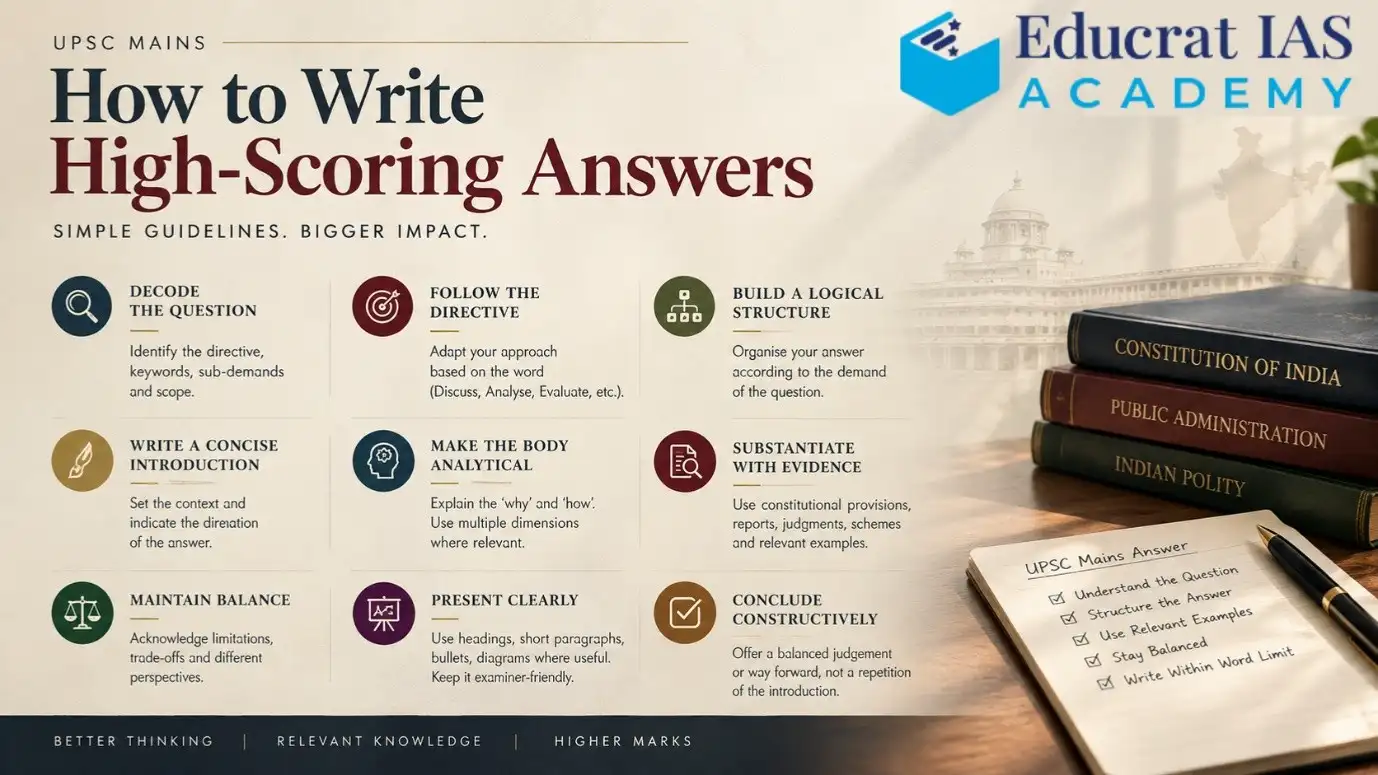
The first step towards writing a high-scoring UPSC Mains answer is to resist the temptation to start writing immediately after reading the question. The question itself contains the blueprint of the answer. Every word matters, particularly the directive word, keywords and specific demands. Before beginning the introduction, an aspirant should mentally decode what UPSC expects.
For example, if a question asks you to “Evaluate the role of Digital Public Infrastructure in transforming government-to-citizen service delivery and suggest measures to overcome the digital divide,” it is not asking for a general essay on e-governance. It has distinct demands: evaluate the role of DPI, discuss its impact on G2C delivery, address the digital divide and suggest solutions. A candidate who writes only about the advantages of digital governance may possess good knowledge but will not fully satisfy the question.
A useful mental process is to identify the directive, core subject, keywords, sub-demands and boundaries of the question before constructing the answer.
- Directive: What exactly must you do—discuss, examine, analyse, evaluate or critically examine?
- Core subject: What is the central issue?
- Keywords: Which terms define the scope?
- Sub-demands: How many separate aspects need to be answered?
- Boundaries: What information is relevant and what should be deliberately excluded?
This simple habit prevents one of the most common Mains mistakes: writing everything you know about a topic instead of answering the question actually asked.
Let the Directive Word Shape Your Answer
The directive word is not a formality. It determines the intellectual approach required in the answer. An aspirant preparing through any serious UPSC Coaching in Kolkata should develop the ability to distinguish between these directives rather than applying one fixed template to every question.
“Discuss” generally requires a balanced presentation of the major aspects of an issue. “Examine” requires investigation of the issue through relevant arguments, implications and limitations. “Analyse” requires breaking an issue into components and explaining the relationships between them. “Evaluate” requires judgement based on achievements, limitations and appropriate criteria. “Critically examine” or “critically analyse” requires a balanced assessment in which both strengths and weaknesses are considered before arriving at a reasoned conclusion.
Therefore, the directive should influence the body of the answer. An “evaluate” question needs assessment; an “analyse” question needs relationships and causality; an “examine” question requires investigation; and a “discuss” question generally requires a broad but relevant presentation.
The introduction and conclusion may remain concise, but the thinking pattern inside the body must change according to the directive.
Build the Structure Around the Demand
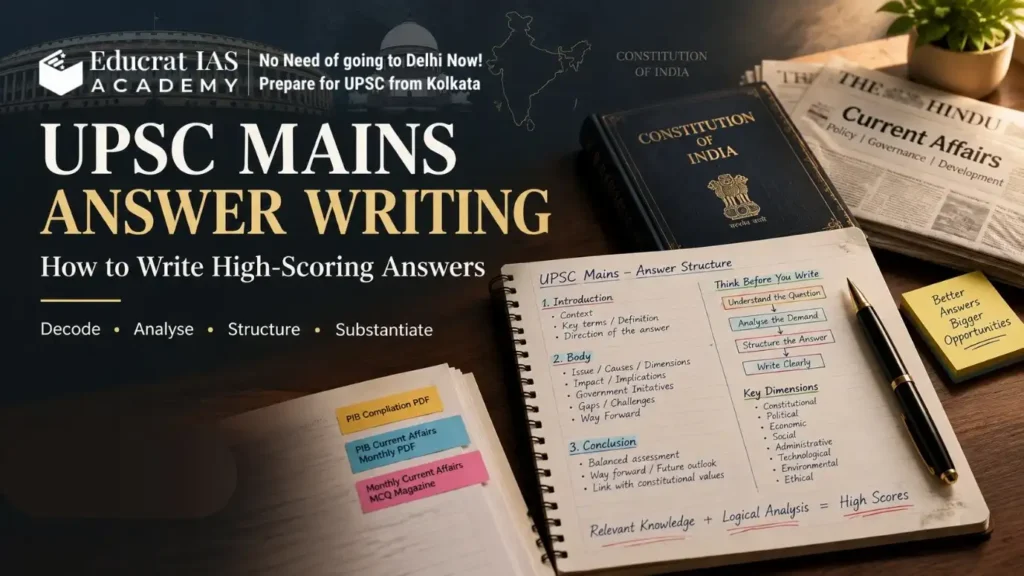
Once the question has been decoded, the next step is to create a logical framework. The broad structure of Introduction–Body–Conclusion remains useful, but the internal organisation of the body should emerge from the question.
For a governance question, the structure may move from the problem to its causes, implications, institutional response, implementation gaps and way forward. For a question asking for evaluation, the structure may compare achievements with limitations before reaching an assessment. For a question asking about causes and consequences, the body should focus on those dimensions rather than mechanically adding unrelated sections.
The important principle is that there is no single universal template for UPSC answers. A good structure is one that makes the examiner’s job easier while ensuring that every demand of the question receives adequate attention.
An aspirant should be able to look at the question and mentally construct its answer architecture within a few seconds. With regular practice, this process becomes increasingly automatic.
Write a Concise and Relevant Introduction
The introduction should establish the context of the question without consuming valuable words. A strong introduction demonstrates immediately that the aspirant understands the subject and the direction of the question.
Depending on the topic, an introduction may begin with a constitutional provision, definition, contemporary development, Supreme Court judgment, government report, relevant statistic, historical context or conceptual distinction. However, the introduction should always remain directly connected to the question.
For example, instead of beginning an answer on Digital Public Infrastructure with a generic statement such as “Technology has become an important part of modern life,” an aspirant can establish the conceptual distinction between digitisation and digital transformation. This immediately creates a framework for discussing DPI.
The introduction should ideally perform two functions:
Context + Direction
It should establish what the issue is and indicate where the answer is going. A long background paragraph rarely adds value in a time-bound examination.

Make the Body Analytical Rather Than Descriptive
The body is where most of the marks are earned. This is also where the distinction between an average answer and a strong answer becomes most visible.
A descriptive answer tells the examiner what happened or what exists. An analytical answer explains why it matters, how it works, what consequences it produces and what limitations it faces.
For example, writing “DPI improves government service delivery” is a basic assertion. A stronger answer explains that interoperable digital systems can reduce transaction costs, improve portability, minimise dependence on intermediaries and facilitate faster delivery, while also recognising that these benefits depend upon digital access, institutional capacity and reliable authentication.
The analytical progression can therefore look like:
Argument → Mechanism → Impact → Limitation
This approach allows an aspirant to demonstrate depth without writing excessively long answers.
Use Multiple Dimensions Where They Add Value
UPSC expects future civil servants to understand issues from multiple perspectives. Depending on the question, these may include constitutional, political, economic, social, administrative, technological, ethical, legal, environmental, security and international dimensions.
For example, Artificial Intelligence in governance can be examined from the administrative perspective of efficiency, the economic perspective of productivity, the social perspective of inclusion, the ethical perspective of algorithmic bias, the legal perspective of accountability and the security perspective of cyber risks.
However, multidimensionality should never become a checklist. Mentioning ten dimensions without developing any of them does not make an answer analytical. The objective is to identify the few dimensions that genuinely explain the issue.
A good answer demonstrates breadth while maintaining relevance.
Integrate Static Knowledge With Current Affairs
Current affairs should not appear in the answer as an isolated paragraph labelled “Current Affairs.” The strongest answers integrate contemporary developments with static concepts.
For example, while discussing federalism, an aspirant can connect constitutional provisions with contemporary issues concerning fiscal federalism, the GST Council, centrally sponsored schemes and Centre-State coordination. While discussing fundamental rights, constitutional principles can be connected with relevant judicial developments. While discussing agriculture, structural issues can be connected with contemporary reforms and government initiatives.
This is where disciplined current-affairs preparation becomes important. Instead of collecting unlimited material, aspirants should organise current affairs according to the UPSC syllabus and potential Mains applications.
Resources such as a PIB compilation PDF, PIB Current Affairs Monthly PDF and a well-structured Monthly Current Affairs MCQ Magazine can help aspirants regularly revise government initiatives, policy developments and important facts. However, current affairs should ultimately be converted into usable arguments, examples and evidence rather than simply memorised.
At Educrat IAS Academy we provide:
Daily Current Affairs Analysis
Monthly Current Affairs Analysis Magazine
Monthly Current Affairs MCQ Magazine
Each Analysis is based on UPSC Syllabus with syllabus mapping to enhance UPSC Preparation.
The objective is:
Static Concept + Current Development + Analytical Application

Substantiate Your Arguments With Evidence
A strong argument becomes more credible when it is supported by appropriate evidence. The ideal approach is to connect an argument with a relevant constitutional provision, report, committee, judgment, government initiative, institutional finding or contemporary example.
For instance, while arguing that decentralisation strengthens participatory democracy, an aspirant can connect the argument with the 73rd and 74th Constitutional Amendments and illustrate it through mechanisms such as Gram Sabha participation and social audits.
The basic principle is:
Argument → Evidence → Example
Evidence should be selective. An answer does not become superior merely because it contains numerous statistics, committees and reports. Incorrect statistics can actually weaken credibility.
If the exact figure is uncertain, it is better to use a safe qualitative statement than to invent numerical precision. UPSC rewards accuracy and relevance, not manufactured sophistication.
Think Like a Future Civil Servant
UPSC is selecting individuals who will eventually deal with complex administrative realities. Therefore, answers should demonstrate an ability to recognise stakeholders, competing interests, institutional constraints and practical solutions.
Whenever appropriate, ask:
Who is affected? What are the underlying causes? What are the consequences? What has already been attempted? Why do gaps remain? What can realistically be done?
Consider a question concerning urban governance. Relevant stakeholders may include municipal bodies, state governments, residents, migrant workers, informal workers, developers and environmental groups. Recognising their different interests demonstrates administrative maturity.
This approach also prevents ideological answers. A future civil servant should be capable of identifying both the benefits and limitations of a policy and proposing constructive solutions.
The ideal approach is therefore:
Constitutional + Evidence-based + Balanced + Solution-oriented
Maintain Balance and Recognise Trade-offs
UPSC answers should avoid extreme positions. When a question concerns a policy or institutional mechanism, present its strengths as well as its limitations where relevant.
Many public-policy questions involve genuine trade-offs: efficiency versus inclusion, security versus privacy, economic growth versus environmental sustainability, centralisation versus decentralisation, or technological adoption versus employment disruption.
Recognising these tensions adds analytical depth.
For example, digitisation can improve transparency by creating traceable administrative records. At the same time, excessive dependence on digital systems can create exclusion if citizens lack connectivity, devices or digital literacy.
A balanced answer does not mean mechanically writing one positive point followed by one negative point. It means recognising complexity and arriving at a reasoned assessment.

Make the Answer Examiner-Friendly
Presentation matters because the UPSC examiner evaluates a large number of scripts within limited time. An answer that is logically organised allows the examiner to identify arguments quickly.
Clear headings, short paragraphs, relevant bullets, underlined keywords, flowcharts and simple diagrams can improve readability. However, visual elements should be used only when they genuinely improve communication.
For example, a question concerning the digital divide may benefit from a simple progression:
Access Gap → Digital Capability Gap → Usage Gap → Exclusion
Similarly, a governance answer can use a flowchart to demonstrate:
Policy → Implementation → Service Delivery → Citizen Outcome
The purpose of presentation is not decoration. It is information density with clarity.
Respect the Word Limit
UPSC Mains tests the ability to communicate within constraints. For a 10-mark question, approximately 150 words is an appropriate target, while a 15-mark question generally requires around 250 words.
This means every sentence should contribute to the answer.
Aspirants should avoid lengthy introductions, repeated arguments, excessive background information, multiple examples proving the same point and generic conclusions.
A concise answer with five well-developed arguments is often more effective than a long answer containing fifteen disconnected facts.
The discipline should be:
Maximum relevant content within minimum necessary words.
This is one of the reasons regular timed practice is essential for Mains preparation.
Learn What Not to Write
One of the most underrated UPSC skills is knowing what information to leave out.
Suppose the question asks about the role of Urban Local Bodies in improving urban governance. An aspirant may know about Smart Cities Mission, AMRUT, urban flooding, waste management, municipal finance and slum development. All of this may be relevant to urbanisation, but not necessarily to the specific demand of the question.
The question is not asking:
“What do you know about urbanisation?”
It is asking:
“What is the role of Urban Local Bodies in improving urban governance?”
This distinction between topic knowledge and question relevance is fundamental.
Aspirants preparing with the guidance of the Best UPSC Coaching in Kolkata or the Best IAS Coaching in Kolkata should therefore evaluate their answers not merely on how much information they contain, but on how precisely that information responds to the question.
End With a Constructive Conclusion
The conclusion should provide closure without mechanically repeating the body.
Depending on the question, it can emphasise constitutional values, institutional reform, inclusive development, citizen participation, cooperative federalism, sustainable development, accountability or long-term capacity building.
A good conclusion should reflect the temperament expected from a future civil servant: pragmatic, balanced and solution-oriented.
For example, an answer on digital governance could conclude that India’s transformation must move beyond mere digitisation towards inclusive, secure and accountable digital governance in which technology strengthens citizen-centric institutions rather than replacing them.
The conclusion should leave the examiner with a clear sense that the aspirant has not only understood the problem but can also visualise a practical way forward.
A Practical Pre-Submission Checklist
Before moving to the next question, an aspirant should quickly evaluate the answer against a few fundamental parameters. Ask yourself whether the directive was correctly interpreted, whether every sub-demand was addressed, whether the introduction was relevant, whether the body was analytical, whether important arguments were substantiated, whether the answer remained balanced and whether the conclusion actually responded to the question.
Also ask one final question:
“Can I remove any sentence without weakening my answer?”
If the answer is yes, edit it.
This habit gradually develops precision and prevents unnecessary repetition.
Answer Writing Is a Thinking Skill
Answer writing cannot be mastered simply by reading model answers. Nor can it be mastered by writing hundreds of answers without meaningful review.
The purpose of regular practice is to identify recurring weaknesses: misreading directives, missing sub-demands, writing descriptive content, poor time management, weak introductions, repetitive conclusions or inadequate substantiation.
Aspirants should therefore focus not only on the number of answers written but also on the quality of evaluation after each answer.
A useful progression is:
Write → Evaluate → Identify Mistake → Correct → Rewrite → Repeat
Over time, this transforms answer writing from a stressful examination activity into a structured thinking process.
Build an Integrated Mains Preparation Strategy
Answer writing should not exist separately from General Studies preparation. Every topic studied should gradually be converted into potential arguments, examples, constitutional provisions, case studies and contemporary applications.
Current-affairs resources should similarly be prepared with answer writing in mind. A PIB compilation PDF may help consolidate government initiatives, while a PIB Current Affairs Monthly PDF can support monthly revision. A Monthly Current Affairs MCQ Magazine can strengthen factual recall and preliminary examination preparation, but aspirants must also learn to convert relevant current affairs into Mains-ready analysis.
The best preparation ecosystem is therefore one where static syllabus coverage, current affairs, revision, answer writing and evaluation reinforce one another.
For aspirants seeking structured guidance, choosing the right UPSC Coaching in Kolkata can provide a disciplined environment for this integrated preparation.
What Makes a High-Scoring Answer Different?
The difference between an average answer and a high-scoring answer is rarely the sheer quantity of information.
An average answer often focuses on the topic, while a stronger answer focuses on the demand. An average answer describes, whereas a stronger answer analyses. An average answer lists facts, while a stronger answer uses evidence to support arguments. An average answer may be one-sided, whereas a stronger answer recognises limitations and trade-offs. Most importantly, an average answer attempts to display knowledge; a high-quality answer demonstrates judgement.
This is the fundamental shift every UPSC aspirant must make.
Conclusion: Learn to Convert Knowledge Into Marks
UPSC Mains answer writing is ultimately a test of intellectual discipline. An aspirant must read a question carefully, identify its precise demand, retrieve relevant knowledge, connect static concepts with contemporary developments, consider different perspectives and communicate a reasoned judgement within a limited word count.
The goal is therefore not to demonstrate maximum knowledge.
The goal is to demonstrate maximum relevant knowledge, analysis and clarity within minimum necessary words.
The hierarchy should always remain:
Demand of the Question > Relevance > Analysis > Substantiation > Presentation > Extra Knowledge
At Educrat IAS Academy, Top UPSC Coaching in Kolkata we believe that effective Mains preparation is not about accumulating endless information. It is about learning how to convert knowledge into marks through structured thinking, consistent practice, relevant current affairs, answer evaluation and disciplined presentation.
Whether an aspirant is preparing independently or seeking guidance from the Best UPSC Coaching in Kolkata, the principle remains the same: understand the question first, think before writing, substantiate selectively, remain balanced and write with purpose.
Know More. Think Better. Write With Purpose.
Educrat IAS Academy
Your Dream. Our Guidance.
Shaping India’s Future Administrators.